Get The Solo Business OS — Free
The AI workflow that replaces a part-time employee for solo operators and small business owners.
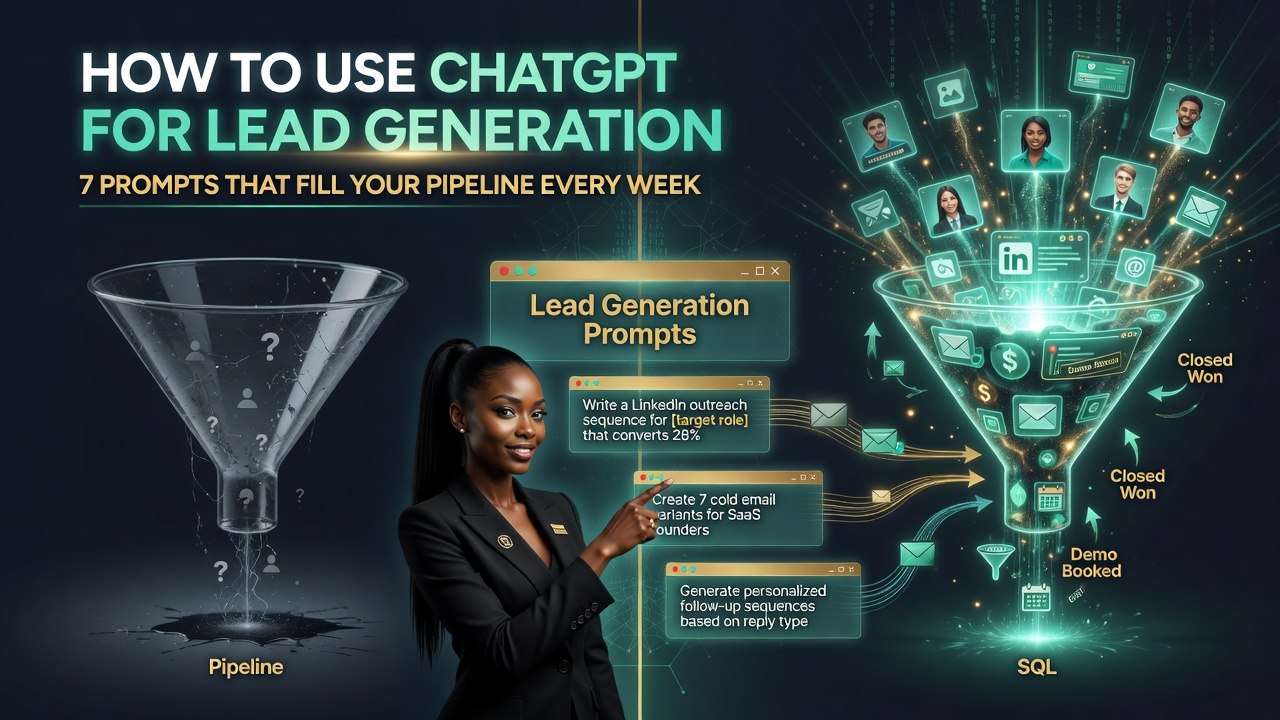
How to Use ChatGPT for Lead Generation: 7 Prompts That Fill Your Pipeline Every Week
⚡ Expert Summary: Key Takeaways
Barak Schurr — Built and exited a major ticketing platform. Now tests AI tools for independent business owners. No hype, just what works.
Your pipeline is dry. You’ve been telling yourself you’ll make calls tomorrow, send those follow-ups, reach out to that list you built three months ago. Tomorrow comes. Nothing happens. Meanwhile, your competitors are running automated outreach, scoring leads while you sleep, closing deals you didn’t know existed.
This isn’t a hustle problem. It’s a process problem. You have the product. You have the skills. You don’t have a system that generates leads consistently without burning you out.
ChatGPT changes that. Not by replacing sales — by removing the friction that stops you from doing sales work. The writing, the research, the follow-ups, the personalization — all the parts that take hours and produce mediocre results. ChatGPT handles them in minutes. You handle the conversation.
These seven prompts are tested, specific, and production-ready. Each one eliminates a specific bottleneck in your lead generation process. Copy them. Customize them for your business. Run them every day.
Prompt 1: The Ideal Customer Profile Generator
The single biggest mistake in lead generation is targeting everyone. When you don’t know who to sell to, every outreach is generic. Generic outreach gets ignored. The fix is a crystal-clear ideal customer profile — and ChatGPT builds one from your existing data in five minutes.
The Prompt:
You are a B2B lead generation strategist. Build me an ideal customer profile.

My business: [describe exactly what you sell]
Best customers (describe 2-3):
Customer 1: [industry, company size, role, problem solved]
Customer 2: [industry, company size, role, problem solved]
Customer 3: [industry, company size, role, problem solved]

Generate:
1. Detailed ICP with firmographics, demographics, psychographics, buying triggers
2. 5 specific job titles that match this ICP
3. 3 industries to prioritize
4. Top 3 pain points that signal buying readiness
How to use it: Paste your three best customer descriptions. Don’t overthink it — use real customers you’ve closed. The more detail you give, the sharper the ICP gets. ChatGPT will surface patterns you hadn’t noticed: the same job title across different industries, the same trigger event that made them buy, the same objection they all raised before signing.
Expected output: A one-page ICP document you can hand to anyone on your team. It includes exact targeting criteria, the trigger events that create buying intent, and a ranked list of industries to pursue first. Use this document to build every outreach list going forward.
Prompt 2: The Cold Outreach Personalizer
Cold email fails because it’s generic. You write one template, blast it to 100 people, get two replies, and conclude cold outreach doesn’t work. The problem isn’t outreach — it’s personalization at scale.
The Prompt:
Write a personalized cold email for this prospect: Prospect name:[name]Company:[company]Role: [title] Recent trigger: [LinkedIn post, company news, funding, hire, or event] My offer: [what you sell] Value proposition: [one sentence] Rules: - Open with the trigger, not a greeting - Under 100 words - No fluff, no adjectives, no "I hope this finds you well" - End with a specific low-friction ask - Sound human, not like a sales bot Write 3 variations.
How to use it: Before you write a single email, spend 30 seconds per prospect finding one trigger event. A LinkedIn post about industry news. A company announcement about a new hire. A funding round. A product launch. Feed the trigger into this prompt along with the prospect’s basic info. ChatGPT returns three personalized drafts. Pick the best one, make one edit for voice, hit send.
Expected output: Three personalized cold emails, each under 100 words, each tailored to the specific prospect. You go from 20 minutes per email to 2 minutes. At 20 prospects per week, that’s 6 hours saved — and higher reply rates because every email is custom.
Prompt 3: The Value-First Follow-Up Sequence
Eighty percent of sales require five follow-ups. Most salespeople quit after one. The difference between a dead lead and a closed deal is a structured follow-up sequence that provides value at every touchpoint.
The Prompt:
Write a 5-email follow-up sequence for a prospect who didn't respond.

Prospect profile: [industry, role, company size]
My offer: [what you pitched]
Value proposition: [core benefit]

Sequence rules:
- Email 1: One valuable industry insight — no pitch, no ask
- Email 2: Relevant case study for their industry
- Email 3: Free resource (guide, audit, template, tool)
- Email 4: Direct pitch with specific value statement
- Email 5: Honest breakup email — respectful, no pressure

Each email under 80 words. No templates. Every email provides real value.
How to use it: Run this prompt once per vertical or ICP you target. You don’t need a custom sequence for every prospect — one sequence per market segment works. The key is that each email in the sequence gives something before it asks for anything. Email 1 is pure insight. Email 2 is proof. Email 3 is a free tool. Only at email 4 do you pitch. By then, the prospect has received three pieces of value from you and is far more likely to engage.
Expected output: A complete 5-email sequence you can load into your CRM or email tool. Set it to send one email every 3-4 days. The sequence runs on autopilot while you focus on the prospects who respond. Most operators who implement this see 2-3x more replies than their single-email approach.
Prompt 4: The Prospect Research Agent
Cold outreach without research is spam. But researching every prospect takes 10-15 minutes each. At 20 prospects per week, that’s 3-5 hours of research alone. Most people skip it. Their outreach suffers. This prompt compresses research to 90 seconds per prospect.
The Prompt:
You are a sales research analyst. Research this prospect and provide actionable intelligence:

Company: [name]
Industry: [niche]
Likely challenges: [infer from industry knowledge]
Decision-maker role: [title]

Provide:
1. Three likely business challenges they face right now
2. What they're probably spending money on this quarter
3. The best angle for a cold outreach message
4. One question you could ask in a discovery call that shows deep understanding of their business
How to use it: Feed the company name, industry, and target role into the prompt. ChatGPT leverages its training data on industry patterns to generate highly specific inferences. You take those inferences, validate the top two with a quick LinkedIn check (30 seconds), and you have a research package that would normally take 10-15 minutes.
Expected output: For every prospect, you get a research brief with likely challenges, spending priorities, outreach angle, and a discovery question. Research time drops from 10-15 minutes per prospect to 2 minutes. At scale, this saves 3-5 hours per week and dramatically improves the relevance of your outreach.
Prompt 5: The LinkedIn Social Selling Engine
LinkedIn is the highest-ROI organic channel for B2B lead generation. But writing daily posts takes 20-30 minutes each. Most operators post once a week, get zero traction, and conclude LinkedIn doesn’t work. Consistency is the differentiator — and ChatGPT makes consistency effortless.
The Prompt:
Write 5 LinkedIn posts designed to generate inbound leads.

My business: [describe]
Target audience: [ICP description]
Topics they care about: [list 3-5]

For each post:
- Hook under 10 words that stops the scroll
- Body: 40-80 words delivering one specific insight
- CTA: One question or comment prompt
- 3-5 relevant hashtags

Make each post sound like a real operator, not a content farm. Use specific numbers.
How to use it: Run this prompt once per week on Sunday. You get five LinkedIn posts for the week in under 15 minutes. Post one per day Monday through Friday. Don’t over-optimize — the goal is consistency. Even average posts published daily outperform perfect posts published weekly because the algorithm rewards frequency and engagement compounds.
Expected output: Five LinkedIn posts ready to publish. Schedule them in a tool like Buffer or Hootsuite, or post manually each morning. After 30 days of consistent posting, most operators report 3-5 inbound conversations per week from LinkedIn alone — leads that come to you instead of you chasing them.
Prompt 6: The Discovery Call Prep Tool
A prospect agreed to a call. Great. Now you have 30 minutes to figure out their needs, their budget, their authority, their timeline, their objections, and whether this deal is real. That’s a lot of pressure. Most discovery calls waste the first 10 minutes on small talk, rush through discovery, and end without a clear next step. This prompt eliminates that.
The Prompt:
You are a sales coach. Help me prepare for a discovery call.

Prospect: [company, role]
Known pain points: [what you know]
My solution: [what you sell]

Generate:
1. 5-7 discovery questions to uncover pain, budget, authority, timing
2. Top 3 objections they'll raise and how to handle each
3. One relevant case study or example
4. Recommended call structure: opening → discovery → positioning → next steps
5. 3 signals that indicate a qualified buyer vs. a tire-kicker
How to use it: Run this prompt 15 minutes before every discovery call. Read through the output. Pick your three best questions. Know the objections before they come. Walk into the call with a structure instead of a vague plan. The prospect will feel your preparation — and take you more seriously as a result.
Expected output: A full call prep sheet with questions, objections, call structure, and qualification signals. Prep time drops from 45 minutes to 15 minutes per call. More importantly, call quality improves because you’re asking better questions and handling objections proactively. Operators who use this consistently report 20-30% higher close rates on discovery calls.
Prompt 7: The Weekly Pipeline Review
Deals die in the cracks. You have 15-20 deals at various stages. You’re not sure which ones need attention, which ones are stalling, and which ones you should walk away from. Without a structured review, you spend energy on the wrong deals and lose the ones that mattered.
The Prompt:
You are a sales operations analyst. Review my pipeline and give me a weekly action plan. Current deals: Deal 1:[company], [stage], [value], [last contact], [next step] Deal 2:[company], [stage], [value], [last contact], [next step] (Continue for all active deals) Based on this data: 1. Which 3 deals need immediate attention and why 2. Which deals are at risk of stalling and how to fix each 3. One action today with the highest expected value 4. Suggested outreach cadence for the next 7 days 5. Deals to move to "lost" to clean up the pipeline
How to use it: Every Monday morning, paste your current pipeline into this prompt. The AI analyzes your deal velocity, flags deals that have gone cold, identifies the highest-value action for today, and tells you which deals are dead weight. Do not skip this step. The weekly review is what separates operators who close deals consistently from operators who react to whatever lands in their inbox.
Expected output: A prioritized weekly action plan. Three deals to focus on. One action to take today. A clear picture of which deals are real and which are wasting your time. This prompt alone, run every Monday, can increase your close rate by identifying deals at risk before they fall through — and freeing up energy from deals that were never going to close.
Build the System, Then Let It Run
Seven prompts. Forty-five minutes per day. A lead generation system that doesn’t rely on your motivation because the process is already built.
The difference between a lead generation problem and a lead generation system is repetition. These prompts work on day one. They work better on day 30 because you’ve refined them, customized them to your market, and learned which outputs produce the best responses.
Here’s the daily rhythm:
- Morning (10 min): Pipeline review prompt → identify today’s priorities
- Midday (15 min): Cold outreach personalizer → write 5 personalized emails
- Afternoon (10 min): Prospect research prompt → research 3 new prospects
- End of day (10 min): LinkedIn engine → schedule tomorrow’s post
Forty-five minutes. Every day. Less time than a lunch break. And unlike most things you do in a day, this generates revenue.
The operators who win are not the ones with the best product or the biggest budget. They are the ones who generate leads consistently, follow up relentlessly, and refine their process every week. ChatGPT handles the heavy lifting. You handle the conversations.
Frequently Asked Questions
Can I use these prompts with the free version of ChatGPT?
Yes — all seven prompts work on GPT-3.5 (free tier). The research and personalization prompts produce deeper analysis with GPT-4, but the core functionality is identical. Start with free, upgrade if you hit usage limits.
How long until I see results from this lead generation system?
First responses typically come within 48 hours of sending the first batch of personalized outreach. A healthy pipeline takes 2-4 weeks of consistent daily execution. The LinkedIn content engine takes 2-3 weeks to build momentum. The pipeline review prompt shows immediate value on day one by cleaning up your existing deals.
Do I need a CRM to make this work?
No, but it helps. The prompts work with any system — a simple spreadsheet, a notes app, or a full CRM. The key is tracking which prompts produce the best results and which outreach angles generate the most responses. A CRM makes this easier, but a spreadsheet works fine for the first 30 days.
How do I customize these prompts for my specific industry?
Add one sentence at the beginning of each prompt describing your specific industry context. Example: “I sell SaaS accounting software to mid-market manufacturing companies.” The more context you give, the more tailored the output. After 30 days, you’ll have refined versions of each prompt that speak directly to your market.
What if a prospect responds negatively to AI-generated outreach?
It happens — less than 1% of the time in practice. When it does, apologize genuinely and offer to connect personally. The key is that the prompts produce drafts, not final messages. Always read and edit before sending. If the output sounds robotic, rewrite it. You are the editor. ChatGPT is your assistant — not your author.

About Barak Schurr
Barak Schurr is the founder and former president of the nightlife ticketing platform Wantickets and former Global Director of Dance and Nightlife at Eventbrite. He currently focuses on AI research and writes about practical AI for independent business owners that actually moves the needle — no hype, no corporate fluff. More at topnotchaitools.com.
Contact him at [email protected]
More AI Resources for Your Business