Get The Solo Business OS — Free
The AI workflow that replaces a part-time employee for solo operators and small business owners.
Celerant Command AI POS: What the 2026 AI Update Means for Your Business
⚡ Expert Summary: Celerant unveiled a slate of built-in AI tools at its May 2026 client conference, headlined by Skylar IQ, a conversational agent that answers plain-English questions about your sales, inventory, and customers. For US retailers running on Celerant Command, the shift means the AI features you used to bolt on separately now come inside the POS and eCommerce stack you already pay for — but only some of them are live today, and a few (like facial recognition) are still in development.
Your point-of-sale system does more than ring up sales. It holds the receipts for every customer, every product, every month of inventory movement your business has ever seen. The problem has never been a lack of data — it’s that the data sits buried in reports nobody builds and dashboards everybody ignores. Celerant is betting that the fix is an AI agent that talks back to you in plain English.
At its May 2026 client conference, Celerant — the company behind the Command POS and eCommerce platform used by thousands of US and Canadian retailers — rolled out a redesigned POS and back office alongside a family of AI tools designed to sit inside that system. If you run a specialty retail operation (apparel, sporting goods, outdoor, pet, or gift), this matters more than a generic “AI is coming” headline: it changes what your existing software can do without you buying another subscription.
What Celerant Actually Announced
The 2026 update is really two things at once: a ground-up redesign of the POS and back-office interface, and a layer of AI tools built into both the POS and the eCommerce side. Celerant frames the AI as making the platform more “agentic” — meaning tools that not only show you information, but act on it and answer your questions directly. It’s a deliberate shift from “here are your reports” to “ask me anything about your business.”
Here’s the honest framing before you get excited: some of this is live today, and some is described as “coming soon” or recently previewed. When you evaluate a rollout like this, the question isn’t whether the vendor announced it — it’s which features you can actually turn on this quarter. I’ll mark what’s real now versus what’s on the roadmap as we go.
Skylar IQ: The Conversational AI Agent That Reads Your Back Office
The headline feature is Skylar IQ, an interactive AI agent built into the Celerant back office. Instead of digging through report menus and pivot tables, you type a plain-English question — “What were my top three brands by revenue last month?” or “How much inventory do I have in the flagship line?” — and Skylar answers with tables, summaries, and auto-generated charts.
This is the same pattern that’s quietly becoming table stakes across retail software: natural-language queries over your real operational data. The part that distinguishes Celerant from a generic chatbot is what happens under the hood. Skylar surfaces the SQL queries it runs and lets you export results to CSV or PDF, which means you can verify the answer rather than trust it blindly. For a business owner, that verification layer is the difference between a novelty and a tool you’d actually rely on for a buying decision.
Celerant says Skylar reduces the time you spend chasing reports and building dashboards. For the average independent merchant who currently waits for “report time” or bugging a manager to pull numbers, that’s a real productivity unlock — the kind that frees hours back into your week without hiring anyone.
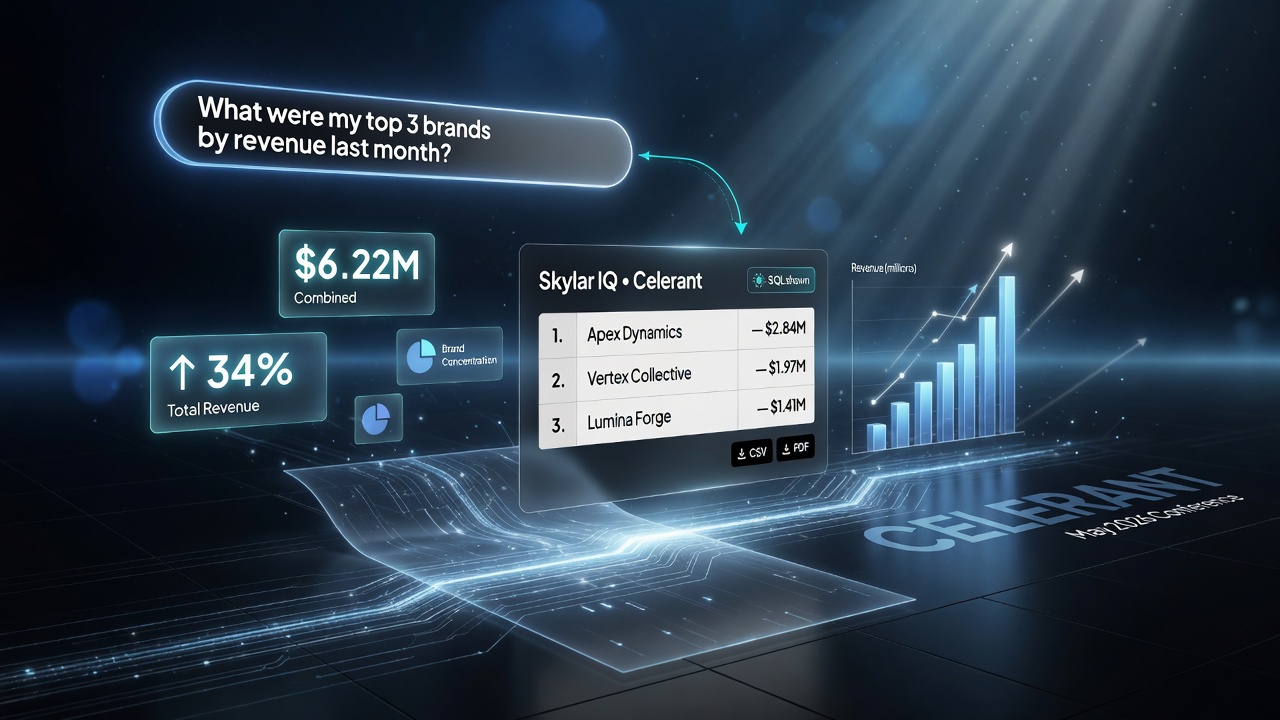
Skylar IQ lets a merchant ask “what were my top brands last month?” in plain English and get a table or chart from live back-office data, with SQL and CSV export for verification.
The Content AI Suite: Marketing Output Without the Copywriting Hours
The second tool is a Content AI Suite that generates product descriptions, category pages, review responses, marketing emails, and social media posts. It’s designed to auto-post optimized content across your website, email, and social channels.
For a retail operator, this directly attacks the most underfunded part of the business: content. Most independent merchants know they should be writing product descriptions and responding to reviews, but they don’t have the hours. An AI that drafts it in your voice, and that you review before it posts, removes the “I’ll get to it later” excuse that costs you local search rankings and customer trust.
The same honesty caveat applies here as everywhere in AI marketing: the output is a starting point, not final copy. Product descriptions and review responses need your eyes on them before they go live. What the suite does is compress the time from blank page to publishable draft from hours to minutes — that’s the actual value, not “set it and forget it” automation.
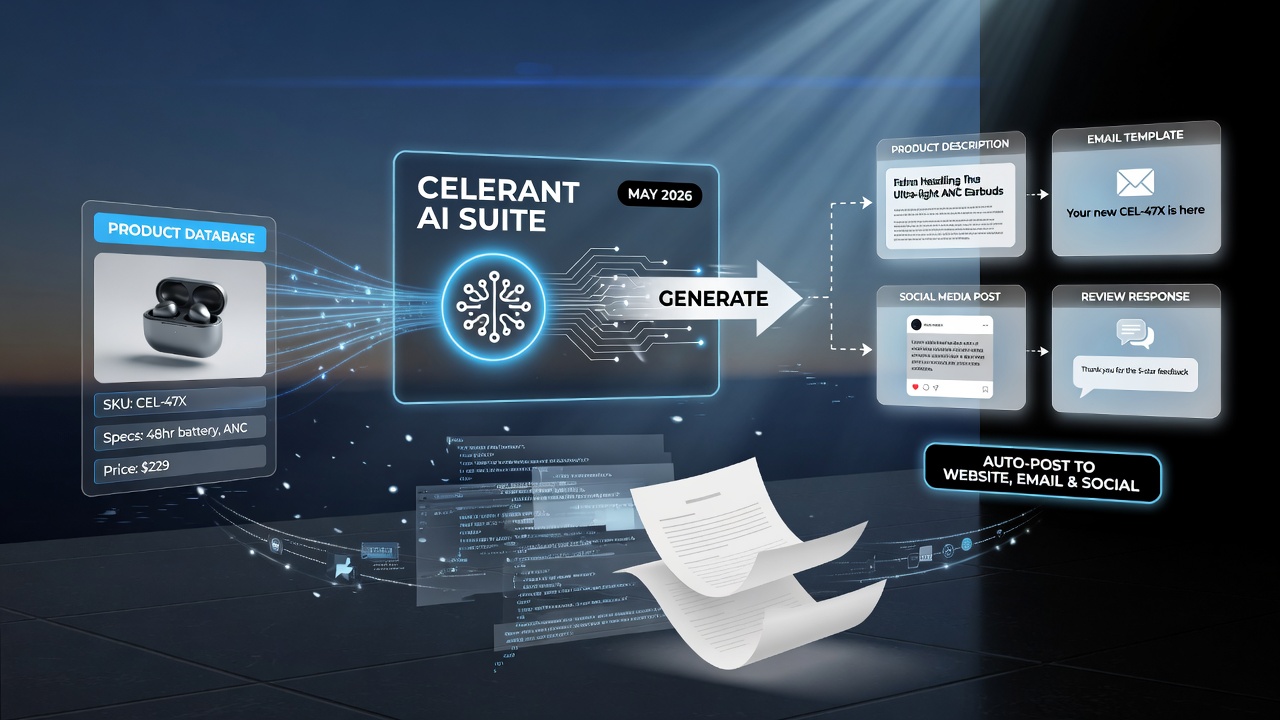
The Content AI Suite drafts product descriptions, category pages, review responses, and social posts — cutting the time from blank page to publishable draft from hours to minutes.
Predictive Search and Product Recommendations
On the eCommerce side, Celerant added predictive site search and product recommendations. The system anticipates customer intent as they type, shows instant matches with photos, prices, and details, and suggests alternatives based on behavior, purchase history, popularity, seasonality, and recency.
This is the online equivalent of a good sales associate who knows what a returning customer tends to buy. On a retail website, better search and recommendations typically mean higher average order value and fewer abandoned sessions — because shoppers find what they want faster and see relevant upsells they’d otherwise miss. It has POS ties too, since the unified platform shares customer data across channels.
Dynamic Price Optimization
Celerant’s dynamic price optimization uses machine learning on historical sales, supply and demand, competitor pricing, and availability to suggest — or in some configurations, auto-adjust — prices for better profitability.
This is most relevant to your online storefront, where price changes don’t require repricing physical labels. The AI analyzes the same margin and velocity data a pricing manager would, but across far more products and faster. For a merchant with thousands of SKUs, that’s a level of repricing discipline most small teams simply can’t maintain manually.
It’s worth flagging that dynamic pricing is one of those features that sounds impressive in a press release and requires real trust before you hand it the wheel. Start with the “suggest” mode, review the recommendations against your margins, and only consider auto-adjust once you’re confident the logic matches your strategy. Celerant supports both so you control the risk.
Facial Recognition and AI-Assisted Support
Celerant also previewed facial recognition for faster customer check-in, self-service kiosks, automated entry, and more secure register logins, and it’s building an AI-assisted tech support chatbot trained on its support data to resolve common issues faster.
The AI support piece is the least controversial and probably the most broadly useful — a better help queue for when you or your staff hit a problem at the register. Facial recognition, by contrast, is the feature to watch carefully from both a privacy and a compliance angle. For a US retailer, any biometric technology carries data-handling obligations and customer-notice questions. It’s in development and collaboration with retailers, not a fully live consumer-facing feature today — treat it as roadmap, not a reason to buy.
What This Means for Your Business
Strip away the launch-day language and here’s what the Celerant AI update actually changes for your operations:
1. AI is becoming a feature of the software you already own, not another subscription. The most important shift in this announcement isn’t any single tool — it’s that AI is being baked into the POS and eCommerce platform. That lowers the barrier to adoption for a small business that was never going to buy five separate AI point solutions.
2. The bottleneck is your attention, not your data. Tools like Skylar IQ and the Content AI Suite don’t create new information; they make the information you already have legible and actionable. For a merchant who’s been sitting on months of sales and inventory data, that’s the real unlock — turning stored history into decisions.
3. Adoption should be one function at a time. Don’t try to turn everything on at once. Pick the single pain that costs you the most hours — often it’s either reporting (Skylar IQ) or content (Content AI Suite) — get that working, measure the time saved over two weeks, then expand.
4. The verification layer is the trust layer. Skylar’s SQL transparency, the review-before-publish flow in the content suite, and the optional “suggest” mode in dynamic pricing all point the same direction: these tools are designed to be supervised. That’s not a weakness, it’s the safe way to adopt AI in a business where mistakes cost real money.
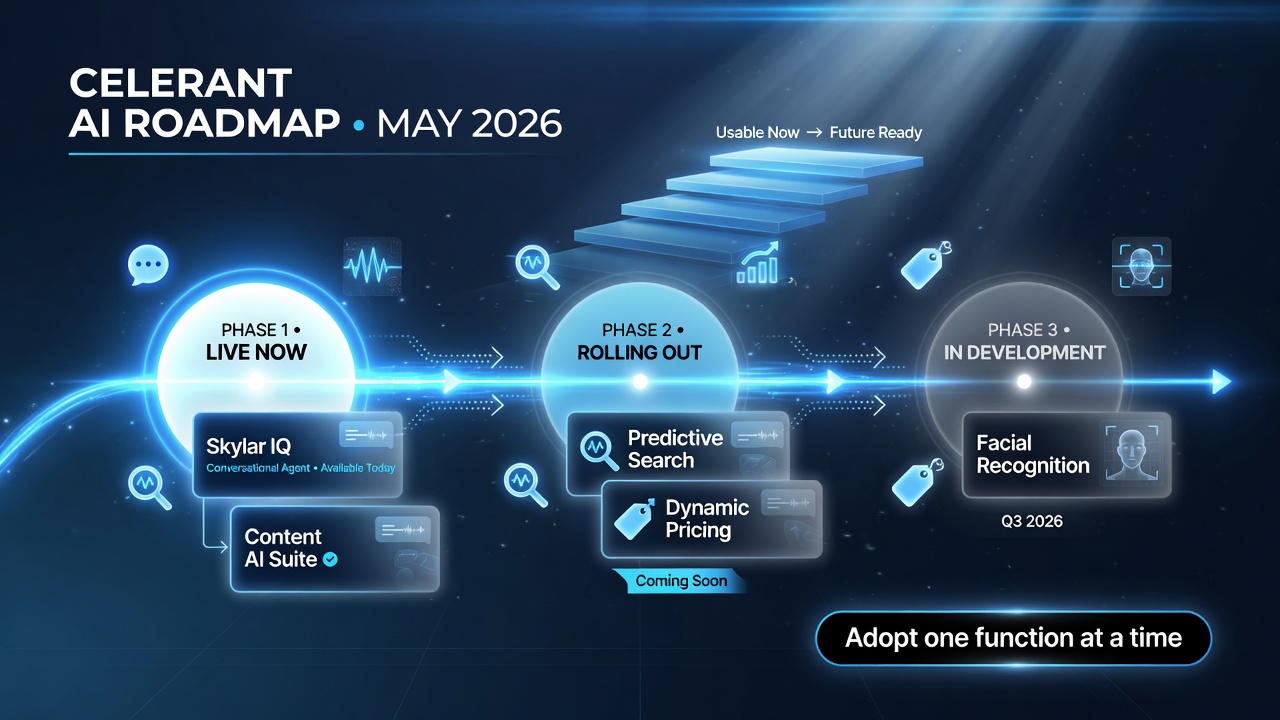
Not every Celerant AI feature is live today: Skylar IQ and the Content AI Suite are usable now, while facial recognition and full dynamic-pricing automation sit further down the roadmap.
How Celerant Command Compares to a DIY AI Stack
To decide if Celerant’s built-in AI is worth it vs. what you could assemble alone, compare it to the typical setup: a separate analytics tool, a separate content tool, and a separate review-management process all stitched together. Here’s the gap Celerant’s suite is trying to close:
| Capability | DIY AI Stack | Celerant Command AI |
|---|---|---|
| Business reporting | Separate analytics tool, manual exports | Skylar IQ plain-English queries + auto charts |
| Content & marketing | Standalone AI writer + awkward posting | Content AI Suite auto-posts to site/email/social |
| Site search & upsell | Third-party search app, separate data | Predictive search + recommendations on unified data |
| Pricing decisions | Manual repricing or separate tool | Dynamic price optimization (suggest or auto) |
| Vendor overhead | Multiple subscriptions + integrations | One platform, AI included |
The trade-off is real. A DIY stack lets you pick best-in-breed tools and change vendors freely, but it multiplies subscriptions, integrations, and the hours spent feeding data between systems. Celerant’s approach centralizes everything at the cost of locking you into its ecosystem and trusting its roadmap. For a merchant who already runs on Celerant Command, the math usually tips toward the built-in suite — the data is already there, and the marginal cost of enabling AI is far lower than standing up four new tools.
The Honest Risks Before You Jump In
I want to be straight with you, because every AI POS announcement hides real caveats:
Some features are roadmap, not reality. Facial recognition and parts of the AI suite are described as in development or recently previewed. Enabling something “coming soon” isn’t the same as running it in production. Ask your Celerant rep exactly which tools are live on your plan today.
AI output still needs your judgment. The content suite drafts copy you must review; dynamic pricing in auto mode needs margin guardrails. An AI-generated product description that’s wrong, or a price auto-drop that kills your margin, does real damage. You quarterback the AI, not the other way around.
It’s a vendor update, not an independent benchmark. Celerant’s client conference frames everything positively, as such events always do. Treat individual performance claims as directional — pressure test them against your own numbers in the first 30 days.
How to Evaluate Celerant’s AI Like a Buyer
Whether you’re on Celerant or evaluating any AI-enabled POS, use this checklist before you trust it with your operations:
- Is the feature live or roadmap? Get the rep to confirm exactly which tools are available on your current plan today.
- Can you verify the answers? Skylar’s SQL transparency is a good sign — any AI that shows its work is safer than one that gives you unverifiable numbers.
- What’s the human-review path? Confirm where AI drafts/acts and where you or a manager signs off. You need control, not autonomy.
- Does it act on data you already have? Built-in tools are only valuable because they sit on your existing sales and inventory data — confirm the integration is real.
- What does it cost to enable? If it’s included in your current platform, the ROI is easier to justify than a new per-seat AI subscription.
Frequently Asked Questions
What is Celerant Command?
Celerant Command is an all-in-one POS and eCommerce platform used by specialty retailers in retail sectors like apparel, sporting goods, outdoor, pet, and gift. It covers point-of-sale, inventory, eCommerce, loyalty, and customer management, and Celerant is now adding built-in AI tools.
What AI tools did Celerant announce in 2026?
At its May 2026 client conference, Celerant announced Skylar IQ (a conversational AI agent for sales, inventory, and customer questions), a Content AI Suite for product descriptions and marketing, predictive site search and recommendations, dynamic price optimization, AI-assisted tech support, and facial recognition (in development).
Is Celerant’s AI included with my plan or extra cost?
That depends on your contract. The AI is being integrated into the broader Celerant platform, but you should confirm with your account representative which features are included on your current plan versus billed separately.
Is Celerant’s facial recognition live?
Facial recognition was previewed as being in development and collaboration with retailers. It is not described as a fully live consumer-facing feature today — treat it as roadmap and confirm availability with Celerant before relying on it.
Is Celerant a good POS for restaurants?
Celerant is primarily a retail POS provider and does not offer dedicated restaurant features like table management or kitchen display systems. Restaurant operators are generally better served by platforms like Toast, Square for Restaurants, or NCR that are built for food service.
How do I report on my sales with Skylar IQ?
Skylar IQ lets you type questions in plain English about sales, inventory, customers, revenue trends, or top brands and returns tables, summaries, and auto-generated charts. It also exposes the SQL it runs and supports CSV and PDF export for verification.

About Barak Schurr
Barak Schurr is the founder and former president of the nightlife ticketing platform Wantickets and former Global Director of Dance and Nightlife at Eventbrite. He currently focuses on AI research and writes about practical AI for independent business owners that actually moves the needle — no hype, no corporate fluff. More at topnotchaitools.com.
Contact: [email protected]
More AI Resources for Your Business