Get The Solo Business OS — Free
The AI workflow that replaces a part-time employee for solo operators and small business owners.
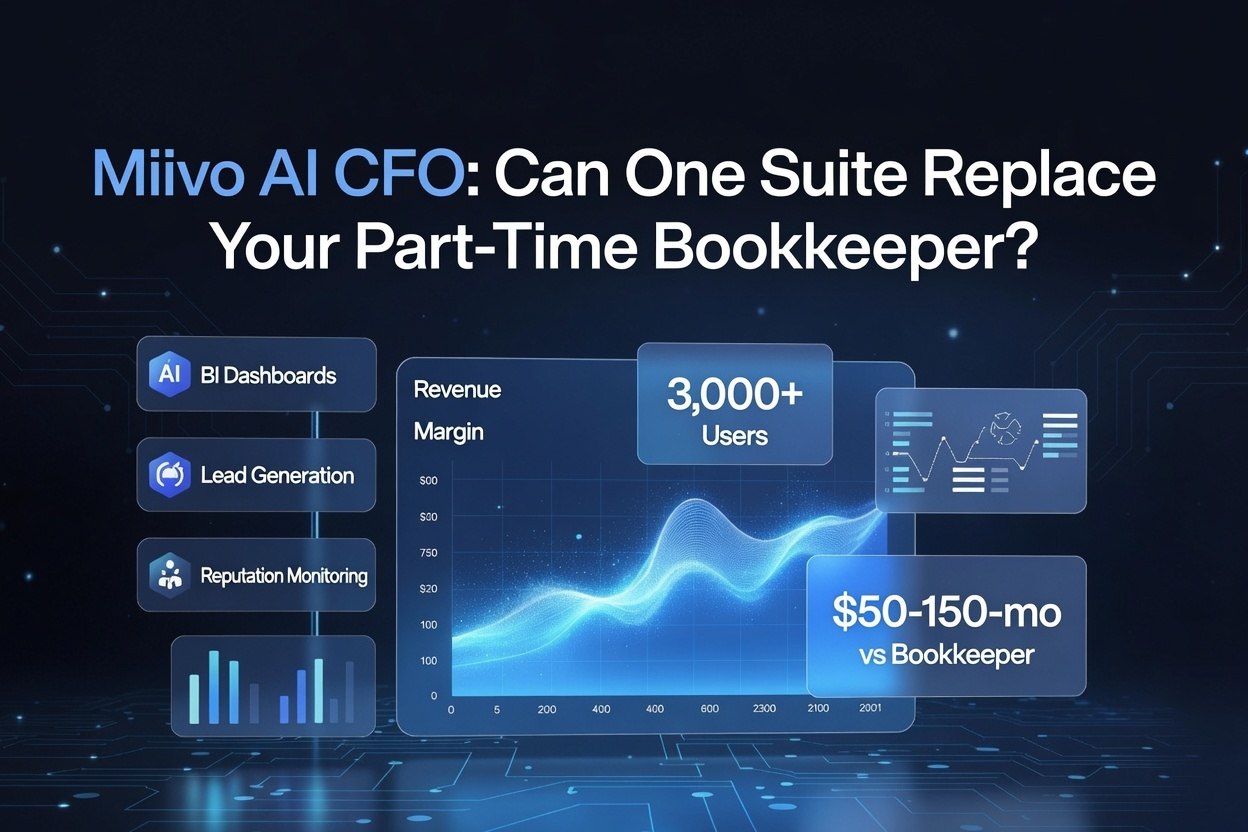
Miivo AI CFO: Can One Suite Replace Your Part-Time Bookkeeper?
⚡ Expert Summary: Miivo AI (TSXV: MIVO) shipped three AI CFO products for SMBs in the first half of 2026 and onboarded over 3,000 users. The suite covers business-intelligence dashboards, AI lead generation, and reputation monitoring, but it is not a replacement for a human bookkeeper. For US business owners, the real question is whether a $50-150/month AI stack beats a part-time bookkeeper on speed and cost.
Your finance stack has a problem: it’s slow, manual, and scattered. Your bookkeeper exports from QuickBooks, your dashboard is a mountain of stale spreadsheets, and nobody knows what your cash flow looks like until the month is over. Now a Vancouver AI company is betting SMBs want a different answer — a suite of AI agents that does the analytics, the prospecting, and the reputation tracking all in one place.
Miivo AI (TSXV: MIVO, OTCQB: MIVOF) just dropped a corporate update that’s worth a hard look if you run a small or medium business. Over the first half of 2026, the company launched three products under its “AI CFO” umbrella, onboarded over 3,000 users, grew its recurring-revenue base, and expanded engineering plus a dedicated North American sales team. Here’s what Miivo actually built, what it costs you in time, and the honest questions before you hand your books to an AI agent.
Who Is Miivo AI?
Miivo is a Canadian public company (founded in Vancouver) that builds AI products for SMBs. It trades on the TSX Venture Exchange (MIVO), the OTC (MIVOF), and Frankfurt (L7S0). Its CEO is Alexander Damouni.
The strategic shift worth noting: Miivo is not building one monolithic platform. Instead, it’s building a portfolio of focused AI products, each solving a specific business problem. That’s a deliberate play to create multiple low-friction entry points into its ecosystem — a customer can start with one tool and expand from there.
Its stated mission: help SMBs integrate AI with confidence, emphasizing SOC compliance as a security and trust signal.
The Three AI CFO Products
Let’s break down exactly what Miivo launched in 2026, because “AI CFO” sounds vague until you see the actual product list. These are three distinct tools aimed at different parts of your business:
1. Business Intelligence (BI) Dashboards
This is the “CFO brain.” It integrates with your existing accounting software and produces real-time dashboards showing revenue, cash flow, margins, operational performance, and KPIs. Beyond just displaying numbers, it highlights risks and recommends actions to improve profitability.
This is the product most likely to replace the “where are we this month?” spreadsheet scramble. Instead of exporting data and building pivot tables, your dashboard updates live and flags what deserves your attention.
Think about what that actually does for a founder or ops manager. Without this, your financial picture lives in a bookkeeper’s file and a monthly reconciliation call. With a live BI dashboard, you can see a margin dip in a specific product line while it’s happening, not weeks later when it’s baked into your profit number. The “recommends actions” layer is the differentiator — it doesn’t just show you that cash flow tightened; it suggests what to do about it, which is the part a spreadsheet can’t do.
2. AI Lead Generation
This targets the sales side. It finds potential B2B customers, scores prospects against an ideal customer profile, enriches contact information, drafts personalized cold emails, and tracks outreach campaigns.
If outbound prospecting eats your sales team’s hours, this automates the repetitive part: finding leads, cleaning the list, and writing the first touch. A human still reviews and hits send, but the busywork disappears.
The honest cost-benefit here: cold outreach is a numbers game, and the setup — segmenting a list, researching each account, personalizing each email — is where hours disappear. Offloading that to an AI that scores against your ideal customer profile and generates draft outreach means your sales reps spend their time on the calls and the closes, not the spreadsheet macro. The risk is generic-sounding emails, which is why the “human reviews before send” step is non-negotiable.
3. Reputation & Customer Insights
This is the customer-facing radar. It monitors reviews and mentions across Google Reviews, Instagram, and Reddit, analyzes sentiment, generates AI-written response drafts for you to review and publish, and recommends internal actions to address the feedback.
For a business owner who’s drowning in review platforms and doesn’t respond fast enough (which actively hurts local rankings and trust), this is a time-saver that also protects your online reputation. Responding to reviews quickly and genuinely is one of the most inexpensive things that moves local search rankings and customer trust — yet most SMBs never get to it consistently. An AI that monitors across channels, summarizes sentiment, and drafts a response you can edit and post removes the “I’ll reply later” excuse, which is genuinely valuable whether or not you ever use Miivo’s other products.
Real Numbers Behind the Update
Here are the concrete milestones Miivo reported for the first half of 2026 — the ones that actually tell you something:
- 3,000+ users onboarded to the platform in six months.
- Recurring revenue customers expanding — the metric that matters for a subscription business model.
- Average subscriber time on platform rising significantly — a proxy for engagement and perceived value.
- Larger engineering team and a dedicated North American sales team — real hires behind the growth.
- SOC compliance — a security certification that matters when you hand your financial data to a third party.
Miivo’s CEO says much of 2025 went into designing, developing, and testing the software, with 2026 being the launch-and-grow phase. The company frames the update as early proof of “tremendous customer uptake.”
The Market Numbers You Should Know
The pitch rests on two big market realities, and both check out:.
First, there are over 400 million small and medium-sized companies globally. That’s the addressable pool. AI is shifting from a “nice to have” experiment to an essential operating tool — meaning the demand isn’t hypothetical, it’s structural.
Second, and most important for your own planning: McKinsey & Company estimates generative AI could unlock US$200–340 billion in annual productivity value once companies deploy AI in finance functions. That’s not Miivo’s number — it’s a top-tier consultancy backing the core thesis that AI finance tools pay for themselves. For an American SMB owner, that’s the difference between finance being a monthly admin chore and being a live decision-making input — and the tools to capture that value are getting cheap enough that the barrier is adoption, not price.

Miivo’s AI CFO suite: three products spanning BI dashboards, lead generation, and reputation tracking, with 3,000+ users onboarded in H1 2026.
What This Means for Your Business
Strip away the investor-speak and here’s what the Miivo model tells you for your own operations:
1. AI finance is moving from experiments to daily tools. The interesting shift isn’t Miivo specifically — it’s that the market now rewards AI products that integrate with workflows you already use and deliver measurable outcomes without long implementation cycles. That’s exactly what SMB owners want: results, not a six-month rollout.
2. The “AI CFO” category is expanding beyond bookkeeping. Miivo’s suite bundles financial analytics, sales prospecting, and reputation management. That’s a statement about where AI adds value for growing businesses — it stops being a single-tool feature and becomes an operating layer across finance, sales, and customer experience.
3. Security certification is becoming table stakes. Miivo leaning on SOC compliance is a signal: when you outsource financial functions to AI, trust and security matter as much as features. Any AI finance tool you adopt should be able to answer the security question before you connect it to your accounting data.
4. Start with one entry point, not the whole suite. Miivo’s product-portfolio strategy mirrors a practical adoption pattern: solve one painful problem first — say, real-time cash flow visibility — then expand once it’s proven. That’s a lower-risk way for you to adopt AI than committing to a full platform blind.
How Miivo Compares to the DIY Finance Stack
To decide if an AI CFO suite is worth it, compare it to what you likely have today: accounting software (QuickBooks, Xero), a spreadsheet for tracking, a separate CRM for sales, and someone manually checking reviews. Here’s the gap Miivo’s suite is trying to close:
The trade-off is real: a DIY stack keeps you in control and costs less outright, but it burns hours across disconnected tools. An AI CFO suite centralizes the view at the cost of trusting a third party with your data. For a growing SMB, the math usually tips when finance review time is the bottleneck — which is true for most American small businesses that have outgrown “just check the bank balance.”

Miivo’s AI CFO suite at $50-150/month vs a part-time bookkeeper at $300-800/month.
The Honest Risks Before You Jump In
I want to be straight with you, because “AI CFO” headlines hide real caveats:
Early-stage adoption. 3,000 users in six months is solid traction, but it’s an early-stage base, not a proven enterprise track record. You’d be an early adopter, not a reference customer.
It’s a public-company press release. The update is framed positively (as corporate updates always are). Treat it as directional: the product category is real, but individual performance claims need your own testing.
AI agents still need human review. Cold-email drafts and review responses are starting points, not final copy. A bad AI-generated outgoing email to a prospect, or a tone-deaf reply to a customer review, can do real damage. You’ll still quarterback the output.
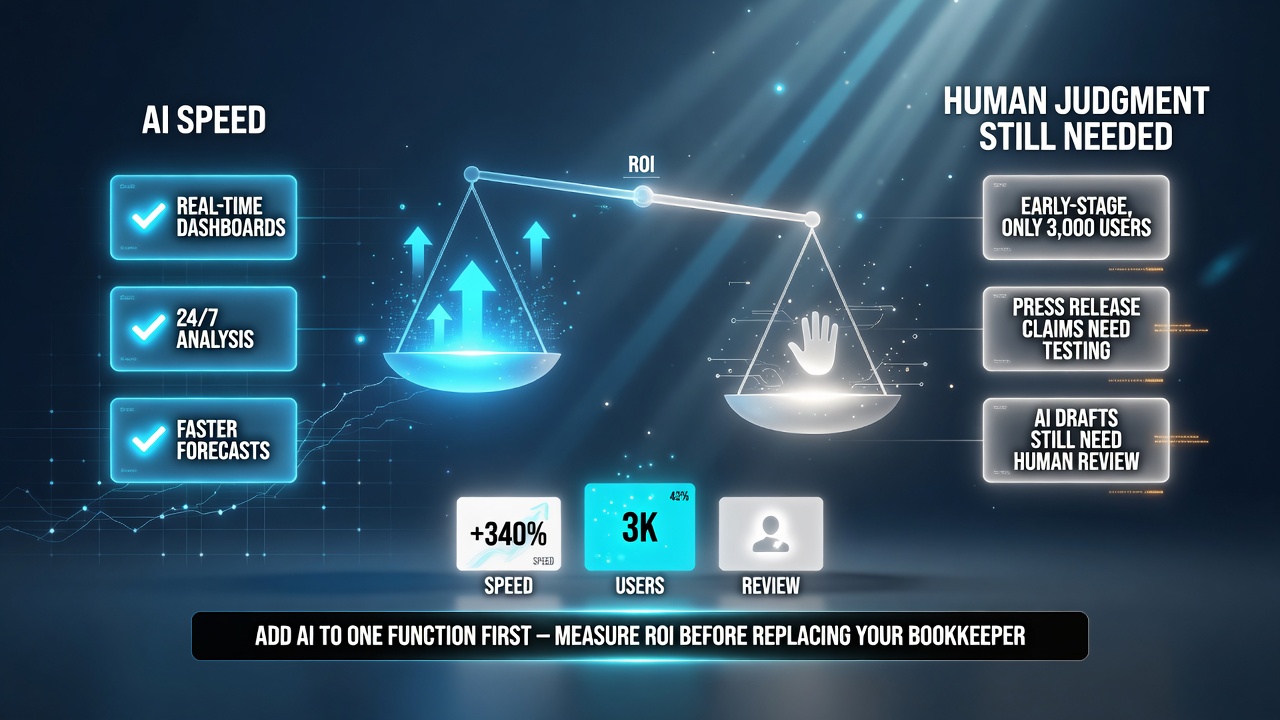
Where AI CFO tools genuinely speed you up — and where you still need a human for judgment and sign-off.
How to Evaluate an AI Finance Tool Like This
Whether you look at Miivo or a competitor, use this checklist before connecting anything to your books:
- Does it integrate with your actual accounting software? Real-time dashboards only work if they read your real data.
- What’s the security story? Ask for SOC 2 / SOC compliance, data encryption, and who can access your financial data.
- Can you try it on one function first? Avoid committing to a full suite until one tool proves its ROI.
- What does the human still do? Clarify where AI drafts/acts and where you review. You need control, not autonomy.
- Does it pay for itself? If a tool saves your bookkeeper or sales team even a few hours a week, the math usually works — but only if you actually reclaim that time.
Frequently Asked Questions
What is Miivo AI?
Miivo AI (TSXV: MIVO, OTCQB: MIVOF) is a Vancouver-based public company that builds AI products for small and medium-sized businesses. Under its “AI CFO” umbrella it has launched three products: Business Intelligence dashboards, AI Lead Generation, and Reputation & Customer Insights.
How many users does Miivo’s AI CFO platform have?
According to Miivo’s August 2026 corporate update, the platform has onboarded over 3,000 users in the first half of 2026, with an expanding base of recurring-revenue customers and rising average subscriber time.
What products did Miivo launch in 2026?
Miivo launched three products: a Business Intelligence tool that integrates accounting software with real-time dashboards showing revenue, cash flow, and margins; an AI Lead Generation tool for B2B prospecting and personalized cold outreach; and a Reputation & Customer Insights product that monitors reviews and suggests responses.
Is Miivo AI secure for my financial data?
Miivo states it is SOC compliant and positions its platform as secure, reliable, and trusted. As with any AI finance tool, you should confirm the specific security certifications and data-handling policies before connecting your accounting data.
How big is the market for AI finance tools for SMBs?
There are over 400 million small and medium-sized businesses globally. McKinsey & Company estimates generative AI could unlock US$200–340 billion in annual productivity value in finance functions, supporting demand for deployable AI finance tools.
Should I replace my bookkeeper with an AI CFO?
Not necessarily. AI tools like Miivo automate analytics, prospecting, and review management, but they work best alongside a human who reviews output and makes strategic decisions. Start by adding an AI tool to one function and measure the ROI before restructuring your finance workflow.

About Barak Schurr
Barak Schurr is the founder and former president of the nightlife ticketing platform Wantickets and former Global Director of Dance and Nightlife at Eventbrite. He currently focuses on AI research and writes about practical AI for independent business owners that actually moves the needle — no hype, no corporate fluff. More at topnotchaitools.com.
Contact: [email protected]
More AI Resources for Your Business