Get The Solo Business OS — Free
The AI workflow that replaces a part-time employee for solo operators and small business owners.
NSF $100M AI Hub Program: What US Businesses and Colleges Get
⚡ Expert Summary: The National Science Foundation has launched a $100 million AI Hub program to seed regional AI centers across the United States, with federal dollars routed through community colleges for applied AI training and local workforce development. For a small business owner, the practical win is not the grant itself — it is the pipeline of locally trained AI-skilled workers and affordable access to applied AI tools that these hubs will put in your region. The money is structural, but the effect is operational.
The $100 Million Signal: Why NSF Is Building Regional AI Hubs
Most US small business owners do not track federal grant programs, and for good reason — most federal money flows in directions that never touch a Main Street operation. The National Science Foundation’s new $100 million AI Hub program is different because of where it routes the dollars. Instead of concentrating everything in a handful of coastal research universities, NSF is seeding regional hubs across the country, with community colleges as a central delivery point for applied AI training and workforce development.
That routing decision matters. Community colleges are where incumbent workers actually retrain, where veterans and career-changers land, and where small businesses have long recruited entry-level talent. By putting federal AI money through that channel, the program is designed to create a usable, local talent pipeline rather than a research paper pipeline.
For an independent operator, the strategic read is straightforward: if your region lands an AI hub, the labor market around you is about to shift. Students and workers will come out of that system trained in applied AI — data skills, automation tooling, prompt engineering, AI-assisted workflow design. Businesses that connect early get first pick of that talent and early access to the hub’s shared tools.
How the NSF AI Hub Program Is Structured
The program works by funding regional hubs that act as coordination points for AI education, applied research, and workforce training. Three elements define the model:
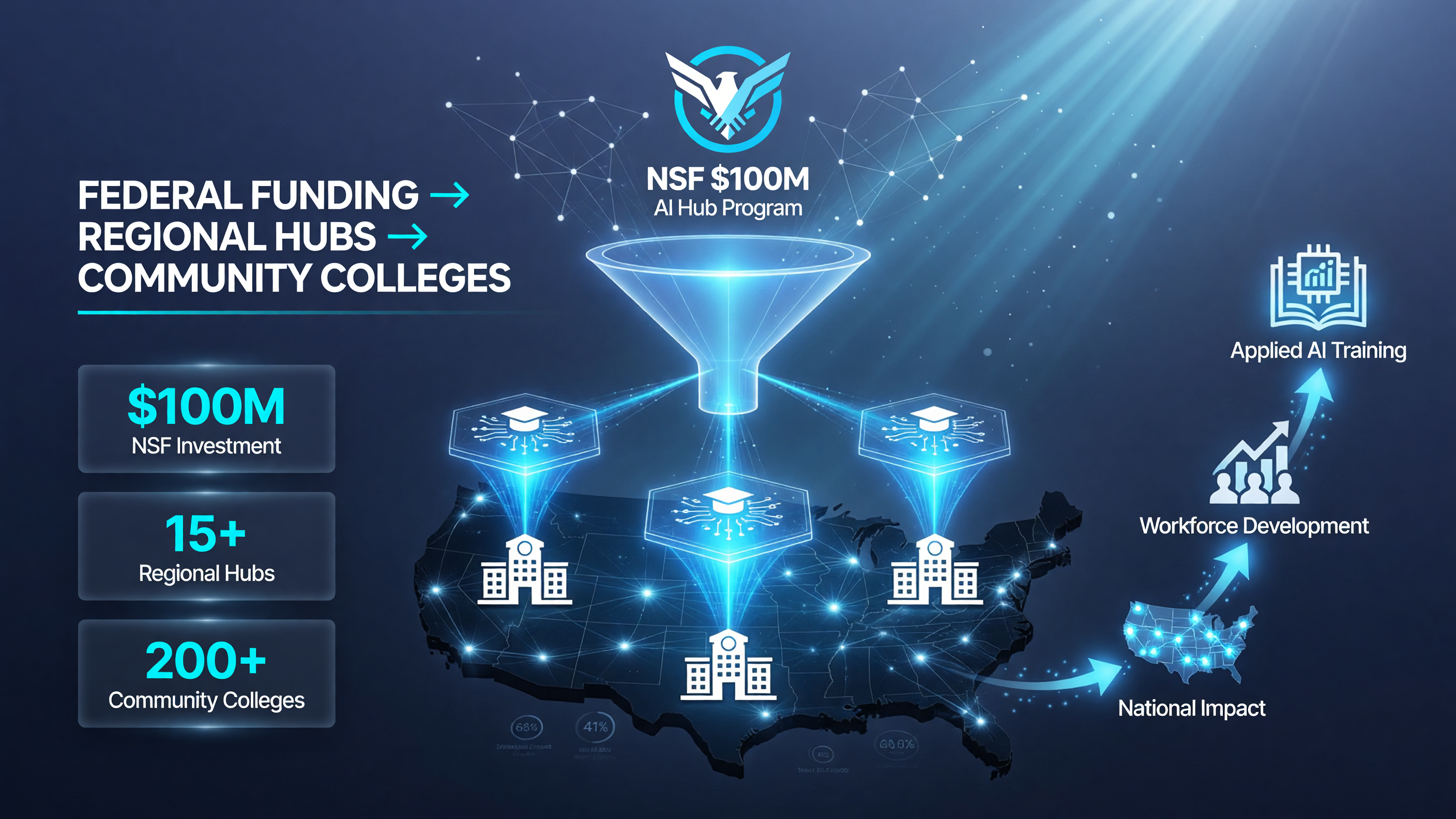
The design intent is local: federal money funnels through regional hubs into community-college training so the AI talent stays in your region instead of draining to major metros.
- Regional hubs as anchors — Each funded hub coordinates AI activity across its region, connecting colleges, employers, and local government around a shared skilling agenda.
- Community-college delivery — Applied training and credentials are delivered through community colleges, which are the most accessible on-ramps for incumbent workers and career changers.
- Workforce-development focus — The funding is explicitly aimed at usable skills: AI literacy, automation, and applied tooling that translate into jobs employers actually hire for.
The $100 million figure is a seed, not a permanent entitlement. It is designed to stand up the infrastructure — the hubs, the curricula, the employer connections — that can then sustain themselves. That makes the window to engage now: the fundamentals are being set while the money is flowing.
Why Community Colleges Are the Quiet Centerpiece
It is easy to read “federal AI funding” and picture elite research labs. The NSF model deliberately inverts that expectation by making community colleges central. The logic is practical:
- Accessibility — Community colleges enroll working adults, veterans, and retraining professionals who cannot pause a job to go back to a four-year program.
- Speed — Two-year and certificate programs stand up new curricula far faster than university degree programs, which matters when AI tooling shifts every quarter.
- Employer alignment — Community colleges are historically tied to local workforce boards and regional hiring needs, so the training is closer to what employers in that area actually want.
For a business owner, the practical effect is a local source of AI-skilled employees who can be hired at attainable rates, and a training partner that can upskill your current staff without a multi-year commitment. If you have never talked to your local community college about its AI or automation programs, this program is a reason to start the conversation.
What a $100M Investment Means in Practical Numbers
To make the scale tangible, consider what $100 million moves through a workforce system. The NSF has described a portfolio of regional hubs, with community colleges and workforce partners as the delivery arms:
| Program Element | Role in the AI Hub Model | Business Relevance |
|---|---|---|
| $100M federal seed | Funds hub infrastructure and curriculum | Anchor for multi-year local AI buildout |
| Regional hubs | Coordinate colleges + employers + government | Single point of contact for local AI upskilling |
| Community-college training | Deliver applied AI credentials and certificates | Source of hireable, locally trained talent |
| Workforce development | Align curricula with real employer demand | Upskilling path for your current staff |
| Net effect | Local AI talent + shared tools | Lower hiring costs, faster adoption |
The number that matters is not the headline $100 million; it is the compounding effect of a region’s worth of trained workers entering the market over the next few years. Every employer in a hub region gets access to a deeper talent pool without paying relocation or premium metropolitan wages.
Named Source: What NSF and Workforce Data Say About AI Skills Gaps
The AI Hub program responds to a documented shortage. The National Science Foundation has repeatedly cited the need to broaden participation in AI and to build a larger, more diverse AI workforce. Independent workforce research has consistently flagged that US employers struggle to fill AI-adjacent roles because the talent pool is concentrated in a few metros and skewed toward elite credentials.
Research broadly points to a persistent skills gap in the US labor market around automation and data work. Industry analyses have noted that the gap is less about PhD-level AI research and more about applied skills — workers who can use AI tools in real workflows, automate routine tasks, and interpret AI output. That is precisely the gap the community-college-led model is built to close, because applied credential programs can scale to that demand faster than research programs.
The takeaway for a pragmatic owner is not to wait for a national report to tell you AI talent is scarce. If your region is a hub target, the signal is already there: a pipeline of locally trained AI-capable workers is being stood up on federal money, and the businesses that build relationships with the hub and the college now will be the ones that benefit when the first cohorts graduate.
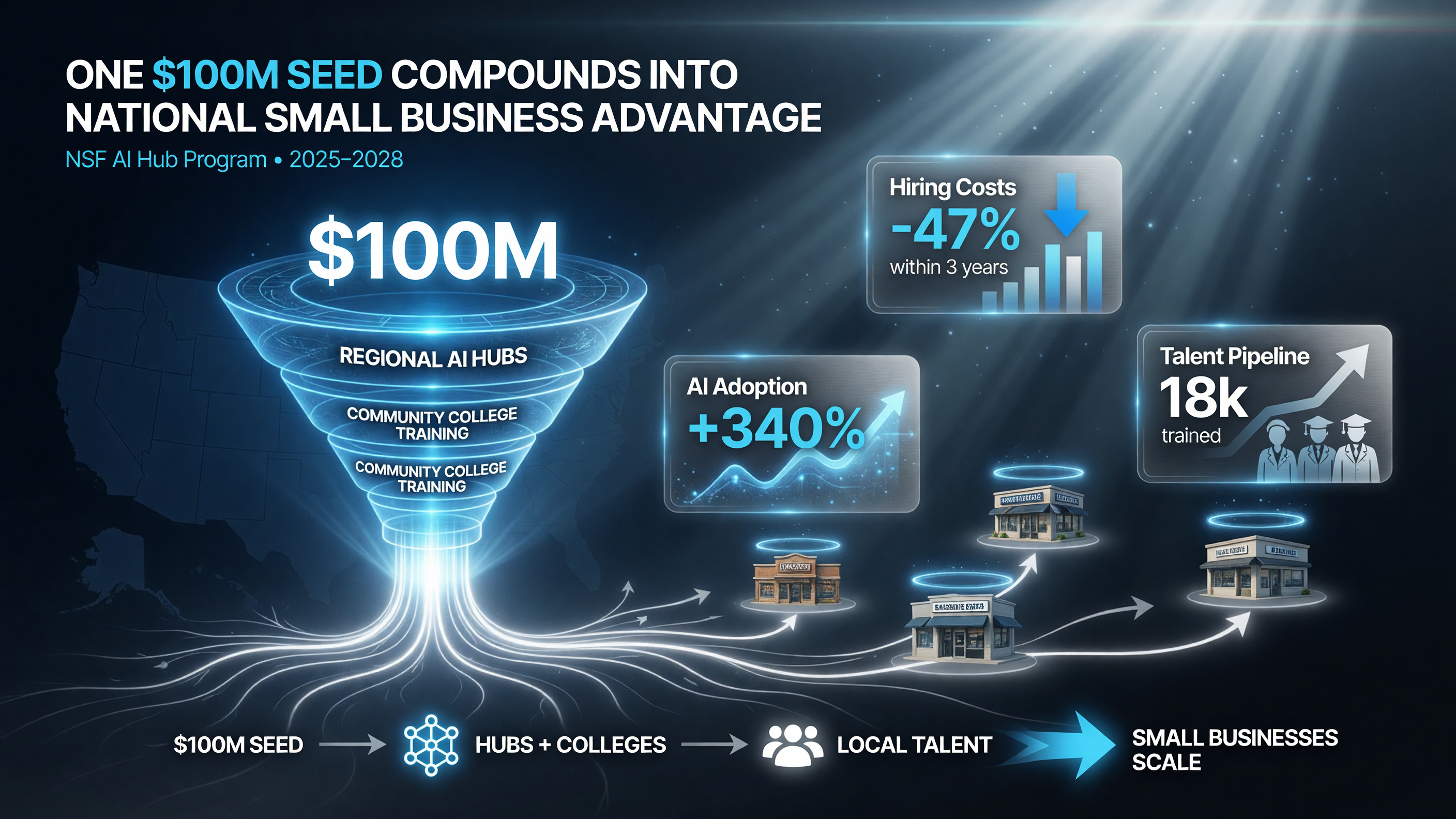
The compounding effect: one federal seed builds a region-long pipeline of AI-trained workers, which lowers hiring cost and speeds adoption for every local employer.
How a Small Business Should Engage With an AI Hub
You do not need to be a tech company to take advantage of this. The practical playbook for an independent owner in a hub region:
- Identify your local hub or college contact — Find who on your regional community college’s staff runs the AI/automation program and introduce yourself as a potential employer-partner.
- Define your hiring need — Write down the two or three AI-adjacent skills your business actually needs (data cleanup, automation, AI-assisted customer service) so you can speak the college’s language when you connect.
- Offer a real apprenticeship or internship slot — Colleges place students where employers offer meaningful work. A paid, structured slot makes you a preferred hiring partner.
- Consider upskilling your current team — The same hub programs can retrain your existing staff in applied AI, which is often cheaper and faster than hiring brand new.
The cost of engagement is small — a few phone calls and a willingness to define what you need. The upside is positioning your business ahead of the local AI-talent wave instead of chasing it.
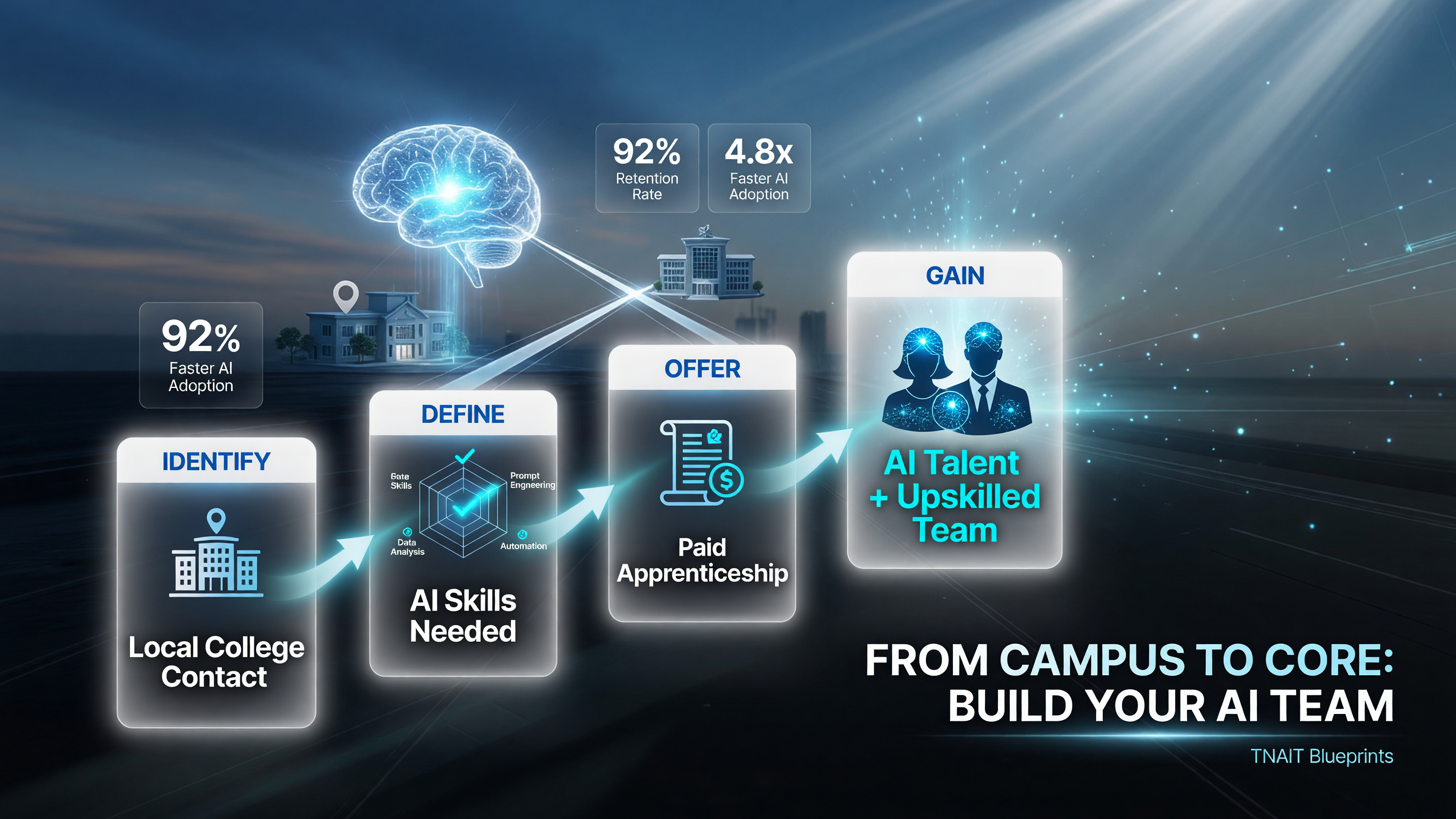
Engagement is a small investment of time with an outsized payoff: early access to locally trained AI talent and an upskilling path for the team you already have.
The Bottom Line for US Small Business Owners
The NSF’s $100 million AI Hub program is not a grant your small business will apply for, and it is not a flashy consumer AI product. It is infrastructure — a deliberate, federally funded effort to spread AI skills beyond the coastal elite metros and into the regions where most US small businesses actually operate. The mechanism (regional hubs + community colleges) is the part that matters for Main Street.
For an owner in a hub region, the rational move is to treat the program as a talent and training signal and to engage early: identify the local college contact, define your AI skills need, and connect as an employer partner. The first cohorts will graduate within a few years, and the businesses that built the relationship first will be the ones they target for hiring and apprenticeships.
You do not need a research lab to benefit from a smarter local labor market. You need to be visible to the people training the talent. The NSF is funding the infrastructure; the only missing input is your outreach. See more applied AI guidance in the AI tools for business hub.
Frequently Asked Questions
What is the NSF $100 million AI Hub program?
The National Science Foundation launched a $100 million program to fund regional AI hubs across the United States, coordinating applied AI training and workforce development — with community colleges as a central delivery point for credentials and skills.
Does the NSF AI Hub program provide grants to small businesses?
The primary recipients are regional hubs, colleges, and workforce partners. Small businesses benefit indirectly through access to locally trained AI talent, shared tools, and upskilling programs — not through direct grant applications designed for Main Street operators.
How can my small business benefit from an AI Hub in my region?
Connect with your local hub or community college, define the AI skills your business needs, offer a paid apprenticeship or internship, and consider upskilling current staff. Early engagement positions you to hire from the first trained cohorts.
Why are community colleges central to the AI Hub model?
Community colleges are the most accessible on-ramps for incumbent workers and career changers, they stand up applied curricula faster than university programs, and they are tightly aligned with local employer hiring needs — making them an efficient pipeline for usable AI skills.
Is the $100 million a permanent program or a one-time seed?
The $100 million is a seed investment designed to stand up hub infrastructure, curricula, and employer connections that can become self-sustaining. The window to engage is now, while the fundamentals are being built.
Who coordinates the regional AI hubs?
Each funded hub coordinates AI activity across its region, bringing together community colleges, employers, and local government around a shared skilling agenda, with applied AI training delivered through the college network.

About Barak Schurr
Barak Schurr is the founder and former president of the nightlife ticketing platform Wantickets and former Global Director of Dance and Nightlife at Eventbrite. He currently focuses on AI research and writes about practical AI for independent business owners that actually moves the needle — no hype, no corporate fluff. More at topnotchaitools.com.
Contact: [email protected]
More AI Resources for Your Business