PAR Technology’s AI Head: The Secret Isn’t Use Cases — It’s Data Integration
⚡ Expert Summary: Oliver Ostertag, president of growth and AI at PAR Technology, told Restaurant Dive on July 14, 2026 that the key to successful AI in business isn’t finding the perfect use case — it’s having deep, integrated data. His argument applies far beyond restaurants: small businesses chasing AI wins without fixing their data plumbing first are wasting money. The companies seeing real ROI from AI are those with unified platforms that connect operations, inventory, customer data, and financials.
The Problem With Chasing AI Use Cases
Every week there’s a new AI tool promising to revolutionize how you run your business. Customer service chatbots. Inventory predictors. Marketing content generators. Voice ordering systems. The temptation is to pick one shiny use case, subscribe, and expect results.
Oliver Ostertag, president of growth and AI at PAR Technology — the company behind point-of-sale and back-office systems used by Burger King, Shake Shack, and thousands of other restaurants — says that approach is backward. In a July 14 interview with Restaurant Dive, Ostertag argued that the technology’s “continued maturation and its ability to integrate a wide range of data matter more than finding individual tasks for which the tech is especially suited” (Restaurant Dive, July 2026).
“Use case is important, but it’s really a question of whether or not the technology is enterprise-grade, whether it’s proven and how deep the data is,” Ostertag said.
This isn’t a restaurant-only insight. Every small business owner running disconnected tools — a separate POS, a separate accounting system, a separate inventory tracker, a separate customer database — is facing the same bottleneck. AI layered on top of fragmented data produces fragmented results.
What “Deep Data Integration” Actually Means
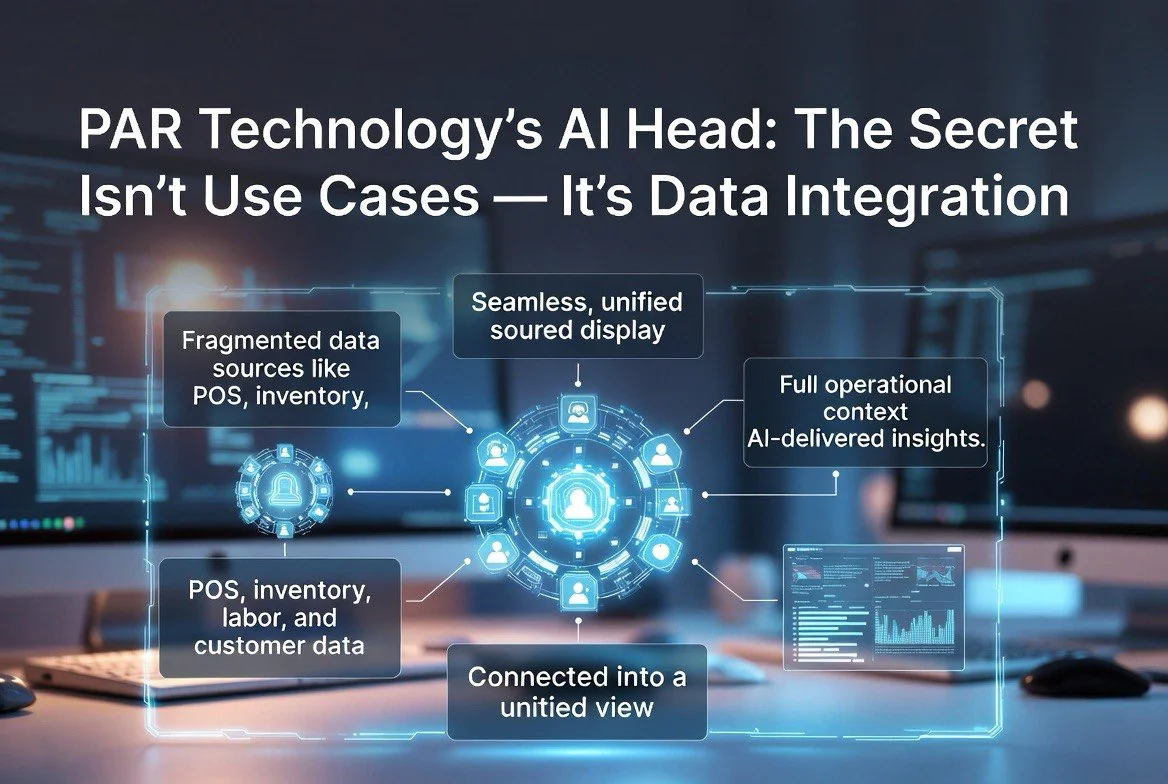
Ostertag defines the ideal as having “full context equity” — a platform that understands the complete operation of a business, not just a single slice. In a restaurant context, that means the system knows:
- Where orders come from (in-store, online, third-party delivery)
- Where orders are routed (which station, which shift, which employee)
- What each order contains at the component level (not just “cheeseburger” but the bun, patty, cheese, and toppings individually)
- Current pricing of every component
- Current inventory levels of every component
- Labor scheduling data tied to demand patterns
Replace “restaurant” with “any small business” and the same principle applies. A retail store needs AI that connects point-of-sale data, inventory levels, supplier lead times, marketing campaign performance, and customer purchase history in a single view. A service business needs AI that links appointment scheduling, client history, billing, and staff availability.
“If AI tooling is sitting on really deep data and it understands — for instance — inventory and labor, and then has context on how that ties back to your in-store sales and operations, it is actually very performant,” Ostertag said. “You can have a platform provider that doesn’t have the full 360-degree view — maybe it’s just the back-office piece — but as long as a platform covers multiple dimensions over an extended period you can actually have great results with AI.”
The Patterns of AI That Actually Works
Ostertag identified the most effective current AI applications for operators. These patterns apply broadly to any small business:
Natural-language analytics. Instead of needing a data analyst to write SQL queries, you ask questions in plain English: “Which locations perform best and why?” or “Where am I seeing the largest amount of waste and why?” The AI spits out the answer because it sits on top of integrated data.
Automated action triggers. Beyond passive analytics, AI agents can take action. An “offers agent” that sets up promotions based on current inventory. A “fraud agent” that proactively identifies cash leakage. These aren’t futuristic concepts — Ostertag says they’re already the most common use cases PAR is deploying today.
Back-office optimization first. “The easiest application of AI will always be on the back-office side,” Ostertag said. Labor scheduling, inventory management, and operational efficiency — these produce immediate, measurable ROI without the complexity of customer-facing applications.
The pattern is consistent: the highest-impact AI applications are the ones that sit on top of connected data and produce automated decisions, not just recommendations. For U.S. small business owners, this means the most valuable AI investment right now might not be a new tool at all — it might be integrating the systems you already have.
Why Integration Beats Innovation
Starbucks abandoned its AI-powered inventory counting system after less than nine months. McDonald’s scaled back voice AI testing. Pizza Hut’s AI order management system allegedly cost one franchisee $100 million in sales. These high-profile failures aren’t evidence that AI doesn’t work — they’re evidence that AI without deep data integration creates more problems than it solves.
“If you don’t have full context equity, AI cannot solve the challenges that operators are facing,” Ostertag said. “You’re only as good as the underlying tech stack, and if integrations are not great, it’s really hard to have that 360 approach.”
PAR’s own approach uses platforms like AWS Bedrock and models from OpenAI and Anthropic. They’re seeing real efficiency gains in development — coding specifically — and expect those gains to translate into same-store sales and margin improvements over the next 2-3 years (Restaurant Dive, July 2026). But the gains come from the depth and breadth of data, not from any single model or tool.
For a small business owner reading this, the practical takeaway is simple: before you subscribe to another AI tool, ask whether it connects to your existing systems. A chatbot that can’t access your inventory isn’t going to handle customer questions about product availability. An analytics tool that can’t pull your financial data isn’t going to tell you where you’re losing money. An email marketing AI that doesn’t know your purchase history isn’t going to personalize anything useful.
The Token Cost Reality Check
Ostertag also addressed a growing concern for small businesses: rising token costs. As AI providers shift toward token-based billing, costs can climb month over month. PAR tracks its token spend “very closely” and has seen it increase steadily.
But his perspective is pragmatic: “As long as the relative efficiency gains are climbing in excess of the rising token cost, you don’t have much of a problem.”
He also predicts that token prices will come down as the market becomes more competitive and as IPO pressures force providers to compete on cost. For small businesses, the strategy should be: invest in AI tools that integrate with your data first, and the cost will make itself back through efficiency gains — regardless of where token pricing goes.
What This Means for Your Business
PAR Technology’s AI blueprint works because it connects payment processing, point-of-sale, back-office operations, loyalty programs, and online ordering into a unified platform. The AI layer on top is powerful precisely because of what sits underneath — complete, connected, real-time data.
Audit your tech stack. List every system your business uses. How many of them talk to each other? If the answer is “not many,” your AI tools will underperform no matter how advanced they are.
Prioritize platforms over point solutions. A single platform that handles multiple functions with integrated data will outperform five best-in-class tools that don’t share information.
Start with back-office. The easiest AI wins are in scheduling, inventory, and operations — areas where the data is already structured and the ROI is measurable.
Real Companies Using This Pattern
PAR Technology itself is the best case study. The company provides point-of-sale, payment processing, back-office systems, loyalty programs, and online ordering to major U.S. restaurant chains including Burger King, Shake Shack, and Dairy Queen. Their AI layer — powered by AWS Bedrock and models from OpenAI and Anthropic — sits on top of this unified platform, giving it access to transaction data, inventory levels, labor schedules, and customer behavior across thousands of locations.
Ostertag noted that PAR is already seeing development efficiency gains from its AI investment, particularly in coding. “With coding, yes, for sure,” he said when asked if things are getting dramatically more efficient. The company expects these gains to translate into same-store sales growth and margin improvements for their customers over the next 2-3 years (Restaurant Dive, July 2026).
For small business owners who aren’t Burger King, the lesson translates directly. The tools exist today to integrate your operations. A coffee shop using Square for POS, 7shifts for scheduling, and Toast for online ordering can use AI analytics that pulls from all three — but only if those systems are connected. The businesses seeing AI ROI are the ones that paid the integration tax first, then layered AI on top.
This is why platform companies — Toast for restaurants, HubSpot for marketing, Shopify for retail — are winning the AI race. Their AI features work because the data is already unified in one system. Independent operators running disconnected tools need to bridge those gaps before expecting AI to deliver meaningful results.
Ostertag’s framework applies to anyone running a business with multiple systems: the quality of your AI output is directly proportional to the depth of your data integration. Fix the plumbing, and the AI follows.
FAQ
What did PAR Technology’s AI head say about AI in restaurants?
Why do some AI implementations fail in business?
What are the most effective AI applications for small businesses right now?
What is “context equity” in AI?
How can small businesses get started with AI integration?

About Barak Schurr
Barak Schurr is the founder and former president of the nightlife ticketing platform Wantickets and former Global Director of Dance and Nightlife at Eventbrite. He currently focuses on AI research and writes about practical AI for independent business owners that actually moves the needle — no hype, no corporate fluff. More at topnotchaitools.com.
Contact: [email protected]
More AI Resources for Your Business