OpenAI Launched a Small Business Program for ChatGPT Work — Here Is What Free Training Gets You
⚡ Expert Summary: OpenAI launched its ChatGPT Small Business Program on July 21, 2026, offering free virtual training, in-person AI academies across the United States, and curated partner integrations with Dropbox, Shopify, Intuit, Slack, and Wix. The program targets small teams that need practical AI workflows — not just chat prompts but full agentic workflows through ChatGPT Work, powered by the GPT-5.6 model family (Sol, Terra, Luna). The training covers specific business use cases: accounting, marketing, ecommerce, and operations.
OpenAI’s problem has never been that small businesses don’t know ChatGPT exists. The problem is that most small business owners open ChatGPT, type a prompt, get a mediocre result, and close the tab.
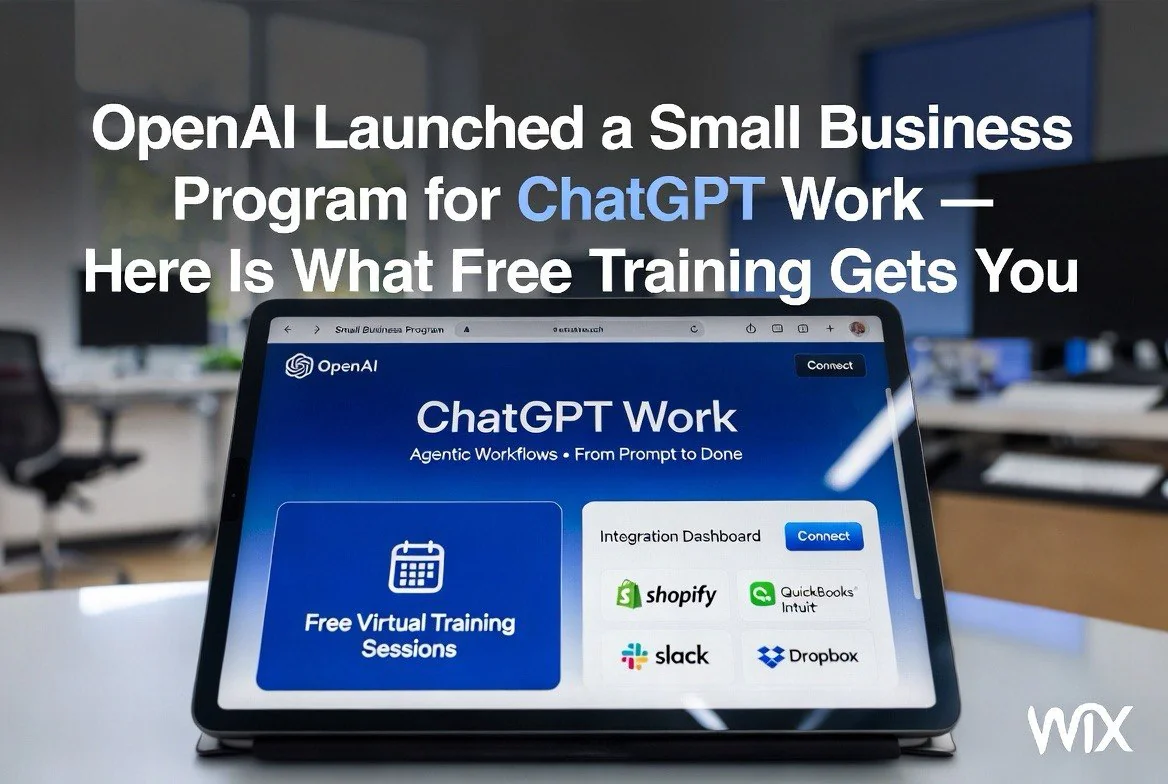
The Small Business Program, announced July 21, 2026, is designed to fix that. It combines free hands-on training with ChatGPT Work — OpenAI’s agentic workspace that completes multi-step jobs instead of just answering questions.
What the Small Business Program Includes
The program has three components:
Virtual training sessions. Free webinars covering specific SMB use cases: accounting workflows, marketing content generation, ecommerce operations, customer communications. These are not generic “how to write a prompt” sessions. They walk through real workflows — connecting ChatGPT to QuickBooks, generating a Shopify product description from raw specs, setting up a Slack integration that summarizes daily messages.
In-person AI academies. OpenAI is running in-person training events across US cities. The curriculum covers the same use cases as the virtual sessions but with hands-on guidance and networking. SMB owners can bring their actual business problems and build workflows on-site.
Curated partner integrations. OpenAI pre-configured integrations with Dropbox, Shopify, Intuit, Slack, Atlassian, and Wix. Each integration comes with pre-built workflow templates designed for the specific platform. A Shopify store owner can deploy an inventory analysis workflow in minutes, not hours.
Comparison with Similar Programs from Other AI Companies
OpenAI is not the first AI company to offer free small business training, but it is the first to pair it with a full agentic platform. For context, here is how the competitive landscape looks in mid-2026:
Google’s Gemini for Business offers free training through its Grow with Google program, which has existed since 2017. The AI-specific training includes Gemini Workspace Labs (Gmail, Docs, Sheets integration basics) and costs nothing. However, Google’s training focuses on prompt engineering and single-tool usage — writing a Gemini email draft, generating a slide deck — rather than full agentic workflows. The training is also spread across general “digital skills” courses rather than being SMB-specific. Google’s advantage is breadth; its weakness is that the tools (Gemini in Workspace) are less powerful than ChatGPT Work for multi-step automation.
Anthropic has no formal small business training program. Claude’s Business plan ($25/user/month) includes admin controls and usage analytics, but training is limited to documentation and community forums. Anthropic is targeting enterprise customers and API developers rather than SMB owners.
Microsoft’s Copilot training is bundled with Microsoft 365 Business Premium ($22/user/month) and includes free tutorials, but the training is heavily focused on Microsoft’s own ecosystem — Copilot in Word, Excel, PowerPoint, Teams. For a small business not already on Microsoft 365, the training has limited transfer value. Copilot’s agent capabilities (via Copilot Studio) require additional licensing at $200/month, putting true agentic workflows out of reach for most SMBs.
OpenAI’s program is the first to combine free hands-on training with a genuinely agentic platform at SMB-friendly pricing. The pre-built workflow templates for third-party tools (Shopify, Slack, Intuit) give it a practical edge over competitors that train on their own ecosystem only.
Detailed Examples of the Workflow Templates
To understand what the program actually delivers, it helps to walk through specific workflow templates. Here are three that OpenAI has highlighted:
The Inventory Reorder Workflow (Shopify Integration): This template connects ChatGPT Work to your Shopify admin. At 8:00 AM daily, the agent checks inventory levels across your product catalog, compares current stock against the reorder threshold you set during setup, generates a prioritized list of products that need reordering, and drafts an email to your supplier with quantities, SKUs, and preferred pricing per your last order — all without you opening a spreadsheet. The agent learns your selling velocity over time and adjusts reorder thresholds automatically. If a product sold 40% faster last month than the previous three, the agent flags the increased trend and recommends a higher safety stock level.
The Month-End Close Workflow (Intuit QuickBooks Integration): This template processes the entire month-end accounting cycle. The agent connects to QuickBooks Online, categorizes any uncategorized transactions from the past 30 days, reconciles the credit card and bank statements (flagging discrepancies larger than $50 for human review), generates an income statement and balance sheet, and produces a one-page executive summary highlighting the month’s key financial movements — revenue by category, expense variances over 10% of budget, and cash position changes. Pilot participants reported reducing month-end close from three days to under four hours.
The Customer Triage Workflow (Slack Integration): This template creates a support triage system in your team’s Slack workspace. Incoming customer emails are forwarded to a dedicated channel where ChatGPT Work reads each inquiry, checks your knowledge base and past responses for similar issues, and drafts a proposed response. The agent categorizes the issue (billing, product question, technical support, complaint), assigns a priority score (1-5 based on language urgency and customer history), and tags the appropriate team member. If a customer mentions a competitor or expresses intent to cancel, the agent flags the message as high priority and drafts a retention-focused response. The team reviews and sends with one click.
How ChatGPT Work Changes the Calculation
The Small Business Program would be less useful if it only taught prompt engineering. What makes it valuable is the tool it trains you on: ChatGPT Work.
ChatGPT Work is OpenAI’s agent workspace — a separate environment from standard ChatGPT. It functions as an agent that completes whole jobs rather than generating text for you to manually act on. Key capabilities for small businesses:
- Goal-to-completion workflows. You describe what you need — “create a monthly social media calendar for my bakery” — and ChatGPT Work researches competitors, drafts posts, designs images, formats a calendar, and delivers a finished spreadsheet or slide deck.
- Cross-app automation. The agent reads from your Slack, Google Drive, Notion, and email. It pulls data, synthesizes it, and produces output without you manually copying between tools.
- Model tier routing. ChatGPT Work uses the GPT-5.6 model family. Simple tasks route to Luna (fastest, cheapest, $1/million input tokens). Routine business work runs on Terra (balanced, $2.50/million). Complex projects leverage Sol (flagship, $5/million). You only pay for the intelligence you need.
For a solopreneur wearing five hats, the difference between “write me an email draft” and “handle my customer inquiry flow from email to CRM to response” is the difference between a tool and an employee.
The Use Cases the Training Covers
OpenAI structured the program around the most common SMB pain points based on usage data:
Accounting and finance: Connecting ChatGPT Work to QuickBooks or Xero for invoice reconciliation, expense categorization, and month-end close workflows. OpenAI reports that some pilot participants reduced month-end close from three days to under four hours.
Marketing and content: Generating blog posts, social media calendars, email sequences, and ad copy with brand voice consistency. The training covers how to upload your brand guidelines once and have the agent apply them across all outputs.
Ecommerce operations: Inventory analysis, product description generation, customer review summarization, and competitor price monitoring. Shopify integration is the flagship — your product catalog syncs directly into the agent’s context.
Customer operations: Email triage, meeting scheduling, CRM updates, and follow-up sequences. The Slack integration automatically routes inquiries to the right workflow.
Pricing Tier Breakdown
Understanding the pricing is essential because the training is free, but actually deploying what you learn costs money. Here is the full breakdown of ChatGPT Work pricing as of July 2026:
ChatGPT Business — $25/user/month: Includes standard ChatGPT access with GPT-5.6 across all three tiers (Sol/Terra/Luna routed automatically). Does NOT include ChatGPT Work agent workspace. This is for teams that want standard chat functionality with business-grade data privacy (your conversations are not used for training).
ChatGPT Work Starter — $50/user/month: Adds the ChatGPT Work agent workspace with goal-to-completion workflows. Includes the cross-app integrations (Slack, Google Drive, Notion, email), pre-built workflow templates, and up to three active custom workflows. Best for a single operator or very small team.
ChatGPT Work Pro — $100/user/month: Unlimited active workflows, priority processing for Sol-tier tasks, advanced analytics on agent performance, workflow sharing across team members, and API access for custom integrations. Best for teams of 3-10 that want to build the program’s training into daily operations.
Enterprise — Custom pricing: SSO/SAML, dedicated workspace, custom model fine-tuning option, advanced security controls. For businesses above roughly 50 seats.
The most relevant tier for Small Business Program graduates is Work Starter at $50/user/month. A solopreneur running three active workflows (inventory, accounting, customer triage) can fully automate the most time-consuming weekly tasks for the cost of one streaming subscription.
How to Get the Most Out of the Program
If you register for the Small Business Program, here are strategies to maximize the value:
Attend with your actual business data. Do not go through the training exercises with their example data. Bring your QuickBooks export, your product catalog, your customer email templates. Build workflows on your real problems during the sessions. The templates are pre-built, but the configuration is where the value comes from.
Identify your top three time sinks before attending. What recurring task consumes the most hours per week? Inventory management? Customer email responses? Social media scheduling? The training covers four main use cases. Pick the one that maps to your biggest time drain and build that workflow first.
Set up the integration during the session. The in-person academies include hands-on guidance. Do not wait to get home to connect ChatGPT Work to your Shopify or QuickBooks. Do it with a trainer available to troubleshoot. The most common failure mode for small business AI adoption is incomplete initial setup.
Schedule a two-week workflow review. After deploying your first workflow, review the output quality after two weeks. ChatGPT Work improves over time as the agent learns your patterns and preferences. Verify that the workflow is producing the expected output quality. Adjust thresholds and guardrails during this review period.
Join the program’s community forum. OpenAI operates a community forum for program participants where workflow templates are shared and discussed. Other small business owners have solved problems you have not encountered yet. Browse the forum weekly to discover new workflow patterns.
Where the Program Falls Short
A realistic assessment requires acknowledging the program’s limitations.
Limited tool selection. The pre-built integrations cover six partners: Dropbox, Shopify, Intuit, Slack, Atlassian, and Wix. If your business runs on HubSpot, Zoho, Salesforce, or QuickBooks Desktop (not Online), you are configuring custom integrations rather than using pre-built templates. The program teaches you how to build custom workflows, but that requires more effort than deploying a template.
No ongoing support. The virtual sessions and in-person academies are free, but once they end, you are on your own with standard OpenAI documentation. There is no ongoing mentorship, no hotline for troubleshooting, and no dedicated support queue for program participants. If you get stuck on a workflow configuration three weeks after your academy session, you are opening a standard support ticket.
Oversimplified training for complex use cases. A 90-minute webinar on accounting workflows cannot cover the nuance of every business’s chart of accounts, tax structure, and reconciliation process. The training assumes your business has straightforward accounting needs. Restaurants, contractors, and service businesses with complex COGS structures may find the accounting training too generic.
Lock-in risk. Building your workflows inside ChatGPT Work means your automation is tied to OpenAI’s platform. If pricing changes, if the platform experiences outages, or if a superior alternative emerges, migrating your workflows is non-trivial. The workflows are not portable to other AI platforms.
Steep learning curve for non-technical owners. Despite the “no code needed” messaging, building custom workflows in ChatGPT Work requires logical thinking skills that not every small business owner has. Defining workflows, setting conditional logic, and configuring error handling are conceptually different from running a business. The training covers these topics, but some owners will find the learning curve too steep for the time investment required.
Is This Worth Your Time?
The program is free. The virtual sessions are no-cost, the in-person academies are free to attend, and ChatGPT Work is available on existing ChatGPT Business plans starting at $25/user/month.
The value is not the tool access — most small businesses already have ChatGPT accounts. The value is the workflow templates. Building an AI workflow from scratch takes trial and error. The Small Business Program gives you pre-built, tested workflows for the most common use cases.
For US-based solo operators and small teams, the in-person academies are the highest-leverage option. A single afternoon session where you build a working automation for your specific business problem saves weeks of experimentation.
The program launched July 21. Registration for the virtual sessions opens through OpenAI’s Academy portal. In-person academy locations and dates are rolling out throughout Q3 2026.
Key takeaways:
- OpenAI’s ChatGPT Small Business Program offers free virtual training and in-person AI academies across the US
- Training covers specific SMB use cases: accounting, marketing, ecommerce, and operations with ChatGPT Work
- Pre-built workflow templates for Dropbox, Shopify, Intuit, Slack, and Wix integrations are included
- ChatGPT Work’s Sol/Terra/Luna model tiers route tasks by complexity, so you pay for what you use
Frequently Asked Questions
What is OpenAI’s ChatGPT Small Business Program?
A free training initiative launched July 21, 2026, offering virtual webinars and in-person AI academies for small businesses. Covers accounting, marketing, ecommerce, and operations use cases with ChatGPT Work.
How much does the Small Business Program cost?
The training is free. Virtual sessions and in-person academies have no cost. ChatGPT Work is available on existing Business plans starting at $25/user/month.
What integrations does the program cover?
Pre-built workflow templates are available for Dropbox, Shopify, Intuit, Slack, Atlassian, and Wix. Each integration comes with use-case-specific templates.
Do I need technical skills to use ChatGPT Work?
No. ChatGPT Work accepts natural language goals — describe what you need and the agent handles the multi-step execution. The training sessions walk through everything.
Where are the in-person AI academies located?
OpenAI is rolling out locations across US cities throughout Q3 2026. Registration opens through OpenAI’s Academy portal. Virtual sessions are available for those who cannot attend in person.

About Barak Schurr
Barak Schurr is the founder and former president of the nightlife ticketing platform Wantickets and former Global Director of Dance and Nightlife at Eventbrite. He currently focuses on AI research and writes about practical AI for independent business owners that actually moves the needle — no hype, no corporate fluff. More at topnotchaitools.com. Contact: [email protected]
More AI Resources for Your Business