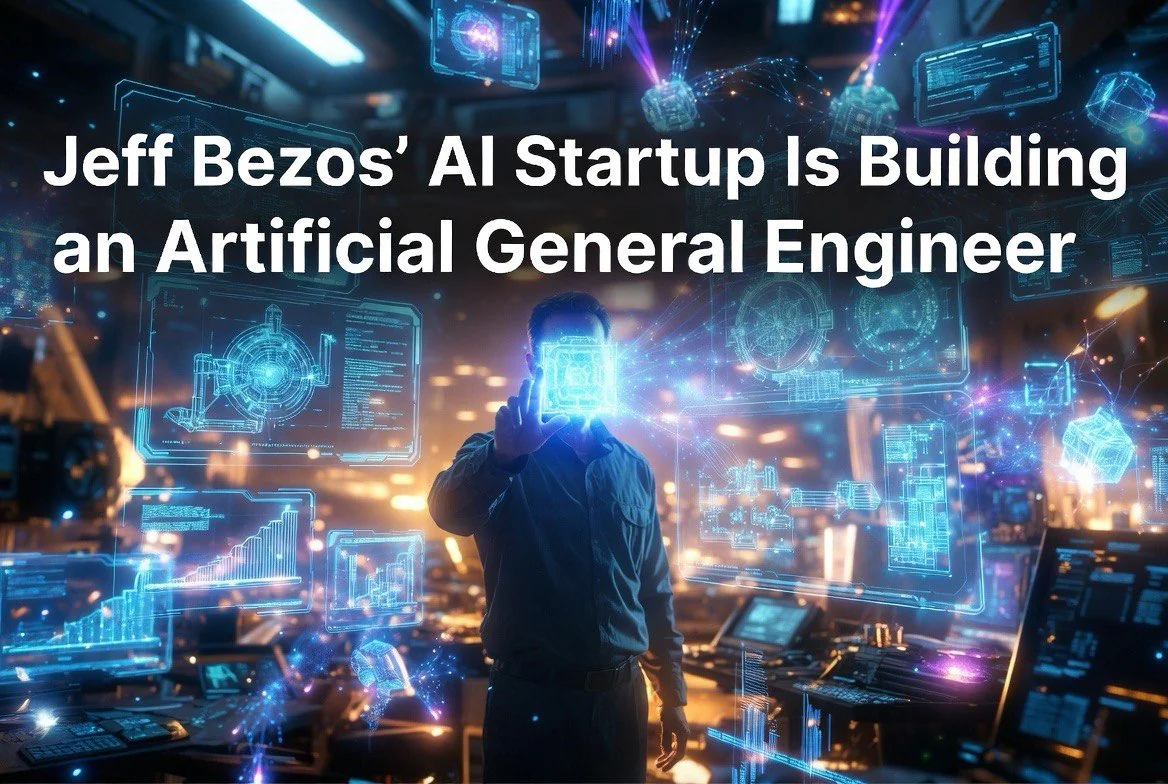
Jeff Bezos’ AI Startup Is Building an “Artificial General Engineer”
⚡ Expert Summary: In June 2026, The Verge reported that Jeff Bezos has backed a new AI startup with the goal of building an “Artificial General Engineer” — an AI system capable of performing engineering work across multiple disciplines. While tech headlines focus on AGI hype, the real story for small business owners is simpler: more competition in the AI market means better tools, lower prices, and faster innovation. This article breaks down what Bezos’s AI play means for SMBs, why AGI-for-engineering matters more than AGI-general, and how to position your business to benefit.
What Is an “Artificial General Engineer”?
The term comes from The Verge’s June 12, 2026 reporting on a new Bezos-backed startup. Unlike conventional AI tools that are narrow — they write code OR generate images OR analyze data — an Artificial General Engineer aims to combine multiple engineering capabilities into one system.
Think of it as an AI that can:
- Read a product requirement and design a technical solution
- Write the code to implement that solution
- Test and debug its own output
- Optimize for cost, performance, and scalability simultaneously
- Iterate on feedback without human hand-holding at every step
This isn’t a chatbot that answers questions. It’s an AI that does engineering work — the kind of work that small businesses currently pay agencies, freelancers, or in-house teams to handle.
Why This Matters for Small Businesses
Most AI coverage focuses on the big picture: AGI timelines, existential risk, market disruption. For a business owner running a 10-person company, that’s noise. Here’s what matters to you:
Engineering Costs Are About to Drop
The most immediate impact of an Artificial General Engineer is on the cost of technical talent. Today, hiring a competent software engineer in the US costs $120,000-200,000 per year. A full-stack developer who can build, deploy, and maintain a web application commands $150,000+. For small businesses, that’s often prohibitive — which is why most SMBs outsource their technical work to agencies at $5,000-20,000 per project.
An AI that can perform general engineering work changes that equation. Even if the AI is half as productive as a human engineer, at a fraction of the cost, it opens up technical capabilities that were previously locked behind budgets most SMBs don’t have. McKinsey’s 2026 Technology Trends report estimates that AI engineering tools could reduce custom software development costs by 40-60% for SMBs within three years. Bezos’s bet accelerates that timeline.
Smaller Teams Can Do More
One of the biggest competitive advantages large companies have is engineering headcount. A Fortune 500 company can throw 50 engineers at a problem. A 15-person SMB can throw half a person at it. AI that functions as a general engineer narrows that gap. With the right tools, a small team can build and maintain software that would have required a department five years ago.
The US Small Business Administration’s 2025 technology adoption survey found that 58% of small businesses cite technical skill gaps as their primary barrier to digital transformation. An AI capable of general engineering work directly addresses that gap — not by making SMBs hire engineers, but by making engineering accessible without hiring.
The “Artificial General Engineer” vs. AGI — A Critical Distinction
There’s a difference between Artificial General Intelligence — a system that can perform any intellectual task a human can — and an Artificial General Engineer — a system focused specifically on engineering work. The latter is narrower, more achievable, and far more immediately useful for businesses.
Bezos’s startup is reportedly targeting the engineering domain specifically. That means they’re not trying to build a god-like AI. They’re trying to build a tool that does engineering work well. For SMBs, that’s exactly the right focus. You don’t need an AI that can write poetry and compose music. You need an AI that can build your website, integrate your payment system, and automate your reporting. An engineering-focused AI delivers that.
The Difference Between AGI and an Engineering AI
Much of the public conversation around AI is muddied by imprecise terminology. Artificial General Intelligence — AGI — has become a loaded term that means different things to different people. For some, it’s a system that exceeds human intelligence across every domain. For others, it’s simply an AI that can transfer learning from one domain to another without retraining.
Bezos’s startup is reportedly not targeting AGI in the broad sense. They’re targeting engineering — a specific domain with clear metrics for success. An engineering AI doesn’t need to write novels or compose symphonies. It needs to design systems, write code, test outputs, and iterate on feedback. That’s a narrower target, which makes it more achievable and more immediately useful.
This distinction matters for SMBs because it determines time to value. A general AI that can do everything equally well is years away — estimates range from 2027 to 2035 depending on which expert you ask. An engineering-specific AI is much closer. Based on the pace of progress in AI coding tools over the last 18 months — from GitHub Copilot to Claude’s artifacts to Cursor — a dedicated engineering AI could be usable within 12-18 months.
The businesses that understand this distinction now will be the ones ready to adopt when the tools launch. The ones waiting for “AGI” will miss the window on the more practical, domain-specific tools that arrive first.
What This Means for Your Business in 2026 and 2027
Bezos’s entry into the AI engineering space is one of several signals that the market is shifting from “AI that talks” to “AI that builds.” Here’s what to expect and how to prepare:
1. Custom Software Becomes Affordable
If you’ve held off on building custom software because the quotes came back at $30,000+ — wait a bit longer. The combination of Bezos’s AI engineering effort, existing tools like Claude’s coding capabilities, and competition from Google and OpenAI is driving a race to make engineering cheaper. By late 2027, a custom CRM or inventory management system could cost what a basic Shopify theme costs today.
2. The Skills You Need Are Changing
When AI can handle the technical implementation, the valuable skill shifts from “knowing how to code” to “knowing what to build.” Business owners who can clearly define problems, specify requirements, and evaluate outputs will get more value from AI engineering tools than people who can code but can’t define a product. Start practicing that skill now. Write down exactly what you’d build if you had unlimited technical resources. That clarity will be your advantage when the tools arrive.
3. Watch for Integration, Not Standalone Solutions
The most valuable AI engineering tools won’t be standalone products. They’ll be tools that integrate with your existing stack — your CRM, your accounting software, your project management system. Bezos’s startup hasn’t announced specific integrations yet, but the pattern in enterprise AI is clear: the tools that win are the tools that fit into existing workflows, not ones that require you to rebuild everything.
4. The Timeline Is Shorter Than You Think
The most common mistake business owners make with emerging technology is underestimating how fast it arrives once it starts working. The gap between the first useful AI coding assistant (GitHub Copilot, 2021) and AI that can build functional applications from a description (Claude artifacts, Cursor, 2024) was about three years. The gap between that and an AI that can handle end-to-end engineering work is likely shorter. The pieces are already in place: code generation, debugging, testing, deployment automation. Bezos’s startup is funding the integration of those pieces into a unified system. Expect usable tools within 12-18 months, not three to five years.
The Competitive Landscape: Bezos vs. OpenAI vs. Google vs. Meta
Bezos isn’t alone in targeting AI-powered engineering. Each major player is taking a different approach:
- OpenAI — focused on general reasoning capability through increasingly capable GPT models, with code generation as one feature among many
- Google DeepMind — targeting scientific and mathematical reasoning, with engineering applications as a downstream use case
- Anthropic Claude — strong on code generation and technical documentation, with a focus on safety and reliability
- Meta — as covered in our previous article, currently dealing with internal chaos that threatens product stability
- Bezos-backed startup — explicitly targeting engineering as the primary domain, which could give it a focus advantage over general-purpose competitors
For SMBs, this competition is good news. Multiple well-funded players racing to solve the same problem means faster iteration, lower prices, and better products. The key is knowing which tool to use for which job — and that’s where practical, independent reviews become essential.
What You Should Do Right Now
Don’t wait for the perfect AI engineer to launch. Start building the habits that will let you use it effectively when it arrives:
Document your workflows. Every process in your business that involves technical work — from updating your website to generating reports to managing customer data — should be documented. When an AI engineering tool arrives, you’ll be able to say “automate this” instead of spending weeks figuring out what “this” is.
Test existing AI coding tools. Claude, ChatGPT, and GitHub Copilot can already handle significant engineering tasks. Set aside an hour this week to try building something small — a landing page, a simple data integration, a reporting dashboard. The experience of working with an AI engineer, even a primitive one, will be valuable when the advanced tools arrive.
Watch the hiring signals. When Bezos’s startup starts posting senior engineering roles with titles like “Integration Engineer” or “Partnerships Lead,” that’s a signal that a product launch is 6-12 months away. Follow their LinkedIn page and set a Google Alert for mentions. Being among the first to test an AI engineering tool gives you months of advantage over competitors who wait for the reviews.
Budget for experimentation. AI tools are not free, and the best ones won’t be cheap. But the ROI case for even a basic AI engineering tool is compelling: if it saves you the cost of one outsourced project per year — say $15,000 — the tool can cost up to $1,000/month and still be a net positive. Set aside a budget line for AI engineering tools in your 2027 planning. The businesses that budget for it will use it. The ones that don’t will be scrambling to catch up.
Watch the Bezos-backed startup’s announcements. Early adopters of new AI tools get outsized benefits. When the first engineering-focused AI product launches — whether from Bezos’s startup or a competitor — be ready to test it immediately. The businesses that move first on these tools will have a 6-12 month advantage over competitors who wait.
Frequently Asked Questions
When will Bezos’s AI engineering tool be available?
The startup is still in development as of June 2026. The Verge’s report indicates the team is actively building, but no public launch date has been announced. Most analysts expect a beta within 12-18 months.
How much will it cost?
No pricing has been announced. If the pattern holds from other AI tools, expect a tiered model — a free or low-cost basic tier and a premium tier for businesses. The competitive pressure from OpenAI and Google should keep pricing reasonable.
Will this replace my software developers?
Not entirely — but it will change what they do. The most likely outcome is that AI handles implementation while human engineers focus on architecture, strategy, and quality assurance. For SMBs that don’t have developers at all, the AI becomes a way to access engineering capability for the first time.
Is this related to the Meta AI unit story?
No — Meta’s AI unit and Bezos’s AI startup are separate. But the contrast is instructive. Meta is struggling to run a 6,500-person AI team. Bezos is building a focused engineering startup from scratch. Which approach is more likely to produce a reliable product for businesses? The difference in organizational health is worth noting.
More AI Resources for Your Business