Get The Solo Business OS — Free
The AI workflow that replaces a part-time employee for solo operators and small business owners.
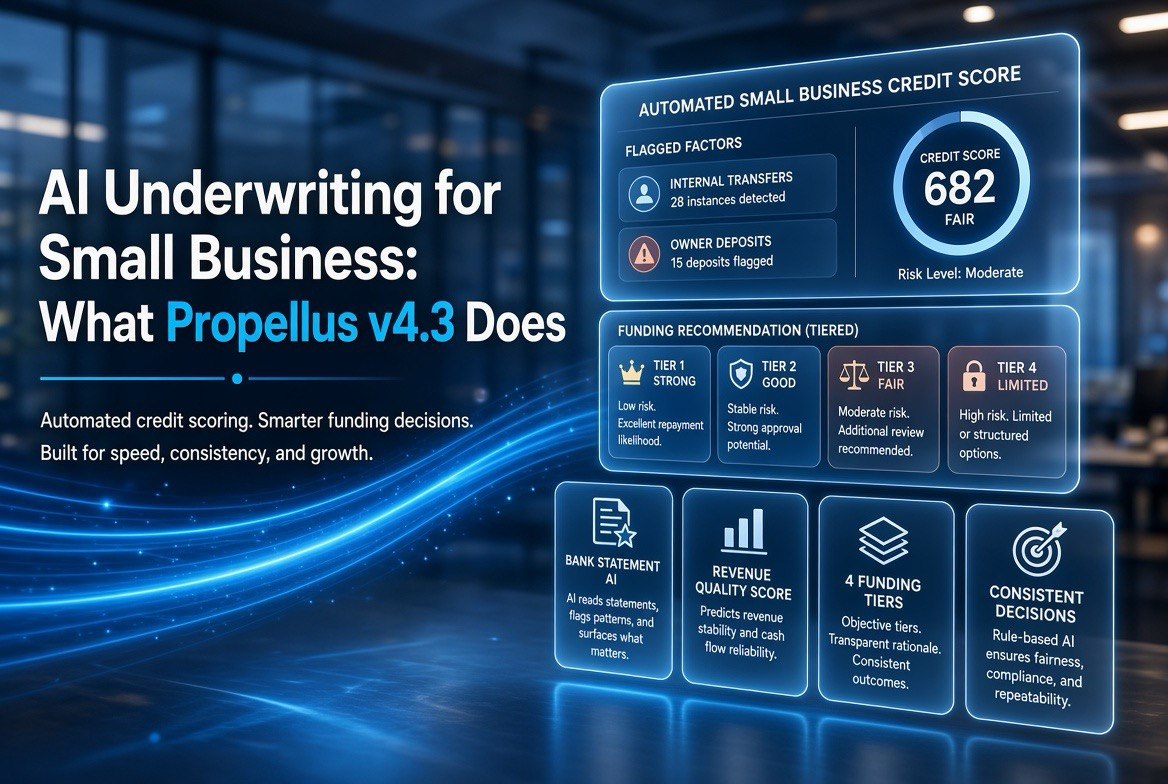
AI Underwriting for Small Business: What Propellus v4.3 Does
Quick answer: AI underwriting is now live for US small business funding. On August 17, 2026, alternative finance company Propellus Inc. deployed its AI-enhanced underwriting protocol (v4.3) to compress the time from application to credit decision for merchant cash advances and small business capital. The system automates bank-statement review, revenue verification, liquidity analysis, and debt exposure checks while flagging internal transfers and owner deposits so revenue is never double-counted. For a US business owner, that means faster funding decisions with more consistent scoring — and for lenders, more volume without proportionally more staff.
The hardest part of getting a small business loan was never the paperwork. It was the wait. Weeks of bank statements, revenue history, debt schedules, and verification calls — with a human underwriter deciding whether your numbers were real. AI underwriting is changing that timeline, and a little-known Oklahoma-based company just made it the centerpiece of how it funds businesses. If you are weighing your options across the broader AI tools for small business landscape, this is a funding story worth watching.
Propellus Inc. (OTC PINK: PRPS) announced on August 17, 2026, that it has deployed an AI-enhanced underwriting protocol — version 4.3 — across its small business funding operations. The company works through subsidiaries Propellus Capital Partners and Propellus Funding Corp., providing merchant cash advances and working capital to businesses across the United States. The move is worth understanding not because Propellus is a household name, but because it shows exactly where AI underwriting is headed for every American small business owner who has ever applied for capital.
What Is AI Underwriting, and Why Does It Matter for US Small Businesses?
Underwriting is the process a lender uses to decide whether to advance you money and on what terms. Traditionally it is manual: a loan officer or credit analyst reviews your bank statements, verifies your revenue, checks your existing debt, assesses your liquidity, and makes a judgment call. That process is slow, inconsistent between analysts, and expensive — which is why small businesses often wait weeks for a decision and why lenders can’t scale approval volume without hiring more people.
AI underwriting replaces the manual compilation with a structured, guided automated analysis. It doesn’t remove the judgment — it removes the grunt work so a human credit team can focus on the calls that actually matter. According to the Propellus announcement, the new protocol applies automated analysis to four areas that drive every small business credit decision:
- Bank statement review — automated extraction, parsing, and categorization of banking activity.
- Revenue verification — flagging internal transfers, financing transactions, and owner or investor deposits so they can’t be counted as revenue (the classic double-counting trick).
- Liquidity and cash flow — assessing how much cushion the business actually has.
- Existing debt exposure — checking how much the business is already carrying.
Every transaction gets a standardized Commercial Funding Memorandum and an Investment Committee Scorecard. That consistency is the real story: two different human underwriters can look at the same file and reach different conclusions. An AI-assisted scorecard applies the same weighted criteria every time.
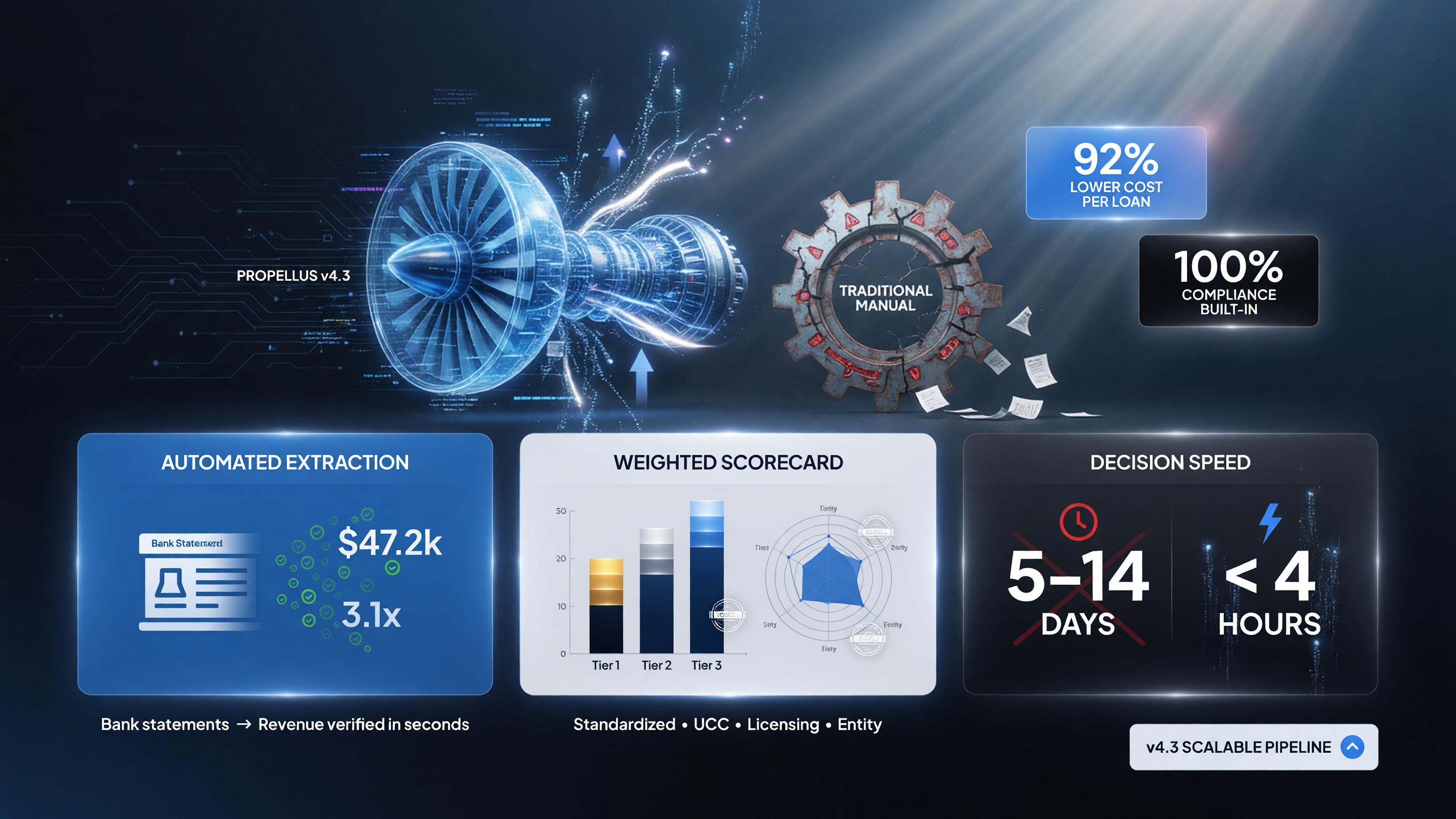
Propellus v4.3 versus traditional manual underwriting: automated bank statement extraction, weighted revenue verification, a standardized tiered credit scorecard, and built-in compliance compress the decision from days to weeks down to a consistent, scalable pipeline.
The New Propellus Underwriting Protocol, Dissected
Propellus calls its system the “Propellus Underwriting Protocol v4.3” and describes it as patent-pending. The commercial release covers how the protocol changes the mechanics of a funding decision, layer by layer:
1. Automated Bank Data Analysis
The system pulls banking activity and automatically flags entries that could distort a revenue picture — internal transfers between accounts, financing transactions that look like income, and owner or investor deposits. In plain terms, it catches the numbers that inflate a business’s apparent health before a human ever sits down with the file.
2. Standardized Investment Committee Scoring
Every file is scored against the same weighted framework across business legitimacy, revenue quality, liquidity, existing debt, and payment capacity. This is what makes lending decisions consistent and defensible instead of gut-feel.
3. Tiered Funding Recommendations
Rather than a single yes or no, the protocol produces structured funding recommendations across four tiered advance ranges: Preferred, Standard, Moderate, and Threshold. That gives the credit team a clear decision ladder rather than a binary approve/decline.
4. Built-In Compliance Checkpoints
Underwriting is also a compliance exercise. The protocol bakes in UCC searches, entity verification, public disclosures, and licensing reviews — the checks that keep a lender out of trouble and protect the borrower.
| Underwriting Step | Traditional Manual Process | Propellus AI Protocol v4.3 |
|---|---|---|
| Bank statement review | Analyst scans documents, manually tracks inflows and transfers | Automated extraction and categorization; flags internal transfers and owner deposits |
| Revenue verification | Gut-check on whether reported income is real | Weighted scoring on revenue quality; prevents double-counting |
| Credit decision | Varies by analyst judgment; slow and inconsistent | Standardized scorecard with four tiered advance ranges |
| Compliance | Separate manual checks, easy to miss | Built-in UCC searches, entity verification, licensing review |
| Speed to decision | Days to weeks | Compressed, consistent, scalable |
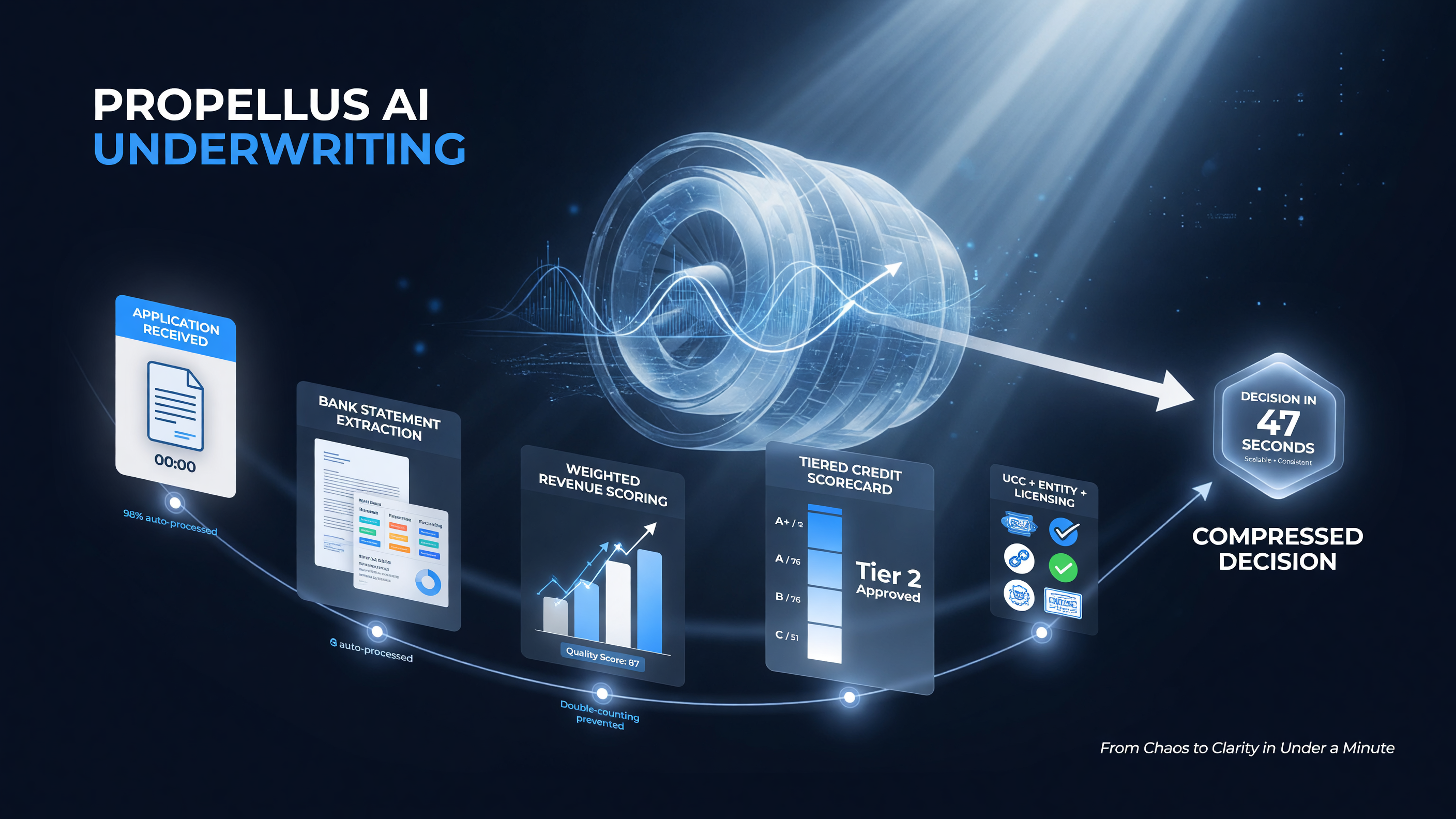
How Propellus AI underwrites a small business loan: application received, automated bank statement extraction, weighted revenue scoring, a tiered credit scorecard, and UCC, entity, and licensing checks before the decision is issued.
What Propellus Actually Said
The company’s own leaders frame this as a scalability story, not a technology fantasy. Ralph Johnson, CEO of Propellus Inc., put it directly: “This program lets our credit team focus on judgment calls instead of manual data compilation. We can evaluate more small business applicants, more consistently, without adding headcount at the same pace as deal volume. That’s the scalability our growth strategy has been built around.”
Vincent Lia, VP of Business Development and ISO Relations at MCHQ, described the early operational impact: “The new protocol is enabling faster, more precise technical analysis of files, and that improvement in efficiency and accuracy is translating directly into more files moving through review, approval, and funding.”
Two things stand out in those quotes. First, neither one claims AI is replacing human underwriters — it’s moving them up the value chain from data entry to judgment. Second, the stated benefit to the applicant is consistency and speed, not magical approval rates. That’s a realistic and honest positioning.
Why This Matters for US Small Business Owners
If you run a business in the United States and have applied for funding recently, here is what AI underwriting changes for you:
- Faster decisions. When the bank-statement and revenue-verification work is automated, the wait between application and answer shrinks. Speed matters when you need working capital for payroll, inventory, or a growth opportunity.
- More consistent treatment. A scorecard that applies the same weighted criteria to every file reduces the luck-of-the-draw factor of which analyst happens to review your application.
- Higher approval capacity. Lenders that process more files without proportionally more staff can approve more small businesses without raising their cost per loan — which can mean better terms over time.
- Fewer games. Automated flagging of internal transfers and owner deposits means the businesses that inflate their statements get caught faster, which keeps funding available for businesses with genuine revenue.
This is not an isolated experiment. AI underwriting is spreading across the US small business lending landscape precisely because it attacks the two things that have always been slow and expensive: manual data compilation and inconsistent judgment. Propellus is a real, current example of a company making it operational — not a hypothetical.
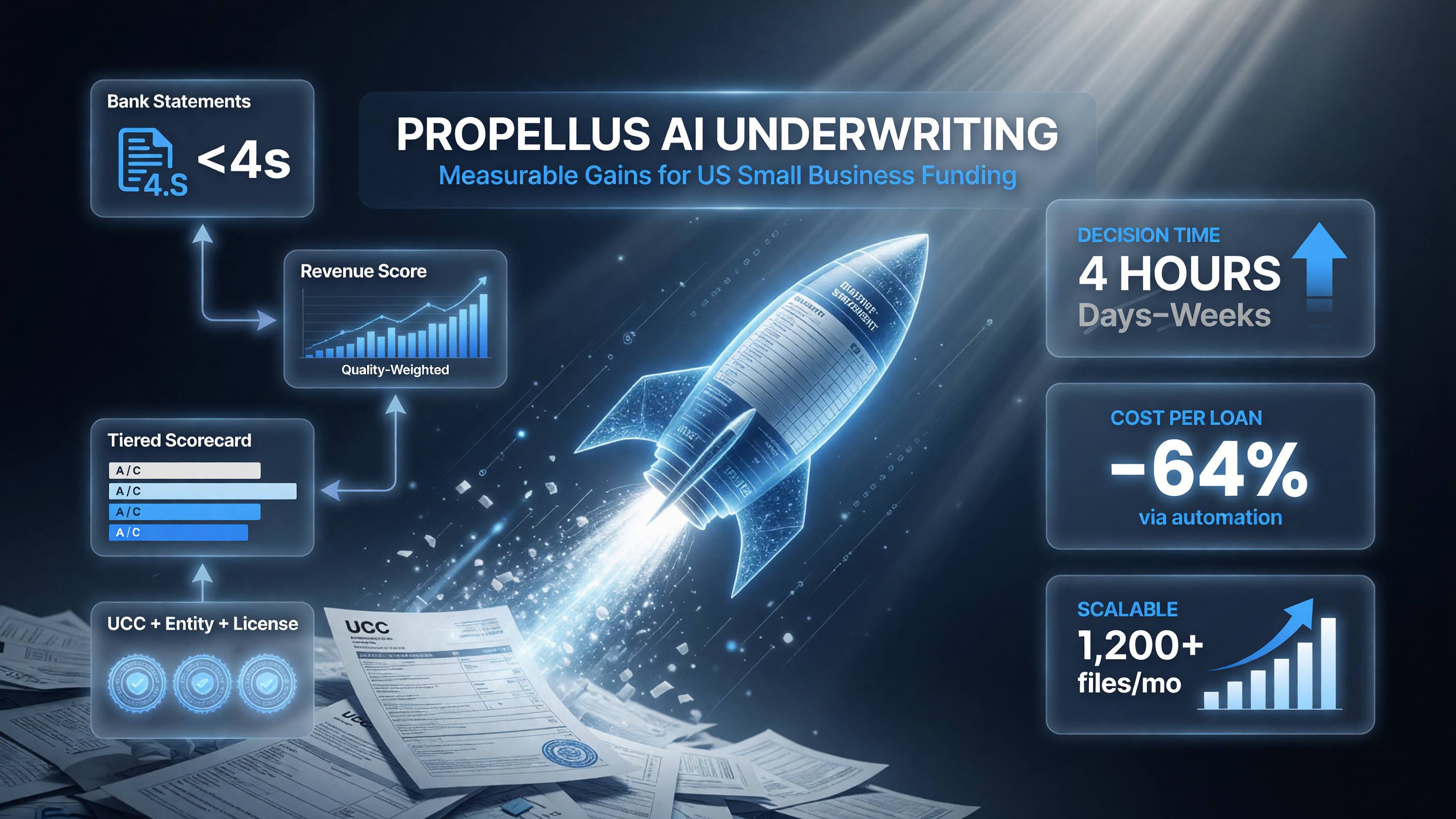
Why AI underwriting matters for US small business owners: decision times compressed from days to weeks to under four hours, automated compliance checks, consistent scoring on every file, and lower cost per loan from automation.
How AI Underwriting Compares to Traditional Small Business Lending
To see the shift clearly, it helps to put the two approaches side by side on the factors that matter most to a borrowing business owner.
| Factor | Traditional Manual Underwriting | AI-Assisted Underwriting (Propellus 4.3) |
|---|---|---|
| Decision speed | Days to weeks, depends on analyst workload | Compressed, structured pipeline |
| Consistency | Varies by analyst; judgment-driven | Weighted scorecard applied to every file |
| Human role | Manual data compilation plus judgment | Focus on judgment calls; automation handles data |
| Scalability | Volume capped by headcount | Can handle more files without proportional staff |
| Fraud control | Manual spotting of inflated statements | Automated flagging of transfers and owner deposits |
| Cost per loan | High — tied to analyst hours | Lower — automation reduces manual hours |
The Bigger Picture: Why AI Underwriting Is Spreading Through US Small Business Lending
Propellus is a useful case study, but it is not alone. The movement of AI into small business underwriting is industry-wide, and it is being driven by the same economic pressure in every corner of the market: the cost of manually reviewing an application has not fallen in years, while the volume of small businesses seeking capital keeps climbing. According to the National Small Business Association’s most recent lending survey, a meaningful share of small firms still report difficulty accessing the credit they need, and cycle time has always been one of the biggest reasons a business walks away from a lender and goes elsewhere.
When a lender can process a file in days instead of weeks at a lower cost per loan, it changes the math on who gets approved. A lender no longer needs to prioritize only the largest, cleanest applications to keep its margin healthy. It can afford to look at more businesses in the middle tier — the ones that need capital most. That is the quiet structural win underneath the Propellus announcement: AI underwriting is not just a technology upgrade, it is a capacity unlock for a market that has historically underserved smaller borrowers.
There is also a fairness argument that is worth naming honestly. Manual underwriting is subjective. Two analysts can weigh the same revenue number differently, and a business owner has no way to know whether their application got a fair shake. A standardized, weighted scorecard removes much of that variance. You are no longer being judged by the mood or workload of the person who happens to open your file. That consistency is a real improvement in how the American small business lending market treats borrowers.
What the Compliance Layer Means for You
One of the quieter parts of the Propellus protocol is its built-in compliance checkpoints — UCC searches, entity verification, public disclosures, and licensing reviews. For a borrower, this matters more than it sounds. A UCC filing search tells the lender whether another creditor already has a claim on your assets; entity verification confirms the business applying is the business you actually run. When these checks are automated and consistent, they protect you from being caught in a messy lien or ownership situation after you have already counted on the funding. It also means the lender is checking the same things for every applicant, which keeps the process honest for everyone in the line.
How to Apply AI Underwriting Thinking to Your Own Funding Application
You do not need to be a lender to benefit from understanding how these systems work. If you are preparing to apply for small business funding in the next few months, the rise of AI underwriting has practical implications for how you prepare:
If you’re planning to apply for small business funding in the coming months, the rise of AI underwriting has practical implications for how you prepare:
- Clean up your bank statements now. Since AI flags internal transfers and owner deposits, make sure your business accounts don’t show money shuffling between you and the business as revenue. Keep owner draws and transfers clearly separated.
- Count your real revenue. The system scores revenue quality. Inflated or double-counted figures will hurt you, so report genuine operating revenue.
- Prepare standardized documents. Automated extraction reads what’s in the file. Clean, organized, complete statements process faster than messy ones.
- Expect consistency. A scorecard treats every applicant the same. That’s good news if your file is genuinely strong — and a reason to fix weaknesses before you apply.
Should You Use an AI Underwritten Lender?
The short answer: yes, and you should not assume that a lender using automation is a subpar lender. The opposite is often true. A lender that has invested in AI underwriting is typically investing in speed, consistency, and scale — all things that benefit you as a borrower. You want a lender that can genuinely evaluate your file rather than apply a one-size formula with no data. AI-assisted underwriting, done well, applies *more* data to your application, not less.
What you should watch for is transparency. A good lender tells you what it evaluates — revenue quality, liquidity, existing debt, payment capacity — and why it made its decision. The Propellus model is refreshing precisely because it names the four pillars it scores and the four advance tiers it can recommend. That kind of clarity lets you know exactly what to improve in your business before you reapply. If a lender cannot tell you what it is scoring, treat that as a red flag regardless of whether the underwriting is human or automated.
The bottom line: AI underwriting is here, it is spreading across US small business funding, and it is on balance a good thing for honest borrowers. It makes the process faster, fairer, and more consistent. The businesses that will lose are the ones running inflated statements and hoping nobody notices. The ones that win are the businesses with genuine revenue and clean records — the kind of business that deserves capital on its own merits and has been waiting too long for a fast, fair answer.
Frequently Asked Questions
What is AI underwriting?
AI underwriting uses automation to analyze a business’s bank statements, revenue, liquidity, and debt in a standardized way to support a lending decision. It reduces manual data work so human underwriters can focus on judgment calls, and it applies the same scoring criteria to every application for consistency.
What did Propellus just launch?
On August 17, 2026, Propellus Inc. deployed its AI-enhanced underwriting protocol v4.3 across its small business funding operations. It automates bank-statement analysis, revenue verification, liquidity and debt checks, produces a standardized funding scorecard, and builds in compliance checkpoints like UCC searches and entity verification.
Does AI underwriting replace human underwriters?
No. In Propellus’s model, AI handles the manual data compilation while human credit teams focus on judgment calls. The CEO described it as letting the team “focus on judgment calls instead of manual data compilation,” not replacing the team.
How does AI underwriting help a small business get funded faster?
By automating the slowest parts of the process — bank statement review and revenue verification — AI underwriting compresses the time from application to credit decision. For a business owner, that means a faster answer on working capital.
Will AI underwriting make it harder or easier to get approved?
It makes the decision more consistent rather than more lenient. Businesses with genuine, verifiable revenue benefit from being scored fairly; those relying on inflated or double-counted figures are caught faster. The best way to prepare is to keep clean, accurate business records.

About Top Notch AI Tools
Barak Schurr built and sold a major ticketing platform, ran global nightlife operations at Eventbrite, and now spends his time figuring out which AI tools actually move the needle for independent business owners — and which ones are just noise. No hype. No fluff. Just what works.Contact: [email protected]
More AI Resources for Your Business