Get The Solo Business OS — Free
The AI workflow that replaces a part-time employee for solo operators and small business owners.
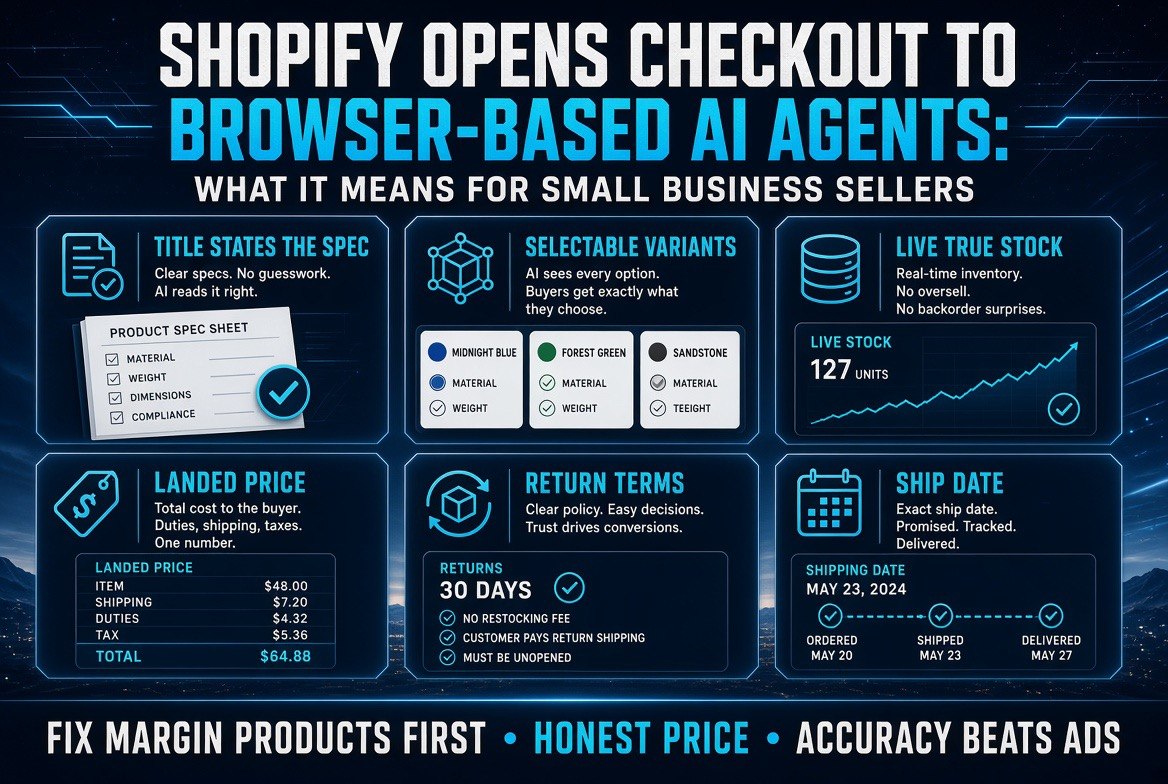
Shopify Opens Checkout to Browser-Based AI Agents: What It Means for Small Business Sellers
⚡ Expert Summary: Shopify now lets browser-based AI agents complete checkout on behalf of a buyer. That means a shopper can tell an assistant what they need and never open your product page. For US small businesses this is the third time the buying interface has moved — desktop, mobile, now an agent — and the first two times the sellers who re-platformed early took the market. The work is unglamorous: clean product data, real stock numbers, honest shipping terms, and prices an agent can compare without you in the room.
A US small business wakes up to an order it cannot explain. The customer never visited the site, never added anything to a cart, never entered a card. A person typed one sentence into an assistant — “order the replacement filter for the model in my email history” — and an agent found the store, checked the stock, confirmed the price, and paid. The merchant’s only role was having data clean enough to be believed.
That is what Shopify’s move means. Checkout is now something software does on a buyer’s behalf, and the seller who cannot be read by software does not get the sale. Not because they lost a comparison — because they were never in it.
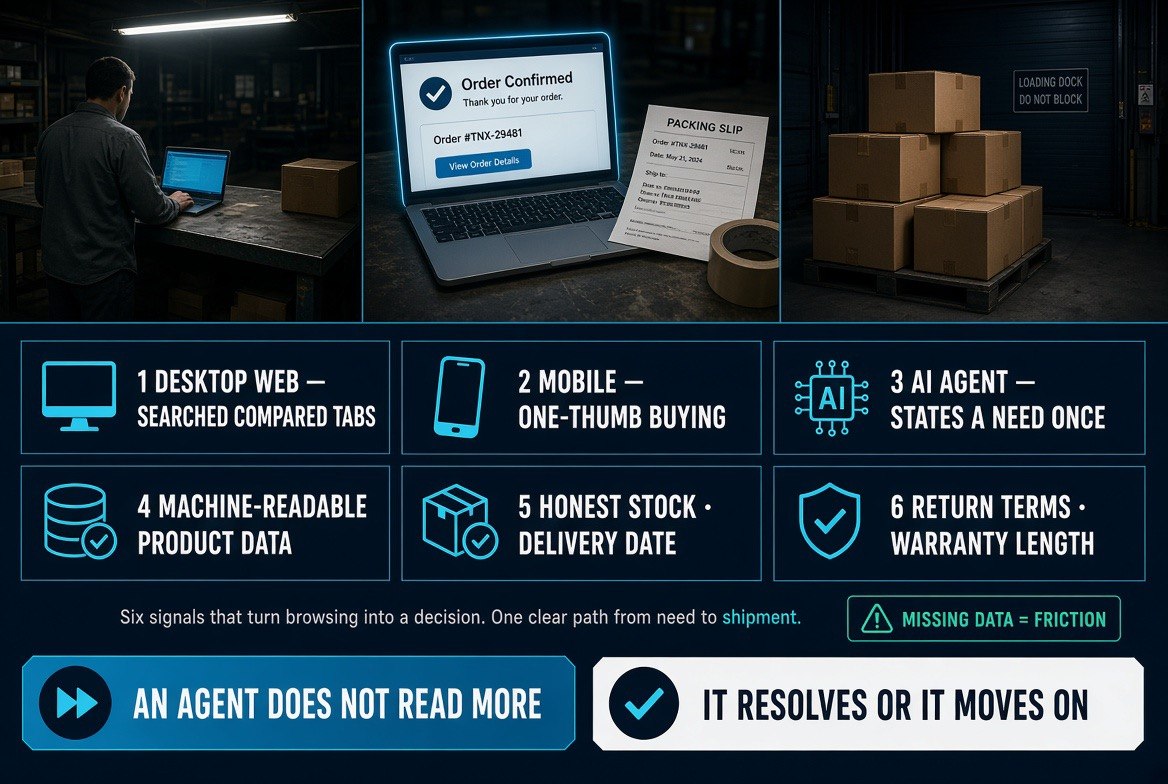
Three buying interfaces, one repeating pattern: each shift rewarded sellers whose product data answered the question without a human.
What Actually Changed
Shopify extended its checkout so that browser-based AI agents can complete a purchase end to end. The important word is browser-based. This is not a chatbot bolted onto a storefront and it is not a plugin you install. The agent operates a browser the way a person would — reading a page, selecting an option, filling a form, confirming a payment — which means it works against the standard storefront, not a special integration built for it.
For a small business the practical consequence is uncomfortable: an agent does not see your brand story, your photography, or the paragraph where you explain that your product is worth the extra eight dollars. It sees structured facts. Name, variant, price, availability, delivery estimate, return terms. Whatever it can read, it can act on. Whatever it cannot read does not exist.
For an independent operator competing against larger catalogs, that is both a threat and the cleanest opportunity in years. The advantage of a big retailer has always been breadth. In an agent-mediated purchase, breadth matters less than accuracy — the agent is not browsing, it is resolving a specific need, and it will take the source that answers cleanly.
Three Buying Interfaces, One Pattern
| Shift | What the Buyer Did | What Sellers Had to Fix | Who Won |
|---|---|---|---|
| Desktop web | Searched, compared tabs, read reviews | A findable site and a working cart | Sellers with decent SEO and a real catalog |
| Mobile | One-thumb buying, impulse, app notifications | Checkout that survives a small screen | Sellers who fixed friction, not sellers with the best product |
| AI agent | States a need once, agent resolves and pays | Machine-readable product data and honest stock | Sellers whose data answers the question without a human |
The pattern repeats. Each transition punished sellers who treated the new interface as a marketing problem instead of a data problem. Mobile did not reward the best brand; it rewarded the shortest path from desire to payment. Agent checkout is the same test with the volume turned up, because the agent has no patience and no loyalty.
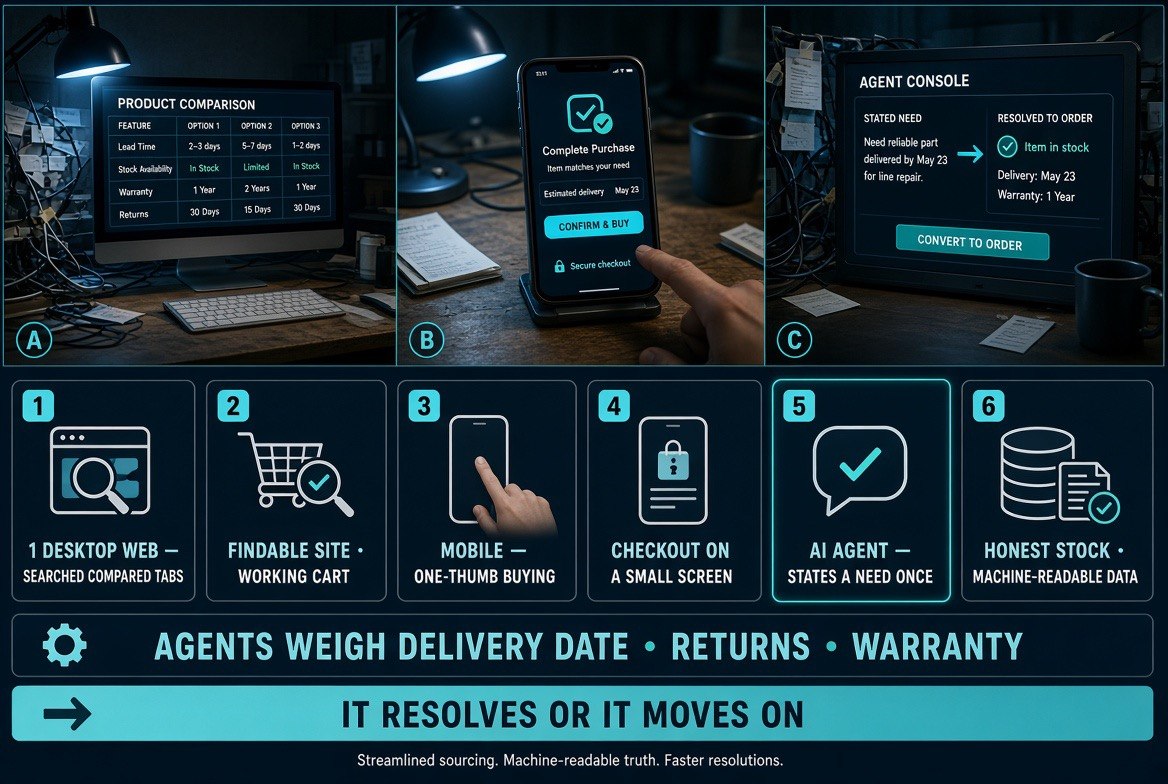
Three screens, one pattern: each shift moved the advantage to sellers whose data answered the question without a human. Agents weigh delivery date, returns and warranty.
Where Small Sellers Have a Real Edge
Agent commerce favours specificity. An agent given a vague need — “a good office chair” — will resolve against the broadest, most confidently documented catalog it can find. An agent given a precise need — “a chair for a 6’4″ user with a 300 lb capacity and a 10-year warranty” — is looking for a match, and a specialist who stocks exactly that beats a general retailer every time.
That is the whole opportunity. Your catalog does not need to be large. It needs to be unambiguous. A small business that sells four types of industrial sealant can win agent traffic that a home-improvement giant loses, because the giant’s page talks about a category and the specialist’s page answers a specification.
The second edge is trust. Agents increasingly weigh return policy, warranty length, and delivery certainty when a buyer has not specified a preference. Those are the things a real operator can actually improve this quarter — unlike ad budget, which is a bidding war against larger pockets.
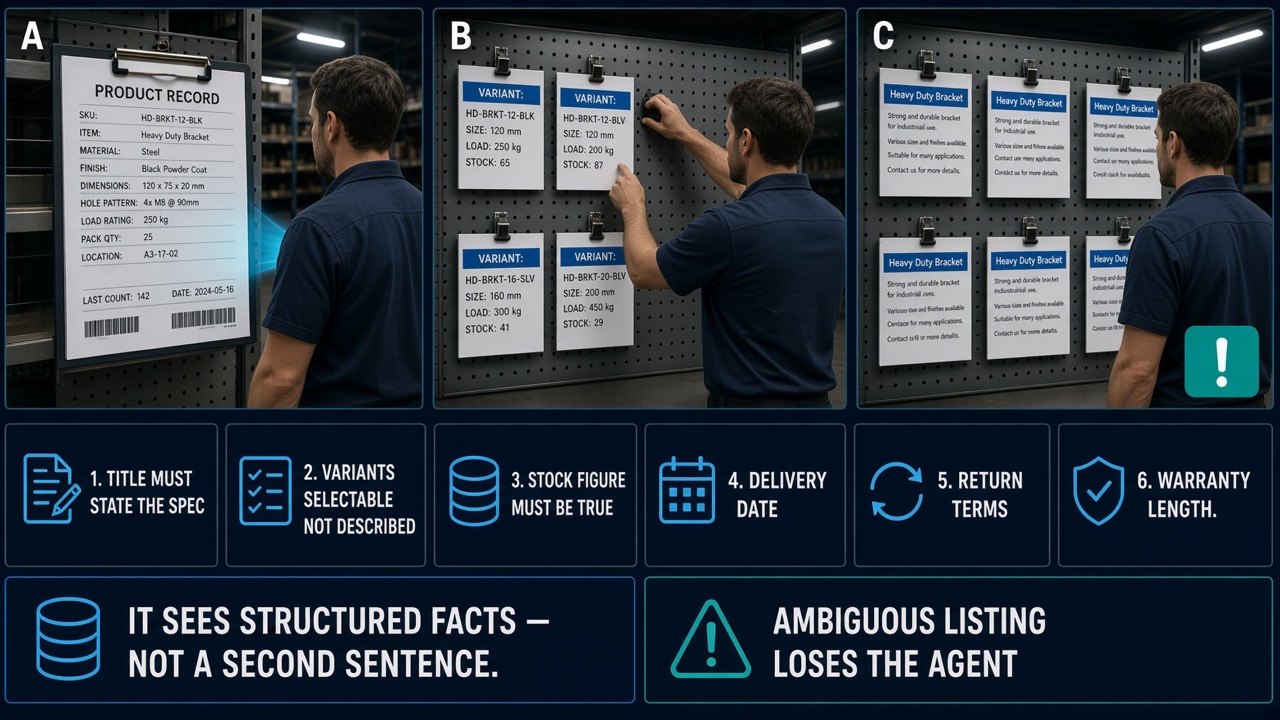
What the agent actually reads: six fields stated outright, against the ambiguous listing that never gets a second sentence.
What an Agent Needs From You, and What Most Catalogs Fail
| Signal | Agent-Ready | Common Failure |
|---|---|---|
| Product title | Model, capacity, size stated in the title | “Premium Bundle” with the spec buried three paragraphs down |
| Variants | Every size and colour as its own selectable option | Variants described only inside an image or a PDF |
| Stock | Live quantity that matches the shelf | “In stock” that is really backorder, discovered at shipping |
| Pricing | Total landed cost including shipping and tax | A low headline price with costs revealed at the last step |
| Returns | Window, conditions and who pays the label | “See our policy” as a link an agent may not follow |
| Shipping | Date, carrier and cut-off stated plainly | “Fast shipping” with no number attached |
None of these require new software. They require an afternoon with your product list and the discipline to stop writing marketing copy in fields that a machine reads as fact. The merchant who does this in September is being read correctly by October, while competitors argue about whether it matters.
The Part That Should Worry You
Agent checkout removes the last natural place where a seller could recover a confused buyer. On a website, a person who is unsure reads a little more, and a well-written page can close them. An agent does not read more. It resolves, or it moves to the next source. If your listing is ambiguous, you do not get a second sentence to fix it.
The second worry is price transparency. An agent comparing three sellers is doing what a spreadsheet does, without the politeness. Sellers who have been maintaining a fictional list price for years to support discount marketing are about to be compared on the number that actually matters: what a buyer pays today, delivered. That change is painful and it is also a correction. A business that runs on a real margin instead of a manufactured discount is better positioned than it has been in a decade.
And the honest limit: agent-mediated purchases are still a small share of total volume. Shopify enabling the capability does not mean buyers arrive in force next quarter. What it means is the interface is now open, and the sellers who prepare before the volume shows up are the ones who capture it when it does. That pattern has held through every previous transition, and there is no reason this one breaks it.
What to Do This Month
Start with the products that carry your margin, not your whole catalog. For each one, confirm that the title states the specification, the variants are selectable rather than described, and the stock figure is true. Then fix the three fields agents weigh most when a buyer is undecided: delivery date, return terms, and warranty length. Those are the tiebreakers.
Next, make your prices honest. If a discount is permanent, the permanent price is the price. Agents and comparison tools converge on the real number anyway, and the merchant who is not hiding anything is the one who looks trustworthy in a machine summary.
Finally, treat this as the same lesson as getting more output from the AI tools you already pay for — the value comes from using what you have properly, not from buying more. Your catalog is already the raw material. Agent-ready data is just the version of it that software can act on.
For the broader context on how agents are entering business operations, the pattern of AI agents taking over setup work inside SMB tools is the same one arriving at checkout. The interface moves, the sellers who adapt keep selling, and the ones who wait for certainty pay for it in volume.
Why the Agent Does Not Care About Your Brand
There is a version of this story that vendors are already telling, and it goes like this: agents will shop for your customers, so you need to be visible to agents. True, and useless without the next sentence. An agent does not have preferences. It has a task, a budget, and a set of constraints the buyer gave it. It resolves those constraints against whatever data it can verify, and it stops when it finds a match.
That inverts a decade of marketing advice built on the assumption that a human would be persuaded. Persuasion requires attention, and agent-mediated purchase is the one channel where attention never lands on you. What lands is your data — and if the data is wrong, no amount of positioning recovers the sale, because the agent never formed an impression to change.
The practical translation for a small business is that the marketing budget matters less than the accuracy budget. Ten hours spent making your product data clean and consistent will outperform a month of retargeting ads aimed at people who are about to hand the decision to software anyway. That is not a comfortable sentence for anyone who has spent years learning the craft of persuasion. It is also the most reliable arbitrage available to a small operator right now, because big competitors have more inertia in their data than they have budget in their ads.
The Two Businesses in This Story
Go back to that unexplained order. The merchant who understood it spent the following weeks auditing their catalog — every title, every variant, every stock figure — and fixing the ones that described a feeling instead of a product. The merchant who did not understand it assumed a glitch, contacted support, and moved on.
A quarter later, one of them is appearing in agent comparisons and the other never knew there was a comparison. Nothing about their products changed. One of them became legible.
Frequently Asked Questions

About Barak Schurr
Barak Schurr built and sold a major ticketing platform, ran global nightlife operations at Eventbrite, and now spends his time figuring out which AI tools actually move the needle for independent business owners — and which ones are just noise. No hype. No fluff. Just what works.
Email: [email protected]
More AI Resources for Your Business