Get The Solo Business OS — Free
The AI workflow that replaces a part-time employee for solo operators and small business owners.
Wix Symphony: The Multi-Agent AI Workforce for Your Small Business
⚡ Expert Summary: Wix Symphony is a no-code multi-agent AI platform built into the Wix website builder. Its orchestrator agent, Maestro, coordinates specialized sub-agents across website, marketing, and admin workflows so a small US business can run tasks that used to need a whole team. It launched in late 2026 as one of the first mainstream AI-orchestrator stacks aimed squarely at non-technical owners.

As SMB AI adoption climbs steadily through 2026, agentic delegation — owners handing whole jobs to AI agents rather than asking for answers — accelerates faster, which is why Wix built its multi-agent Symphony platform for non-technical US owners.
Your competitor just shipped a new landing page, launched an email sequence, and updated their Google Business Profile — all before you finished your coffee. You didn’t see it happen. You saw the result: more traffic, more calls, more clients.
You’re not losing to a bigger team. You’re losing to an owner who gave their website a workforce it doesn’t pay salaries to.
That workforce is a multi-agent AI system. And in late 2026, it stopped being something only enterprises could afford.
What Is Wix Symphony?
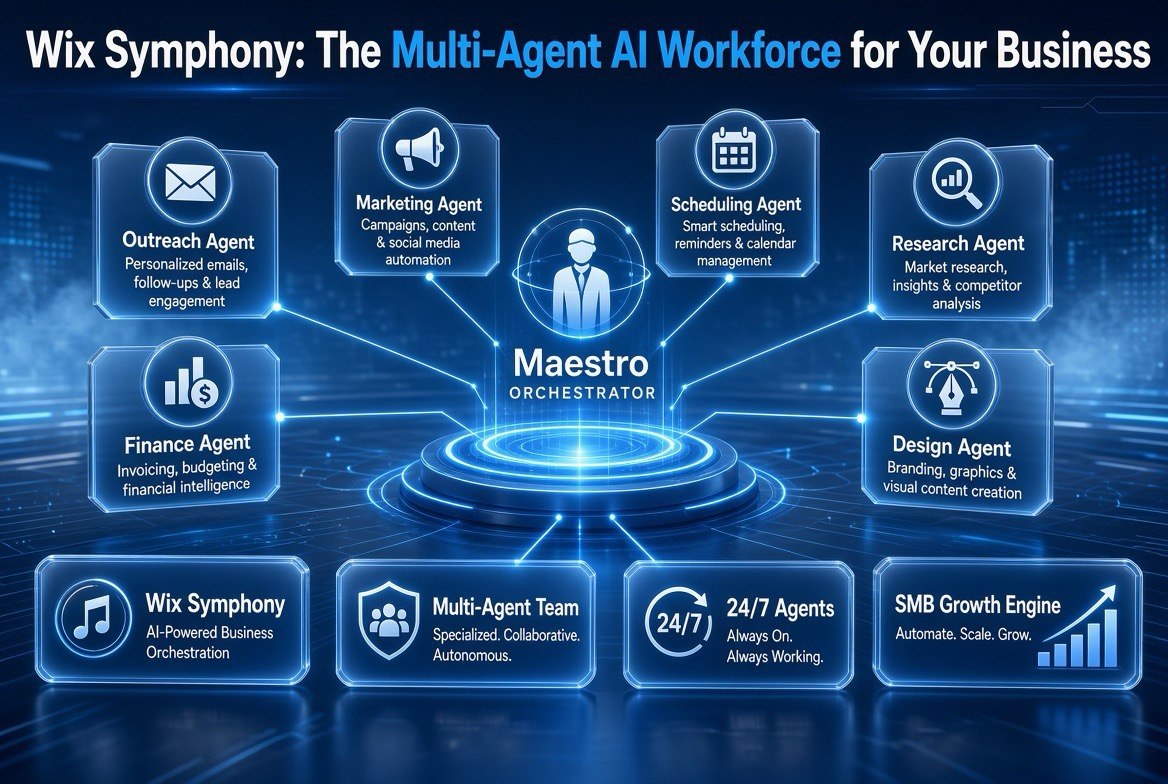
Wix Symphony is a multi-agent AI platform baked directly into the Wix website builder. It’s built around one central organizing agent — called Maestro — that breaks a job into steps, hands each piece to a specialized sub-agent, and reports back when the whole task is done.
Think of it like the difference between asking one employee to do everything versus running a team where each person has one job. A site-maintenance sub-agent keeps pages updated. A marketing agent drafts and schedules campaigns. An analytics agent tracks what’s working. Maestro is the manager who makes them cooperate.
For a US small business owner, the appeal is blunt: you don’t hire a marketing manager, a webmaster, and a data analyst to run a website that generates $50,000 a year. You let Symphony run the busywork and you keep the decisions.
| Capability | What Maestro Orchestrates | What It Replaces |
|---|---|---|
| Website upkeep | Content updates, page refreshes, on-page SEO fixes | A webmaster or $150/hour freelancer |
| Marketing execution | Email campaigns, social posts, ad copy drafts | A marketing coordinator |
| Reporting | Scheduled performance summaries and alerts | A data analyst retainer |
That table is the whole pitch in one screen: Wix is selling business owners the capacity of a small team, without the payroll. The question is whether it actually delivers — and where it falls short.
Why Multi-Agent Matters Right Now
For most of the last two years, “AI for small business” meant a chatbot you asked questions. You typed, it answered, you did the work with your own hands. That’s a calculator with better manners — it augments you, it doesn’t execute for you.
The shift in 2026 is toward agentic AI: tools that don’t just answer but do. Research shows a majority of US small businesses already lean on AI regularly — reports in 2026 put regular AI usage among US SMBs around 77% (Intuit). The next wave isn’t adoption, it’s delegation. Owners are moving past “what can AI tell me” to “what can AI finish for me.”
Multi-agent systems are that delegation, organized. Instead of one AI doing everything sequentially, you get a coordinator that parallelizes work: the marketing agent drafts while the analytics agent verifies while the website agent updates. That parallelism is what makes Symphony feel like a team instead of a tool.
Wix’s timing is smart. Agency orchestration tools already exist — platforms like Zapier Agents and Omni by xpander let power users chain AI workflows. But those demand comfort with automation concepts. Wix is betting the majority of US owners who don’t code and don’t want to learn will pay to have the orchestration handled for them.
How Maestro Works: A Walkthrough
You don’t need to understand agents to use Symphony, but knowing the structure helps you direct it. Here’s the flow in plain terms:
- State the goal. You type what you want, in normal language: “run a promotion for my new menu item across email and my homepage.”
- Maestro plans. The orchestrator breaks that into subtasks — write the email, update the homepage, schedule the send, check the copy against my brand voice.
- Sub-agents execute. Each subtask is handed to a specialized agent. They run in parallel where possible.
- Maestro reviews and reports. The orchestrator checks the outputs, assembles the result, and tells you what’s done and what needs your sign-off.

Maestro runs the whole job as a four-step loop — take the task, break it into subtasks, hand each piece to a specialized sub-agent that executes in parallel, then assemble and review the result — so a non-technical owner directs work instead of doing it step by step.
The key detail most people miss: the orchestrator doesn’t fire agents and forget them. It checks each subtask’s output for quality before assembling the result, and it holds back anything that needs a real decision. That review loop is what separates a genuine multi-agent system from a glorified script that chains a few steps together and calls itself intelligent.
| Old Way (Manual) | Wix Symphony Way |
|---|---|
| Draft an email, edit it, schedule it | Ask Maestro to run the campaign; it drafts, matches brand, schedules |
| Log into the site to update a page | Sub-agent updates the page; Maestro confirms the change |
| Wait for a freelancer to respond | Agents work in parallel and finish in minutes, not days |
The system is built on the Wix infrastructure you may already use, so there’s no separate login or new platform to learn. If your business already lives in Wix — website, email campaigns, bookings — Symphony slots into the stack you have.
Wix Symphony vs. Standalone Agent Builders
Symphony isn’t the only multi-agent game in town. The difference is who it’s for. Here’s how it stacks up against the alternatives a US owner might consider.
| Factor | Wix Symphony | Zapier Agents | Omni by xpander |
|---|---|---|---|
| Who it’s for | Non-technical Wix users | Power users who automate | Operators managing many agents |
| Learning curve | Low — natural-language goals | Moderate — workflows and triggers | Moderate — agent building |
| Built-in website | Yes — native Wix site | No — connects to many apps | No — workspace for agents |
| Best for | One-person and small teams on Wix | Cross-app automation | Running many named agents |
If you’re already deep in Zapier or managing a fleet of named agents with Omni, Symphony won’t replace that — it overlaps a piece of it. But if your website, email, and bookings are all in Wix, Symphony is the shortest path from “I should automate this” to “it’s done.” You can read more about building AI workflows without code in our breakdown of Zapier Agents, and about managing a fleet of dedicated agents in our review of Omni by xpander.
What Wix Symphony Will Actually Do For You
Concrete use cases, not vibes. These are the workflows where a US small business owner gets measurable return:
1. Marketing that runs itself
Promotions are where most owners waste the most time. Symphony’s marketing agents can draft an email for a new product, match it to your brand voice, schedule it, and post corresponding social content — then hand you a summary of what went out and when. The result isn’t just finished work; it’s finished work that happened on schedule.
2. A website that stays current
Outdated hours, stale menu, missing info — these lose real revenue. A site-maintenance sub-agent keeps listings and pages current, and Maestro flags anything that needs a human decision, like a price change you haven’t approved. Offloading that upkeep frees hours every month.
3. Reporting without a retainer
Instead of paying someone to pull reports you barely read, an analytics agent can produce scheduled summaries: what’s converting, what pages are dead weight, where traffic came from. You get the signal without the invoice.

Symphony delivers a scheduled reporting dashboard on autopilot — traffic line, conversion metric, and visitor and signup callouts — so a small owner sees the numbers without pulling a report by hand each week.
A Decision Framework You Can Use Today
Agents are not one-size-fits-all, and buying every new one is how you end up paying for six subscriptions that each do a tenth of a job. Here’s the three-question filter I use before adding any AI tool — including Symphony — to a stack:
1. Does it execute, or just answer? A tool that hands you a finished draft, an updated page, or a scheduled send removes work. A tool that hands you advice leaves the work on your plate. If the output requires you to do the task yourself, it’s a calculator, not an agent.
2. Is the process repeatable? Multi-agent automation only pays off when the same workflow runs again and again. A one-off task isn’t worth the setup. A weekly promotion, a monthly report, a recurring content refresh — that’s where delegation compounds. If you do it once a quarter, do it by hand.
3. Can you review the output before it matters? The strongest AI systems still need a human checkpoint before anything expensive or public ships. Make sure the tool hands you a reviewable result before it auto-publishes to customers or your site. That one habit prevents 90% of the disasters people blame on AI.
Run those three questions against Symphony, and the answer becomes obvious. For a Wix-based US small business with repeatable marketing and upkeep tasks, it clears the bar easily. For a one-off project, skip it and get back to work.
Pricing and Getting Started
Wix has been rolling Symphony into its existing business plans rather than selling it as a costly standalone add-on, which is part of why the launch grabbed attention. For most existing Wix users, the tool appears inside their current dashboard and can be turned on without a separate setup process.
If you’re not already on Wix, the honest move is to price out the business tier that includes Symphony against the cost of the manual hours it replaces. A single freelancer retainer you no longer need can quickly pay for the whole stack. The math changes from “is this feature worth it” to “how many hours does this buy back every week” — and that’s the only framing that matters for a small operation.
Start narrow. Pick one repeatable workflow — a weekly campaign, a content refresh, a standing report — and let Maestro run it for a couple of weeks. Measure the hours saved and the output quality before you expand. Delegation is a muscle, and it gets stronger with use.
Where Wix Symphony Falls Short
Honesty costs nothing, so here’s the other side. Symphony is not a silver bullet, and I’d be doing you a disservice to pretend otherwise.
It’s built for Wix’s world. If your business isn’t on Wix, most of the value evaporates. This is a feature of the platform, not a standalone product you bolt onto any stack.
Agents still need supervision. These are capable, not infallible. Marketing copy will occasionally miss your brand’s tone, and a generated campaign needs a human eye before it goes live. Maestro hands you decisions — you still have to make them.
Creative judgment stays human. The big-picture calls — positioning, offer design, where to spend attention — are yours. Symphony executes; it doesn’t set your strategy.
Should You Use Wix Symphony?
If you run a US small business on Wix and spend more than a few hours a week on website, marketing, or admin busywork, the math is straightforward. This is a cheap way to get recurring tasks handled by a system instead of your own unpaid overtime.
If you’re not on Wix, or you already have a mature automation setup in Zapier or a multi-agent workspace, you’re probably better served where you are.
And if you’re still treating AI as a chatbot that answers questions — that’s exactly the mindset Symphony is built to retire. The owners pulling ahead in 2026 aren’t the ones asking better questions. They’re the ones delegating the work. The full library of AI tools for US business owners — including more agentic and automation guides — lives on our AI tools hub, where you can keep up as this space moves.
Frequently Asked Questions
What is Wix Symphony?
Wix Symphony is a multi-agent AI platform built into Wix. Its orchestrator agent, Maestro, coordinates specialized sub-agents to complete website, marketing, and admin workflows from natural-language requests, so the business owner directs work instead of doing it step by step.
What is Maestro in Wix Symphony?
Maestro is the central orchestrator agent. It plans a task, breaks it into subtasks, assigns each to a specialized sub-agent, and assembles the final result with its own review.
Does Wix Symphony replace Zapier Agents or Omni?
Not exactly. Symphony is built for non-technical Wix users to automate work inside the Wix stack. Zapier Agents and Omni by xpander are standalone automation and agent-management tools better suited to power users. For a Wix-based business, Symphony is the shortest path to automation; for cross-app or multi-agent management, the others win.
Is Wix Symphony good for a one-person business?
Yes — it’s aimed squarely at small and solo teams. It handles the recurring website, marketing, and reporting busywork that a larger company would staff, which is exactly where small operators lose the most time.
Do small businesses need multi-agent AI?
Not every business, but the ones that automate recurring work free up hours weekly and often respond to opportunities faster than competitors doing it manually. Multi-agent AI matters most when you have repeatable processes with several steps.

About Barak Schurr
Barak Schurr is the founder and former president of the nightlife ticketing platform Wantickets and former Global Director of Dance and Nightlife at Eventbrite. He currently focuses on AI research and writes about practical AI for independent business owners that actually moves the needle — no hype, no corporate fluff. More at topnotchaitools.com.
Contact him at [email protected]
More AI Resources for Your Business