Get The Solo Business OS — Free
The AI workflow that replaces a part-time employee for solo operators and small business owners.
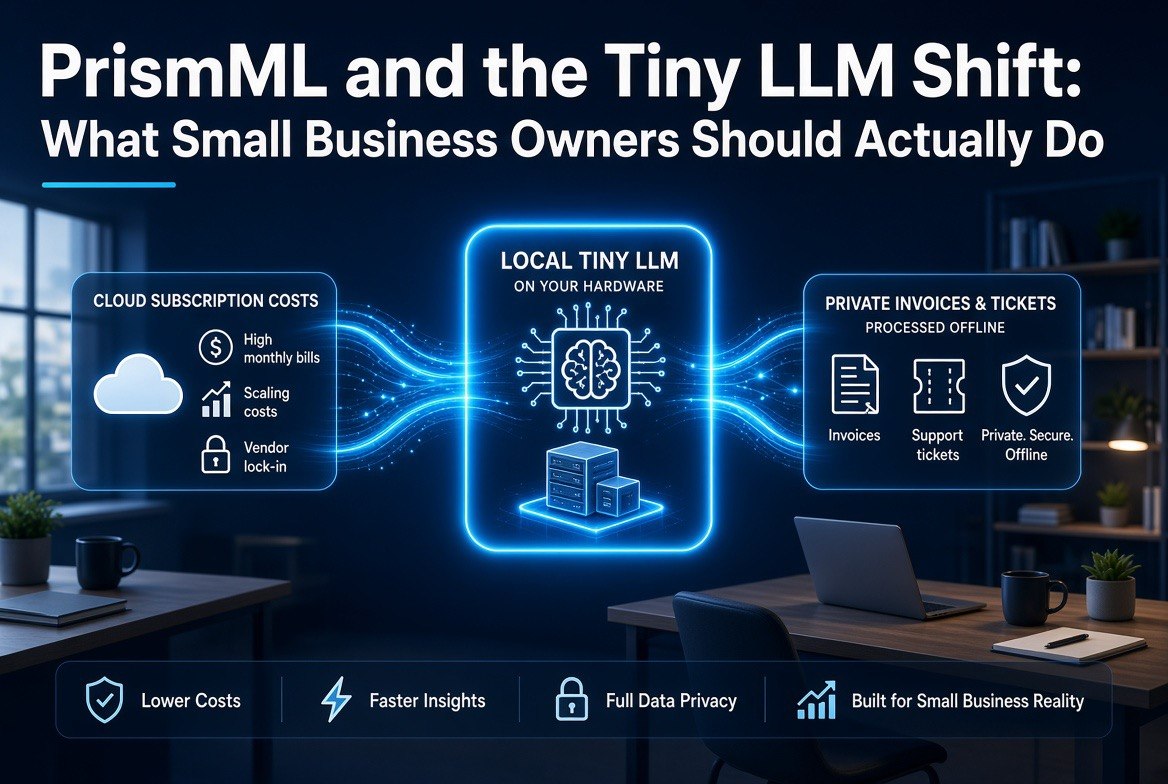
PrismML and the Tiny LLM Shift: What Small Business Owners Should Actually Do
⚡ Expert Summary: PrismML has released a tiny large language model that runs locally on ordinary hardware instead of rented cloud capacity. For a 5-to-50 person business, that changes the two objections that have blocked AI adoption — cost per seat and data leaving your building. This breakdown covers what tiny LLMs actually are, the real hardware and cost math for an SMB, where they win and where they still lose to frontier models, and a concrete three-step plan to test one in your business this month without a developer.
Every small business owner I talk to has the same two reasons for not putting AI into their daily operations. The first is cost: per-seat subscriptions that stack up faster than the value they return. The second is trust: sending customer names, invoices, and pricing to a server nobody has ever shown them.
Both of those objections have been reasonable. Both of them are now being answered — not by a bigger model in a bigger data center, but by the opposite. PrismML’s tiny LLM is part of a wave of small models designed to run on hardware you already own, with no data leaving your premises and no monthly per-token bill.
What a Tiny LLM Actually Is
A large language model is a pattern engine trained on enormous amounts of text. The “large” refers to parameter count — the internal dials the model tunes during training. Frontier models run into hundreds of billions or trillions of parameters and require data center hardware to serve.
A tiny LLM strips that down. Parameters land in the range of a few hundred million to a few billion. That is small enough to run on a laptop, a mini PC, or even a phone, with no internet connection required. The model is less capable in the aggregate, but it is dramatically cheaper, dramatically faster, and entirely private.
The trade is simple and worth understanding before you buy anything: you give up breadth of knowledge and complex multi-step reasoning. You keep speed, privacy, zero marginal cost, and the ability to run offline forever.
Why This Matters More to a Small Business Than a Big One
Large enterprises already have AI budgets, legal teams, and vendor security reviews. A 12-person insurance agency or a 6-person landscaping company has none of those. It has an owner who does their own invoicing on Sunday night.
That owner’s realistic blockers are not model quality. They are:
Cost predictability. Cloud AI is billed per token or per seat. Volume grows, the bill grows, and the number is never fully fixed. A local model turns a variable expense into a one-time hardware purchase.
Data control. If your AI tool needs to read client contracts or patient intake forms, sending that to a third-party API is a real compliance question — not a hypothetical one. Local inference means the data never leaves the machine.
Dependency risk. Every cloud tool can change its pricing, throttle your usage, or shut down. A downloaded model on your own hardware keeps working when the vendor pivots.
The Real Cost Math for an SMB
This is where most AI content gets vague. Here are concrete numbers an owner can check against their own situation.
| Cost Factor | Cloud AI (per-seat subscription) | Local Tiny LLM (self-hosted) |
|---|---|---|
| Upfront cost | $0 | $600–$2,000 hardware (or $0 on an existing machine) |
| Ongoing cost | $20–$30 per user per month | $0 in usage fees (electricity only) |
| Annual cost, 5 users | $1,200–$1,800 and rising with volume | $0 after hardware, flat forever |
| Data location | Vendor servers | Your machine, offline capable |
| Works without internet | No | Yes |
| Reasoning depth | Highest available | Good for narrow, repeatable tasks |
The break-even point for a five-person team is usually somewhere between month six and month twelve. After that, the local option keeps getting cheaper relative to the subscription while the subscription keeps getting more expensive.
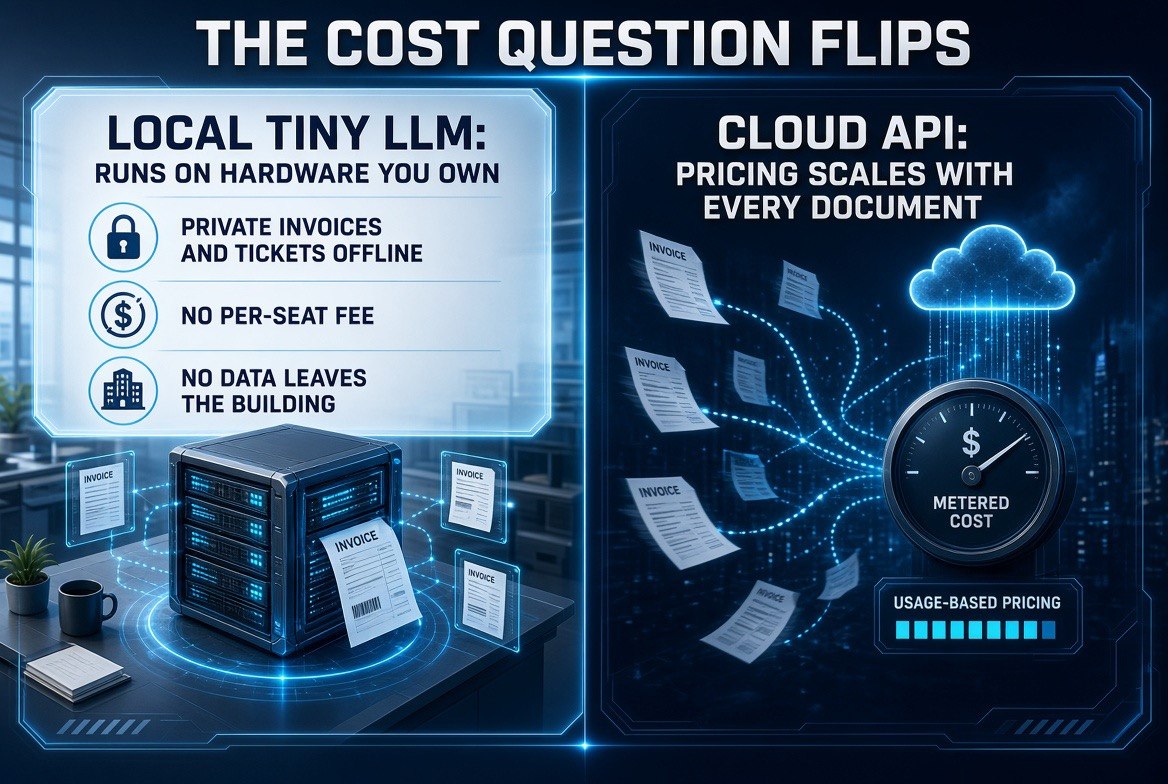
The cost question flips once a tiny model runs on hardware you already own: no per-seat fee and no metered bill that grows with every invoice you process.
Where Tiny Models Win, and Where They Still Lose
This is the part most coverage skips, and it is the part that determines whether you waste money.
Tiny models win at: summarizing documents, extracting structured data from emails and invoices, classifying and routing support tickets, drafting first-pass replies, tagging and organizing files, and any task that runs thousands of times a day on predictable input.
Tiny models still lose at: complex multi-step reasoning, long-context work across hundreds of pages, nuanced writing that has to sound like you, and anything requiring current information from the web.
The practical answer for most small businesses is not one or the other. It is routing. High-volume, private, repetitive work goes to the local model. Complex or customer-facing work goes to the frontier model you already pay for.
| Business Task | Best Fit | Why |
|---|---|---|
| Invoice data entry | Local tiny LLM | Repetitive, sensitive, no reasoning needed |
| Customer email triage | Local tiny LLM | High volume, benefits from privacy |
| Marketing strategy | Frontier cloud model | Needs breadth and nuance |
| Contract review | Frontier cloud model | Long context, high stakes |
| Meeting notes summary | Local tiny LLM | Confidential, predictable format |
| Competitive research | Frontier cloud model | Requires live, current information |
The SMB Adoption Reality in 2026
Adoption data has been consistent for two years and it still has not moved the way the headlines suggest. Industry surveys through 2026 continue to show roughly three in four small businesses reporting some use of AI tools, but the depth of that use is shallow — most of it is a chat window used occasionally, not workflow automation.
The gap is not awareness. MIT research published in 2025 found that the overwhelming majority of enterprise AI pilots failed to reach production, largely because they were bolted onto processes rather than designed around them. Small businesses repeat that mistake at smaller scale: buy a subscription, use it twice, forget it exists.
Local models do not solve that problem by themselves. But they lower the stakes of the experiment enough that owners actually run one. There is no subscription to cancel and no procurement to justify. You download something, point it at a task, and see what happens.
How to Test This in Your Business This Month
You do not need a developer, a server room, or an IT consultant. Here is the sequence that works for a business under 50 people.
1. Pick one repetitive, private task
Not the most exciting use case — the most boring one. Invoice line extraction. Support ticket tagging. Summarizing call notes. Choose something that currently eats 3–5 hours a week of somebody’s time and involves data you would rather not paste into a public chatbot.
2. Run it on hardware you already own
Before buying anything, check the machine on your desk. Modern laptops with 16GB of memory handle small models comfortably. If you need dedicated hardware, a mini PC in the $600–$2,000 range covers most small business workloads. Buy after you have proven the task, not before. Tools like Ollama make downloading and running local models a single command with no configuration.
3. Measure one number for 30 days
Pick a single metric: hours saved, dollars of subscription avoided, or error rate on the task. Track it for a month. If the number is real, expand. If it is not, you have lost nothing but the hardware you can reuse for something else.
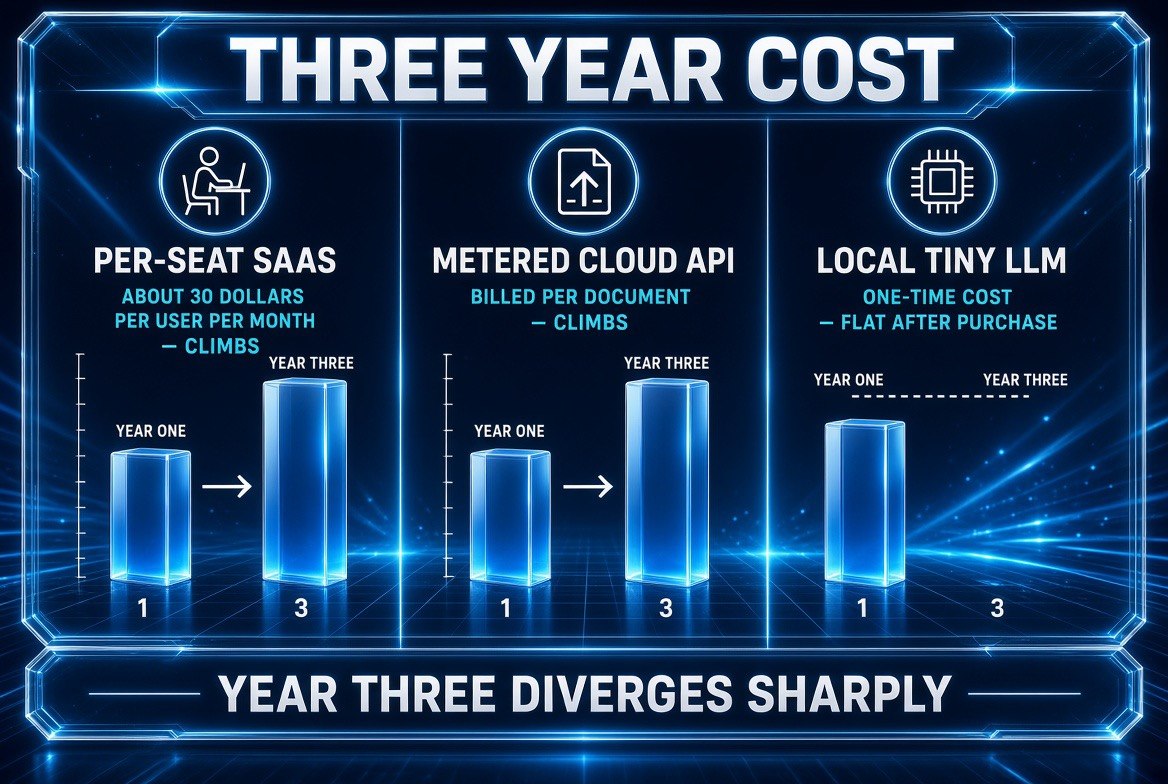
Subscription and metered pricing both climb every year you use them. A local tiny model has a one-time cost and then stays flat — which is why the year-three gap is where the decision gets made.
The Security Argument Nobody Makes Loud Enough
Ask a small business owner why they have not put client data into an AI tool and you will usually get a shrug. They know it is a risk. They have not had to name it.
Name it plainly: pasting a client contract, an employee’s personal details, or a patient intake form into a public chatbot means that text is now on a third party’s infrastructure under a terms-of-service document almost nobody has read. For a business in a regulated field — accounting, insurance, healthcare, legal, anything touching personal data — that is not a vague concern. It is the kind of thing that shows up in a breach inquiry or a client audit.
A local model removes that entire category of risk from the equation. There is no vendor data processing agreement to negotiate. There is no sub-processor list to review. The text goes in and comes out on a machine in your office, and if you unplug the network cable it still works.
For an owner who has wanted to use AI for document-heavy work but has been unwilling to send files off-site, this is the first option that clears the bar. That is a bigger deal than any benchmark number.
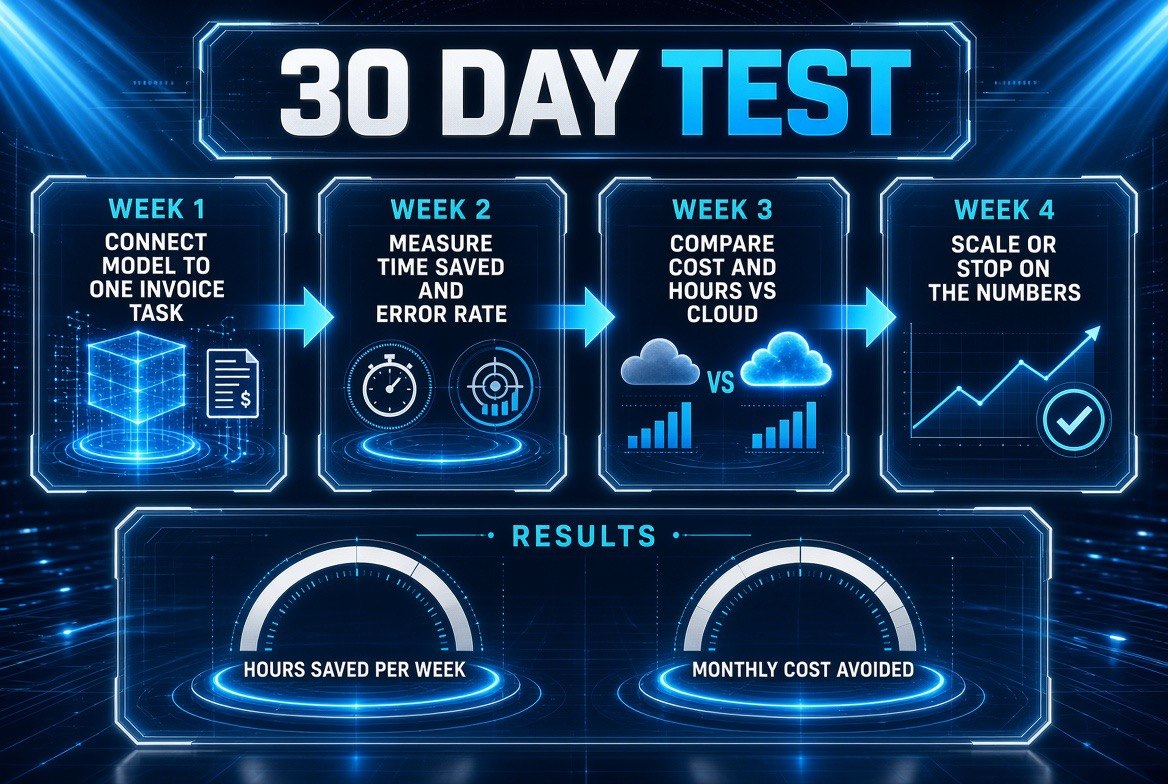
You do not need a migration plan to test this. One document task, thirty days, four checkpoints — and the week-four decision is made on measured hours and cost, not on vendor claims.
The Hidden Advantage: No Usage Ceiling
Subscription AI has a behavioral cost most owners never account for. When usage is metered, people ration it. They save the chatbot for the “important” questions. They hesitate before running a batch of 200 invoices through it because somewhere in the back of their mind there might be a limit, an overage charge, or a rate limit at exactly the wrong moment.
Local inference has no meter. You can run the same task five hundred times, re-run it after a bad result, or point it at an entire archive of documents overnight. That changes behavior, and behavior is where the actual savings come from.
Think about what that unlocks for a small operation. A landscaping company could process every estimate it has ever written to find its real pricing patterns by job type. A bookkeeping firm could classify a decade of client transactions in a single weekend. Neither of those happens on a metered plan, because the owner is watching the cost counter the entire time.
What This Means for Your Competitors
The reason this shift matters competitively is the cost asymmetry it creates. A business that routes high-volume work to a local model cuts its per-task cost to nearly zero and can run that work as often as it wants. A business still paying per seat and rationing usage will do less of it.
Over a year, that difference compounds. The operator running automated invoice processing on free local inference is not just saving money. They are processing more, faster, with fewer people — and their cost structure looks nothing like yours at the end of the year.
The tools are not exotic anymore. The question is which side of the cost curve you are on when your competitor figures it out.
The Bottom Line
Tiny LLMs are not going to replace the frontier models you use for hard thinking. They are going to take over the boring, private, high-volume work that you are either paying too much to automate or not automating at all.
That is the actual opportunity for a small business. Not a smarter assistant. A cheaper one you can run a thousand times a day without watching a meter.
Start with one task. Run it locally. Measure it for 30 days.
Frequently Asked Questions
What is a tiny LLM and how is it different from ChatGPT?
A tiny LLM is a small language model with far fewer parameters, designed to run on ordinary hardware you own rather than vendor cloud servers. ChatGPT-class frontier models are more capable at complex reasoning but are billed per use and require sending your data to a third party.
Can a small business really run an AI model locally?
Yes. Most modern laptops with 16GB of memory handle small models without modification. For heavier workloads, a mini PC in the $600–$2,000 range is sufficient for typical small business tasks like document summarization and data extraction.
Is local AI actually private?
Local inference means the input and output never leave your machine, and the model works with no internet connection. That is a meaningful difference for businesses handling client contracts, patient information, or financial records.
Will a tiny LLM save money compared to a subscription?
For a five-person team, a typical per-seat subscription costs $1,200–$1,800 annually. A local model eliminates usage fees after the hardware purchase. Most small businesses break even between months six and twelve, then keep saving.
Where do tiny LLMs still fall short?
Complex multi-step reasoning, long-context document analysis, nuanced brand-voice writing, and anything requiring live current information. The practical approach is routing those tasks to a frontier cloud model while high-volume, private, repetitive work runs locally.

About Barak Schurr
Barak Schurr built and sold a major ticketing platform, ran global nightlife operations at Eventbrite, and now spends his time figuring out which AI tools actually move the needle for independent business owners — and which ones are just noise. No hype. No fluff. Just what works.
Email: [email protected]
More AI Resources for Your Business