Get The Solo Business OS — Free
The AI workflow that replaces a part-time employee for solo operators and small business owners.
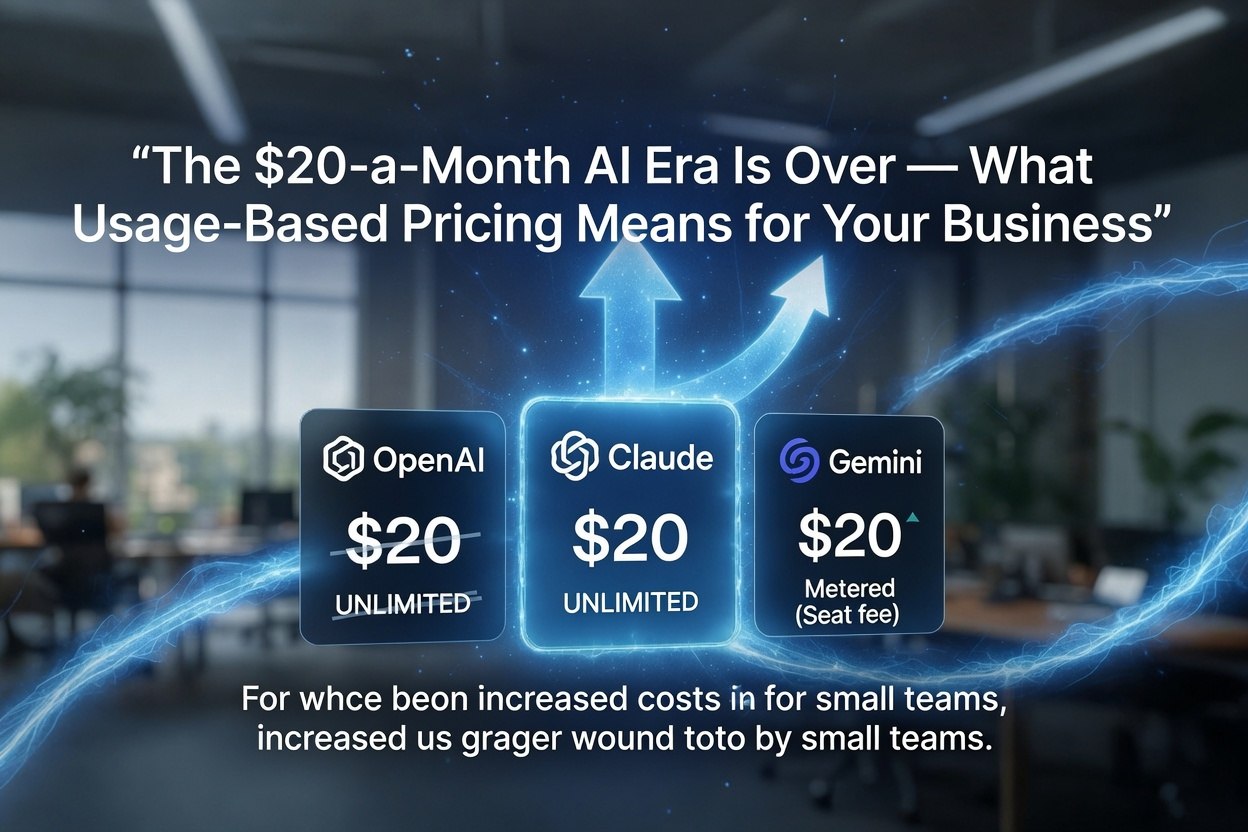
The $20-a-Month AI Era Is Over — What Usage-Based Pricing Means for Your Business
⚡ Expert Summary: The flat $20/month “all-you-can-eat” AI subscription — the deal that made ChatGPT, Claude, and Gemini feel like unlimited utilities — is ending. In 2026, OpenAI, Anthropic, Google, and GitHub are all shifting toward hybrid usage-based pricing: a base seat fee plus metered token or credit costs on top. This isn’t a rumor; GitHub Copilot already killed its unlimited premium tier in June 2026, and Anthropic’s team plans now bill AI usage separately from the seat price. For small business owners, the $20 era was convenient — but it’s also why your power users hit walls, why agents kept getting capped, and why your invoice could quietly rise. Here’s exactly what’s changing, what it costs you now, and how to structure your AI stack so pricing shifts don’t gut your budget.
If you’ve been running your business on two or three $20/month AI subscriptions and assuming that number never moves, you’re about to get a surprise. The flat-rate model that made ChatGPT feel like an unlimited intern — log in, ask anything, never think about the meter — is on its way out. The providers that built the $20 era are now the ones tearing it down, and they’re not asking permission.
This matters to you for one reason: your AI bill is about to become variable, and most US small business owners are not prepared for a variable bill they can’t predict. The habit you built — “ChatGPT is $20, done” — is exactly the assumption the pricing changes are eroding. Here’s what’s actually happening, what the new numbers look like, and the playbook to keep your AI costs flat while your competitors’ invoices drift upward.
Why the $20 Subscription Was Always Too Good to Be True
The flat $20/month plan worked in 2023 when the average user asked a handful of questions a day. Run the math on a serious user and the model breaks. A power user running multi-step agents, long document analysis, or heavy image generation can burn inference worth far more than $20 in a month. OpenAI, Anthropic, and Google are not charities — when a single account consumes more compute than it pays for, the provider eats the difference. Multiply that across millions of subscribers and the economics don’t hold.
That’s the core of the argument from MindStudio’s analysis titled “The End of the $20 a Month Era“: inference costs for power users and agentic workflows routinely exceed the $20 revenue per active subscriber. Training costs are high, and agentic AI — autonomous multi-step tasks, not simple chat — amplifies usage by an order of magnitude. A single agent that loops through several model calls per task is not the same cost profile as a chat thread, and providers have noticed.
Inference costs for heavy and agentic users routinely exceed $20 of revenue per subscriber. That gap is the entire reason flat-rate AI pricing is dying.
Forbes contributor Ron Schmelzer put it in terms a business owner understands in his April 2026 piece, “The AI Subscription Buffet May Not Last Much Longer“: the “buffet” model — pay one price, eat your fill — works only when most diners eat lightly. The moment heavy users arrive, the buffet collapses. That’s the situation every major provider now faces, and the response is the same everywhere: meter the consumption.
What the New Pricing Actually Looks Like
The shift is not a clean move to pure per-token billing for consumers. It’s a hybrid model: you keep a base subscription for access, but heavy uses and add-on features meter on top. Here’s how the majors break down in mid-2026:
| Provider | Consumer Tiers | Where Metering Creeps In |
|---|---|---|
| OpenAI (ChatGPT) | Go ~$8, Plus $20, Pro $100–$200 | Codex and newer agent tools moving to token-mapped credits; Plus rate limits tighten |
| Anthropic (Claude) | Pro $20, Max $100–$200 | Team plans now bill seat fee + usage tokens/credits separately |
| Google (Gemini) | AI Pro $19.99, higher tiers to ~$250 | Workspace bundles meter premium model usage per tier |
| GitHub Copilot | Flat premium requests ended June 2026 | Now AI credits at ~$0.01 each, mapped to token usage |
GitHub Copilot is the cleanest example of where this is heading. In June 2026 it ended its flat-rate unlimited premium tier and moved to an AI credit system — roughly one cent per credit, with each credit mapped to token usage. Developers who burned through unlimited requests suddenly had a meter. It was the clearest public signal yet that “all-you-can-eat” is dead, and it mirrors what CNBC reported in April 2026 about AI token pricing across Anthropic, OpenAI, and Nvidia — the industry converging on usage-based token economics.
Anthropic’s team shift is arguably more relevant to you. Historically, a Claude team seat was a flat per-user fee. Now Anthropic is moving to a structure where you pay a per-seat fee and AI usage bills separately on top, measured in tokens or credits. That’s the exact pattern that changes budgeting for a small team: the seat is predictable, but what your people actually consume is variable.
What This Means for Your Business Budget
Here’s the honest translation of all this for a US small business owner. If you run a solo operation or a small team and your people use AI lightly — occasional chat, a summary a day — you may barely notice the change. Your cost might even drop, because OpenAI’s cheaper entry tiers give light users an $8 option instead of forcing everyone onto $20.
But if your business has power users — the person who builds automation, the one who runs long document analysis, the operator who’s wired an agent into your CRM — those are exactly the accounts that hit the new meters first. Your invoice becomes a function of how much your heaviest user does, not a fixed number you can budget around. Teams paying $25–30 per user per month today could see that climb as usage add-ons land.
The uncomfortable reality: the more value you squeeze out of AI, the more you’ll pay. That’s the trade you didn’t see coming, because the whole pitch of the $20 era was that value was unlimited for a flat fee. It wasn’t — it was subsidized, and the subsidy is ending.
How to Keep Your AI Costs Flat Anyway
You don’t have to just absorb this. A few structural moves keep your bill predictable even as the industry meters everything:
1. Know Your Heavy Users Before the Meter Lands
Before you can control usage-based costs, you need to know who’s consuming. If you have access to your provider’s admin console or usage dashboard, pull it now. Identify the accounts burning far more than average. Those are your risk. If you don’t have visibility because you’re all on individual $20 plans, that’s your first thing to fix — individual consumer accounts give you zero management and zero warning when a meter appears.
2. Route Cheap Tasks to Cheap Models
You don’t need the flagship model for every task. A lot of daily business work — drafting an email, summarizing a paragraph, classifying a lead — runs perfectly well on a cheaper, faster model. The hybrid pricing world rewards exactly this: stop paying flagship rates for light work. This is the single highest-leverage habit and most operators skip it because the $20 plan made model choice invisible.
3. Use Your API for Volume Instead of Chat Subscriptions
For high-volume, repetitive work — automation, batch processes, anything running hundreds of calls — API access with per-token pricing is often cheaper and more predictable than forcing it through a $20 consumer subscription with tighter limits. If you’re building automation, price both paths. The subscription is convenient; the API is precise.
4. Consolidate Before You Meter
Every tool you add is another potential meter. If you’re paying for ChatGPT, Claude, and Gemini separately and your people use them about the same, you now have three variable bills instead of one. Consolidating onto fewer providers — and routing your team’s work through the ones you keep — gives you one budget to watch instead of three surprises.
5. Watch the Annual Commitments
Providers are pushing annual plans hard right now, and some (like Claude Pro at ~$17/month annual) genuinely cut the base seat cost. But an annual commitment on a plan whose usage pricing is still shifting is a bet. Lock in the base seat if the savings are real, but don’t pre-commit to usage add-ons until you’ve seen a real month of your team’s consumption.
An Action Plan for the Next 30 Days
Don’t wait until your first surprise invoice to react. Here’s a concrete sequence you can run this month to get ahead of the pricing shift:
Week 1 — Get visibility. Log into every AI tool your business uses and pull the usage report. If a tool doesn’t give you one, that’s a red flag by itself. Identify the top consumers and what they’re doing. You can’t manage what you can’t see.
Week 2 — Set routing rules. Write down which tasks genuinely need a flagship model and which don’t. Emails, meeting notes, lead classification, first drafts — most of these run on cheaper, faster models. Move them. Keep the flagship for the 20% of work that’s genuinely complex, so you spend on what actually returns value.
Week 3 — Price your automations both ways. If you have any automation or agent running on chat subscriptions, run a side-by-side estimate of the same workload on API per-token pricing. You’ll often find the API is cheaper for volume, plus it gives you hard usage numbers you can budget against.
Week 4 — Consolidate and lock in the base. Cut the redundant subscriptions and consolidate your team onto the providers you’re keeping. Take the annual discount on the base seat if it’s real, but hold off on committing to usage add-ons until you’ve seen one full month of your real numbers.
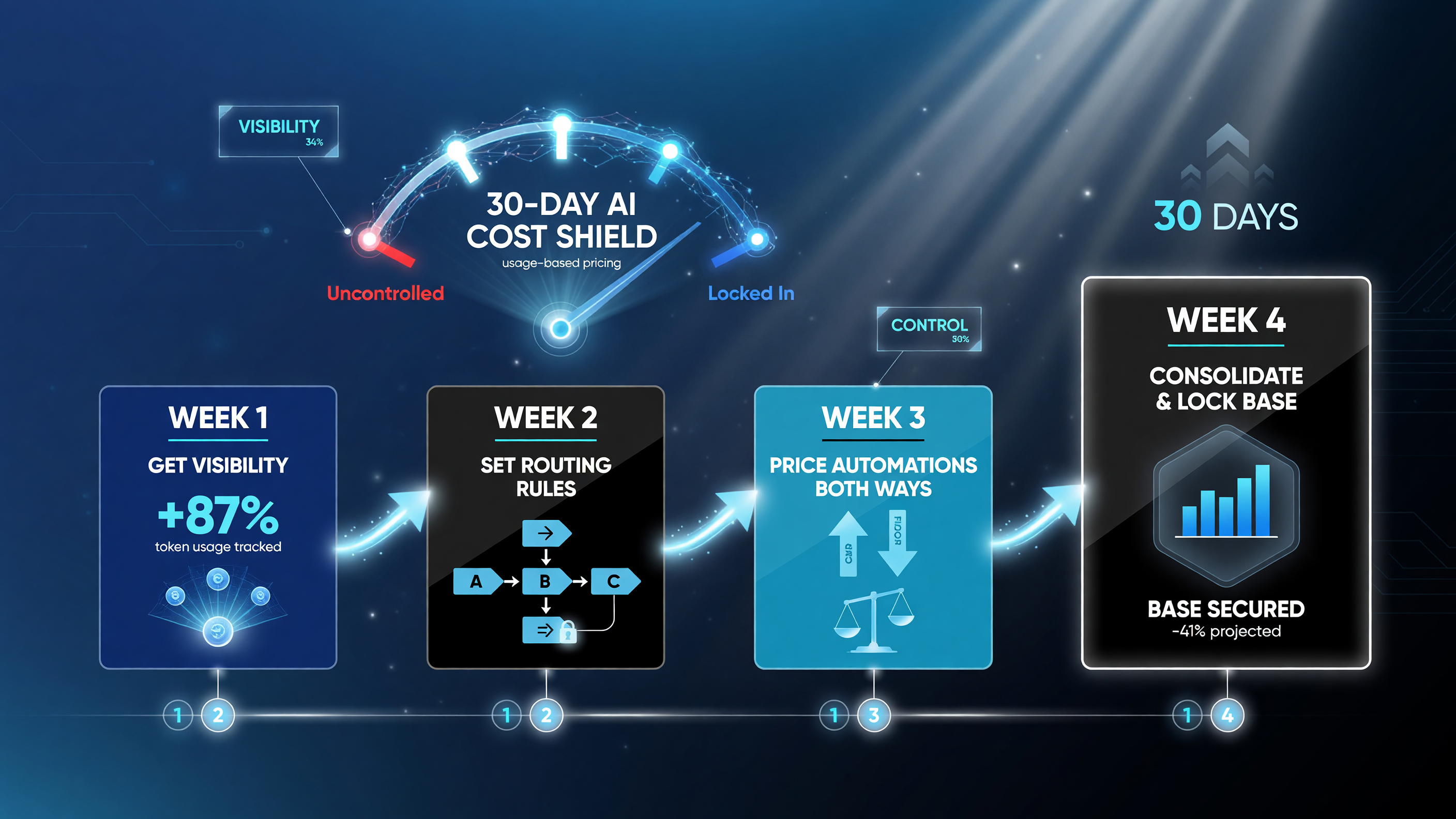
A 30-day sequence gets you ahead of metered pricing: get visibility on usage, set routing rules, price automations both ways, then consolidate and lock in the base.
Run that sequence and you’ll head into the usage-based era with a plan instead of a panic. The businesses that lose in this shift are the ones that assume nothing changes; the ones that win are the ones that treat AI cost like any other variable expense — measured, routed efficiently, and consolidated.
The Bottom Line
The $20-a-month AI era was a subsidy, not a law of nature. It bought adoption by hiding the real cost of heavy use, and now that the heavy users have arrived, the subsidy is ending. For a small business, the winners in this shift are the owners who see it coming: know your heavy users, route cheap work to cheap models, consolidate your stack, and treat your AI bill as something you manage rather than something you assume.
The businesses that keep running on three flat $20 plans and hoping nothing changes will be the ones hit with the surprise invoices. The ones who structure for usage-based pricing now will keep their costs flat while their competitors’ drift. Same tools, same work — different bill. The choice is yours.

For a five-person team, the same AI work under flat plans costs about 0/month. Under usage-based pricing, the base seat stays 0 but heavy users can add -90 in variable overage — the variance you need to budget for.
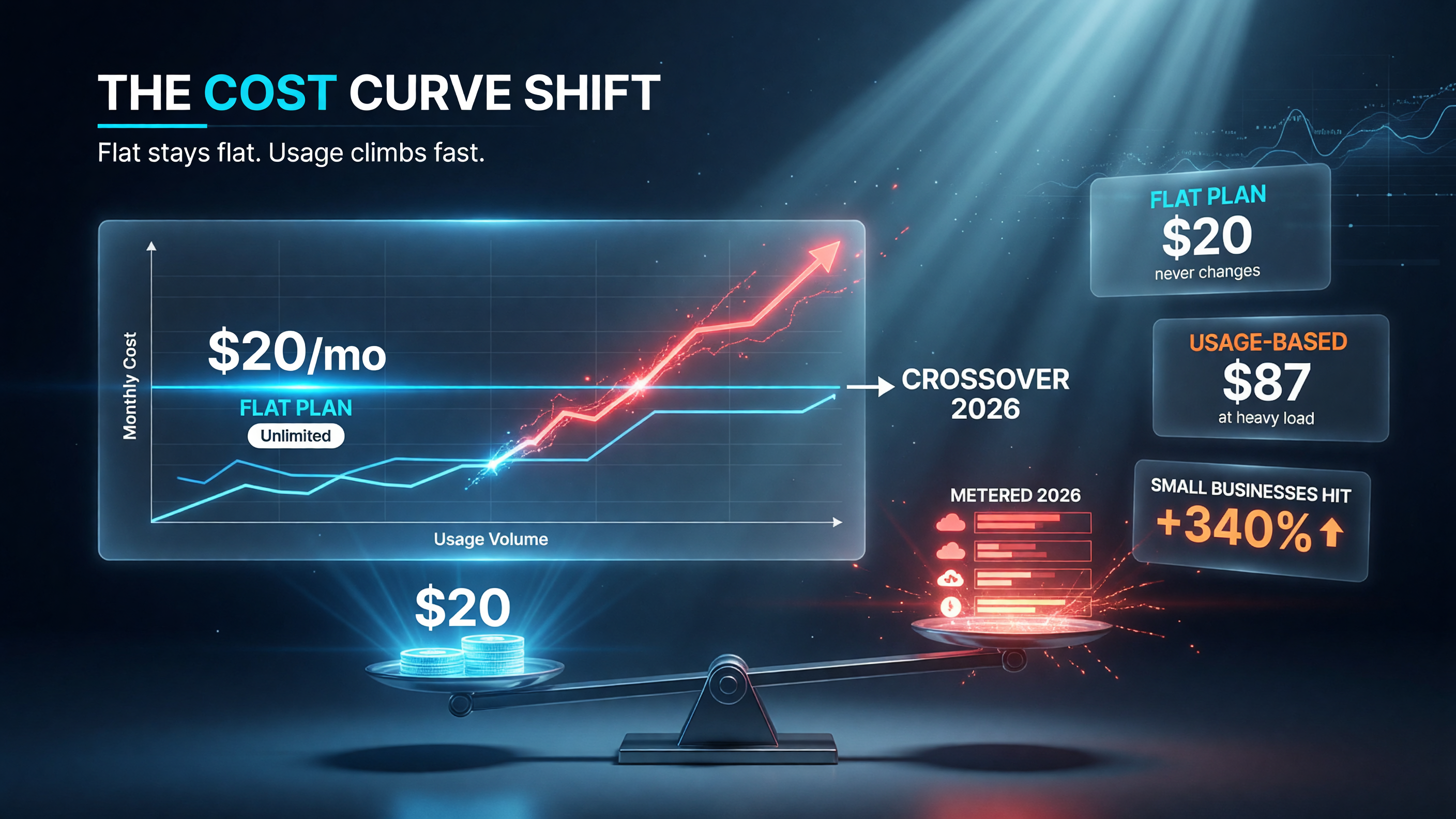
The flat plan hides cost until heavy usage starts — then usage-based pricing climbs past it, which is exactly the shift hitting small businesses in 2026.
The pattern is consistent across every major provider, and that consistency is the tell. When four of the biggest AI companies independently arrive at the same pricing structure in the same twelve months, it is not a coincidence; it’s a market-wide restructuring. CNBC’s April 2026 coverage of AI token pricing made the direction explicit — the industry is converging on usage-based token economics as the standard way to charge for AI compute, the same way cloud providers meter compute and bandwidth. The question was never whether metered pricing would arrive; it was how quickly, and the answer has turned out to be fast.
The other thing worth understanding is how this interacts with agentic AI, because that’s where the cost explosion lives. A chat query is one round trip. An agent is a loop: it plans, calls a tool, reads the result, decides the next step, and repeats — often several times per task. Each step is a separate model call, and each call costs tokens. The same task your employee used to do in one chat prompt might burn five or ten times the compute when automated. That’s not a bug in your tooling; it’s the price of autonomy, and it’s exactly the usage the new pricing is designed to meter.
For a small business, the practical takeaway is that the perceived cost of AI went up the moment you started relying on it heavily, even before the invoices changed. The $20 era hid the real consumption; the usage-based era reveals it. That’s uncomfortable, but it’s also information — and information you can act on to keep costs in line.
Frequently Asked Questions
Is the $20 ChatGPT Plus plan going away?
Not entirely, but it’s evolving. OpenAI still offers ~$20 Plus but with rate limits, and it’s shifting newer features like Codex toward token-mapped credits. Light users now have cheaper entry options; heavy users pay more as usage grows.
Why is AI pricing moving away from flat subscriptions?
Because inference costs for heavy and agentic users routinely exceed the $20 per-subscriber revenue. Providers lose money on power users under flat-rate plans, so they’re moving to hybrid models: a base fee plus metered token or credit costs for heavy use.
What does usage-based AI pricing mean for a small business?
Your AI bill becomes variable instead of fixed. Light users pay the same or less, but power users — those building automation or running heavy workflows — face higher costs. Budgeting requires knowing who your heavy users are and routing cheap tasks to cheaper models.
Did GitHub Copilot actually end its flat-rate plan?
Yes. In June 2026, GitHub Copilot ended its flat-rate unlimited premium tier and moved to an AI credit system at roughly $0.01 per credit, with credits mapped to token usage. It’s the clearest signal that all-you-can-eat AI is over.
How can I keep my AI costs predictable with usage-based pricing?
Know your heavy users, route cheap tasks to cheaper models, use API for high-volume automation, consolidate onto fewer providers, and price API versus subscription before committing. These habits keep your bill flat even as the industry meters usage.

About Barak Schurr
Barak Schurr is the founder and former president of the nightlife ticketing platform Wantickets and former Global Director of Dance and Nightlife at Eventbrite. He currently focuses on AI research and writes about practical AI for independent business owners — no hype, no corporate fluff. More at topnotchaitools.com.
Contact: [email protected]
More AI Resources for Your Business