Get The Solo Business OS — Free
The AI workflow that replaces a part-time employee for solo operators and small business owners.
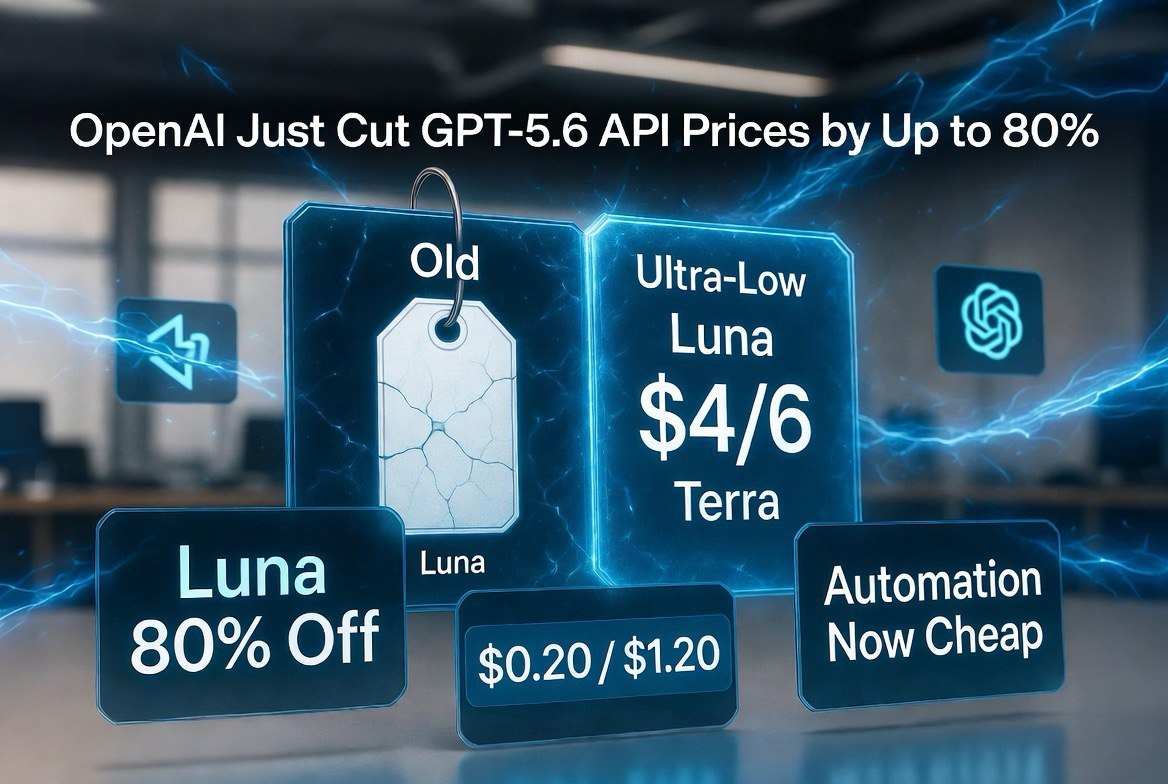
OpenAI Just Cut GPT-5.6 API Prices by Up to 80%
⚡ Expert Summary: On July 31, 2026, OpenAI slashed API pricing across its GPT-5.6 model family. GPT-5.6 Luna dropped 80% — now $0.20 per million input tokens and $1.20 per million output tokens — while GPT-5.6 Terra fell 20% to $2/M input and $12/M output. The flagship Sol model kept its price but gained faster inference options. For US small businesses and developers building on OpenAI, this is the biggest cost cut in the family’s history, and it changes the math on when to automate.
What OpenAI Actually Changed
OpenAI announced price cuts for its GPT-5.6 API models effective July 31, 2026, as part of a push to make advanced AI more accessible for wider adoption. The changes are not uniform across the family — they target the workhorse models businesses actually call in high volume, while leaving the premium flagship untouched.
- GPT-5.6 Luna: 80% price reduction — now $0.20 per million input tokens and $1.20 per million output tokens.
- GPT-5.6 Terra: 20% price reduction — now $2.00 per million input tokens and $12.00 per million output tokens.
- GPT-5.6 Sol: no direct price cut, but instead received other optimizations, including faster inference options.
The 80% cut on Luna is the headline move. It is a dramatic reduction that takes a fast, capable model from a meaningful per-call expense down to pocket-change territory for most automation workloads — which is exactly the point of the pricing change.
Why the Price Cut Matters for Your Business
For a small business owner in the US, API pricing is the difference between experimenting with AI and actually building it into your operations. When a model costs $1.20 per million output tokens, automating a customer-facing task becomes cheap enough to run at scale without watching every dollar. The 80% Luna cut specifically removes the “is this worth it?” hesitation that keeps many owners from shipping real automation.
Here is the practical framing: the pricing drop does not just lower your bill — it shifts what is worth building. A workflow that made sense only at high volume now pays for itself at much lower volume, and tasks that were too costly to automate become viable. That is the strategic payoff of this announcement for US operators: more of your manual work now clears the cost-to-automate bar.
A Real-World Cost Example
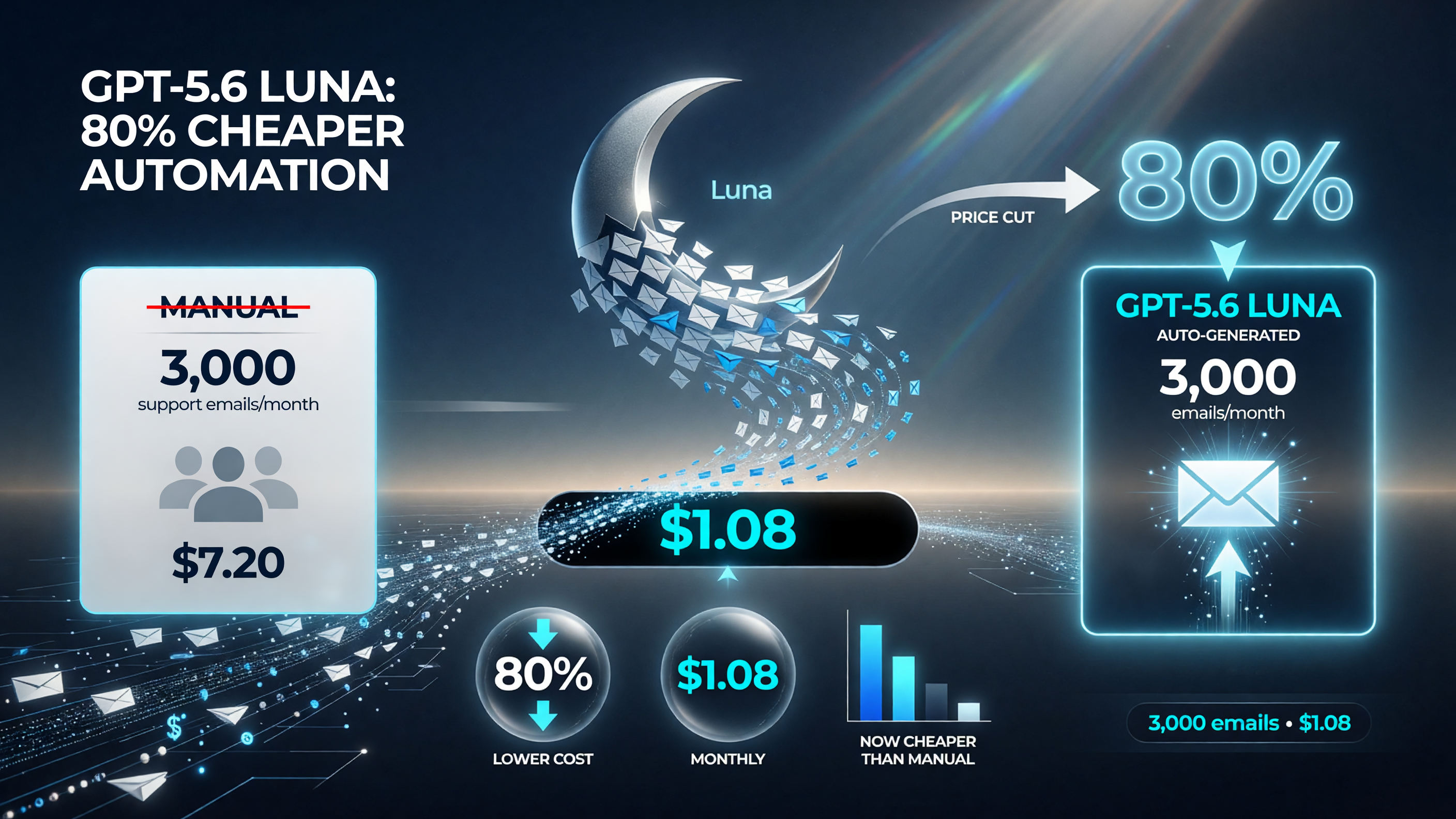
At the new rate, 3,000 support emails a month cost roughly $1.08 — vs $7.20 done manually.
Concrete numbers make the cut tangible. Suppose you run a small US e-commerce operation and want to auto-generate a personalized support response for every incoming email, about 3,000 emails a month. A typical support reply might be 300 output tokens, so 3,000 responses consume roughly 900,000 output tokens a month.
- At the old Luna rate (before the 80% cut), that volume cost noticeably more per month — enough that many owners balked.
- At the new $1.20 per million output tokens, 900,000 output tokens cost about $1.08 a month for the generation itself.
- Add input tokens (the email plus instructions, maybe 1,500 tokens each) at $0.20 per million, and the whole pipeline still lands well under the cost of a part-time employee doing the same triage.
The conclusion is not that AI replaces the human — it is that the marginal cost of handling each additional email is now so low that you can afford to route the routine volume to automation and keep your team for the edge cases. That is the practical consequence of an 80% cut: it turns a fixed-quality calculation into a clear yes.
The same logic scales to other recurring text workloads — product descriptions, review responses, basic reporting. Any task where you can measure per-unit output and volume becomes a simple cost comparison, and the new Luna rate makes nearly all of them come out in favor of automating. If you have been holding a handful of workflows because “the API bill would add up,” that assumption is now several times cheaper to test.
Luna vs Terra: Where to Route Your Work
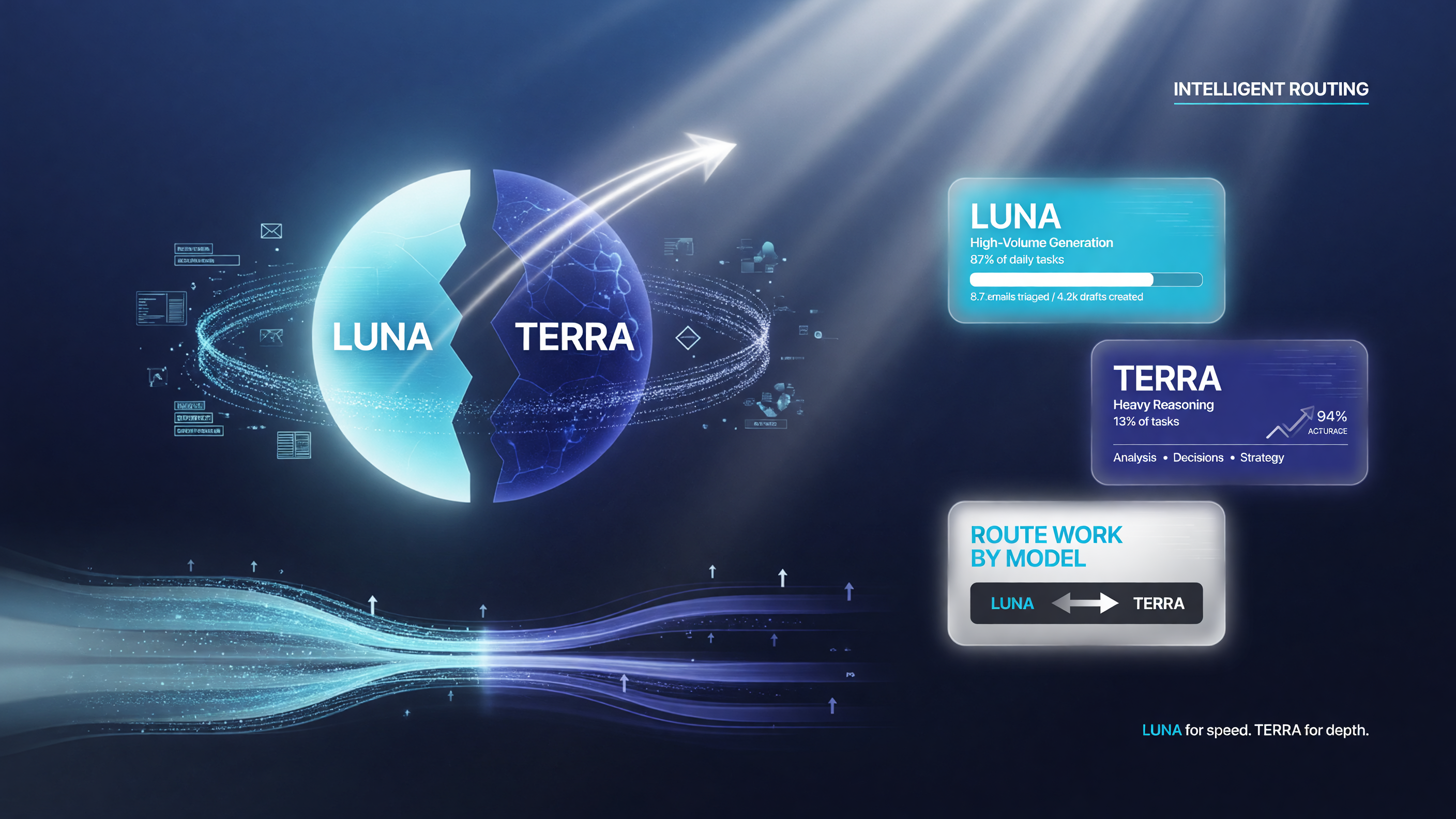
Most small-business workloads belong on Luna; reserve Terra for true reasoning tasks.
The two discounted models are not interchangeable, and picking wrong erases part of the savings. Luna is the fast, high-volume workhorse — ideal for classification, extraction, drafting, and anything where speed and low cost beat cutting-edge reasoning. Terra is the heavier reasoner, better suited to multi-step analysis, decision logic, and tasks where you need the model to think before it answers.
The 80% Luna cut is the bigger headline, but it only wins if you actually route the right work to it. Get into the habit of asking each workflow one question: does this need deep reasoning, or just fast, reliable generation? If the answer is the latter, Luna is where the money is saved. If it genuinely needs to reason, feeding it to a cheaper reasoning-light model to save $0.80 in compute usually costs far more in rework.
In practice, most small-business automation is a mix. Email triage, invoice categorization, document summarization, and first-pass drafting all sit comfortably on Luna. Strategic analysis, contract review, and complex decision trees justify Terra. Building your workflows around that split is how you capture the full benefit of the new price structure.
How the New Pricing Compares
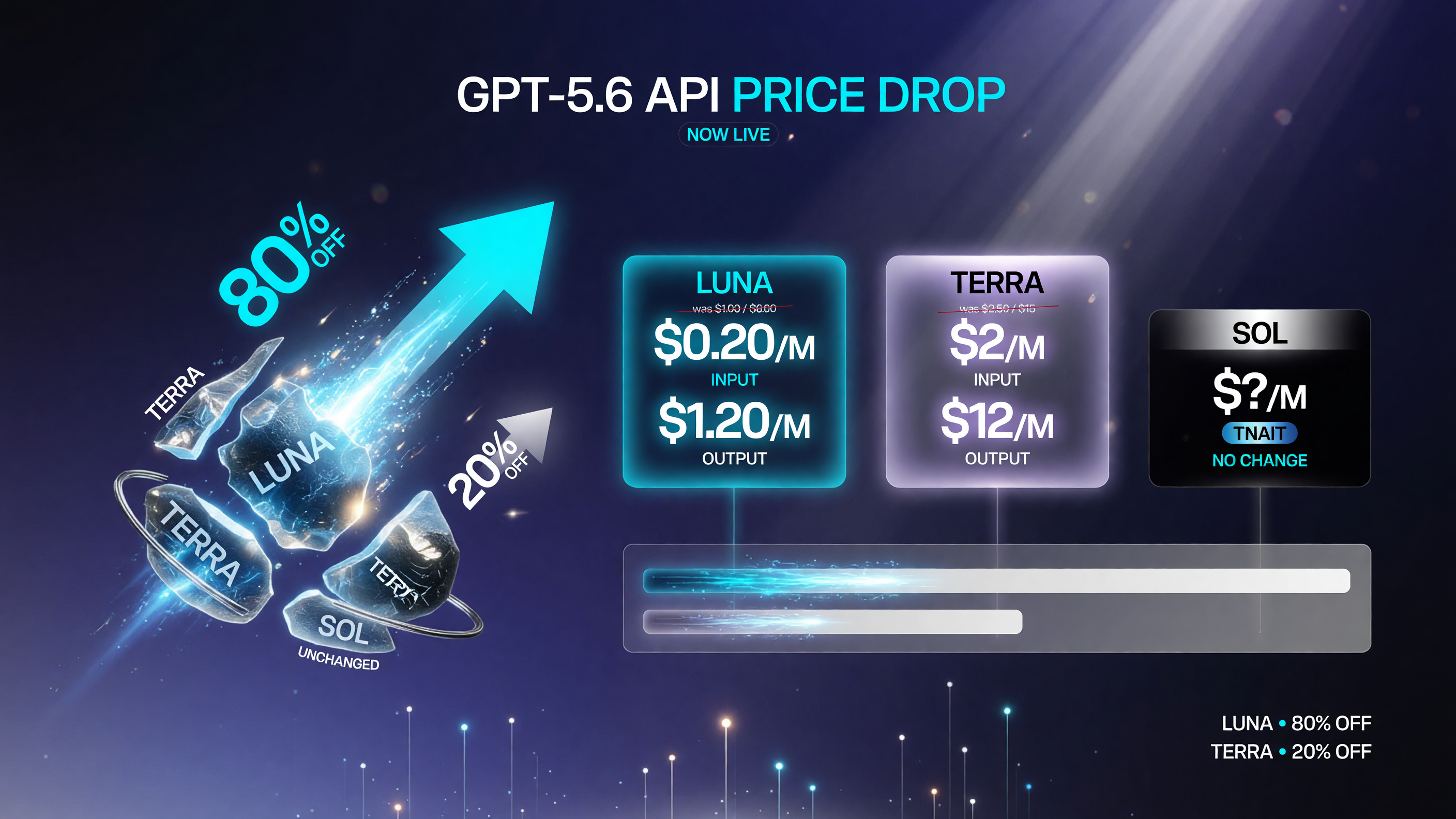
OpenAI cut Luna 80% and Terra 20%; Sol stayed premium with faster inference.
To see the impact clearly, the reductions translate into real per-call numbers you can plug into your own usage:
| GPT-5.6 Model | Price Cut | Input / M tokens | Output / M tokens | Best For |
|---|---|---|---|---|
| Luna | 80% off | $0.20 | $1.20 | High-volume, cost-sensitive tasks |
| Terra | 20% off | $2.00 | $12.00 | Reasoning-heavy tasks |
| Sol | No cut | Premium | Premium | Flagship, fastest inference |
The tier structure is deliberate. Luna is positioned as the volume play — 80% cheaper so you can run it everywhere. Terra is the mid-tier reasoning model at a modest 20% discount. Sol stays premium for buyers who need the absolute best output and now get faster inference as its value-add instead of a price drop.
Who Should Act on This Now
- If you build small tools or automations, Luna at $0.20/M input is cheap enough to move prototype workflows into production without per-call anxiety.
- If you run a business that processes lots of text — email triage, support responses, document review — the 80% cut on your highest-volume model directly trims a recurring cost.
- If you have been waiting on the sidelines, this is the moment the cost math flips. The cheaper the dominant model, the less risk in starting to automate.
- If you only call the API occasionally, the cut still helps, but the real win is for steady, frequent usage where 80% compounds.
How to Take Advantage of the Price Cut
- Re-prioritize Luna first. Move your highest-volume, lower-complexity calls to Luna, where the 80% discount delivers the largest absolute savings on your bill.
- Reserve Terra for reasoning. Keep Terra (or Sol) for tasks that genuinely need deeper reasoning, so you do not pay flagship prices for routine calls Luna can handle.
- Recalculate your automation backlog. Use the new per-million rates to re-run the math on workflows you had shelved as too costly — the cheaper pricing changes the verdict on many of them.
- Monitor your usage split. After rebalancing to Luna, watch quality on a sample of outputs to confirm the cheaper model still clears your bar before you shift everything.
Why OpenAI Cut Prices Now
Price cuts of this size are a strategy, not a gesture. OpenAI framed the change as a push for wider access, and the move targets a specific market reality: the highest-volume users are exactly the ones whose bills OpenAI wants to grow, and charging them 80% less on a fast model is how you get more of them building more workflows on your platform.
It also signals competitive pressure across the AI market. As rival models close the capability gap at lower prices, cutting the workhorse tier is how a frontier lab protects its adoption base. For a US small business, the motive does not change the outcome: cheaper compute is cheaper compute, and this particular cut lands on the models you are most likely to call in volume.
The strategic read for buyers is to treat the cut as a durable direction rather than a one-time promo. When a provider cuts its volume tier by 80%, it is trying to shift the whole market’s unit economics. Acting on that direction now — before competitors rebuild around the same pricing — is the advantage worth seizing.
What to Watch For Next
OpenAI framed these cuts as a push for wider access, and price drops of this size rarely come alone. Expect follow-on moves: deeper reasoning-fast pricing, more aggressive volume tiers, and continued pressure on other providers to match. For US buyers, the direction is uniformly favorable — AI capability is getting cheaper, and the firms that rebuild workflows around the new pricing now will hold a cost advantage over competitors still paying yesterday’s rates.
Frequently Asked Questions
How much did OpenAI cut GPT-5.6 API prices?
Effective July 31, 2026, GPT-5.6 Luna dropped 80% to $0.20/M input and $1.20/M output tokens, and GPT-5.6 Terra dropped 20% to $2/M input and $12/M output tokens. GPT-5.6 Sol was not price-cut but gained faster inference options.
What is the new GPT-5.6 Luna pricing?
After the 80% cut, GPT-5.6 Luna costs $0.20 per million input tokens and $1.20 per million output tokens.
Did GPT-5.6 Sol get a price cut?
No. GPT-5.6 Sol kept its premium pricing but received other optimizations, including faster inference options, as its value enhancement instead of a lower price.
Which GPT-5.6 model should I use with the new pricing?
Use Luna for high-volume, cost-sensitive calls where the 80% discount delivers the most savings, and reserve Terra or Sol for tasks that genuinely require deeper reasoning.
When did the GPT-5.6 API price cuts take effect?
The changes took effect around July 31, 2026, following OpenAI’s announcement in its push for wider access to advanced AI.

About Barak Schurr
Barak Schurr is the founder and former president of the nightlife ticketing platform Wantickets and former Global Director of Dance and Nightlife at Eventbrite. He currently focuses on AI research and writes about practical AI for independent business owners that actually moves the needle — no hype, no corporate fluff. More at topnotchaitools.com.
Contact: [email protected]
More AI Resources for Your Business