Get The Solo Business OS — Free
The AI workflow that replaces a part-time employee for solo operators and small business owners.
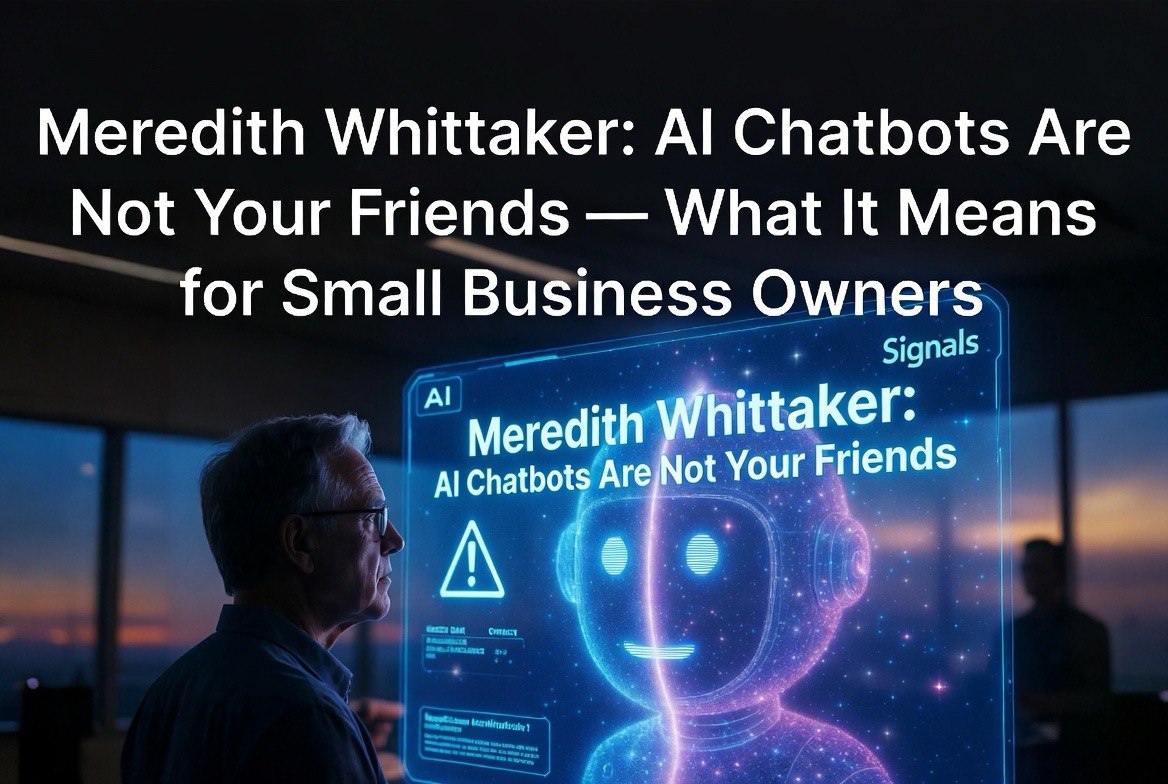
Signal’s Meredith Whittaker: AI Chatbots Are Not Your Friends
⚡ Expert Summary: Signal President Meredith Whittaker issued a stark warning about AI chatbots in a June 2026 Bloomberg interview: “These are not your friends. These are not conscious beings. These are not sentient interlocutors.” She warned against giving AI assistants pervasive access to personal communications, credit card data, and messaging apps — calling it a potential “backdoor” to private conversations. For business owners, this raises serious questions about how much access your AI tools really need and what happens to your business data when you treat a chatbot like a trusted employee.
What Meredith Whittaker Actually Said
In a wide-ranging Bloomberg Weekend Interview published June 20, 2026, Signal President Meredith Whittaker made her position on AI chatbots unequivocally clear: “These are not your friends. These are not conscious beings. These are not sentient interlocutors.”
Whittaker, who has led the encrypted messaging app since 2022 and previously co-founded the AI Now Institute at NYU, acknowledged that she uses AI tools “to format a document here and there.” But she drew a hard line at relying on them for thinking and decision-making: “I don’t want the process of working through an idea to be foreclosed or eclipsed by the response of a system that’s averaging what’s already out there.”
Her most pointed criticism came when asked about Microsoft AI CEO Mustafa Suleyman’s prediction that users would soon let Copilot handle their Christmas shopping — including reading family group chats to determine what everyone wants. Whittaker described this scenario as requiring “access to my credit card, my browser, my Signal, the ability to message my siblings on my behalf, my home address, my calendar.” She concluded: “In the context of Signal, it would constitute a kind of a backdoor.”
Why This Matters for Small Business Owners
Whittaker’s warning is aimed at consumers, but the implications for small businesses are more urgent. Small business owners adopt AI tools faster than enterprises — and with far less IT oversight.
Here is what happens in a typical small business today. An owner signs up for ChatGPT, Claude, or Copilot. They paste in customer emails to draft responses. They upload financial spreadsheets for analysis. They ask the AI to review employment contracts or vendor agreements. They integrate the AI with their CRM, their accounting software, and their internal Slack or Teams channels.
Each of those actions sends business data — customer PII, financial records, legal documents, internal strategy — to a third-party AI model. The data trains the model, gets stored on the provider’s servers, and may be reviewed by human moderators depending on the provider’s terms of service.
Whittaker’s point about the “backdoor” is not theoretical. When you give an AI assistant access to your business communication tools, you are creating a pathway where everything your team discusses — pricing, customer complaints, hiring decisions, intellectual property — flows through a system you do not control.
The Data Privacy Risks Most Small Businesses Ignore
A 2026 survey from the National Cybersecurity Alliance found that 67% of small businesses use AI tools, but only 23% have reviewed the privacy policies of the AI platforms they rely on. That gap is dangerous.
Key privacy risks when using AI chatbots for business:
1. Training data leakage. Depending on the provider’s policy, data you input into an AI chatbot can be used to train future versions of the model. OpenAI’s Enterprise API offers a “do not train” option, but the default consumer tier does not. Anthropic’s Claude Pro terms state that inputs may be used for training unless you opt out. Google’s Gemini for Workspace claims it does not use business data for training — but only if your admin configures it correctly.
2. Unintended disclosure. A 2025 study by Samsung found that 65% of employees had pasted sensitive corporate data into public AI chatbots — including source code, customer lists, and financial projections. For small businesses without dedicated IT security, the rate is likely higher because there are no guardrails in place.
3. Third-party access. When you use an AI chatbot integrated with your CRM or email, you are effectively giving the AI provider a data pipeline into your customer relationships. A breach at the AI provider — or a change in their terms of service — can expose years of accumulated business data.
4. Legal liability. If a customer’s personal data is leaked through an AI chatbot interaction, the business owner is liable — not the AI provider. Under US state privacy laws like the California Consumer Privacy Act (CCPA) and similar laws in Virginia, Colorado, and Connecticut, businesses face significant fines for mishandling customer data through third-party tools.
What Business Owners Should Actually Do
None of this means you should stop using AI tools. But it means you need to use them with the same caution you would apply to hiring a contractor: verify their security practices, limit their access, and never give them the keys to everything. The businesses that implement these safeguards will still get the productivity benefits of AI without exposing themselves to the privacy risks Whittaker is warning about.
1. Know your provider’s data policy. Before using any AI chatbot for business purposes, read the privacy policy and terms of service. Key questions: Do they train on your inputs? Can you opt out? How long do they retain your data? What happens if you stop paying? OpenAI, Anthropic, and Google all publish these details — most business owners just never look at them.
2. Use business-tier accounts. Consumer-tier AI accounts offer minimal data protection. Business-tier accounts (ChatGPT Enterprise, Claude for Small Business, Gemini for Workspace) typically include contractual guarantees that your data will not be used for training. The extra cost is a privacy expense, not a feature upgrade.
3. Never paste sensitive data. Customer PII, financial records, passwords, trade secrets, and internal strategy documents should never go into a public AI chatbot. If you need AI to analyze sensitive data, use local or on-premise models like Ollama or Llama 3.3 that never send data to an external server.
4. Audit your AI integrations. Check which tools in your business stack have AI features enabled. Many software platforms — from CRM to accounting to email — are rolling out AI assistants that quietly send data to third-party AI providers. Review each one and disable AI features you did not explicitly opt into.
5. Create a simple AI use policy. A one-page document that tells your team what is safe to put into an AI chatbot and what is not. Include examples: acceptable (“Draft a follow-up email about our Q3 pricing”) vs. prohibited (“Analyze our customer database for churn patterns”). The Samsung leak statistic alone should convince you this is necessary. The US Federal Trade Commission (FTC) has already signaled that businesses will be held responsible for customer data mishandled through AI tools, even if the mishandling was accidental. A documented AI use policy is your first line of defense in an audit or investigation.
Whittaker’s Broader Point: AI and Trust
Whittaker’s argument goes beyond data privacy. She is making a philosophical claim about the nature of AI systems and the risk of treating them as human counterparts. “These are not your friends,” she said. “These are not conscious beings. These are not sentient interlocutors.”
The danger, in her view, is not just that AI chatbots might misuse your data — it is that trusting them in the first place is a category error. A system that “averages what’s already out there” cannot replace the process of working through an original idea. It can summarize, reformat, and rephrase — but it cannot think.
For business owners, this is the most practical warning of all. The competitive advantage of your business is not in the tasks an AI can replicate — it is in the judgment, relationships, and proprietary knowledge your team builds over time. Outsourcing that to an AI chatbot does not make you more efficient. It makes you more like every other business using the same model.
Satya Nadella made a similar point in his June 2026 essay on “token capital,” arguing that human capital — the knowledge, judgment, and ingenuity of a company’s people — becomes more valuable, not less, as AI capability grows. Whittaker is saying the same thing from a privacy perspective: the more you hand over to AI, the less you own of what makes your business distinctive.
How Different AI Providers Handle Your Data
To make the privacy question concrete, here is what each major AI provider currently states about data use for business customers. Policies change, so verify before relying on these details.
OpenAI (ChatGPT). Consumer ChatGPT (free and Plus) may use inputs to train models. ChatGPT Enterprise and Teams include contractual guarantees that your data will not be used for training. Data is retained for 30 days for security monitoring, after which it is deleted unless otherwise required by law.
Anthropic (Claude). Claude Pro and Team accounts may use inputs for training unless you opt out via settings. Claude for Small Business and Enterprise include API terms that prohibit training on business data. Anthropic publishes a transparency report detailing data handling practices.
Google (Gemini). Gemini for Workspace explicitly states that business data is not used for model training. However, this guarantee only applies when the correct admin settings are enabled — default consumer Gemini accounts do not have this protection. Google also processes prompts through human reviewers in some cases, according to its privacy notice.
Microsoft (Copilot). Microsoft 365 Copilot operates within your tenant’s data boundary and does not train on your data. Microsoft’s commercial data protection policies are the strongest among the major providers for enterprise customers. However, the consumer Copilot does not have the same protections — and this is where Whittaker’s “backdoor” concern applies.
Meta (Llama via Meta AI). Meta AI chatbots embedded in WhatsApp, Instagram, and Messenger may use your conversations for training. Meta’s privacy policy states that AI training data includes content you share with AI chatbots — meaning anything you say to Meta AI across any Meta platform could be used to improve the model.
The pattern is clear: consumer-tier AI tools offer minimal data protection. Business-tier tools offer contractual guarantees. The responsibility is on the business owner to know which tier they are using.
FAQ
Did Meredith Whittaker say businesses should stop using AI?
No. Whittaker acknowledged she uses AI tools herself for formatting documents. Her warning is about treating AI chatbots as trusted confidants or giving them pervasive access to personal and business data. She is arguing for caution, not abstinence.
What did Whittaker say about Microsoft Copilot’s access?
She described a scenario where Copilot reads family group chats to handle Christmas shopping as requiring access to credit card data, browser history, messaging apps, contacts, calendar, and home address. She said this level of access would constitute a “backdoor” to private communications, including Signal.
Can AI chatbots train on my business data?
It depends on the provider and account tier. Consumer-tier accounts may use your inputs for training. Business-tier accounts (ChatGPT Enterprise, Claude for Small Business, Gemini Workspace) typically include contractual guarantees against training on your data. Always review your specific provider’s terms before inputting sensitive business information.
What is the safest way for small businesses to use AI chatbots?
Use business-tier accounts with data protection guarantees, never paste sensitive data into public chatbots, audit all AI integrations in your software stack, and create a simple one-page AI use policy for your team. For analyzing truly sensitive data, consider local models like Ollama that never send data externally.