DeepSeek Just Cut Prices 75% — But Your AI Tool Costs Could Still Explode
⚡ Expert Summary: DeepSeek slashed V4-Pro pricing by 75%, making it one of the cheapest frontier models available. But falling token prices alone won’t save you money if your AI agents burn 100x more tokens than a simple chatbot. Here’s why the real cost story is about token amplification — and how small business owners can avoid the hidden math that’s catching enterprise teams off guard.
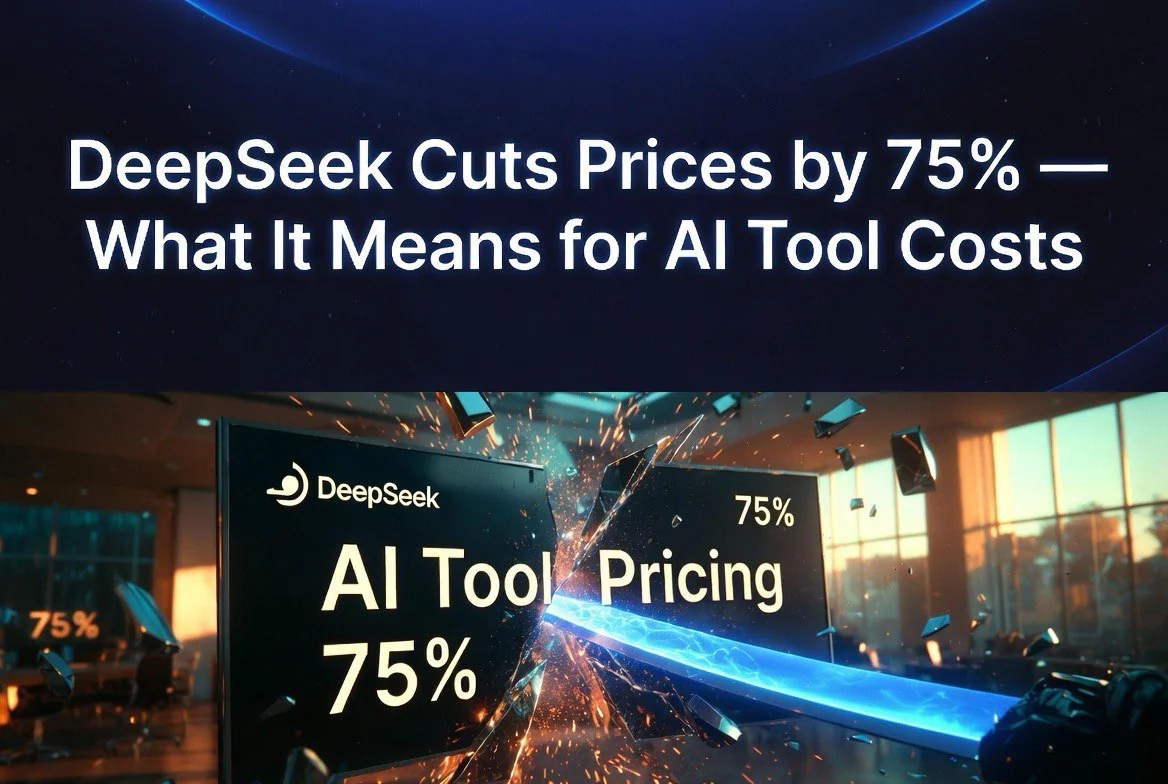
DeepSeek dropped a bomb on the AI pricing market in July 2026: a 75% price cut on its V4-Pro model, making it one of the most cost-effective frontier models for developers and businesses running AI-powered tools.
On paper, this is great news. Cheaper models mean cheaper tools, right?
Not exactly. And the reason is something few small business owners are watching.
The 100x Problem Nobody Is Talking About
Here’s the trap: a chatbot turns one question into one model call. Cheap. Simple. Predictable.
An AI agent — the kind now being built into CRMs, email tools, scheduling apps, and customer support platforms — turns one question into a chain of planning, retrieval, tool use, verification, summarization, and follow-up decisions. The user sees one answer. The vendor pays for the entire loop.
VentureBeat’s July 2026 analysis of the DeepSeek price cut calls this “token amplification” — and the numbers are staggering.
A single-turn chatbot has an input-to-billed ratio of roughly 1:5. One user message generates about 5x the tokens in context and output.
A multi-step agent running across customer support, sales, or finance operations? That ratio routinely hits 1:700 or higher.
Every loop iteration carries forward the cumulative conversation. Tool outputs append. Reasoning traces append. Nothing gets dropped until the task completes — or times out.
What a “Simple” Agent Query Actually Costs
Let’s walk through one query: “What did our top customer ask about last week?”
That one sentence triggers roughly seven priced operations:
- User prompt: ~50 tokens
- System prompt + tool definitions: ~3,000 tokens (repeated every call)
- Retrieval context: ~5,000 tokens
- Model call #1 (tool selection): 8,000 in / 200 out
- Tool execution results: ~4,000 tokens returned
- Model call #2 (summarization): 12,000 in / 400 out
- Model call #3 (follow-up decision): 12,400 in / 100 out
One sentence in, roughly 35,000 input tokens billed. Somewhere between $0.10 and $0.40 per query on a frontier model.
Now multiply that by a million queries a month — the baseline volume any growing business generates across support, sales, and operations — and you’re looking at a six-figure annual line item.
Why This Matters for Small Business Owners
You might be thinking: “I’m not running a million queries a month. I have 5 employees.”
That’s exactly why you need to understand this now.
The AI tools you’re buying — your CRM assistant, your email agent, your scheduling bot, your customer support AI — are all built on this agent architecture. Every time your team uses them, they’re generating token chains you never see. The vendor is paying the inference cost, and that cost is baked into your subscription pricing.
Here’s the problem VentureBeat identified: several AI vendors are now privately reporting negative gross margins on heavy users. A power user running 50 agent invocations a day on a $40/month seat plan can cost more in inference than the plan charges. That math doesn’t hold.
When that pressure hits, vendors have two options: raise prices or cap usage. Either way, the small business owner absorbs the cost.
This is already showing up in public coverage. Bloomberg reported in July 2026 on a widening gap between Salesforce’s Agentforce marketing demos and the capabilities actually shipping to customers. When promised functionality is technically possible but uneconomical to serve at the price the seat plan implies, something has to give.
What the DeepSeek Price Cut Actually Means
DeepSeek’s 75% reduction on V4-Pro is real, and it’s meaningful for certain use cases. If you’re building a simple RAG pipeline or running straightforward chatbot queries, you’ll see genuine savings.
But the company’s own architecture tells the complete story. DeepSeek’s radical approach to model design — which VentureBeat has covered extensively — slashes per-token costs. Yet even with those savings, the volume of tokens consumed by agentic workflows overwhelms the per-token discount.
OpenAI’s response to this dynamic is telling. The company reportedly proposed giving every Y Combinator startup $2 million in API credits — an amount that would have funded an entire seed round in any prior tech cycle. That’s less a recruiting perk than an admission of what it actually costs to run an AI-native company through its first year.
3 Things Small Business Owners Should Do Right Now
-
Ask your vendors about usage caps. Before you buy any AI-powered seat-based tool, ask: “Is there a limit on agent queries per user per month?” If the answer is vague, that’s a red flag.
-
Track your actual AI tool costs. Most small businesses have no visibility into per-query costs because they’re bundled into subscriptions. Watch for price increases or tier changes that quietly limit what “unlimited” means.
-
Prefer simple tools for simple tasks. Not every workflow needs an agent. Sometimes a basic chatbot or a well-designed template is cheaper and faster. The agent hype is real, but deploying it where you don’t need it just burns tokens.
The Bottom Line
DeepSeek’s price cut is good news. Cheaper inference is good for everyone building on AI. But it doesn’t fix the fundamental economics of agentic workflows, where one user action generates 100x the token cost of a simple chat query.
The small business owners who understand this math now — before their vendors change pricing structures — will be the ones who don’t get blindsided by subscription hikes or surprise usage limits in 2027.
Why the AI Pricing War Doesn’t Solve Your Problem
DeepSeek’s move follows a pattern you’ve seen before in tech. AWS cut prices 50+ times over a decade. Cloud storage costs fell 90%. Yet your AWS bill went up every year because you used more of it.
Same dynamic. Different layer.
The race to the bottom on per-token pricing — DeepSeek at 75% off, OpenAI matching with GPT-5.6 efficiency gains, Google slashing Gemini API costs — creates the illusion that AI gets cheaper every quarter. For simple use cases, it does. For agentic workflows, it doesn’t, because the number of tokens per workflow grows faster than the price per token falls.
VentureBeat’s analysis points to a paradox that’s now visible across the industry: the more customers deepen their agent adoption — the very usage curve vendors are selling to their boards — the worse their gross margins get. Several vendors are now privately reporting negative gross margins on their heaviest users, mirroring what the Bessemer ‘Supernova’ cohort data shows about the correlation between AI-agent adoption and margin contraction.
That’s not sustainable. And unsustainable costs on the vendor side eventually become price increases on your side.
Which AI Tools Are Most at Risk
Not all AI tools face the same token amplification problem. The ones to watch are the agent-heavy platforms where a single user action triggers multiple model calls:
- CRM agents (Salesforce Agentforce, HubSpot prospecting agents) — These autonomously research leads, draft emails, update records, and analyze pipelines. Each step is a separate model call with full context carried forward.
- Customer support platforms — An AI support agent might search knowledge base, pull order history, draft a response, check tone, and log the interaction. That’s 5-7 model calls per ticket.
- Email and calendar assistants — Tools that read threads, summarize, draft replies, check schedules, and send follow-ups are running multi-step agent chains every time you hit “suggest reply.”
- Content and marketing agents — AI tools that research topics, draft content, optimize for SEO, check brand voice, and schedule posts are token-intensive by design.
Simple tools with narrow scope — a basic chatbot, a transcription service, a single-purpose image generator — don’t have this problem. Their token consumption is predictable and bounded.
What the OpenAI $2M Credit Program Tells You
OpenAI’s reported plan to give every Y Combinator startup $2 million in API credits is the most revealing signal in this entire story.
In the last tech cycle, YC startups got a few thousand dollars in AWS credits. That was enough to run servers for a year. Now AI-native companies need two million dollars in inference credits to survive their first 12 months.
That’s not inflation. That’s token amplification at company scale. If a startup with 5-10 engineers burns through $2M in inference credits before they ship a product, what do you think happens when a small business with 5-10 employees runs AI tools embedded in their daily workflow?
The costs get passed down. Seat prices rise. Usage caps tighten. “Unlimited” plans quietly become limited.
How to Read the Tea Leaves
Here are the warning signs that your AI tool vendor is feeling the token amplification squeeze:
- Sudden feature deprioritization. If announced agent features keep getting delayed, the economics may not work at the current price point.
- New usage tiers. If “Pro” and “Business” suddenly have different query limits, the math caught up to them.
- Quiet price increases. A 10-20% price hike with no feature additions is usually margin repair, not product improvement.
- Self-serve vs. sales-led splits. If vendors start requiring sales calls for agent features, they’re trying to qualify heavy users before they become negative-margin accounts.
Frequently Asked Questions
How much did DeepSeek cut prices in July 2026?
What is token amplification in AI agents?
Will cheaper AI models like DeepSeek lower my subscription costs?
Which AI vendors are most affected by token amplification?
How can a small business protect itself from rising AI tool costs?

About Barak Schurr
Barak Schurr is the founder and former president of the nightlife ticketing platform Wantickets and former Global Director of Dance and Nightlife at Eventbrite. He currently focuses on AI research and writes about practical AI for independent business owners that actually moves the needle — no hype, no corporate fluff. More at topnotchaitools.com.
Contact: [email protected]
More AI Resources for Your Business