Get The Solo Business OS — Free
The AI workflow that replaces a part-time employee for solo operators and small business owners.
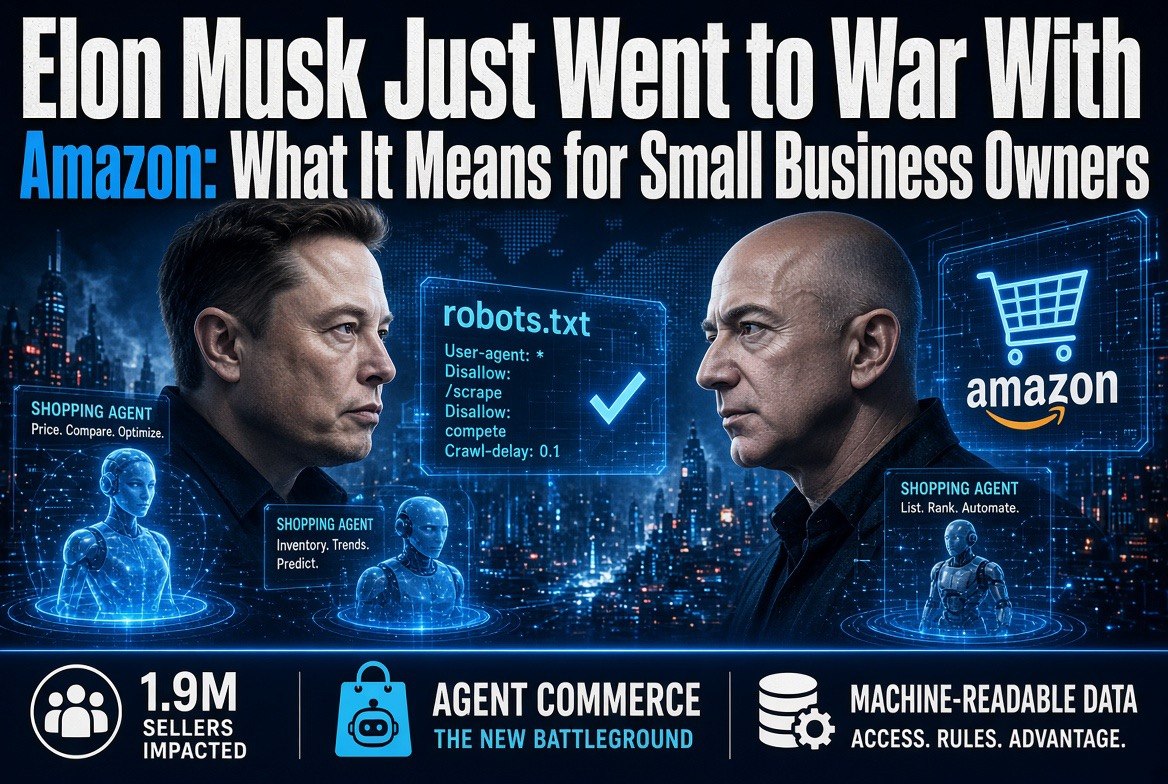
Elon Musk Just Went to War With Amazon: What It Means for Small Business Owners
⚡ Expert Summary: Amazon quietly added AI shopping agents to its robots.txt blocklist — the file that tells automated systems what they may crawl. Elon Musk responded by implying Grok’s bot would ignore it. For small business owners, this is not a Silicon Valley food fight: it decides whether your products are visible to the agents your customers will soon shop through. Here is what actually happened, what the file says, and how to prepare — with the numbers that matter.
If you sell anything online, you have spent years optimising for a human thumb scrolling a product page. That era is ending faster than most owners expect. The fight that broke out this week over Amazon’s robots.txt is the first visible shot in the war over who gets to control that shift.
What Actually Happened
Amazon updated the robots.txt file that governs its storefront. Among the disallowed paths now sit the pages an AI shopping agent would need to reach to complete a purchase on a customer’s behalf — the cart, the sign-in flow, and related checkout endpoints.
That is not a routine technical edit. A retailer that blocks the cart is not blocking traffic; it is blocking transactions. The message is deliberate: automated buyers are welcome to look, and not welcome to buy.
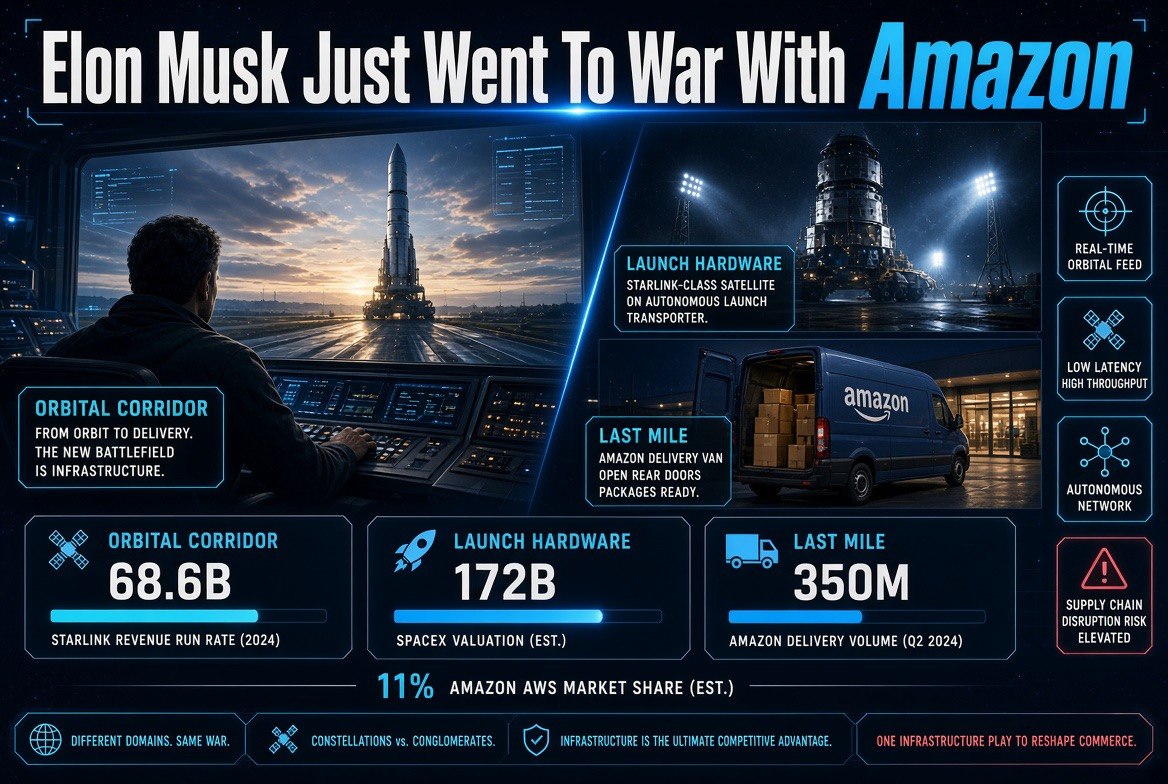
Elon Musk’s response was characteristically blunt. He framed the block as a hostile act and signalled that Grok — xAI’s assistant — would not respect a wall built to keep AI agents out. Attributed directly: the story was broken down by the creator Farzad in a video titled “Elon Musk Just Went To War With Amazon”, which is where the confrontation first got public traction.
The interesting part is not the personalities. It is the precedent. When a company the size of Amazon decides that machine buyers are a category to be fenced off, every smaller retailer inherits that decision as a default — often without ever choosing it.
Why Amazon Would Block Its Own Best Customers
Amazon’s advertising business is projected to reach $94 billion globally by 2026, up from $37.74 billion in 2022. In the United States alone, ad revenue is expected to climb from $27 billion in 2022 to $64 billion by 2026.
Those numbers explain everything. Amazon does not make its money primarily by selling your product — it makes money by mediating the moment of purchase. The search result, the sponsored placement, the buy box: all of it is a toll booth.
An AI agent that goes straight to the cheapest verified source and completes the transaction bypasses every one of those tolls. It turns Amazon from a mall into a warehouse. That is an existential threat to the business model, and blocking the cart is the cheapest available defence.
The Numbers Behind the Shift
This is not a bet on a distant future. The data already shows where the money is moving.
| Metric | Value | What It Signals |
|---|---|---|
| Amazon Q1 2026 net revenue | $181.5 billion | Scale of the platform agents want to reach |
| Advertising Services, Q1 2026 | $17.2 billion (+24% YoY) | Ads grow faster than retail — the toll booth matters more than the shelf |
| US e-commerce market share | 37.8% | Amazon can set the default for the whole market |
| Active third-party sellers | 1.9 million | How many small businesses inherit this decision |
| Units sold by third-party sellers | 62% | Independents are the majority of what actually ships |
| Projected global ad revenue, 2026 | $94 billion | The revenue line agentic checkout threatens |
The pattern is plain. Amazon’s advertising line is growing at 24% year over year while its core retail grows more slowly. The company’s future depends on owning the moment of decision — which is precisely the moment an autonomous agent removes.
Amazon’s Own Numbers: The Fees and the Ads
Before the policy fight, understand the machine it protects. Two figures explain Amazon’s position better than any statement from either side.
- Sponsored product ads: ~$68.6 billion in 2025, on strong growth. A plain search for something as ordinary as “electric toothbrush” now returns a page where most top results are paid placements.
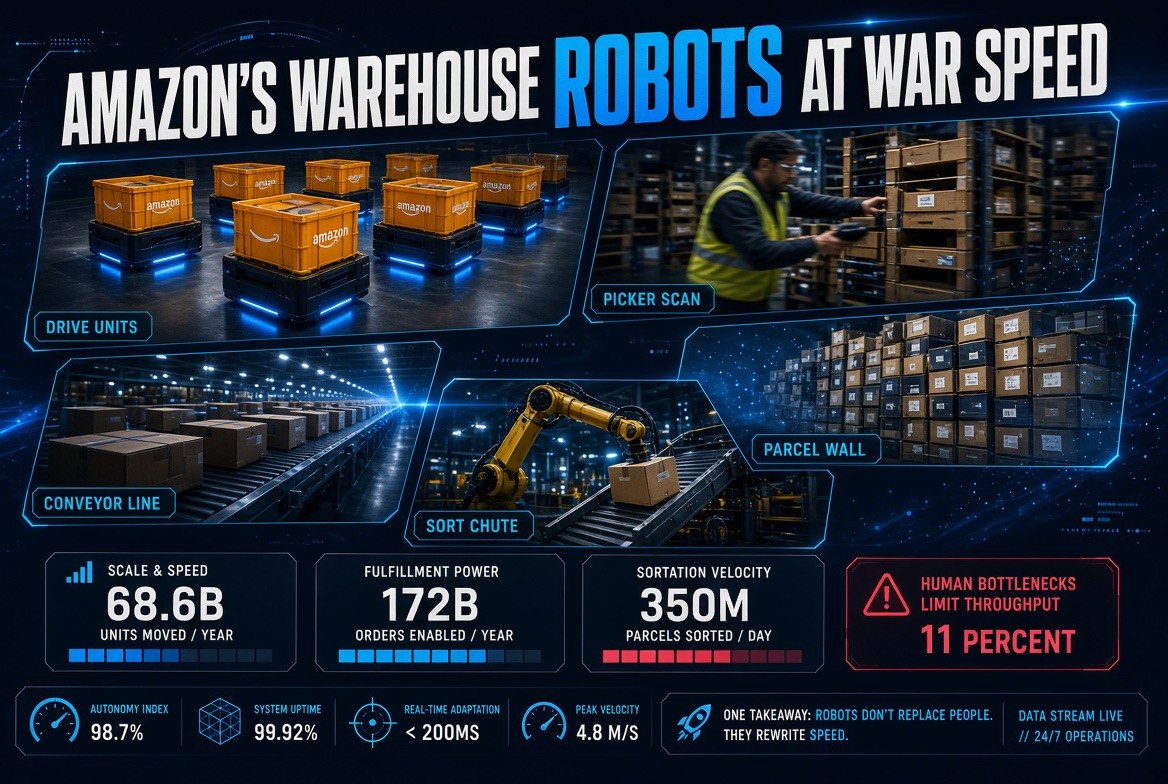
- Third-party sellers pay roughly $172 billion in 2025 in referral, storage, and shipping fees combined. Those sellers account for about 60% of the items Amazon ships.
Read those two numbers together and the whole fight makes sense. Amazon earns billions selling placement to sellers, and billions more charging those same sellers to store and ship their goods. An AI agent that routes around the search page and completes checkout directly threatens both revenue lines at once.
Amazon’s own answer is already visible. It runs Rufus, now branded Alexa for Shopping — an assistant that can auto-buy at a target price. More than 350 million shoppers used it in the past year, and US users spent more than 40% per order when it was involved. It will even shop other brands’ sites on a customer’s behalf.
That is the contradiction at the centre of this story: Amazon wants to be the agent that buys from everyone else, and does not want to be the retailer that agents buy from. The robots.txt edit protects one half of that position and leaves the other half running.
The demand side is still early. In one survey, only about 11% of US shoppers had let an AI complete a purchase for them. That is the window owners have — the behaviour is coming, but the habits are not locked yet.
What the Robots.txt Actually Says
Read the file yourself at amazon.com/robots.txt and you will find, under a blanket User-agent: *, disallow rules aimed at exactly the paths a purchasing agent needs:
/gp/cart— the shopping cart/gp/sign-in— authentication/gp/product/product-availability— stock confirmation/gp/yourstore— the personalised storefront/gp/history— purchase history
The file does not name Grok, OpenAI, Perplexity, or anyone else. It does not have to. A blanket disallow on the cart path closes the door to every automated buyer simultaneously — and it is trivially updated the moment a specific crawler needs naming.
Two Futures: Closed Malls vs. Open Agents
There is a genuine fork here, and it is worth understanding rather than cheering for a side.
| Dimension | The Closed Model (Amazon’s position) | The Open Model (Grok’s implied position) |
|---|---|---|
| Who controls the purchase moment | The marketplace | The agent’s owner |
| Revenue source | Ads, placement, commission | Speed and convenience for the buyer |
| Seller visibility | Bought through ad spend | Earned through price and clarity |
| Winners | Platforms with large ad budgets to protect | Lean sellers with clean product data |
| Risk for small business | Pay-to-play gets more expensive | Commodity pricing, thin margins |
| Practical control | Enforced by robots.txt and authentication | Enforced by ignoring the file — legally untested |
Neither column is obviously better for an independent operator. A closed model means you keep buying attention. An open model means an agent can compare you to forty competitors in milliseconds and pick whichever is ten cents cheaper.
What matters is that you are not asked. The default gets set by whoever has the leverage, and you adapt to it.
What Small Business Owners Should Actually Do
The instinct to panic is misplaced. The instinct to do nothing is worse. There is a practical middle path, and it starts with the boring work most owners skip.
1. Make Your Product Data Machine-Readable
An agent cannot recommend what it cannot parse. Structured product data — clean titles, accurate attributes, real specifications, consistent naming — is the new shelf position. Sellers with 500 listings and sloppy titles are invisible to a machine that reads fields, not marketing copy.
2. Stop Treating Your Own Site as an Afterthought
If your entire business lives inside a marketplace, you are renting access to your own customers. The agent era sharpens that dependency rather than softening it. Every owner selling primarily through Amazon should be asking what share of revenue they could survive losing if a platform changed a policy over a weekend.
3. Watch the Logs, Not the Headlines
Bot traffic on your own site is now a signal. If AI crawlers are visiting your product pages, you have leverage worth understanding. If they are not, that is the gap to close — long before the fight between Musk and Amazon resolves one way or the other.
4. Assume the Rules Will Keep Moving
The robots.txt change was not the end of anything. It was an opening position. Expect marketplaces to fence off more paths, and expect AI companies to test those fences — technically and legally. Owners who build flexible operations settle those arguments without losing a season of revenue.
Why This Fight Matters More Than It Looks
Strip away the billionaires and the posturing and a single question remains: when a machine buys on a customer’s behalf, whose rules govern the transaction?
Amazon has answered for its own storefront: mine. Musk has answered for Grok: ours. Nobody has answered for the 1.9 million third-party sellers whose inventory makes Amazon worth crawling in the first place.
That silence is the actual risk. The businesses most exposed to this shift are the ones with no seat at the table and no plan for the outcome — and they will find out which model won by watching their orders, not by reading the announcement.
The owners who come out ahead will be the ones who treated this week as a warning rather than a spectacle. Clean data, diversified channels, and a real understanding of where your traffic comes from are not glamorous answers. They are the ones that still work after the robots.txt file changes again.
The Three Ways This Breaks for Independent Sellers
Abstract policy arguments are easy to ignore. Here is what the block actually does to a business that depends on Amazon for revenue.
Your Advertising Gets More Expensive
If agents cannot complete a purchase, they will not be the ones buying. Human buyers remain the target — which means the contest for their attention keeps running through paid placement. Amazon’s advertising line grew 24% year over year to $17.2 billion in the first quarter of 2026. A wall that keeps agents out also keeps every seller bidding for the same human eyeballs.
Your Product Data Becomes the Whole Ball Game
When an agent does reach your listing, it does not read your brand story. It reads fields. Title, attributes, specifications, availability, price. A listing built to charm a human with ninety characters of keyword-stuffed copy is a listing an agent may fail to interpret correctly. The sellers who win will be the ones whose data is unambiguous.
Your Channel Risk Becomes Concentrated
Amazon holds 37.8% of US e-commerce and carries 1.9 million active third-party sellers, who account for 62% of units sold. If you are one of them and your only channel is that marketplace, a single policy edit is a single point of failure. That was already true before this week. The robots.txt change just made it visible.
A Short History of Who Controls the Shelf
Retail has always been a fight over the point of sale, and the pattern repeats.
Physical retail concentrated power in whoever owned the real estate. Shopping malls charged rent for foot traffic; the anchor tenant got the best square footage. Then e-commerce moved the fight online, and the shelf became a search result page — ranked, auctioned, and sold. Amazon mastered that model and turned it into a $94 billion projected advertising business.
Agentic commerce is the third move. If an AI can compare every seller’s price, availability, and shipping terms in under a second, the shelf stops being a page anyone reads. It becomes an answer. And whoever writes the answer owns the sale.
That is why Amazon’s robots.txt edit is not a technicality. It is a land grab for the answer layer, executed in a plain text file most owners will never open.
How to Tell Whether You Are Exposed
You do not need a consultant to assess your position. Four questions get you most of the way.
| Question | Healthy Answer | Warning Sign |
|---|---|---|
| What share of revenue comes from one marketplace? | Under half, with a working second channel | Most or all of it |
| Are your product attributes complete and consistent? | Structured fields, uniform naming | Keyword-stuffed titles, missing specs |
| Can customers find you off-marketplace? | Owned site with real search visibility | No site, or a site nobody visits |
| Do AI crawlers reach your own pages? | Visible bot traffic in server logs | No idea — never checked |
Two warning signs is a project. Four is an emergency. The good news is that every one of them is fixable with work you control, rather than policy someone else sets.
What Happens Next
Three outcomes are plausible, and they are not equally likely.
Escalation. Other large retailers copy the block, and AI companies escalate by testing the boundary directly. This produces legal fights, public arguments, and eventually a rule — written by courts or regulators, well after the businesses affected have already adapted or failed.
Negotiation. Access becomes a commercial arrangement. Platforms license agent traffic the way they license content today, and the cost gets passed down to sellers in fees that look, functionally, exactly like advertising spend.
Standardisation. The industry settles on a machine-readable way for agents and retailers to transact with explicit permission. Slow, boring, and the best outcome for small operators — because it replaces a coin flip with a specification.
The least likely outcome is that nothing changes. The file is already edited.
What is robots.txt and why does it matter for my business?
Robots.txt is a plain text file at the root of a website that tells automated crawlers which pages they may and may not access. It is a convention, not a law — well-behaved crawlers follow it voluntarily. It matters because it is the primary mechanism platforms use to decide whether AI shopping agents can reach your listings and complete purchases.
Did Elon Musk really tell Grok to ignore Amazon’s robots.txt?
Musk responded publicly to Amazon’s decision to block AI agents from its cart and sign-in paths, framing it as a hostile move and signalling that Grok would not defer to that kind of block. The confrontation was broken down publicly by the creator Farzad. What has not happened is a formal legal challenge — the position remains a public stance for now.
Will Amazon block AI agents from buying on my behalf?
Amazon has blocked automated access to the specific paths a purchasing agent needs: the cart, sign-in, availability checks, and purchase history. Looking at listings is still permitted. Completing a transaction automatically on the Amazon storefront is what has effectively been closed off.
How much does Amazon make from advertising?
Amazon’s advertising revenue is projected to reach $94 billion globally by 2026, up from $37.74 billion in 2022. Its Advertising Services line alone generated $17.2 billion in the first quarter of 2026 — growth of 24% year over year, faster than its core retail business.
What should small sellers do right now?
Three things: make your product data structured and machine-readable, reduce how dependent your revenue is on any single marketplace, and check whether AI crawlers are visiting your own site. None of this requires knowing how the Musk-versus-Amazon standoff ends — it pays off regardless of which model wins.
Is this a fight between Musk and Amazon, or something bigger?
It is bigger. The personalities made it visible, but the underlying conflict is between platforms that profit from mediating purchases and AI systems that are designed to remove that mediation. Every seller on every marketplace is downstream of how that conflict resolves.
Does this affect businesses that do not sell on Amazon?
Yes, indirectly. Amazon holds 37.8% of the US e-commerce market, so its policies set norms other platforms copy. If blocking purchasing agents becomes standard practice, smaller retailers will inherit the same default — usually without any announcement.

About Barak Schurr
Barak Schurr built and sold a major ticketing platform, ran global nightlife operations at Eventbrite, and now spends his time figuring out which AI tools actually move the needle for independent business owners — and which ones are just noise. No hype. No fluff. Just what works.
Email: [email protected]
More AI Resources for Your Business