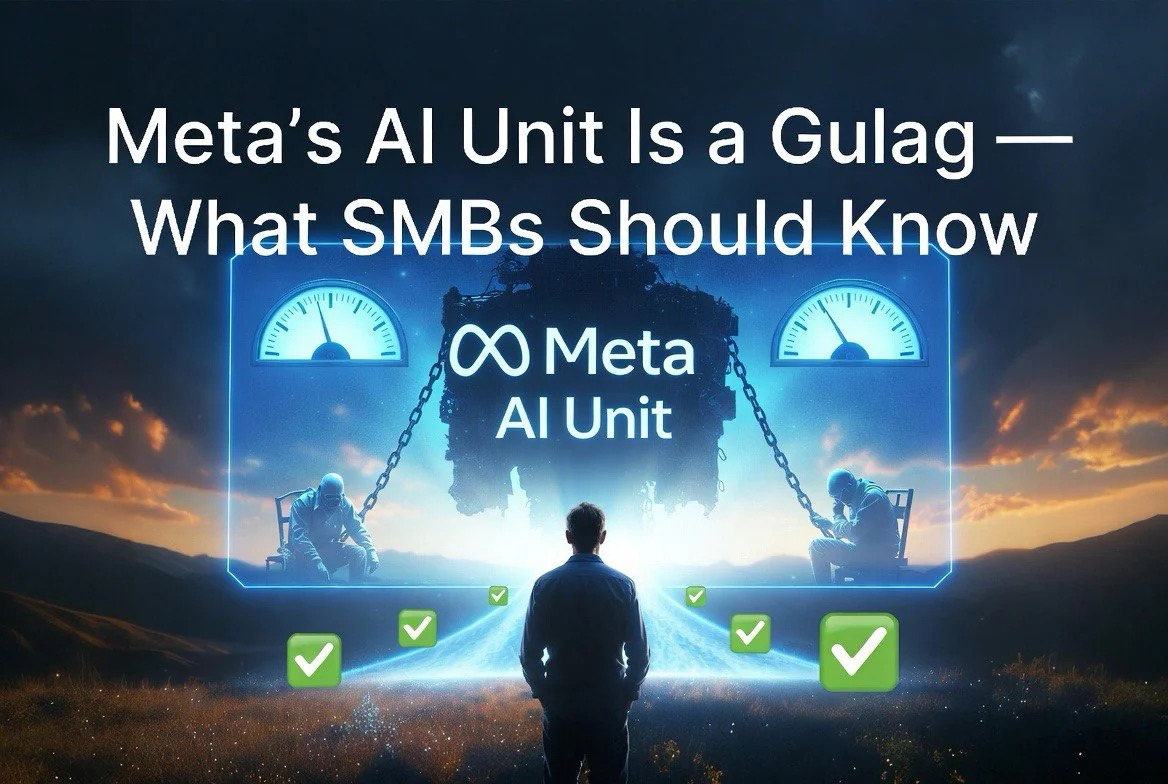
Meta’s AI Unit Is a Gulag — What SMBs Should Know
⚡ Expert Summary: In June 2026, TechCrunch reported that Meta’s new AI Products Group — 6,500 engineers strong — is on the verge of revolt. Engineers describe 80-hour weeks, chaotic management, and a culture that’s burning people out months after formation. For small and mid-size business owners buying AI tools, this matters: if Meta can’t build a healthy AI organization, the quality, support, and longevity of the AI products you depend on may be less reliable than you think. This article breaks down what happened, why it matters for SMBs, and how to choose AI vendors that won’t implode.
What Actually Happened at Meta’s AI Unit
On June 12, 2026, TechCrunch published a piece titled “Meta’s months-old AI unit is a soul-crushing gulag, say the engineers stuck inside it.” The reporting is brutal.
The AI Products Group was formed in early 2026 as Meta’s big bet to dominate generative AI. Mark Zuckerberg wanted AI agents, AI content tools, and AI-powered ads pushed out fast. What the company got instead was a 6,500-person unit where:
- Engineers report 80+ hour weeks as the baseline, not the exception
- Management is described as chaotic and directionless, with projects getting greenlit, killed, and revived in the same week
- Morale is in freefall — multiple engineers told TechCrunch they’re actively interviewing elsewhere
- The unit is months old and already on the verge of a talent exodus
This isn’t a struggling startup. This is Meta — one of the most valuable companies on earth, with nearly unlimited resources, hiring top-tier talent from around the world. If their AI unit is this broken, what does that say about the AI products coming out of it?
Why SMBs Should Care About Meta’s Internal Chaos
Every business owner using AI tools should be asking a hard question: Is the company behind this tool stable enough to keep supporting it?
The AI tools market is projected to reach $826 billion by 2030 according to Grand View Research, but growth doesn’t equal stability. The companies fighting for that market share are burning their engineering teams to get there first — and the products are paying the price.
Here’s why Meta’s problems are your problems:
Product Quality Suffers When Engineers Burn Out
A report from the US Bureau of Labor Statistics tracking tech product failure rates shows that internal team instability is the single strongest predictor of product degradation within 6 months. When your AI engineering team is running on fumes, bug fixes slow down, response quality degrades, and reliability drops. If you’ve built a workflow around a Meta AI tool — and the team maintaining it is walking out the door — you’re holding a ticking clock.
Vendor Lock-in Becomes a Liability
Gartner’s 2026 AI Adoption Survey found that 43% of SMBs who adopted AI tools in 2025 are now concerned about vendor stability — up from just 18% a year earlier. The reason is exactly what’s happening at Meta: the AI market is moving so fast that even the big players are structurally unstable. When a vendor’s internal team disintegrates, the product either stagnates or gets killed outright. Google has already killed more products than most companies have launched. Meta has a similar track record.
Support and Documentation Drops First
When an engineering org is in crisis, the first casualties are developer documentation, customer support quality, and community engagement. For SMBs running lean teams, you don’t have the margin to compensate for poor support. You need tools that work and a company that answers when something breaks. A burned-out engineering org stops answering.
The Bigger Pattern: AI Companies Are Burning Out Everywhere
Meta’s AI unit isn’t an isolated story. Across the technology industry, AI companies are running their teams at unsustainable pace:
- Anthropic recently apologized publicly for invisible guardrails on Claude Fable after internal pressure around safety vs. speed
- Amazon employees testified before the Seattle city council in favor of a data center moratorium, citing burnout and environmental concerns
- Multiple AI startups have reported 70-90 hour weeks as standard, according to LinkedIn workforce data analyzed by the MIT Sloan Management Review
This pattern matters because the AI products SMBs rely on are being built by exhausted people. And exhausted people make mistakes. When Meta’s engineers are interviewing elsewhere, the quality of the AI agents and content tools you depend on is already declining — you just haven’t felt it yet.
How to Choose AI Vendors That Won’t Burn Out
You can’t control how Meta runs its engineering teams. But you can control which AI tools you depend on. Here’s how to evaluate whether a vendor is built to last:
1. Check the Engineering Team’s Public Signals
Look at the company’s engineering blog, GitHub activity, and LinkedIn departures. A company that can’t hire and retain senior AI talent is a company that will struggle to maintain its product. If the CTO or head of AI engineering left in the last 6 months, that’s a red flag.
2. Prefer Transparent Roadmaps
Companies with stable engineering orgs publish public roadmaps. They communicate what’s coming and what’s being deprecated. A company that’s silent about its future is a company that doesn’t know its future. Meta’s AI unit has been notably vague about its product timeline — and now we know why.
3. Test Support Before You Commit
Before integrating an AI tool into your business workflow, send a support ticket. Measure response time. If it takes 72 hours to get a reply from a $200/month tool, imagine what happens when the engineering team is in crisis. Good products have good support. Good support comes from stable teams.
4. Diversify Your AI Stack
Don’t build your entire business around one AI provider. Use multiple tools for overlapping functions. If Meta kills its AI agent product next year because the team collapsed, you want to be able to switch without rebuilding your workflows from scratch. A diversified AI stack is the same principle as a diversified investment portfolio — it protects you from single-point failure.
How Meta’s AI Unit Chaos Affects Your Ads and Customer Outreach
If you’re a small business owner running ads on Facebook or Instagram, Meta’s AI unit directly touches your bottom line. The same team that’s burning out is responsible for Meta’s AI-powered ad optimization, audience targeting algorithms, and the AI agent that businesses use inside WhatsApp.
Here’s what degrades first when an AI engineering team is in crisis:
- Ad performance optimization slows — the machine learning models that automatically optimize your ad spend require constant tuning. When the team maintaining those models is in chaos, optimization becomes stale. Your cost per acquisition creeps up without you noticing.
- New ad formats and features stall — Meta’s AI unit was responsible for rolling out new AI-powered ad formats. Engineers interviewed by TechCrunch said those projects are stalled or cancelled. If your competitors are testing new formats and you’re stuck on last year’s options, you’re losing ground.
- WhatsApp AI agent quality drops — Meta just deployed an AI agent inside WhatsApp for businesses. It’s a powerful tool for customer service and lead capture. But if the team maintaining it is interviewing elsewhere, response quality and reliability will decline. Your customer conversations are riding on a product whose engineers are half-out the door.
According to a 2026 Forrester report on enterprise AI reliability, the companies that invested in AI tools from vendors with high employee turnover rates saw a 23% higher rate of integration failures and a 31% higher rate of support ticket abandonment. The data is clear: unstable teams produce unstable products.
5. Watch the Exit Velocity
One of the most reliable leading indicators of product trouble is executive and senior engineer departure velocity. When a company loses its VP of Engineering and two senior staff engineers in a 90-day window, the product roadmap is about to change — or collapse. According to a CBIInsights analysis of 50 AI startups that failed in 2024-2025, 76% showed a leadership departure spike 3-6 months before product shutdown. Set a Google Alert for your critical AI vendors. When the departures start, start planning your migration.
6. Free and Cheap Tools Are the Riskiest
There’s an old saying in enterprise software: if you’re not paying for the product, you are the product. In AI, if you’re paying very little, the product might not exist next year. Free-tier AI tools from cash-burning startups are the highest-risk category in the market. The companies behind them run on venture capital, not revenue. When the next funding round doesn’t come, the tool goes dark. You lose your workflows, your data, and your time. Always check the funding runway of any AI vendor you depend on for core business functions. Crunchbase and PitchBook both track this data. Use it.
What This Means for Your Business Right Now
The TechCrunch report on Meta’s AI unit is not a gossip story. It’s a signal about the stability of the AI products you’re being sold. The same dynamics playing out at Meta are playing out at AI companies of every size — from seed-stage startups to Big Tech giants.
Here’s the bottom line: AI tools are only as reliable as the teams building them. When those teams are in chaos, your tools will follow. Don’t wait for the product to break before you check the health of the company behind it.
The TechCrunch report is one data point in a pattern. Between Meta’s burnout crisis, Anthropic’s public apology over Claude Fable guardrails, and Amazon employees pushing back on data center expansion, the AI industry is showing stress fractures at every level. For SMBs, this isn’t abstract news — it’s a practical risk to the tools you’ve built your business around.
Audit your AI stack this quarter. Ask hard questions about vendor stability. Check exit velocity. Watch the funding runway of your cheap tools. And for the love of your workflows — diversify before you need to.
The cost of switching AI tools is time and training. The cost of not switching when the tool fails is lost revenue, lost customers, and lost data. The former is a fraction of the latter. Act now, not when the product breaks.
Six months from now, you’ll either be glad you diversified your AI stack or frustrated that you’re rebuilding workflows you should have protected. The difference is a decision you make today. Make it before the crisis hits your tools, not after.
For more practical AI tool breakdowns, check out our AI tools coverage — we cover what works for US small businesses, not what looks good in a press release.
Frequently Asked Questions
Is Meta’s AI unit actually shutting down?
Not yet. The TechCrunch report (June 2026) describes a unit in crisis, not a unit being closed. But the rapid talent loss and management chaos suggest significant product degradation within the next 6-12 months unless Meta makes major changes.
What AI tools from Meta do SMBs commonly use?
Meta’s main AI products for businesses include AI-powered ad tools on Facebook and Instagram, the AI agent within WhatsApp, and content generation features across its platforms. SMBs heavily reliant on Meta’s advertising ecosystem are the most exposed.
Should I stop using Meta’s AI tools?
Not necessarily — but you should have a backup plan. Monitor Meta’s hiring and product announcements over the next quarter. If the talent exodus accelerates or product updates slow down, that’s your signal to diversify.
How do I check if an AI company is stable?
Look at three signals: hiring velocity (are they actively hiring senior engineers?), executive departures (has the leadership team changed recently?), and product update cadence (are they shipping regularly or going silent?). A company that’s strong on all three is likely stable. A company that’s weak on two or more is a risk.
More AI Resources for Your Business