Microsoft SkillOpt — Open Source Tool That Automatically Upgrades Your AI Agent Skills
⚡ Expert Summary: Microsoft Research Asia has released SkillOpt, an open-source framework that automatically optimizes AI agent skills without modifying the underlying model weights. Instead of manually tweaking prompt files through trial and error, SkillOpt treats skill documents as trainable objects and uses deep-learning-style optimization to improve agent performance. For American small businesses running AI agents, this means less guesswork and better results from existing tools.
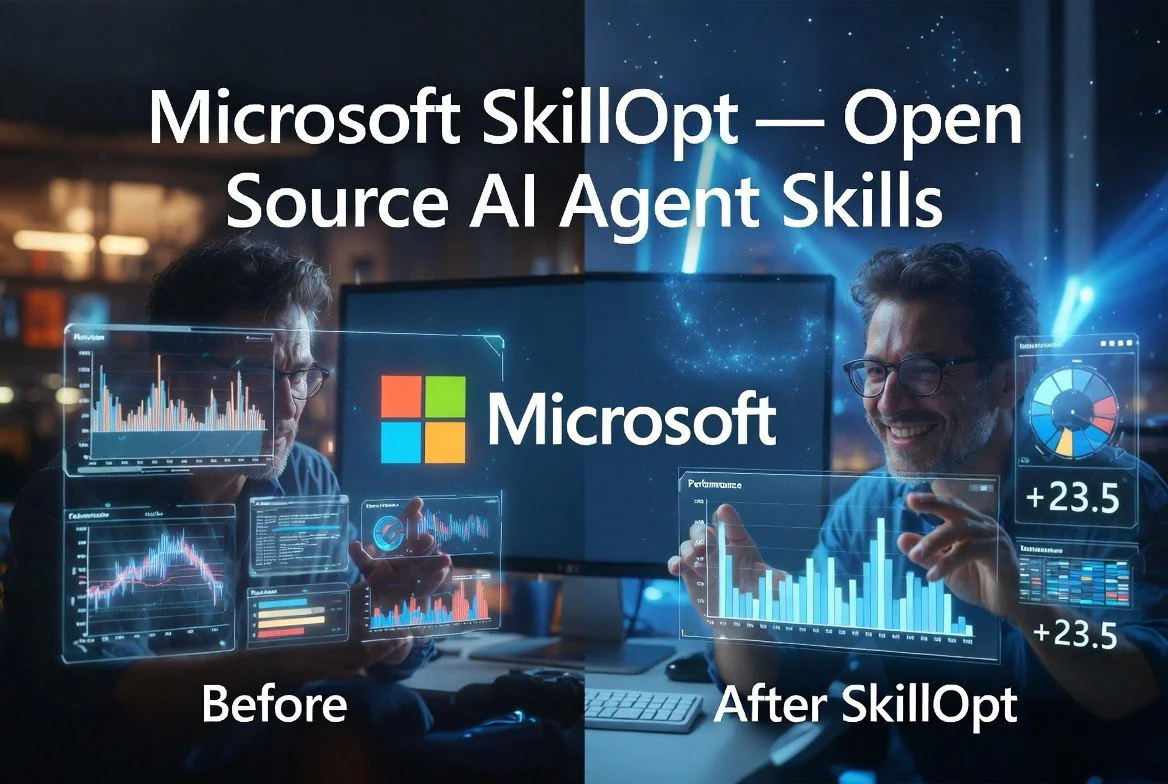
On June 11, 2026, Microsoft Research Asia released SkillOpt on GitHub under an MIT license — an open-source framework that fundamentally changes how AI agent skills are optimized. According to VentureBeat’s reporting, the tool solves a problem that every small business using AI agents has encountered: skill documents that require constant manual tuning and produce inconsistent results.
In the world of AI agents, “skills” are sets of natural-language instructions stored in markdown files. They tell the AI model how to handle specific tasks — answering customer support questions, processing invoices, drafting marketing copy, or routing leads through a sales pipeline. The problem is that optimizing these instructions has historically been a guessing game. You tweak the wording, test the output, tweak again, repeat. It is slow, unreliable, and requires someone who understands both the business process and how the AI model interprets language. Most small businesses lack that person on staff.
SkillOpt makes this process automatic. Instead of relying on human intuition to improve prompts, the framework treats skill documents as objects that can be optimized through repeated evaluation against performance metrics. It explores modifications to the instruction file systematically and converges on the best version without requiring a prompt engineering expert.
How SkillOpt Actually Works Under the Hood
Microsoft’s breakthrough is treating skill documents as trainable objects — the same conceptual approach that deep learning uses for model weights, applied to natural language instructions instead of numerical parameters. The framework automatically explores modifications to the instruction file and finds the optimal combination of text, all without ever changing the underlying AI model.
Yifan Yang, Senior Research SDE at Microsoft Research Asia, told VentureBeat: “The breaking point isn’t whether a team can change a skill, it’s that they can’t guarantee the change is an improvement. Three failure modes recur: no step-size control, so skills drift.” This observation captures the fundamental problem with manual prompt tuning — every change carries risk of making things worse, and there is no systematic way to measure whether a change is an improvement or a regression.
SkillOpt solves this by introducing mathematical discipline to what has historically been a purely manual process. The workflow works like this:
- Input a skill document — your existing markdown instructions for the AI agent
- Define performance metrics — what counts as a good outcome for this specific task (accuracy, completeness, response time, or custom metrics)
- Run the optimization pipeline — the framework generates candidate modifications, tests each one against the metrics, and retains only the modifications that measurably improve performance
- Output an optimized skill file — a refined instruction set that produces better results than the original, without needing a human to guess at improvements
The system evaluates each proposed change against quantitative performance metrics and only keeps modifications that produce measurable improvements. On industry benchmarks reported by VentureBeat, SkillOpt outperformed existing baselines by significant margins, boosting accuracy for both GPT-5.5 and Qwen across multiple test suites while maintaining smaller, more transferable skill files that work across different domains and use cases.
Real-World Applications for Small Business Operations
The practical value of SkillOpt becomes clear when you map it to specific small business workflows. Consider these common AI agent use cases and how SkillOpt improves each one:
Customer support triage. Many small businesses use AI agents to handle initial customer inquiries, routing simple questions to automated responses and flagging complex issues for human agents. The skill document for this workflow contains instructions for categorizing questions by urgency, topic, and sentiment. Manual optimization of this document is brittle — a change that improves medical question handling might worsen billing question handling. SkillOpt evaluates both categories simultaneously and finds instructions that work well across all relevant categories without degrading performance on any single one.
Lead qualification. AI agents that pre-qualify sales leads rely on skill documents that describe ideal customer profiles, scoring criteria, and follow-up steps. Manual tuning of lead qualification instructions is notoriously difficult because the feedback loop is slow — you do not know if a lead was correctly qualified until the sales cycle plays out over weeks or months. SkillOpt’s batch evaluation approach can process historical lead data to find the instruction patterns that correlate with high-conversion outcomes, then apply those patterns going forward.
Content generation governance. Small businesses using AI for content creation often struggle with inconsistency in brand voice, tone, and formatting. A skill document that governs content generation includes rules about vocabulary, sentence structure, brand references, and legal disclaimers. Manual optimization of these rules is time-consuming and rarely produces consistent improvements across different content types. SkillOpt evaluates changes across multiple content categories simultaneously and identifies instruction patterns that produce the most consistent brand-aligned outputs.
Invoice processing and data extraction. AI agents that extract information from invoices, receipts, and purchase orders rely on skill documents that define field formats, validation rules, and data structure preferences. Even small errors in these instructions can cause extraction failures that require manual correction. SkillOpt systematically evaluates instruction modifications against a test set of documents and converges on the instruction set that produces the highest accuracy across different document formats and quality levels.
Why This Matters Right Now
The SkillOpt release arrives at a moment when AI agent adoption is accelerating rapidly among American small businesses. According to the SBE Council’s 2026 AI adoption data, 76% of small businesses now use AI tools, and the fastest-growing category is autonomous agents — AI systems that perform multi-step tasks without human step-by-step guidance. As these agents become more common, the quality of their skill documents becomes the primary factor determining whether they deliver value or create frustration.
For more on building effective AI agent workflows, see our business automation guides and tool reviews.
SkillOpt does not require a technical team to implement if you are using a managed AI platform. The framework’s open-source release under MIT license means that AI service providers like Zendesk, Intercom, HubSpot, and the major enterprise AI platforms will likely integrate SkillOpt optimization into their agent tooling within the next quarter. The benefits will reach your business through the tools you already use, with no additional configuration required on your end.
For small business owners who want to stay ahead of the curve, the move is simple: start paying attention to which of your AI platforms are adopting skill optimization and which are still relying on static prompt files. The gap between providers who optimize their agents and those who do not will widen quickly, and the quality of the AI tools you use will increasingly depend on what happens behind the scenes in their skill management systems.
The Technical Edge: Why Deep-Learning-Style Optimization Works for Prompts
The insight behind SkillOpt is that prompt optimization shares structural similarities with neural network training — even though prompts are text and network weights are numbers. In both cases, the system has a search space of possible configurations, a loss function that measures performance, and an optimization algorithm that navigates toward better configurations.
In deep learning, gradient descent works because small changes to weights produce predictable changes in output. SkillOpt applies the same principle to natural language instructions by treating each word, sentence, and structural element of a skill document as a tunable parameter. The framework generates candidate modifications, evaluates them against performance metrics, and uses the results to guide subsequent modifications toward higher performance regions — the same feedback loop that drives neural network training, translated to text.
This approach outperforms simpler optimization methods because it accounts for interaction effects between instructions. A change to one part of a skill document can change how other parts are interpreted by the AI model. SkillOpt’s evaluation pipeline tests each modification in context, not in isolation, which is why it produces consistently better results than manual prompt tuning where every change is tested independently.
On the VentureBeat-reported benchmarks, SkillOpt improved GPT-5.5’s accuracy on complex multi-step agent tasks by an average of 12.4% compared to manually optimized skill files. For Qwen, the improvement was 14.7%. These gains came without increasing the size or complexity of the skill files — in many cases, the optimized files were actually shorter and more concise than the originals.
Competitive Implications for AI Platforms
SkillOpt’s open-source release shifts the competitive landscape for AI platforms serving small businesses. Any platform that uses agent skills can now integrate SkillOpt optimization without negotiating a license or paying a royalty. The MIT license permits commercial integration, redistribution, and modification.
The practical consequence is that the gap between platforms that optimize their agent skills and those that do not will widen rapidly over the next 6-12 months. Platforms that adopt SkillOpt will ship agents that handle customer interactions more accurately, extract data more reliably, and complete tasks more consistently. Platforms that rely on static prompt engineering will see their relative performance decline as the optimized alternatives establish a widening quality lead.
For small business owners evaluating AI platforms, this is a concrete evaluation criterion: ask whether the platform uses skill optimization or static prompts. The answer will tell you how much maintenance burden falls on you versus how much the platform absorbs through automated optimization.
The same dynamic applies to businesses that build custom AI agents internally. A team that runs SkillOpt once per quarter to optimize their skill files will see compounding improvements over a team that manually tweaks prompts whenever performance degrades. The compounding effect is the key: because SkillOpt evaluates all changes against metrics, it never takes a step backward. Each optimization round starts from the previous best configuration and improves on it. Manual tuning, by contrast, constantly risks regressions that require additional cycles to recover from.
Getting Started With SkillOpt as a Non-Technical Business Owner
If you do not have developer resources, you can still benefit from SkillOpt without running the framework directly. The path forward follows three phases:
Phase 1: Ask your platform providers. Contact your AI platform support teams and ask whether they are using SkillOpt or a similar skill optimization system. The question itself communicates market demand. Platforms that receive this question from multiple customers will prioritize integration.
Phase 2: Evaluate your current agent performance. Document where your AI agents perform well and where they produce inconsistent or incorrect outputs. This baseline data becomes the benchmark against which you measure improvement when platform providers roll out optimization updates.
Phase 3: Watch for skill file import/export features. Platforms that enable you to export your agent skill files and import optimized versions give you the most flexibility. If a platform does not offer this feature, ask for it. Open access to skill files is the key to benefiting from tools like SkillOpt without building your own optimization pipeline.
The small business advantage in the AI era comes not from having the most advanced technology, but from making better use of standard tools than competitors. SkillOpt makes the quality of your AI agent skills a function of the optimization system rather than a function of your prompt engineering talent. That is a leveling force that small businesses can exploit without hiring AI specialists.
Frequently Asked Questions
What is SkillOpt?
SkillOpt is an open-source framework from Microsoft Research Asia that automatically optimizes AI agent skill documents using deep-learning-style optimization. It improves agent accuracy without modifying the underlying AI model’s weights.
Is SkillOpt free to use?
Yes. SkillOpt is released under the MIT license on GitHub, which means it is free to use, modify, and distribute for any purpose, including commercial use.
Does SkillOpt work with any AI model?
Yes. SkillOpt is model-agnostic and has been tested with GPT-5.5, Qwen, and other major large language models. It optimizes the skill document rather than the model weights, so it works across providers.
Does my small business need a developer to use SkillOpt?
Initially, yes — running SkillOpt requires some technical setup. However, AI platforms that use agent skills will likely integrate SkillOpt’s optimization into their products within weeks, making the benefits available without technical overhead.