Get The Solo Business OS — Free
The AI workflow that replaces a part-time employee for solo operators and small business owners.
Only 2% of Consumers Trust AI Recommendations: What It Means for Your Business
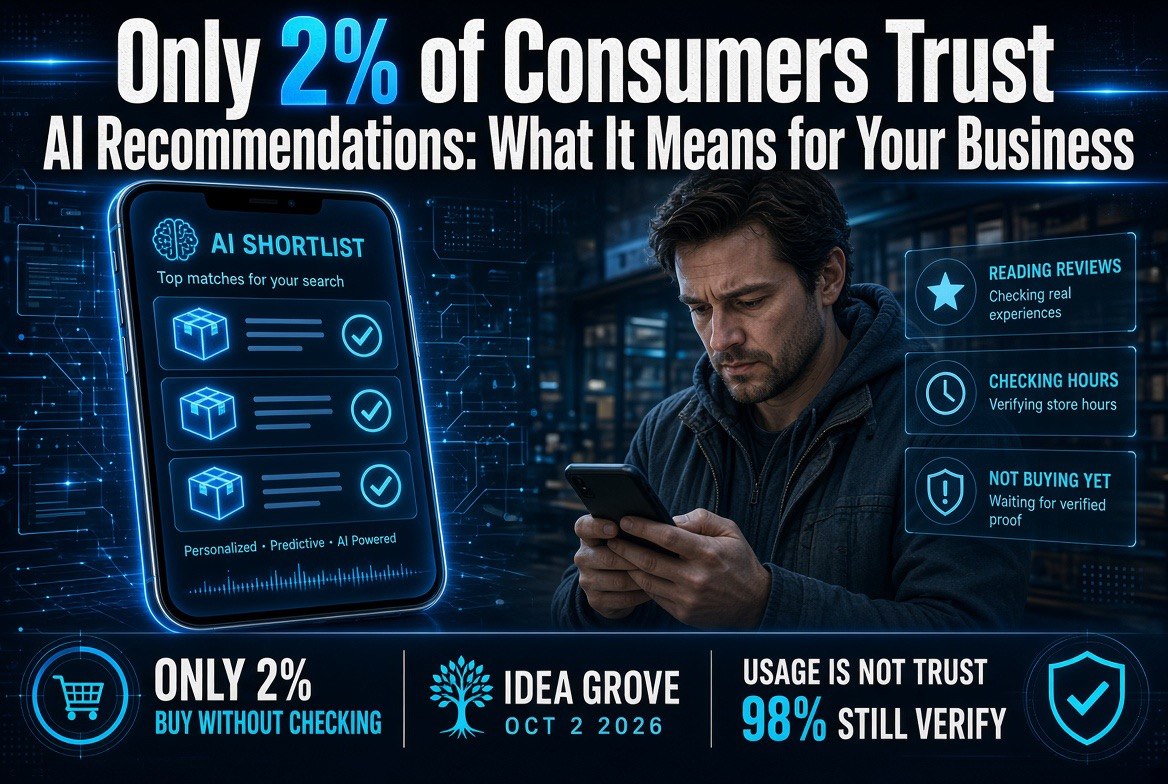
⚡ Expert Summary: An Idea Grove survey reported on October 2, 2026 found that only 2% of consumers buy from a brand recommended by AI without checking it themselves first. That single number is the most useful thing to come out of this week’s AI news cycle, because it tells you exactly where the hype stops and the buying decision starts. Consumers are using AI to research more than ever, but they are not handing it the final call. Here is what that gap means if you sell anything to anyone.
The same week the White House started calling this technology “super intelligence,” a survey landed with a much less exciting finding. The Idea Grove survey reported on October 2, 2026 that only 2% of consumers purchase from a brand an AI recommended without doing their own verification first. Not 20%. Not even 10%. Two percent.
If you run a business in the United States, that number should change how you spend the next six months. It does not mean AI search is useless. It means the tool you are being sold as a replacement for customer judgment is functioning as an input to it.
What the Idea Grove Survey Actually Found
The finding, as reported, is narrow and specific: consumers will let AI narrow the field, but they will not let it close the deal. The 2% figure covers people who buy from an AI-recommended brand with no independent check. That is a measurement of trust, not of usage.
This distinction matters because most AI marketing advice conflates the two. Usage is climbing. Trust in the recommendation itself is not. A buyer who asks ChatGPT for three options and then reads reviews on all three has used AI heavily and still verified every option. From a vendor’s dashboard, that customer looks identical to someone who never opened a chatbot.
It is worth being precise about the sourcing here. This comes from a vendor-run survey, distributed through Business Wire, and reported by TechCrunch. Treat it as a directional signal rather than settled academic research. The direction, though, matches what most operators already see in their own checkout data.
Why the “Super Intelligence” Framing Is Working Against Trust
Also this week, the White House adopted the phrase “super intelligence” to describe frontier AI systems. The terminology shift is worth noting because it widens a gap that already exists. When the language coming out of Washington describes a technology as superhuman, and the consumer experience is a chatbot that confidently invents a restaurant that closed in 2023, the credibility damage is self-inflicted.
For a small business owner, the practical lesson is that grand framing and grounded framing both have to live in the same product. You do not get credit for the technology. You get credit for the answer being right.
Why the Two Percent Number Is the Useful One
Most statistics in AI coverage describe the technology. This one describes the buyer, and that is why it travels. A survey that says adoption is rising tells you what tools exist. A survey that says only 2% of consumers will buy on an AI recommendation without checking tells you what those tools are actually worth at the moment money changes hands.
For an operator, the second is the only one that hits a P&L. It tells you that the shortlist is a beginning, not a sale, and that the work of being chosen still happens in the places a consumer can verify for themselves. Search results, review profiles, a page that loads, a phone that gets answered.
There is a second read on the same number worth sitting with. If only 2% buy without checking, then roughly 98% of buyers are doing something your business can influence directly. That is not a small opening. It is the entire market, minus a rounding error, deciding with information you control the accuracy of.
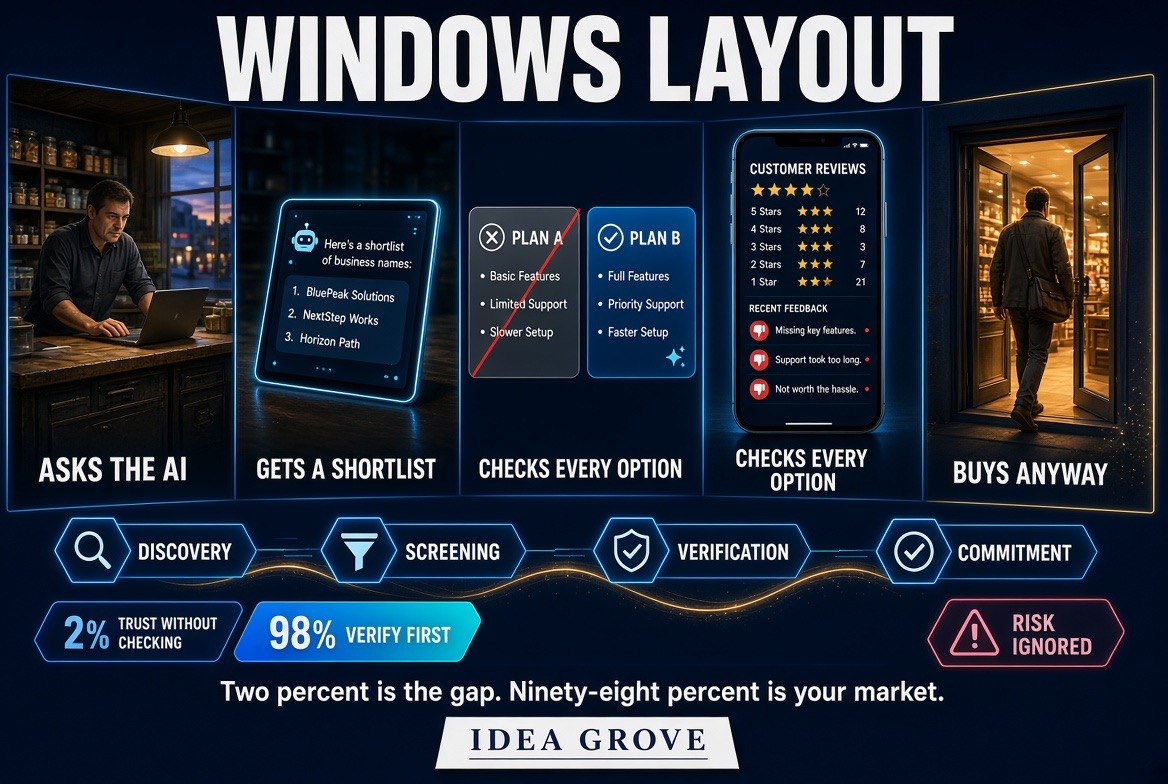
AI owns only the first gate. The consumer owns the screening, verification and commitment that follow — which is where most small businesses lose the sale.
What Actually Happens in the Buying Decision
The 2% figure describes the last step only. Before that step, AI is doing substantial work. A consumer asks for options, receives a shortlist, and then applies their own filters. Price. Distance. Whether the reviews look real. Whether the website loaded in under three seconds.
The failure mode for a business is not being left out of the shortlist. It is being included and then failing the verification that follows. These are two completely different problems, and they require two completely different fixes.
| Decision Stage | Who Decides | What Kills the Sale |
|---|---|---|
| Discovery | AI assistant produces a shortlist | You are absent from the shortlist entirely |
| Screening | Consumer checks price, location, hours | Outdated details on your own site |
| Verification | Consumer reads reviews independently | Thin review profile or unanswered complaints |
| Commitment | Consumer buys only after checking | A checkout process that adds friction |
Read that table as a funnel with four gates. AI owns the first gate. The consumer owns the other three. Every dollar you spend trying to influence the first gate needs a matching dollar spent surviving the rest.
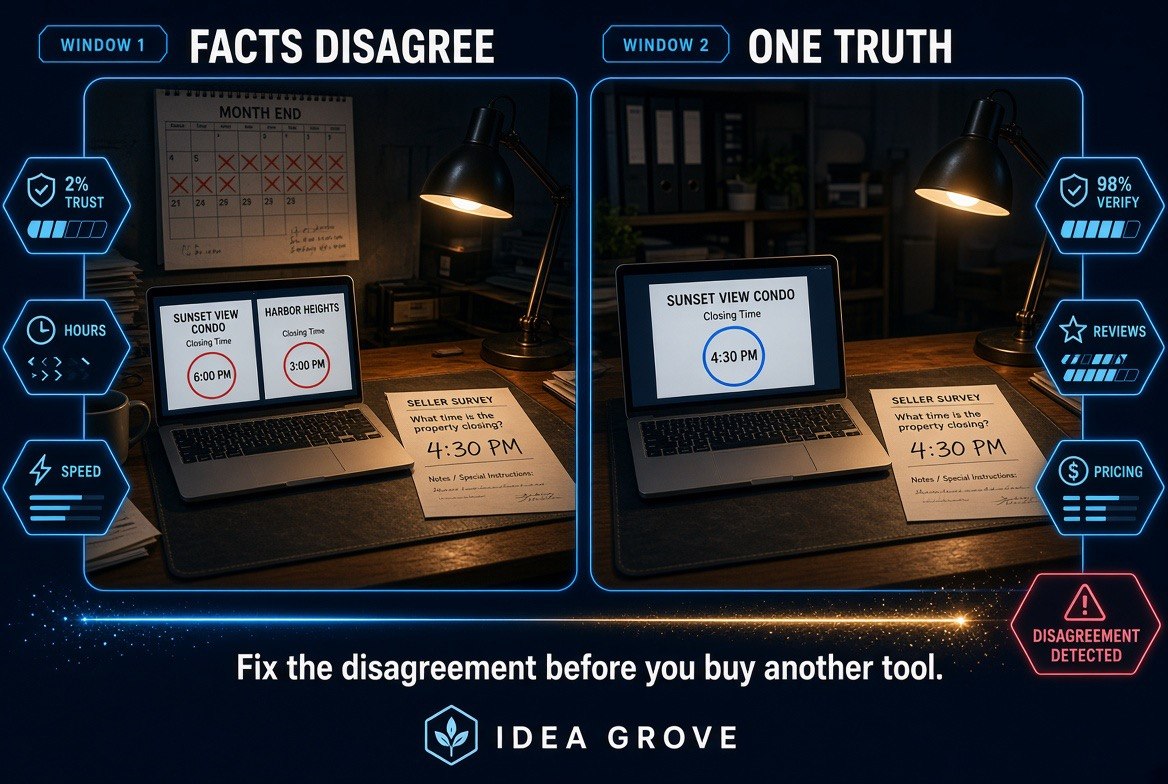
Contradictory facts across your own listings break verification. If your site and a directory disagree on closing time, the searcher trusts neither.
Where Small Businesses Keep Losing
Most owners over-invest in getting mentioned and under-invest in being verifiable. The mention gets you into a conversation. The verification decides whether the conversation ends in revenue.
Three things break verification constantly. First, contradictory information across the web. If your own website says one closing time and a directory listing says another, the searcher trusts neither and moves on. Second, a review profile with twelve reviews and one visible unresolved dispute. Third, a mobile page that loads slowly, which reads as a struggling business even when it is not.
None of these are AI problems. They are the same operational hygiene problems that existed before chatbots, now carrying more weight because AI has compressed the number of options a consumer will even look at.
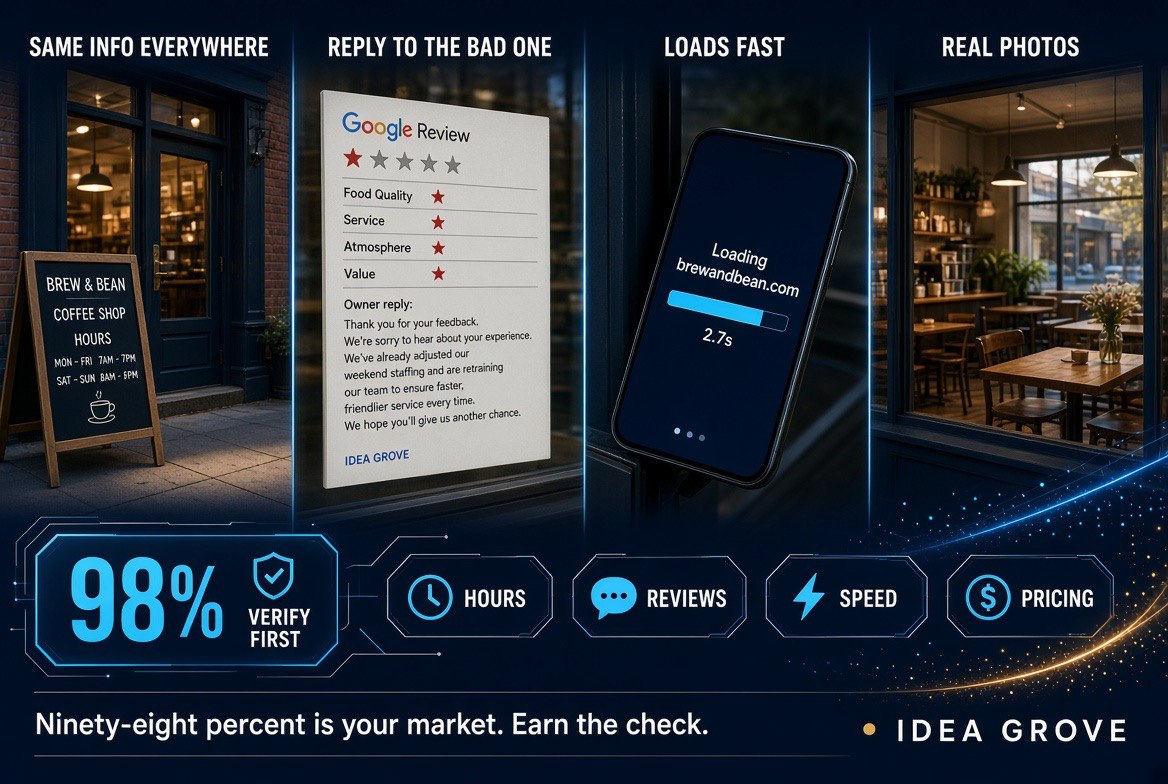
Four things a stranger checks before committing: the same facts everywhere, a reply to the bad review, a fast page, and real photos. None of them require an AI purchase.
How AI Mention and Consumer Trust Differ
The two forces pull in opposite directions, which is why owners get whiplash. AI visibility rewards structured, machine-readable, frequently refreshed information. Consumer trust rewards human signals: recent reviews, responsive owners, specific details that only a real operator would know.
| Signal | Wins the AI Shortlist | Wins the Human Check |
|---|---|---|
| Business hours | Structured and consistent everywhere | Accurate on the day they show up |
| Reviews | Volume and recency | Whether the owner replied to the bad one |
| Website | Crawlable text, clean markup | Speed on a phone, real photos |
| Pricing | Published ranges beat “contact us” | No surprise fees at checkout |
A business that only optimizes the left column gets a steady stream of visitors who never convert. A business that only optimizes the right column never gets seen at all. The 2% figure is the gap between those two columns.
The Mistake Owners Make With This Statistic
The wrong conclusion is to stop investing in AI visibility because consumers do not trust it. That reads the number backwards. Consumers are not ignoring AI recommendations. They are treating them as a starting point, which is precisely why being in the starting set matters so much.
The right conclusion is harder to execute. Every channel that gets you mentioned needs a matching channel that lets a stranger confirm you are real. Structured information for the machine. Recent, answered reviews for the person. Speed and accuracy for both.
Owners who get this right stop treating AI visibility and reputation work as separate budgets. They become one project with two audiences, and the businesses that pair them are the ones that turn a 2% trust figure into revenue instead of a headline.
What to Do This Week
Start by checking your own facts across every place your business appears. Your site, your map listing, the directories that scrape you against your will, and any AI summary that already describes you. If those disagree, fix the disagreement before you buy another tool.
Then look at your recent reviews as a stranger would. Not the rating. The responsiveness. A single thoughtful reply to a one-star review does more for a skeptical reader than a year of five-star accumulation, because it is the only visible evidence that a person is actually running the place.
Finally, test your own business inside the tools your customers use. Ask the same question a buyer would ask and see what comes back. Most owners have never done this, and a fair number discover that the AI describes a version of their business that has not existed for two years.
Frequently Asked Questions
What did the Idea Grove survey find?
The survey, reported on October 2, 2026, found that only 2% of consumers buy from a brand recommended by AI without checking it themselves first. It measures trust in AI recommendations, not overall AI usage. The survey was distributed through Business Wire and covered in TechCrunch’s coverage of consumer AI sentiment.
Does this mean AI search does not matter for my business?
No. It means AI matters at the discovery stage and stops mattering at the commitment stage. Being absent from an AI shortlist still costs you the conversation entirely. The difference is that being present is no longer sufficient on its own.
What is the “super intelligence” terminology change?
In the same week as the survey, the White House adopted the term “super intelligence” to describe frontier AI systems. It is a framing change rather than a regulatory one, and it widens the language gap between how institutions describe the technology and how consumers experience it day to day.
How do I check whether AI describes my business accurately?
Ask an AI assistant the same question a customer would ask about your category and location. Compare its answer against your own records. Any mismatch in hours, services, or pricing is a fixable error that is quietly costing you verification-stage customers.
Should I spend more on AI visibility or on reviews?
Both, in proportion. Visibility determines whether you are considered. Reviews and accurate information determine whether you are chosen. A business investing in only one of the two is paying for traffic it cannot close.

About Barak Schurr
Barak Schurr built and sold a major ticketing platform, ran global nightlife operations at Eventbrite, and now spends his time figuring out which AI tools actually move the needle for independent business owners — and which ones are just noise. No hype. No fluff. Just what works.
Email: [email protected]
More AI Resources for Your Business