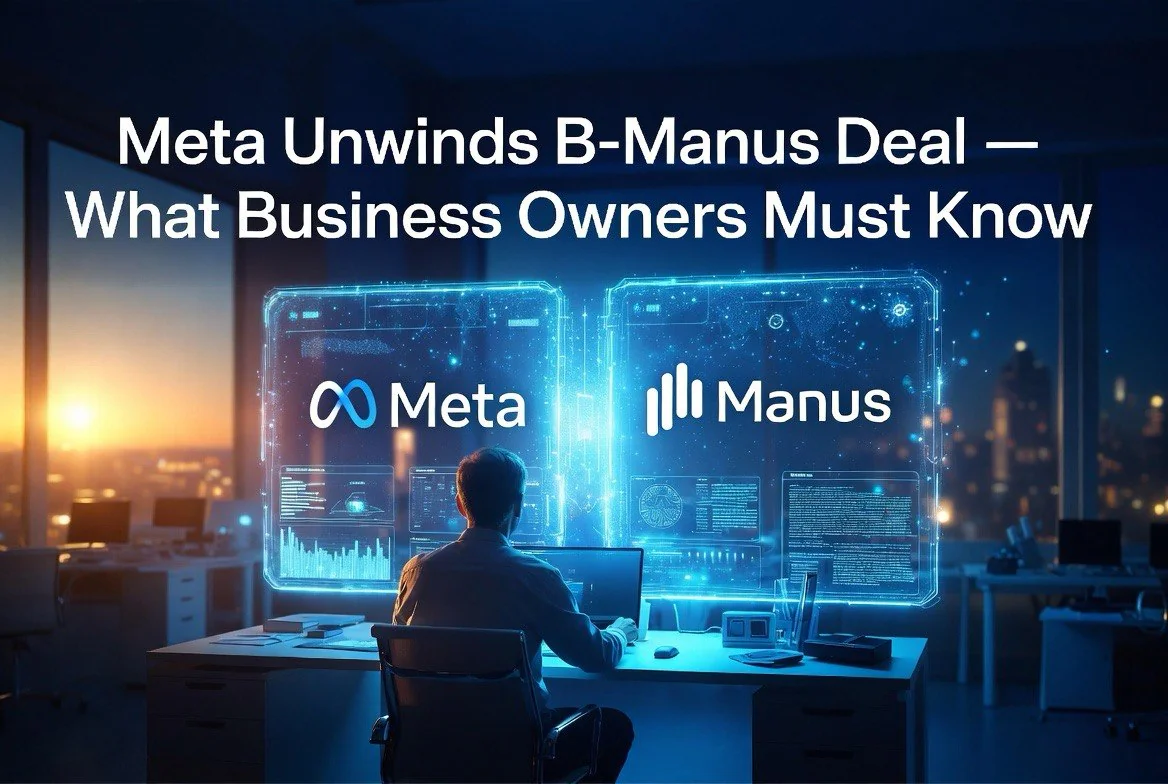
Meta Unwinds $2B Manus Deal: What Business Owners Must Know
⚡ Expert Summary: Meta has begun dismantling its $2 billion acquisition of Manus, cutting off data access and operational ties after Beijing ordered the deal reversed. For small business owners, this is more than tech industry drama — it’s a wake-up call about how dependent your AI tools are on cross-border deals that can be unwound by governments. Here’s what happened, why it matters, and how to protect your AI stack.
Learn more about AI tools for small business on our dedicated category page.
What Happened With Meta and Manus?
Meta announced it’s unwinding its $2 billion acquisition of Manus, an AI startup founded by Chinese engineers. This is a direct response to an order from China’s National Development and Reform Commission (NDRC) demanding the deal be reversed on national security grounds.
The situation escalated quickly. In April 2026, Beijing blocked Meta’s acquisition of Manus after a months-long investigation. Now, just two months later, Meta has taken concrete action: cutting Manus off from internal systems, halting all data sharing between the two companies, and beginning the operational separation required to comply with the divestiture order. Bloomberg broke the story on June 11, 2026, confirming Meta had severed Manus’s data access.
For context, Meta acquired Manus in late 2025 — an agentic AI startup founded by Chinese engineers that had relocated to Singapore. The deal was Mark Zuckerberg’s big bet on AI agents that could autonomously complete complex tasks. The startup was widely discussed in AI circles for building autonomous agents that could independently plan and execute multi-step workflows, from market research to content creation. Now that bet is being unwound at Beijing’s command.
What makes this particularly significant is the speed of the reversal. The acquisition was announced in December 2025, blocked in April 2026, and is being dismantled by June 2026. That’s roughly six months from acquisition to forced unwind. In the tech world, six months is barely enough time to integrate a team, let alone build stable products on top of acquired technology.
Why This Matters to Small Business Owners
You might read this and think: “Meta problem, not my problem.” That’s the wrong take by a mile.
Here’s the reality: The AI tools you use every day — your chatbot, your content generator, your customer service AI, your analytics platform, your email marketing optimizer — almost all of them rely on models and infrastructure that cross international borders. The companies building those tools acquire startups, sign licensing deals, and share data across jurisdictions constantly. When those deals get unwound, the effects cascade down to you.
What happened to Meta can happen to any company that depends on AI supply chains crossing U.S.-China lines. The tech giants can absorb a $2 billion hit. A small business that loses a critical tool because of a regulatory decision does not have that luxury.
Consider the chain of dependencies in a typical small business AI stack:
- Your customer service chatbot might run on OpenAI’s API, which relies on Microsoft’s Azure cloud infrastructure
- Your content generation tool might access Anthropic’s Claude models, which trained on data from multiple international sources
- Your CRM’s AI features might depend on models acquired through cross-border deals
- Your email marketing platform might use proprietary AI that was developed by a remote team operating across time zones
Each link in that chain represents a potential point of failure. And the NDRC didn’t explain why it blocked the Meta-Manus deal — it just ordered both parties to unwind it. That’s the risk: opaque government decisions that reshape the AI landscape overnight with no warning.
How the U.S.-China AI Tension Affects Your Business Tools
This isn’t an isolated incident. The AI industry is increasingly caught in U.S.-China technology tensions, and the Manus deal unwind is the latest and most expensive example. Here’s the broader landscape:
- China’s NDRC blocked Meta’s Manus acquisition in April 2026 — no detailed explanation offered
- The US has restricted advanced AI chip exports to China since October 2022, with multiple rounds of tightening in 2024 and 2025
- Both the US Commerce Department and China’s Cyberspace Administration have expanded their authority to review and block AI-related technology transfers
- Multiple AI startups in both countries are now structuring their corporate entities specifically to reduce cross-border regulatory exposure
According to KPMG’s February 2026 analysis of AI regulatory risk in cross-border transactions, over 60% of companies using AI tools across international borders reported compliance challenges. That number is projected to exceed 75% by the end of 2026 as more governments assert regulatory control over AI technology flows.
The US government hasn’t been passive either. The Committee on Foreign Investment in the United States (CFIUS) has expanded its review scope to include AI acquisitions, investments, and technology licensing agreements. TechCrunch reported that CFIUS reviews of AI-related deals increased by 40% in 2025 compared to the previous year, with no signs of slowing down.
The timeline of the Meta-Manus deal shows how fast things change: Zuckerberg scooped up Manus in December 2025. By April 2026, China blocked the acquisition. By June 2026, Meta was actively dismantling the integration. A deal that took months to negotiate was unraveled in weeks.
Practical Steps to Protect Your AI Stack
If you’re running a small business and using AI tools day-to-day, here’s exactly what you need to do. This isn’t theoretical — these are actions you can take this week.
Step 1: Map Your AI Supply Chain
Take 45 minutes to figure out where your AI tools actually come from. Most small businesses use platforms that layer on top of larger models. Open a simple spreadsheet and list every AI tool you use. For each one, identify: What underlying model does it use? Where does it process data? What’s the corporate structure of the company? If you can’t answer those three questions, you have supply chain risk you can’t see.
Check documentation disclosure pages. Tools built on top of acquired technology almost always have footnotes about their infrastructure. A chatbot that runs on OpenAI is one thing. A chatbot built on top of an acquired Chinese startup that got severed from the acquiring company’s systems is another thing entirely.
Step 2: Build Model Diversity Into Your Workflows
If your entire operation depends on a single AI provider, you’re one regulatory decision away from a disruption. This is the most important takeaway from the Meta-Manus situation.
Look for tools that support multiple model backends. The smartest AI platforms built for business use already allow you to switch between GPT-5.5, Claude Fable 5, Gemini, and open-source models. If your current tool doesn’t, ask why. The technology to support multi-model workflows has existed for over a year, and providers that haven’t adopted it are making a strategic choice you should see clearly.
For writing and content generation, use tools that let you test the same output across different models. For customer service chatbots, choose platforms that abstract the underlying model so you can swap without rebuilding. For analytics, pick solutions that don’t lock you into a single inference provider.
Step 3: Monitor Your Providers for Infrastructure Changes
When deals unwind, data gets separated. When data gets separated, products change. Watch your provider’s changelogs for signs of infrastructure shifts.
Specific signals to watch for: sudden changes in pricing, adjustments to data processing locations, modifications to API behavior, new “corporate restructuring” announcements, or changes in how customer data is handled. If a tool suddenly starts routing requests differently or changes its privacy policy, that could be a downstream effect of a forced divestiture.
Step 4: Prioritize Flexibility Over Features
In the current regulatory environment, a tool that’s flexible is better than a tool that has more features but is locked into a single vulnerable supply chain. When evaluating new AI tools, add one question to your checklist: “Can I replace this tool with minimal friction if the underlying supply chain breaks?”
This is especially important for American small businesses. Tools built on US-based infrastructure and models carry less cross-border regulatory risk. That doesn’t guarantee stability — US regulatory action can also impact AI tools, and the California AI safety bill debates demonstrated that clearly. But it significantly reduces the specific risk of deal unwinds like the Meta-Manus situation.
What Real Businesses Are Doing Right Now
Smart operators aren’t waiting for the next regulatory shoe to drop. They’re already making changes based on what the Meta-Manus situation reveals about the AI industry.
Last week’s gathering at the AI Business Summit in San Francisco included multiple sessions on supply chain resilience. According to VentureBeat’s coverage of the event, the most common question from small business attendees was no longer “Which AI tool is best?” but “Which AI tools can I still use in 12 months?” That shift in thinking is exactly what the Meta-Manus situation should trigger.
Here’s what the early movers are doing: building redundant AI workflows that can fall back to different providers within hours, not weeks. Maintaining local copies of critical outputs. Running parallel tests on competing platforms to avoid lock-in. Asking providers directly about their infrastructure dependencies during sales calls. These aren’t expensive or time-consuming changes, but they build a buffer between your business and the next geopolitical decision that reshuffles the AI deck.
The Bigger Picture: AI Deals Are Getting Unwound
The Meta-Manus situation isn’t an isolated event. It’s part of a broader, accelerating trend of government scrutiny around AI acquisitions and cross-border technology deals. Both the US and China are asserting more control over how AI technology moves between countries.
This creates uncertainty that larger companies can absorb more easily. A Fortune 500 company has entire legal departments that can track regulatory changes, maintain relationships with multiple vendors, and negotiate contracts with disruption protection clauses. A small business with 5 to 20 employees doesn’t have that infrastructure. What you do have is agility.
Small businesses can switch tools faster than enterprises. You can test three different options in a single afternoon. You can build workflows that aren’t locked into a single ecosystem. The key is knowing the risk exists and planning for it before it’s an emergency.
Frequently Asked Questions
Will the Meta-Manus deal unwind affect my AI tools directly?
Probably not directly — Meta doesn’t sell enterprise AI tools to small businesses the way OpenAI or Google do. But the precedent is what matters: if a $2 billion acquisition can be unwound by government order, any AI deal is vulnerable. The effects eventually reach end users through disrupted supply chains, changed APIs, or sunset products. The ripple effect from this decision will take months to fully materialize.
What AI tools are most exposed to cross-border risk?
Any tool that relies on models or technology from companies with significant Chinese operations, cross-border supply chain dependencies, or recent international acquisitions. Check whether your tools disclose their underlying model sources, training data origins, and infrastructure locations in their documentation or privacy policies. If that information isn’t readily available, that itself is a red flag.
How do I check if my AI provider has cross-border dependencies?
Review their documentation for mentions of model sources, training data origins, and infrastructure locations. Check their investor backing and recent acquisition history on Crunchbase. Read their privacy policy for data location disclosures. If a tool was built on technology that came from a cross-border deal, that fact is usually disclosed somewhere in their product docs, funding announcements, or media coverage. A simple search for “[tool name] acquisition funding origin” often reveals the full picture.
Should I stop using tools from companies with Chinese connections?
Not at all. Many excellent AI tools come from Chinese companies or rely on Chinese technology. DeepSeek’s models are competitive with anything coming out of Silicon Valley. TikTok’s AI recommendation engine is best-in-class. The point isn’t to avoid Chinese technology — it’s to be aware of the regulatory risk and have alternatives ready. Diversification is the strategy, not blanket avoidance.
Can US regulators do the same thing?
Yes. CFIUS has been actively reviewing and blocking AI-related foreign investments and acquisitions. The US government could theoretically order the unwind of a cross-border AI deal involving technology it considers sensitive. The California AI safety bill debates, FTC interest in AI market competition, and Commerce Department chip export controls all signal that regulatory action on AI deals is bipartisan, growing, and directionally consistent: more scrutiny, not less.

About Barak Schurr
Barak Schurr is the founder and former president of the nightlife ticketing platform Wantickets and former Global Director of Dance and Nightlife at Eventbrite. He currently focuses on AI research and writes about practical AI for independent business owners that actually moves the needle — no hype, no corporate fluff. More at topnotchaitools.com.
Contact: [email protected]
More AI Resources for Your Business