
Puzzle Review 2026: The AI Bookkeeping Platform Built for Startups
⚡ Expert Summary: Puzzle is a software-only, AI-native bookkeeping platform built for startups and lean small businesses that want to stop paying for a manual bookkeeper. It auto-categorizes up to 98% of your transactions through direct fintech integrations, generates accrual-basis books with runway tracking in real time, and starts at a free tier — then roughly $25–50/month as you scale. If Digits is the “continuous close” AI ledger, Puzzle is the lower-cost, solo-first cousin that closes your books without the bookkeeper invoice.
Here’s a pattern I see constantly with US founders and small business owners: they’re paying a bookkeeper $300–800 a month mostly to categorize credit card charges and reconcile the bank statement — work an AI model can do at 95%+ accuracy for a fraction of the cost. Then they’re stuck waiting days for a P&L their bookkeeper produces “after month-end,” which in practice means the second week of the following month.
Puzzle attacks exactly that problem from the startup angle. It’s not a stripped-down entry ledger. It’s an AI-native accounting platform built around the way modern small businesses actually transact — through Stripe, Mercury, Ramp, and other fintech rails — rather than the way a 1990s small business did, with paper receipts and a desktop file. The pitch is simple: your books should close themselves, your runway should be real-time, and you shouldn’t need a CPA on retainer to see where you stand.
What Puzzle Does Differently
Puzzle’s core bet is that direct integrations beat manual data entry. Most onboarding happens by connecting the accounts your money already flows through — Stripe for revenue, Mercury or Ramp for spend, your corporate card — and Puzzle pulls the transaction data natively instead of asking you to import a CSV.
Auto-categorization that learns your business
Puzzle advertises up to ~98% auto-categorization via those direct integrations. Because it sees the structured data (payment processor metadata, card merchant codes) rather than scrubbing a bank PDF, it can classify with far less guesswork. The remaining couple percent go to a queue you clear in minutes, and the model learns from every correction.
Real accrual-basis books
This is where Puzzle separates from the “cleaner” apps. Many DIY tools run cash-basis only because accrual is hard to automate. Puzzle generates proper accrual-basis books — recognizing revenue when earned and expenses when incurred — plus tracks runway and burn in real time. For a founder who raised money or needs investor-ready books, that’s the difference between a toy and a real ledger.
Faster close, guaranteed
Puzzle leans on a concrete guarantee: close your books 50% faster or get your money back on certain plans. The mechanism is straightforward — since categorization and reconciliation run continuously, there’s no month-end data-entry pile to work through. The close is mostly already done; you’re reviewing, not entering.
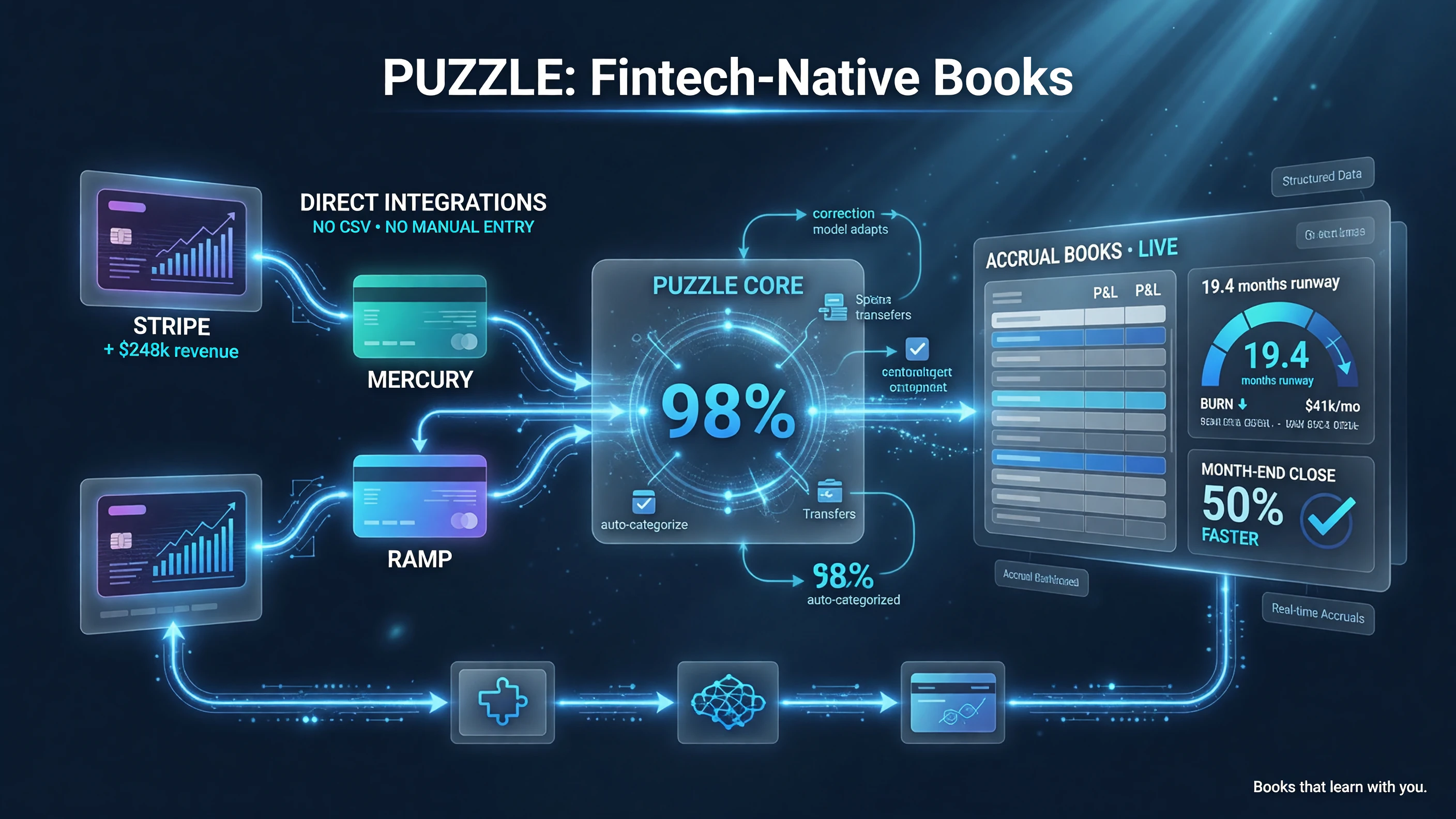
Direct fintech feeds (Stripe, Mercury, Ramp) let Puzzle auto-categorize up to 98% of transactions and keep real accrual-basis books with live runway — so month-end close runs ~50% faster.
Puzzle vs. Digits vs. QuickBooks
Puzzle and Digits are the two names that come up most as new AI-native alternatives to QuickBooks, so let me put them side by side with the legacy option.
| Factor | Puzzle | Digits | QuickBooks Online |
|---|---|---|---|
| Target user | Startups, founders, solos | Lean SMBs + accounting firms | Broad small business |
| Auto-categorization | Up to ~98% via direct feeds | 93–97%+ benchmarked | Rules + basic AI assist |
| Accrual books | Yes — real accrual + runway | Yes — full GAAP-style | Optional |
| Starting price | Free tier → ~$25–50/mo | $65/mo (Essentials) | ~$30–40/mo entry |
| Human add-on | Software-only, no human layer | Software + firm partner option | Adds bookkeeper/accountant |
The honest read: Digits is the deeper tool for firms and multi-entity businesses and carries the higher price tag ($65+ and up to $250 for Agentic Close). Puzzle is the leaner, cheaper, startup-first option — you trade some of the firm-grade depth for a lower entry cost and a product shaped around founder workflows. Both are real alternatives to QuickBooks, but they’re aimed at slightly different operators.
Puzzle Pricing, Broken Down
Puzzle’s pricing is structured to be forgiving on the way up, which suits early-stage businesses perfectly.
| Tier | Price | Who it fits |
|---|---|---|
| Free | $0 (up to ~$20k cumulative transaction volume) | Early-stage founders testing the platform |
| Paid | ~$25–50/month (annual discounts) | Active startups with real transaction volume |
Because Puzzle is software-only — no mandatory human bookkeeper add-on — the total cost stays dramatically below a managed-service model. Even at the top of that paid range, you’re talking about the price of a couple of hours of a bookkeeper’s time, replaced by a system doing the work continuously.
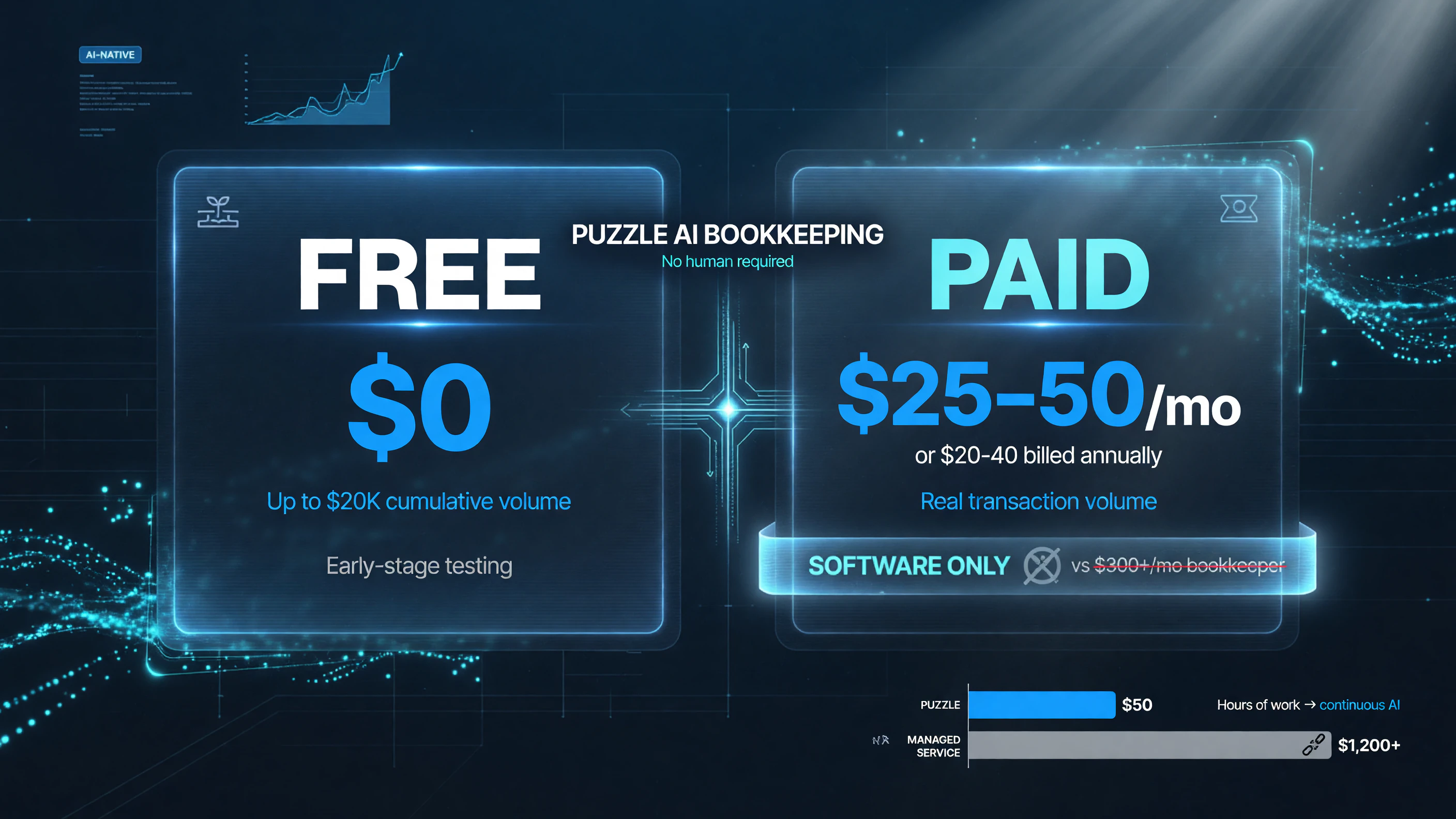
Puzzle starts free up to roughly $20,000 in cumulative volume, then runs about $25–50/month — software-only, a fraction of the $300+/month a human bookkeeper or managed service costs.
Where Puzzle Falls Short
Be honest about the tradeoffs. Puzzle is built for startups and modern fintech flows, which is its strength but also its edge case — if your business runs on a legacy bank with clunky data exports, or you operate a cash-heavy retail operation, the direct-integration magic is weaker than it is for a founder moving money through Stripe and Mercury. It’s also software, not a human: you still need a CPA for tax strategy and filings, and if you want someone to own the books end to end, you’ll layer an accountant on top.
The other consideration is depth. Digits’ higher tiers add multi-entity consolidation, dimensional accounting, and firm-grade Agentic Close — capabilities a growing startup may eventually want. Puzzle covers the founder-critical ground well — auto categorization, accrual books, runway — but if your needs trend toward complex multi-entity consolidation down the road, that’s a reason to look at the higher end of the market.
How to Get Set Up on Puzzle
The practical setup path is short, and most of the effort lands in the first month while the model tunes to your business. Here’s the sequence that gets you running clean rather than chasing a mess later.
- Sign up on the free tier. Puzzle’s free tier covers you up to roughly $20k in cumulative transaction volume — enough to test whether the categorization matches your real business before you pay anything.
- Connect your fintech accounts. This is Puzzle’s core advantage. Hook up Stripe for revenue, Mercury or your operating bank, and Ramp or your corporate card. Direct integrations are what push auto-categorization toward that ~98% figure.
- Clear the exception queue early and often. The model learns from every correction you make. Spending ten minutes a day your first week on the low-confidence items teaches it far faster than letting them accumulate.
- Set your accounting basis. If you need investor-ready accrual books, confirm that’s enabled from the start. Switching basis mid-year is the kind of migration headache you want to avoid.
- Watch runway and burn. Puzzle tracks these in real time. Make the dashboard you actually open — knowing your cash position at a glance is the whole value of real-time books.
- Loop in your accountant before tax season. Puzzle exports clean standard reports, but give your CPA time to get familiar with the platform rather than dropping a new system on them in April.
The realistic expectation: month one has a light learning curve. By month two the exception queue is mostly empty and you’re reviewing, not entering — which is precisely the automation trade you made the switch for.
The Cost Math That Matters
Put real numbers behind the switch. A bookkeeper charging $300–500 a month for categorization and reconciliation is doing work Puzzle automates for $25–50 — call it a 90% cost reduction on the mechanical layer. A founder cleaning up books four hours a month loses ~48 hours a year to it; at $50 an hour of your own time that’s ~$2,400 of opportunity cost, more than several years of Puzzle’s subscription.
The comparison is not Puzzle vs. nothing — it’s Puzzle vs. continuing to pay top dollar for mechanical work software handles better. For a founder whose money flows through modern fintech, that’s an easy trade to justify, and it’s the reason these AI-native platforms are displacing the manual-bookkeeper model for early-stage businesses.
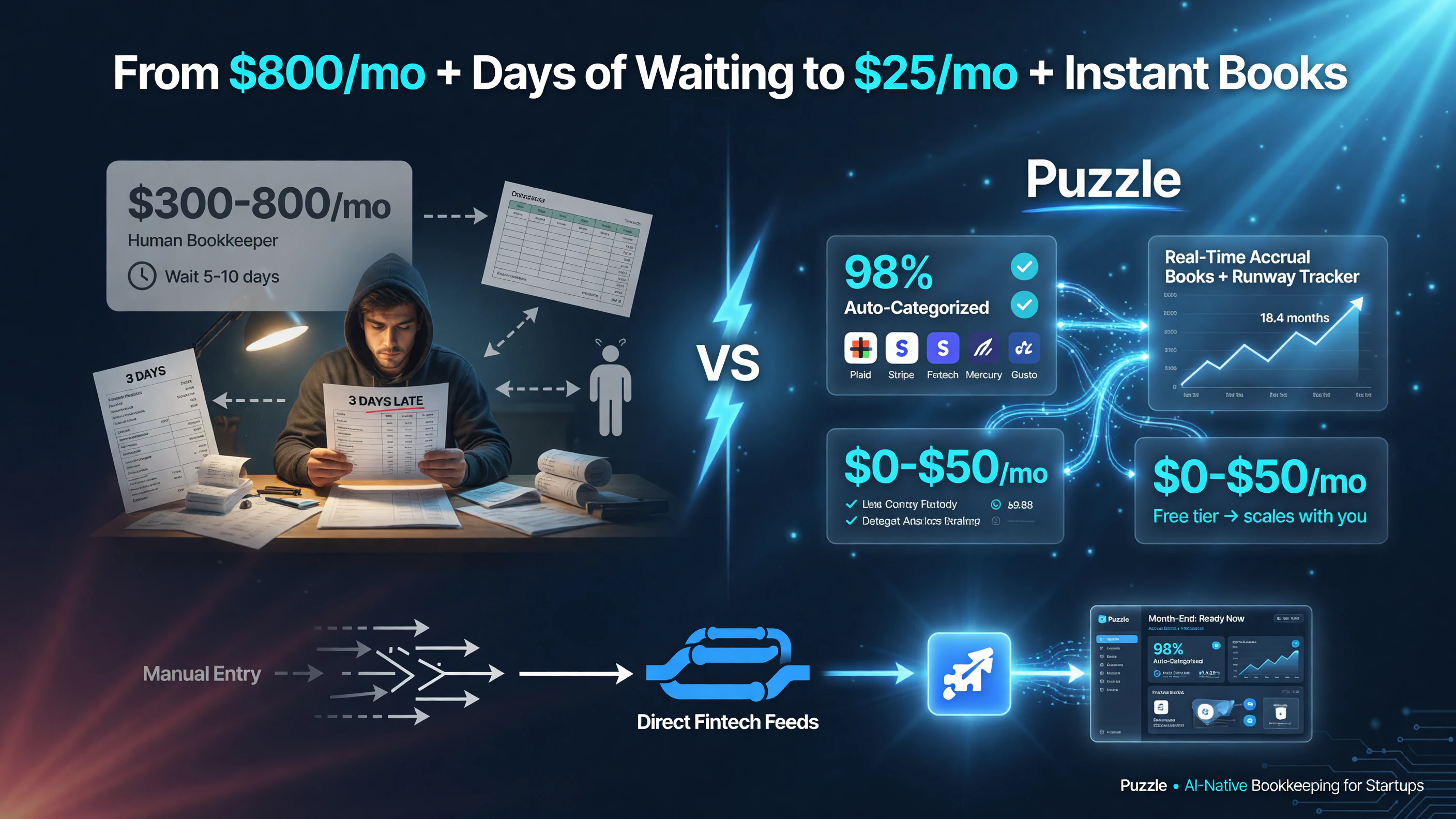
A $300–500/mo bookkeeper does work Puzzle automates for $25–50/mo — roughly a 90% cut on the mechanical layer, plus ~48 hours a year of founder time saved.
Who Puzzle Is Really For (and Who It Isn’t)
Keep expectations clear by being specific about the fit. Puzzle shines for the founder whose money moves through modern fintech: a SaaS or agency taking Stripe payments, spending on a corporate card, paying through Mercury, and needing clean accrual books they can hand to an investor or auditor on demand. For that operator, Puzzle replaces both the manual data-entry habit and the monthly bookkeeper invoice with a system that keeps the books perpetually current.
It’s a weaker fit for a few concrete cases. A cash-heavy retail or food business that still runs on a legacy bank with manual exports won’t get the full direct-integration benefit, because the model is only as good as the structured data you feed it. A business that’s already healthy on the $250–400/month full-service books from a managed provider may not find enough incremental value in swapping to software-only — unless the price gap is the deciding factor. And if you personally want to review and approve every single transaction rather than manage by exception, Puzzle’s autonomous model will feel like it’s making decisions you wanted to make yourself — a signal that a traditional tool is the better fit for your temperament.
None of that makes Puzzle bad; it makes it specific. The platforms winning in 2026 are the ones that pick a lane and automate it deeply rather than trying to be everything to everyone. Puzzle’s lane is the tech-forward solo founder and lean startup that wants real books without a bookkeeper bill — and it nails that lane.
Should You Switch to Puzzle?
Run your situation against these questions.
- Are you a founder or lean team paying for a bookkeeper to do largely mechanical work? If the majority of your bookkeeping spend goes to categorization and reconciliation, Puzzle automates exactly that for a fraction of the cost.
- Does your money flow through modern fintech (Stripe, Mercury, Ramp, corporate cards)? If yes, you’ll get the full benefit of Puzzle’s direct integrations — that’s the sweet spot it was built for.
- Do you need real-time books and runway, not a month-old snapshot? Puzzle keeps accrual-basis books current so you always know your cash position and burn without waiting for month-end.
- Is price the deciding factor between Puzzle and Digits? Puzzle’s free tier and ~$25–50/month paid range make it the value pick; Digits’ $65+ plans buy more firm-grade depth. Choose based on whether you need that depth.
For a US startup or small business that outgrew spreadsheets but refuses to pay for a manual bookkeeper, Puzzle is one of the smarter AI-native bookkeeping plays in 2026. Low entry cost, real accrual books, close the month faster, and stop paying for work the software can do. That’s the automation ROI that actually shows up in your bank account.
FAQ
What is Puzzle accounting software?
Puzzle is an AI-native bookkeeping platform built for startups and small businesses. It auto-categorizes up to ~98% of transactions via direct fintech integrations, generates real accrual-basis books with runway tracking, and offers a free tier that scales to roughly $25–50/month as your transaction volume grows.
How much does Puzzle cost?
Puzzle has a free tier (up to ~$20k in cumulative transaction volume) then moves to roughly $25–50/month depending on volume, with annual discounts available. It is software-only, so there’s no mandatory human-bookkeeper add-on keeping costs low.
Is Puzzle better than QuickBooks?
For startup and founder workflows, Puzzle is often the stronger fit because it’s AI-native and built around direct fintech integrations with real accrual-basis accounting. QuickBooks is more broadly used and familiar to accountants but relies more on manual input and lacks Puzzle’s native AI categorization.
Does Puzzle replace a bookkeeper?
Puzzle replaces the mechanical bookkeeping work — categorization, reconciliation, closing — done by software. It does not replace a CPA for tax strategy and filing. Many founders use Puzzle for the books and keep an accountant for higher-level planning.
Is Puzzle like Digits?
Both are AI-native alternatives to QuickBooks. The short version: Puzzle is the lower-cost, startup-first option with a free tier; Digits is the deeper, pricier platform with firm-grade features like Agentic Close and multi-entity consolidation. Pick Puzzle for lean cost, Digits for more depth.

About Barak Schurr
Barak Schurr built and sold a major ticketing platform, ran global nightlife operations at Eventbrite, and now spends his time figuring out which AI tools actually move the needle for independent business owners — and which ones are just noise. No hype. No fluff. Just what works.
Email: [email protected]
More AI Resources for Your Business