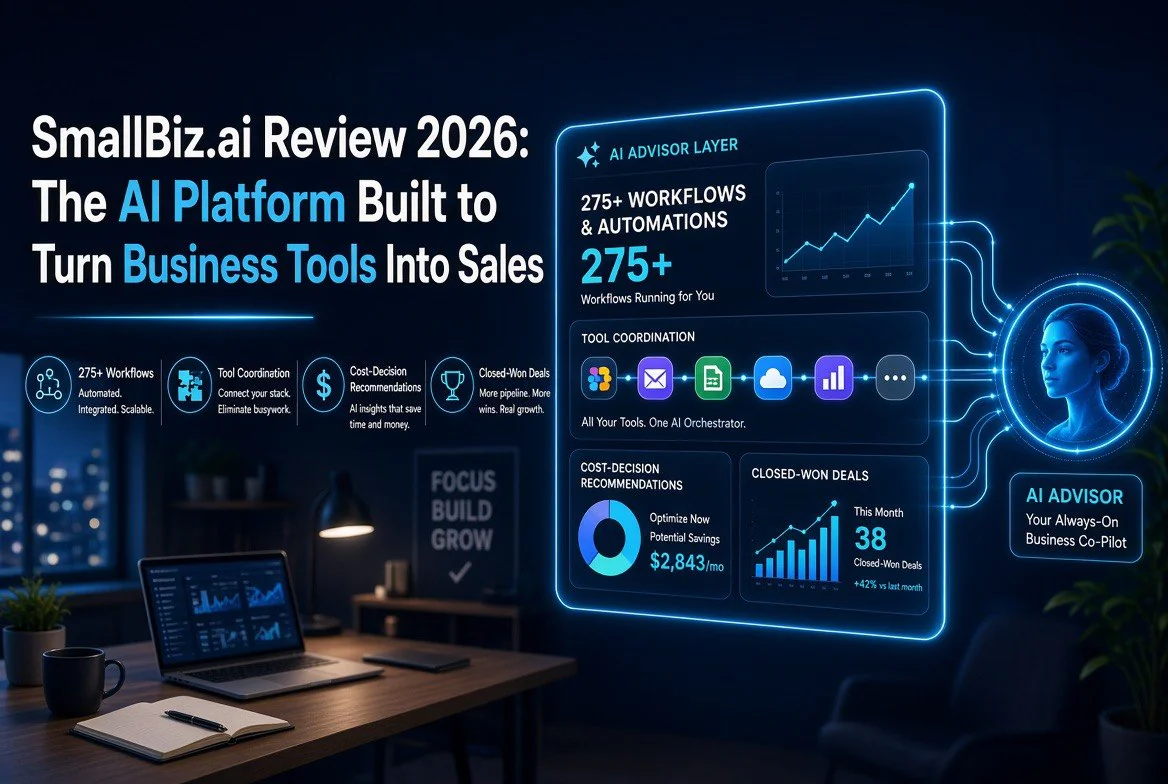
SmallBiz.ai Review 2026: The AI Platform Built to Turn Business Tools Into Sales
⚡ Expert Summary: SmallBiz.ai launched in September 2026 with a 67,000-tool knowledge base, 275+ ready-to-run workflows, and 500 supported business types — built to solve the exact problem US small business owners hit: owning 14 AI subscriptions but still doing the work by hand. It layers an assistant, workflow engine, and cost-decision layer over your existing tools so AI actually lands in your daily operations instead of sitting idle in a browser tab.
Why another AI platform is a fair question right now
Every small business owner I talk to has the same tangle. You signed up for ChatGPT in January. You added a CRM in March because a competitor mentioned it. By June you had a scheduling tool, an email platform, a website chatbot, and a bookkeeping app — and somehow the hours you were supposed to get back never showed up. You are paying for software that duplicates other software, and nobody is stitching it together.
That is the gap SmallBiz.ai is aimed at, and it launched on September 4, 2026 specifically to attack it. The company’s own launch material frames it around a blunt problem: most American small business owners buy AI, then quietly stop using it because the tools demand setup work they don’t have time for. Rather than asking you to learn one more dashboard, SmallBiz.ai tries to sit on top of the stack you already own and tell you what to actually do next.
This is a meaningful repositioning. Most “AI for business” platforms want to be your everything app and replace the tools you use. SmallBiz.ai takes the opposite bet — keep your existing software, and wrap an intelligence layer around it that knows what those tools are for and when to use them.
What SmallBiz.ai actually is
At its core, SmallBiz.ai is three things bolted into one interface, and understanding the distinction matters because it changes whether this platform is right for you.
First, it is a large AI knowledge engine trained and structured around 67,000 business tools and 500 business types. That is not 67,000 subscriptions you can buy — it is a categorized understanding of what tools exist, what each one does, and which ones fit a given business. Second, it comes with 275+ pre-built workflows, which are the difference between a chatbot that answers questions and a platform that completes tasks. Third, it runs a cost-decision layer with 120+ decision engines that map a business to the cheapest tool combination that meets its needs.
That third piece is the genuinely interesting one. Most platforms want to upsell you. SmallBiz.ai is structured to find you the least expensive workable stack, which is an unusual incentive to bake into a product. It positions itself less as a vendor and more as an advisor that happens to sit on top of the tools market.
How the cost-decision engine works
The practical example SmallBiz.ai uses in its launch materials is instructive for how the whole thing operates. Take a business that says it needs a CRM for 50 users. A generic answer is to point you at a popular platform and collect a referral. SmallBiz.ai instead runs the requirement through its decision engine and returns options ranked by actual cost — including the realization that many 50-person teams do not need an enterprise-grade system at all and can meet 90% of the need for a fraction of the price.
That is the core value loop: a business states an operational need in plain language, the knowledge base identifies the tool categories involved, the decision engines compare real pricing, and the workflows show how to actually deploy the recommendation. The business ends up not just with a software suggestion but with a configured process for using it.
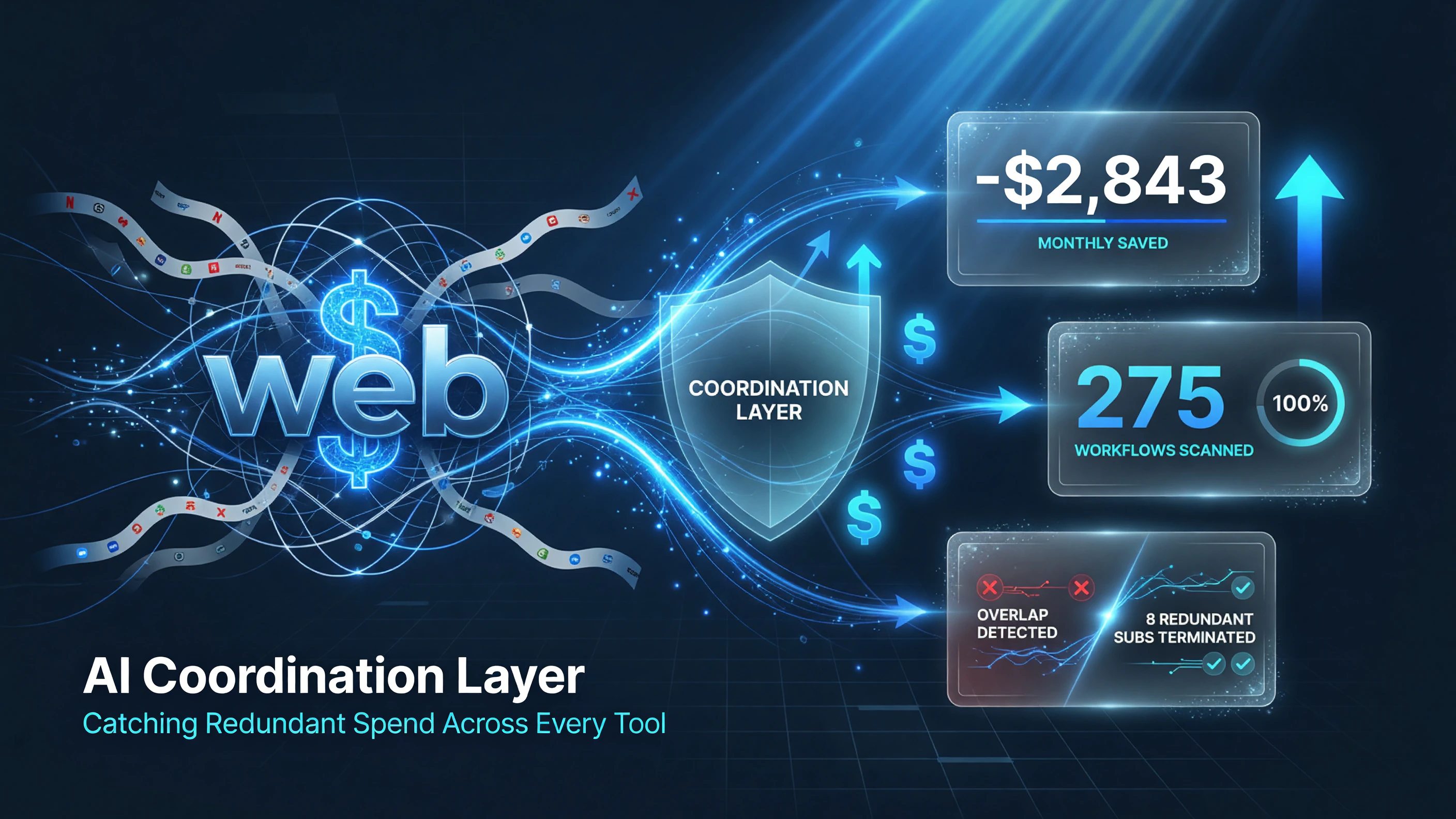
The coordination layer scans 275+ workflows and flags overlapping subscriptions — the $2,843/mo savings example from the platform on one small-business stack.
The 275+ workflows are the real product
An assistant that tells you “you should send follow-up emails” is not worth $30 a month. A platform that drafts the follow-up, schedules it, and hands you a completion report is. SmallBiz.ai’s workflow library is where it earns its keep — pre-built sequences for things like client onboarding, invoice chasing, inventory restocking triggers, marketing campaigns, and hiring pipelines.
For a US small business owner, the appeal is that you do not have to engineer these yourself. You pick a workflow, connect it to the tools it needs, and the platform runs it. The workflows are the difference between advice and automation, and any review of SmallBiz.ai that ignores them is missing the point of the product.
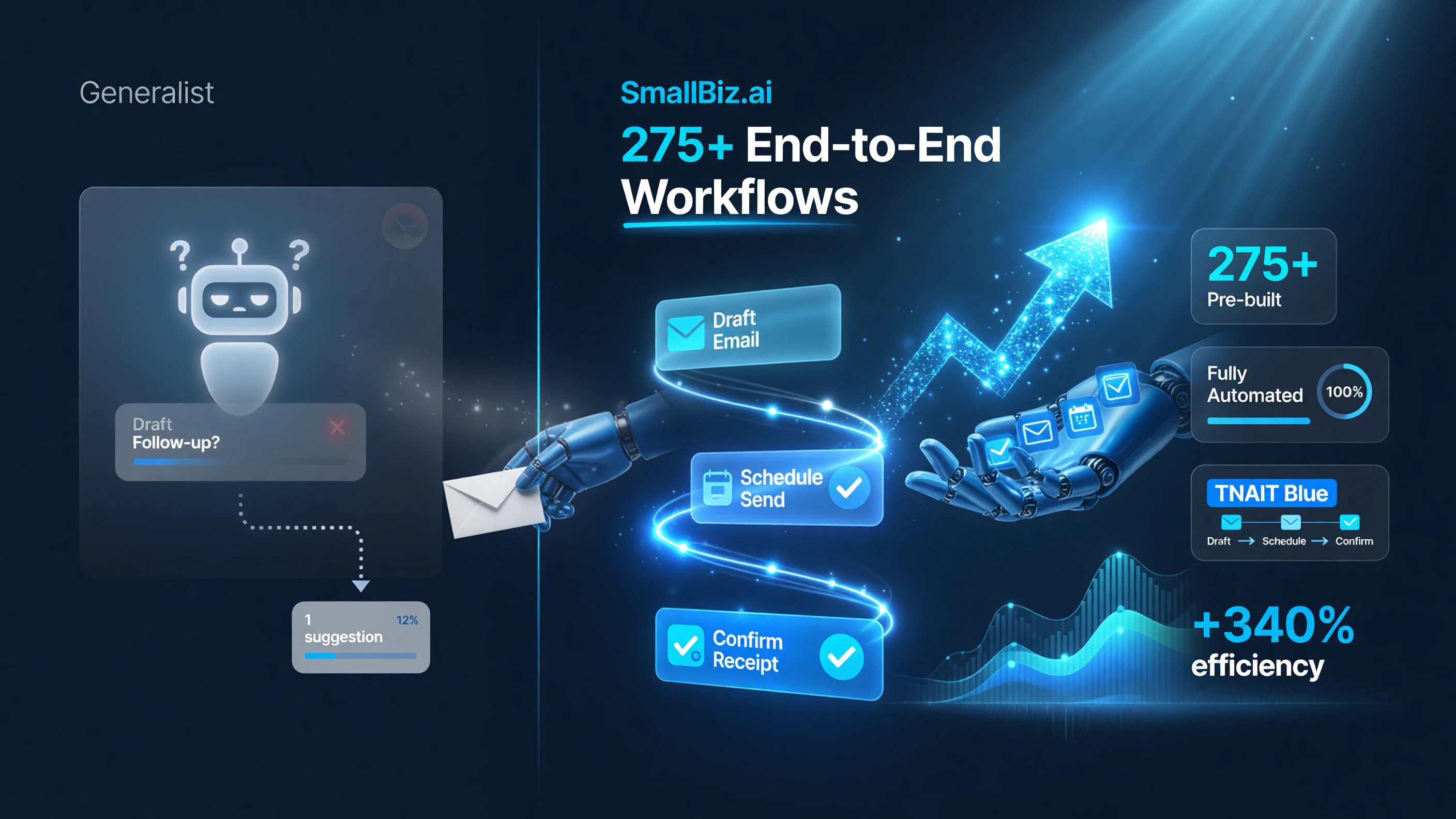
Advice vs automation: a generalist chatbot suggests the follow-up, while a SmallBiz.ai workflow drafts, schedules and confirms it — the pattern behind 275+ pre-built workflows.
A closer look at who it serves best
Because SmallBiz.ai covers 500 business types, its surface area is enormous — and that breadth is also its biggest caveat. A platform that promises something for every kind of business risks being shallow for any single one. The realistic read is that SmallBiz.ai shines for service businesses with repeatable operational patterns: agencies, consultancies, cleaning companies, trades, retail shops, and restaurants on the simpler end of the stack. If your operation runs on recurring client work and standard processes, the workflow library will map to you well.
The deeper your workflows get, the more value you extract. A business that has already invested in tools like QuickBooks, a CRM, and an email platform will get more from SmallBiz.ai than one starting from zero — because the platform is designed to coordinate software that already exists.
SmallBiz.ai vs the general ChatGPT approach
It is fair to ask why you would pay for this when ChatGPT is $20 a month and can do a lot of the same surface-level work. The answer comes down to structure versus improvisation.
Prompting a general model to “create a follow-up sequence for my clients” produces a generic template you then have to adapt yourself. SmallBiz.ai’s workflows are pre-built for the business type and tool, which removes the prompt engineering skill gap that kills most small business AI adoption. The generalist gives you a blank page; SmallBiz.ai gives you a starting process tuned to your industry.
That said, a sharp operator who is comfortable with prompt engineering can replicate a meaningful portion of the workflow value with a general model for less money. SmallBiz.ai’s pitch is strongest for owners who do not want to become AI tinkerers — they want software that does the job out of the box.
| Feature | SmallBiz.ai | General ChatGPT Approach |
|---|---|---|
| Core design | Sits on top of your existing tools and coordinates them | Blank-page assistant — you build everything yourself |
| Workflows | 275+ pre-built by business type and tool | None — you must prompt and design each one |
| Knowledge base | 67,000 tools mapped across 500 business types | General world knowledge, no tool-cost structure |
| Cost optimization | Built-in cost-decision engines (120+) | None — no live pricing comparison |
| Skill required | Low — pick a workflow, connect tools, run | High — needs prompt engineering skill |
| Best for | Owners who want automation without tinkering | Operators comfortable building their own system |
The table above sums up the practical difference: SmallBiz.ai sells structure and pre-built automation, while a general-purpose model sells flexibility you have to build on yourself. For most small business owners, that difference is exactly where the value — or the wasted hours — shows up.
Where it falls short
The most honest knock on SmallBiz.ai right now is that it is new, and a 67,000-tool knowledge base is only as good as its maintenance. Tool pricing and features shift constantly — a decision engine is only as accurate as its last data refresh, and inflated or outdated cost data would undermine the entire cost-saving pitch.
The second caveat is integration depth. Coordinating “your existing tools” sounds clean in a launch deck, but real-world software has uneven APIs. Whether SmallBiz.ai can genuinely push a follow-up into your specific CRM — or only present it as a checklist — is the single most important thing to test in a trial. Read pre-launch reviews of the actual integration quality before committing.
Finally, 500 business types is both a strength and a risk of overpromising. Deep, specialized coverage takes time, and early users in niche verticals may find the knowledge base thinner than the marketing implies.
Pricing and value positioning
SmallBiz.ai did not lead its launch with aggressive discount pricing, positioning instead on the value of the cost-decision layer. The value proposition runs on a simple claim: if the platform steers you away from overspending on software, it can more than pay for its own subscription in avoided tool costs alone — even before counting the labor savings from the workflows.
For a solo operator or a small team carrying several redundant subscriptions, that framing holds up. The realistic test is whether you currently overspend on tools, because the platform’s clearest ROI is catching it.
| What You Get | Why It Matters to a Small Business |
|---|---|
| 67,000-tool knowledge base | Maps the software landscape so you are not choosing tools on guesswork or vendor hype |
| 275+ pre-built workflows | Turns advice into completed tasks — the gap where most AI adoption dies |
| 120+ cost-decision engines | Points you to the cheapest viable stack and catches redundant subscriptions |
| 500 business types covered | Tailors recommendations to your industry instead of generic one-size-fits-all answers |
| Coordination over replacement | Works with tools you already own, protecting your existing investment |
How to evaluate it for your own business
If you are considering SmallBiz.ai, ignore the marketing and run a disciplined three-step trial. First, list your five most repetitive operational tasks — the ones that consume hours weekly. Second, check whether SmallBiz.ai has a workflow for each and, critically, whether it can genuinely connect to the specific software you already use. Third, run the cost-decision engine against your current tool stack and see whether it identifies savings you were missing.
That last step is the cheapest way to judge the platform: even if you do not keep it long-term, a fresh set of eyes on what you are paying for software is usually worth the trial. The broader US small business software market carries enormous redundancy, and most owners are overpaying somewhere without realizing it.
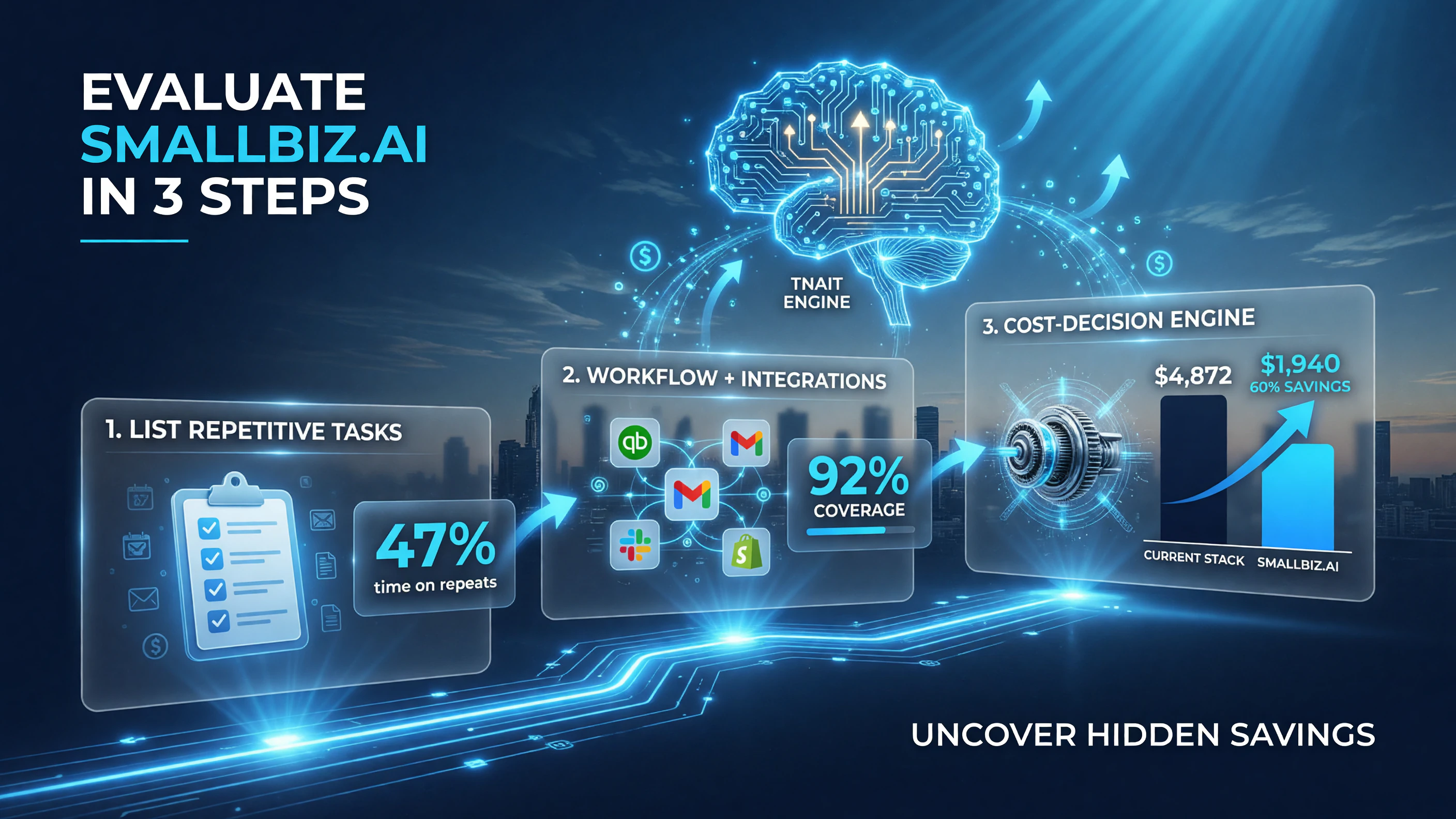
How to trial SmallBiz.ai in three steps: surface your repetitive tasks, verify real workflow and integration coverage, then run the cost-decision engine to find hidden savings.
The bottom line
SmallBiz.ai is a credible answer to a genuine problem: small businesses buy too many disconnected AI tools and use none of them well. Its decision to coordinate existing software rather than replace it is the right instinct, and the cost-optimization layer is a genuinely differentiated feature in a market crowded with platforms that only want to add to your bill.
The open questions are execution — how well the workflows actually integrate with real tools, and how current the 67,000-tool database stays. For any US small business owner drowning in redundant subscriptions and building automations by hand, SmallBiz.ai is worth a real trial. If it delivers even half of what the workflow library promises, it pays for itself in hours saved within the first month.
Frequently Asked Questions
What is SmallBiz.ai?
SmallBiz.ai is an AI platform for small businesses launched on September 4, 2026. It combines a 67,000-tool knowledge base, 275+ pre-built workflows, and a cost-decision layer to help business owners choose and use the right software — with the goal of turning existing tools into automated, money-saving operations.
How is SmallBiz.ai different from ChatGPT?
ChatGPT is a general-purpose assistant where you must build and prompt every workflow yourself. SmallBiz.ai is structured around specific business types and tools — it comes with pre-built workflows and a cost-decision engine that recommends the cheapest viable software stack, so you do not need prompt-engineering skill to get value.
Who is SmallBiz.ai best for?
It is best for US small businesses with repeatable operational patterns — agencies, consultancies, trades, retail, and service businesses. You get the most value if you already use tools like QuickBooks, a CRM, or an email platform that the platform can coordinate, and the least if you want it to replace everything you own.
Does SmallBiz.ai cover my type of business?
SmallBiz.ai says it supports 500 business types. Depth varies by vertical, so if you run a niche operation, test the workflow library and knowledge base directly during a trial before committing — coverage is broad, but specialized industries may be thinner early on.
How does the SmallBiz.ai cost-decision engine save money?
It maps an operational need to real tool pricing and ranks options by actual cost, often identifying that a cheaper tool meets most of your need. If you currently carry redundant or oversized subscriptions, this can more than offset the platform’s own cost.
Is SmallBiz.ai worth it for a solo operator?
It depends on whether you currently overspend on software or build automations by hand. If both are true, the cost-savings and workflow automation can pay for the subscription quickly. If you run lean with one or two tools and prompt AI confidently, you may not need it.

About Barak Schurr
Barak Schurr built and sold a major ticketing platform, ran global nightlife operations at Eventbrite, and now spends his time figuring out which AI tools actually move the needle for independent business owners — and which ones are just noise. No hype. No fluff. Just what works.
Email: [email protected]
More AI Resources for Your Business