Get The Solo Business OS — Free
The AI workflow that replaces a part-time employee for solo operators and small business owners.
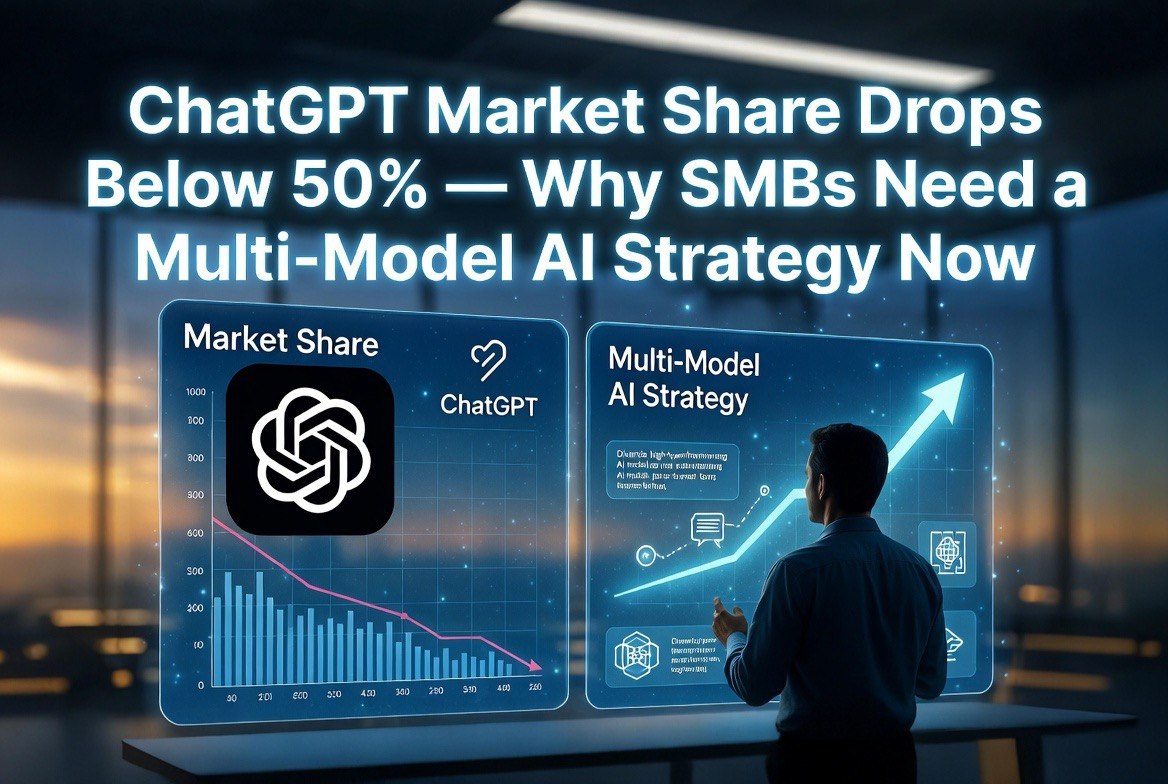
ChatGPT Market Share Drops Below 50% — Why SMBs Need a Multi-Model AI Strategy Now
⚡ Expert Summary: ChatGPT’s share of the AI assistant market has fallen below 50% for the first time as Google Gemini, Claude, and other models rapidly gain users. For small business owners, this fragmentation means betting on a single AI model is a strategic risk. Here’s why a multi-model approach is now essential and how to build one without breaking your budget.
Why ChatGPT’s Market Share Drop Matters to Your Business
According to Sensor Tower data reported in June 2026, ChatGPT still commands 1.1 billion monthly active users — a massive number by any measure. But its share of the AI assistant market has slipped below 50% for the first time since ChatGPT launched in late 2022. Google Gemini has surged to 662 million monthly users, while Anthropic’s Claude family has reached 245 million.
The trend is accelerating. In the past 12 months, at least five new models have crossed 100 million users. OpenAI’s first-mover advantage is eroding as competitors ship competitive products and, in many cases, offer them for free or at significantly lower prices.
For a small business owner, this isn’t just a tech industry story. It directly affects the tools you rely on for content creation, customer service, data analysis, and operations. If you’ve built workflows entirely around ChatGPT, you’re exposed to the same risk as any single-vendor dependency: pricing changes, feature rollbacks, downtime, and model degradation.
Think about what you’ve invested in your current AI setup. You’ve trained employees on specific prompts. You’ve integrated ChatGPT into your CRM or customer service pipeline. You’ve built templates and workflows that depend on its specific output style. None of that transfers easily to another model. The switching cost is high, which is exactly why OpenAI can raise prices and users grumble but stay.
The Fragmentation Is Real — and It’s Permanent
The AI market is not consolidating. It’s fragmenting, and the data backs this up clearly.
Market Share Trends (Sensor Tower, June 2026)
| Model | Monthly Active Users | Market Share Trend |
|---|---|---|
| ChatGPT | 1.1B | Below 50% |
| Google Gemini | 662M | Growing |
| Claude | 245M | Growing |
| Other (Llama, Grok, Qwen, etc.) | 300M+ | Fastest growth |
This fragmentation isn’t a bug — it’s the natural evolution of a market that was artificially concentrated by novelty. As AI becomes infrastructure, multiple providers competing on price, capability, and specialization is the healthier outcome.
But for SMBs, it creates a new problem: choice paralysis and vendor lock-in risk. Every new model launch makes the decision more complex. Do you switch to Gemini because it integrates with Google Workspace? Do you keep paying for ChatGPT Plus because it’s what your team knows? Do you add Claude for its superior long-document handling?
The short answer is: yes, all of the above. The winning strategy isn’t picking one model. It’s building systems that work across all of them.
The Real Cost of Vendor Lock-In
Direct Costs
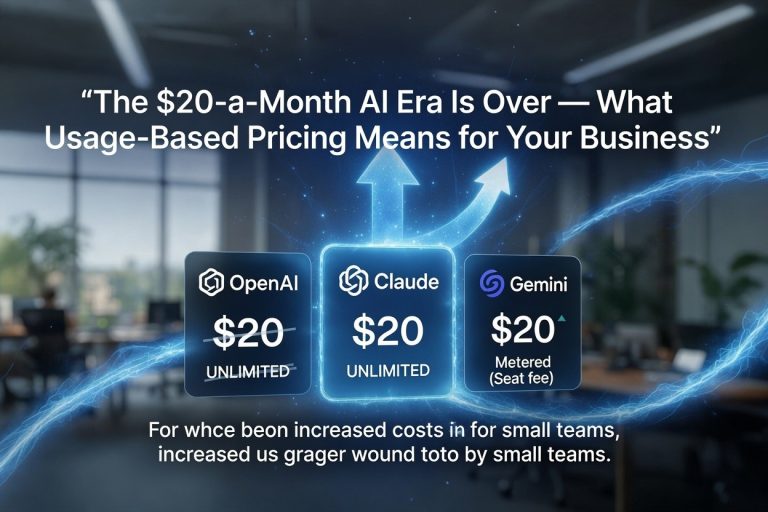
ChatGPT Plus costs $20 per month per user. ChatGPT Pro costs $200. For a team of five, that’s between $100 and $1,000 per month just for one tool. Gemini Advanced is $20 per month. Claude Pro is $20 per month. These add up fast, especially when you consider that each model excels at different tasks and you may need access to all three.
Indirect Costs
The hidden costs are worse. When a model changes its behavior — and they all do, frequently — your prompts break. Your automated workflows produce different output. Your team loses confidence in the tool. Each update cycle costs hours of retesting and rewriting.
OpenAI’s GPT-4 to GPT-4o transition caused widespread prompt breakage across the business community in early 2025. The same happened with Google’s Gemini model transitions. These aren’t bugs — they’re the normal cost of relying on someone else’s rapidly evolving product.
Opportunity Costs
Sticking with one model means you’re not testing the alternatives. You don’t know if Gemini gives better search-grounded answers for your industry research. You don’t know if Claude handles your contract reviews more accurately. You’re paying the same either way but getting potentially worse results.
What a Multi-Model Strategy Looks Like for SMBs
The solution isn’t to abandon ChatGPT. It’s to treat AI models like any other business tool: diversify, test, and optimize across providers.
Step 1: Map Your Use Cases to Model Strengths
| Use Case | Best Model | Why |
|---|---|---|
| Content writing and brainstorming | ChatGPT | Strong creative generation, web browsing |
| Data analysis and spreadsheets | ChatGPT + Gemini | Code interpreter + Google Sheets integration |
| Long document analysis | Claude | 200K token context window |
| Research and citations | Perplexity / Gemini | Real-time web grounding |
| Customer service automation | Open-source models | Lower cost, self-hostable, no API fees at scale |
Step 2: Use a Unified Interface
Tools like TypingMind, Poe, and ChatHub let you access multiple models from one interface. You write the prompt once and compare responses across models. TypingMind Pro runs about $20 per month and gives you access to ChatGPT, Claude, Gemini, Llama, and Grok from a single dashboard. Poe offers a similar setup with a $20 monthly subscription. This costs slightly more per query than a single-model subscription but eliminates the switching cost entirely.
For teams, platforms like Vellum and Hugging Face’s inference endpoints let you route queries to the best model based on cost, latency, and quality requirements. You can set rules like “all customer-facing responses go through Claude for safety, internal analysis goes through Gemini for speed, and long-form content uses ChatGPT.”
Step 3: Build Prompt Libraries That Are Model-Agnostic
Structure your prompts to work across models. Avoid ChatGPT-specific features like custom instructions or GPT actions unless you’re willing to rebuild them on every platform. Write clear, detailed prompts that any competent model can execute.
A good practice is to maintain a prompt library in a shared document or tool like Notion. Each prompt includes the core instruction, expected output format, and a list of which models it’s been tested with. When a model updates, you test the prompt against all models in your stack and note any changes.
Step 4: Monitor Model Performance with A/B Testing
Run the same task through ChatGPT and Gemini for a week. Which gives better answers for your specific business? Track it. Models improve and degrade at different rates. Quarterly reviews keep you on the best option.
Use a simple scoring system: relevance, accuracy, speed, and cost. Give each model a score for your most common use cases. When a new model version drops, run your tests again. This takes maybe two hours per quarter and prevents you from riding a model that’s getting worse while its competitor improves.
Step 5: Keep an Open-Source Option Ready
Open-source models like Llama 3, Qwen, and GLM-5 now rival proprietary models at a fraction of the cost. Z.ai’s GLM-5.2 recently beat GPT-5.5 on multiple coding benchmarks while costing one-sixth as much to run. Services like Groq Cloud offer fast inference for pennies per thousand queries.
Having an open-source fallback means you’re never held hostage by a pricing change. You can spin up a self-hosted model on a $50 per month VPS and route your customer service queries through it. The quality may be 90% of what you get from ChatGPT, but the cost difference is 95% less, and your data never touches a third-party server.
The Business Case for Diversification
A Gartner report from early 2026 found that 47% of enterprises already use three or more AI models in production. The same report predicted that within two years, 75% of businesses that rely on a single AI provider will experience at least one significant disruption from pricing changes or service degradation.
For small businesses, the calculation is even clearer. You don’t have the IT staff to handle emergency migrations. Building portability into your AI workflows now costs time — but not building it costs your business in a crisis.
Consider what happened to businesses that relied entirely on Mailchimp when it changed its pricing structure in 2024. Or companies that built their customer support on Zendesk and had to absorb major cost increases. The same pattern repeats in every software category. AI is no different, except the switching cost is higher because your prompts, workflows, and training data are deeply integrated with the model’s behavior.
The models you use today are not the models you will use in three years. Building your business processes around one provider’s API is like building your website on a proprietary platform you don’t control. It works until it doesn’t, and by then the cost of leaving is punishing.
The American small business sector has already learned this lesson with cloud services, payment processors, and marketing platforms. Diversification isn’t optional — it’s survival. AI is the new frontier of the same old rule: never let one vendor own your critical infrastructure.
The Bottom Line
ChatGPT sliding below 50% market share isn’t a sign of decline. It’s a sign of a maturing market. For small business owners, the smart move isn’t to pick a winner. It’s to build workflows that work with all of them.
Your business survived payment processor changes, social media algorithm shifts, and software subscription price hikes. AI vendor lock-in is the same risk — and the same solution: diversify before you need to.
Start this week. Pick one task your team uses ChatGPT for and run it through Gemini. See what’s better. Next week, try Claude for document review. The goal isn’t to replace ChatGPT tomorrow. It’s to have options when tomorrow changes the rules.
The companies that treat AI as a portfolio — not a single bet — are the ones that will be able to negotiate, adapt, and optimize as this market matures. The ones that stay single-provider will be stuck paying whatever their vendor decides to charge, running whatever features their vendor decides to ship, and waiting however long their vendor decides to take for fixes.
Don’t let that be you.
Less noise. More output. The AI tools you use shouldn’t own your business processes. Treat models like vendors, not partners. Test multiple. Keep your prompts portable. And never let a single provider’s pricing changes determine your operating costs.
Frequently Asked Questions
What is ChatGPT’s current market share in 2026?
ChatGPT’s share of the AI assistant market has dropped below 50% for the first time, according to Sensor Tower. It still leads with 1.1 billion monthly active users, but Google Gemini at 662 million and Claude at 245 million are closing the gap rapidly.
Why does AI model fragmentation matter for small businesses?
Using a single AI model creates vendor lock-in. If that model changes pricing, reduces features, or experiences downtime, businesses that haven’t diversified their AI tools face costly, disruptive migrations. A multi-model strategy protects against this.
How can I use multiple AI models without increasing costs significantly?
Multi-model interfaces like TypingMind or Poe give access to many models for $20-30 per month on top of your existing subscriptions. Open-source models run on Groq Cloud or similar services can cost pennies per query.
Which AI models are best for small business operations in 2026?
ChatGPT leads for content creation, Claude excels at document analysis, Gemini is strongest for research and Google Workspace integration, and open-source models like Llama 3 and GLM-5.2 offer the best value for customer service automation.
What is the risk of relying entirely on ChatGPT?
The primary risks are pricing changes, service degradation, feature limitations that other models don’t have, and the inability to switch providers quickly when needed. A Gartner report predicts 75% of single-provider AI users will face a significant disruption within two years.

About Barak Schurr
Barak Schurr is the founder and former president of the nightlife ticketing platform Wantickets and former Global Director of Dance and Nightlife at Eventbrite. He currently focuses on AI research and writes about practical AI for independent business owners that actually moves the needle — no hype, no corporate fluff. More at topnotchaitools.com.
Contact: [email protected]
More AI Resources for Your Business