Get The Solo Business OS — Free
The AI workflow that replaces a part-time employee for solo operators and small business owners.
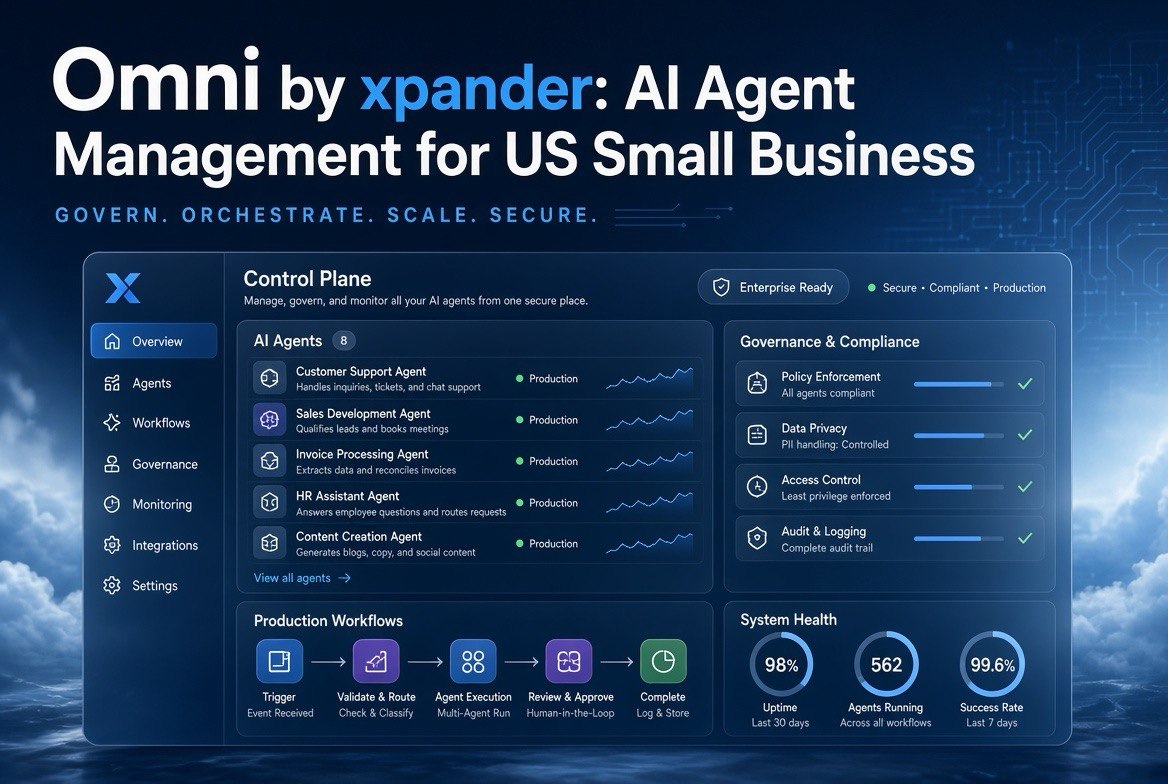
Omni by xpander: AI Agent Management for US Small Business
⚡ Expert Summary: Omni by xpander.ai is a vendor-neutral AI agent management platform that launched on August 17, 2026, alongside a $7.5M seed round led by Pico Venture Partners. It turns a plain-English description of a business outcome into a production-ready “Agentic Application,” complete with a backend agent and frontend interface. For US small business owners finally drowning in disconnected AI tools, Omni’s pitch is one control plane that builds, governs, and scales your agents without locking you to a single model.
Why a US Small Business Owner Should Care About AI Agent Sprawl
You did not need an agent management platform until a few weeks ago, and then suddenly you did. The pattern is familiar to anyone who lived through the app boom: every vendor sells you one more AI tool, each one a separate login, each one doing one thing, none of them sharing context. You now have a chatbot that writes, a chatbot that books, a chatbot that answers support, and a chatbot that processes invoices. Individually helpful. Collectively, a mess.
That mess has a name in the industry: AI agent sprawl. It is the exact same disease as app sprawl, except worse, because agents do not just store data, they take actions. An agent that acts on stale context can cause a missed invoice, a double booking, or a wrong customer response. The more agents you deploy, the more risk of that chaos compounds.
Omni by xpander.ai is attacking this problem head-on. On August 17, 2026, the company launched Omni to general availability as a vendor-neutral control plane for building, deploying, governing, and scaling AI agents across models, frameworks, and environments, including self-hosted options (VentureBeat, August 17, 2026). The launch landed alongside a $7.5M seed round led by Pico Venture Partners, with participation from Emerge Ventures, Samsung Next, and SeedIL (HPCwire, August 17, 2026).
Here is what that means in plain English for an American business owner who is not an engineer: instead of buying one AI tool from one vendor and being married to that model forever, Omni lets you build and manage agents that work across any model, and it gives you one place to watch what they are doing, how much they cost, and whether they are allowed to act.
What Exactly Is Omni by xpander
Omni is the flagship product inside xpander.ai, described as an automated “agentic Forward Deployed Engineer.” The name sounds like Silicon Valley jargon, but the job is simple: you describe the business outcome you want in natural language, and Omni builds the working agent for you. You can do this in the xpander interface itself, or by tagging Omni inside tools like ChatGPT or Claude.
The output is what xpander calls an “Agentic Application”, which is more than a chat bot. It combines a backend agent with frontend elements like chat interfaces, interactive UI components, reports, dashboards, and visualizations (VentureBeat, August 17, 2026). In other words, Omni does not hand you a terminal prompt. It hands you a finished tool your team can actually use.
This matters for small businesses because most owners are not AI engineers and do not want to become one. When the tool can translate “build me something that triages our IT tickets and routes them to the right person” into a working, governed agent with a usable interface, the owner no longer needs a developer to get value from AI agents.
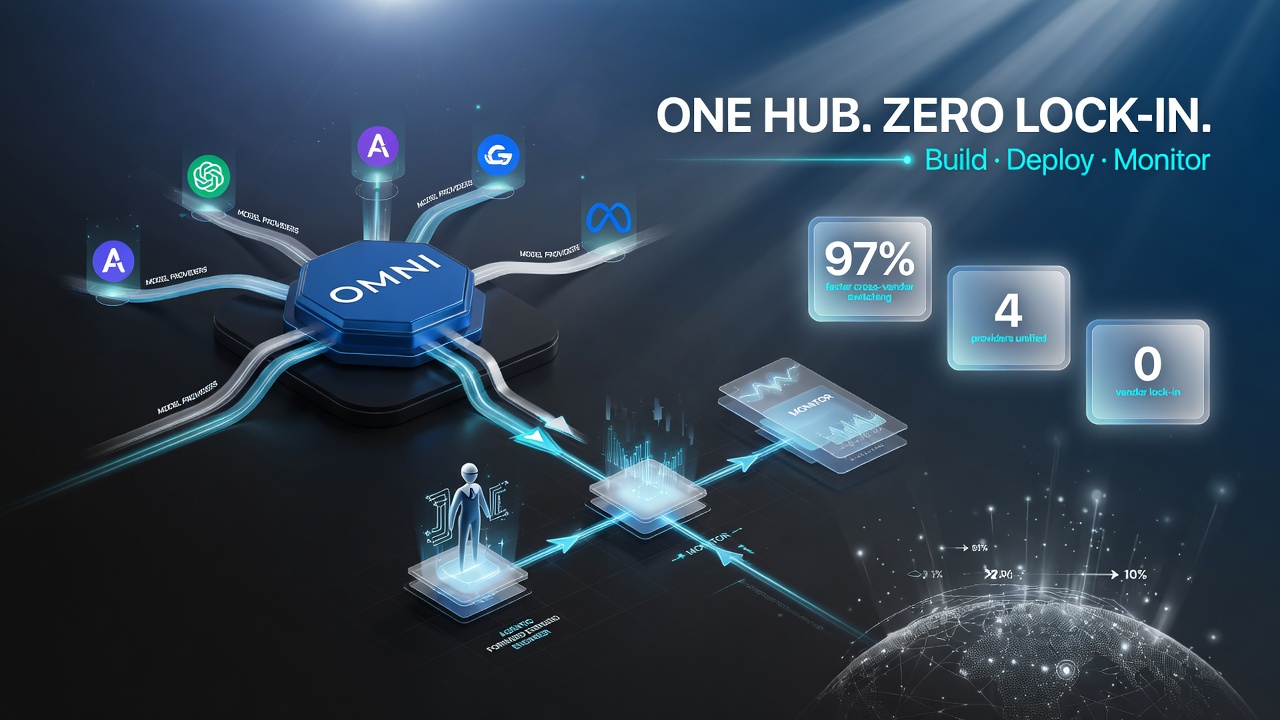
How the Omni operating loop works for a small business: build an agent once, deploy it through the hub, then monitor execution and performance continuously — without rebuilding for each vendor.
What Omni Can Actually Do for You
The four capabilities that matter most to a small business owner are build, optimize, flexibility, and governance.
- Build from a description. Omni maps the process you describe, wires the tools, connectors, skills, and memory, tests the agent (including on mock data), and deploys it. You do not write code; you describe the job.
- Optimize and maintain. After deployment, Omni analyzes real runs and traces to improve the agent’s instructions, fixes issues when tools or APIs change, and migrates laptop-based workflows into governed cloud environments.
- Model and environment flexibility. Omni works with any frontier, open, or self-hosted model, and can deploy in your cloud, a VPC, on-premises, or fully air-gapped. You can swap underlying models without rebuilding the agent.
- Production governance. Agents run with audited actions, scoped permissions, secrets management (credentials injected at runtime rather than exposed to the model), human-in-the-loop approvals, and observability.
On capability, Omni scored 90.9% on the GAIA benchmark, a widely cited measure of agentic reasoning and tool use (HPCwire, August 17, 2026). That benchmark is not the whole story, but it is a useful signal that the underlying agent is genuinely capable, not a dressed-up autocomplete.
For a small business, the combination that stands out is build-plus-govern. A solo tool can build you an agent. Most cannot also tell you what that agent did, who approved it, how much it cost, and which credentials it touched. Omni is explicitly built to answer those questions, which is precisely what an owner needs before letting an agent act on real money.
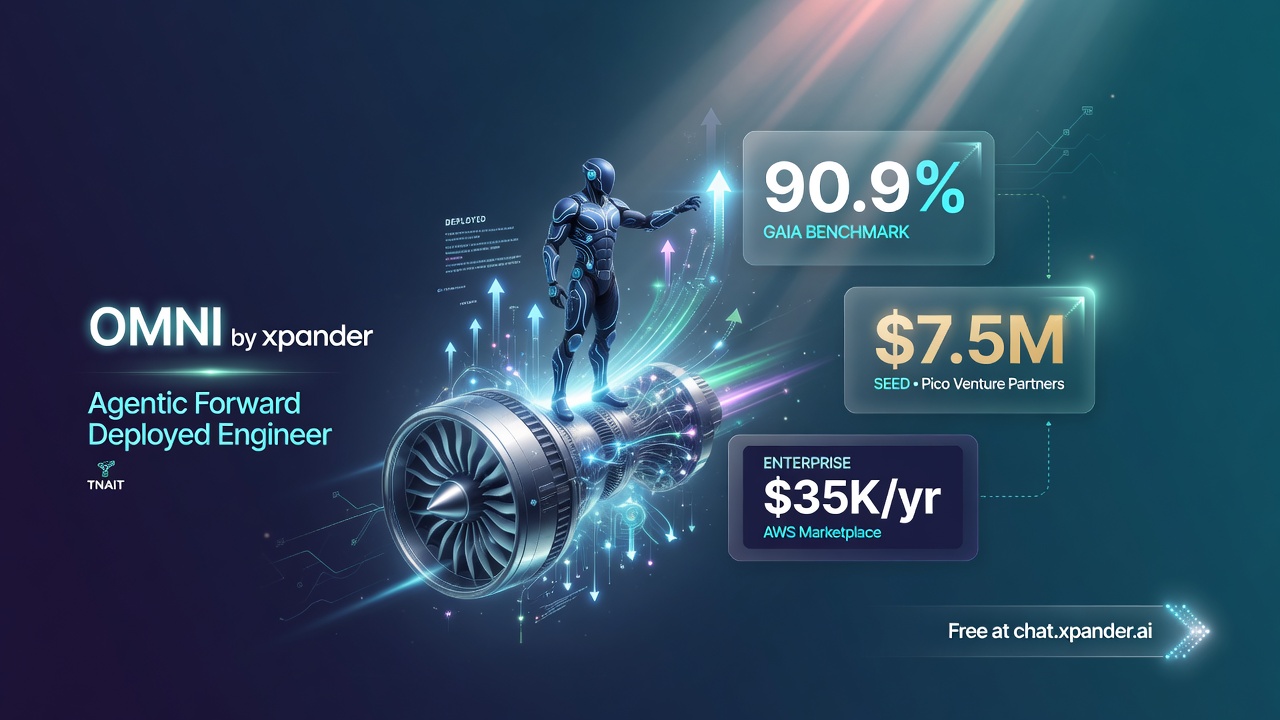
The business case behind Omni: a .5M seed round led by Pico Venture Partners, a 90.9% GAIA benchmark score, free access at chat.xpander.ai, and enterprise pricing around K per year via AWS Marketplace.
How Omni’s Pricing Works for Small Business
The barrier to entry is genuinely low. Omni and the xpander platform are available at chat.xpander.ai, free to start for self-service use. There are no per-seat charges. Instead, usage is tied to credits, where 1 credit = 1 cent, driven by agent activity (VentureBeat, August 17, 2026).
For an individual owner or small team testing the waters, that means you can try the platform without committing to a monthly license just to see if it works. You pay for what you actually run.
For businesses that need it, there is an enterprise tier that is self-hosted on your own infrastructure, Kubernetes, on-premises, or a VPC, with a separate commercial contract. An example listing on AWS Marketplace prices platform access at $35,000 for a 12-month contract (AWS Marketplace). That enterprise tier is a different league from the free self-service option, and it is aimed at organizations that need everything air-gapped and fully under their own control.
| Tier | Best For | Pricing |
|---|---|---|
| Self-service / Team | Owners testing and scaling | Free to start; usage credits (1 credit = 1¢) |
| Enterprise | Fully self-hosted / air-gapped | Contract-based (e.g. $35K/yr on AWS) |
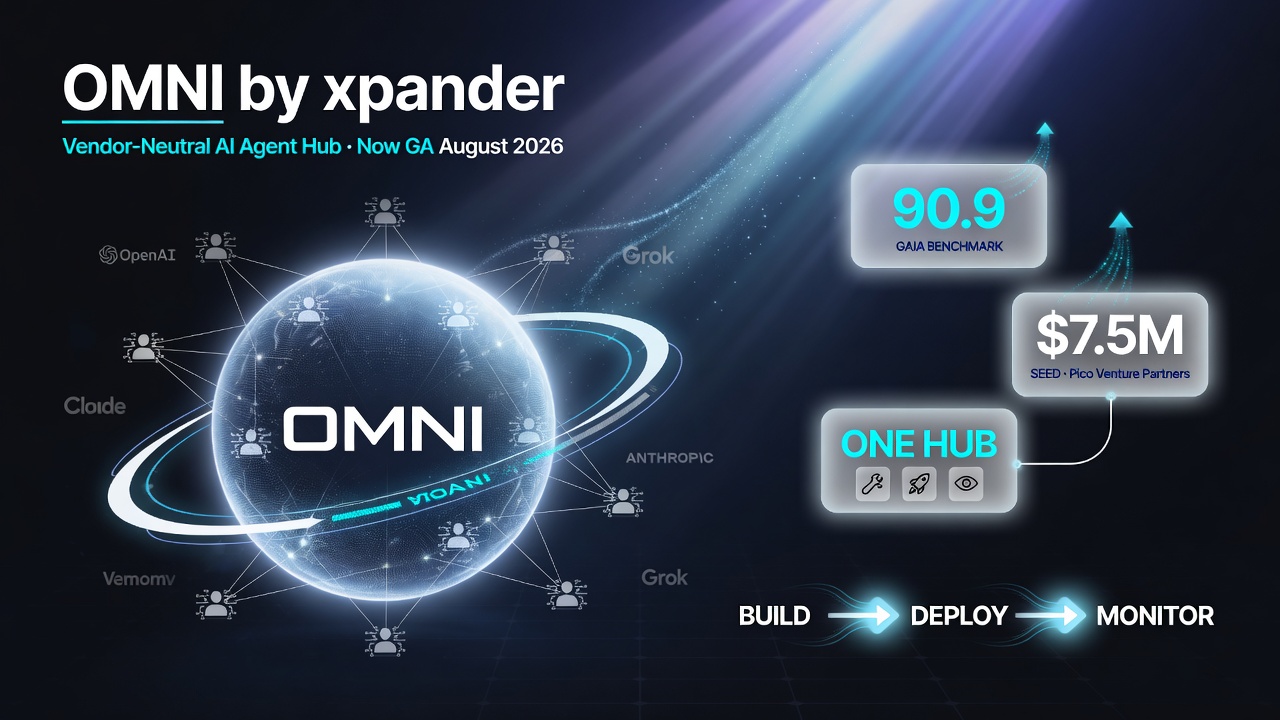
The core promise of Omni by xpander: one hub with zero vendor lock-in, letting a business build, deploy, and manage AI agents across multiple model providers from a single interface.
Why Vendor Neutrality Is the Point
The single most important thing Omni does differently is refuse to lock you to one model vendor. Most AI platforms make you commit: build on this model, and if you want to switch, you rebuild. Omni is built to be model- and framework-agnostic, supporting any frontier or open model, and letting you swap models without rebuilding your agents (VentureBeat, August 17, 2026).
If that sounds abstract, consider the real consequence. The AI market moves fast, models get better, prices change, and a model that is great today may be superseded in six months. If your business processes are hardwired to one model, you are stuck, either paying more than you should or waiting for someone to untangle the integration. With a vendor-neutral control plane, you change the engine without rebuilding the car.
For a small business owner, model neutrality is a form of insurance. It protects you from betting your operations on a single provider that could raise prices, change its API, or go sideways. You keep the flexibility to move to whatever is cheapest and best at any given moment.
Bringing Order to Your Own AI Tool Sprawl
You do not need to run an enterprise IT department to apply the thinking behind Omni. Even at a small scale, the same control-plane principles will save you money and avoid mistakes:
- Keep a single inventory. Know every AI tool and agent you use, who owns it, and what it is connected to. Sprawl is only dangerous when you do not know what you have.
- Scoped permissions. Do not give every tool full access to everything. An agent that handles invoices should not also be able to post to your public accounts.
- Human approval on big actions. Set a rule that anything above a dollar threshold requires a human to confirm. This is the difference between an assistant and an unmanaged liability.
- Track the cost per task. If you are not measuring what each agent costs to run, you cannot tell whether it is earning its keep.
Those four habits are exactly what Omni automates at the platform level. Put them in place, with Omni or on your own, and you stop swimming in tools you do not fully trust and start running a set of agents you actually control.
How Omni Compares to the DIY Approach
To make the value concrete, here is how running agents with Omni stacks up against the DIY approach most small businesses fall into, where each tool is managed separately and nothing is governed.
| Task | DIY Approach | With Omni |
|---|---|---|
| Building an agent | Needs a developer or a single-vendor tool | Describe the outcome in plain English |
| Switching models | Rebuild the integration | Swap models without rebuilding |
| Watching cost | Spread across many separate bills | Credit-based usage, 1 credit = 1 cent |
| Approving actions | Trust the tool, hope for the best | Human-in-the-loop approvals built in |
Every row on the right side removes friction that quietly eats your time or costs you money. That is the whole pitch in one glance: Omni gives a small business the kind of control over its AI agents that used to require a dedicated platform team.
The Bottom Line for US Small Business Owners
Omni by xpander.ai arriving now is a signal that the AI agent market has matured past the “one shiny chatbot” phase and into the “manage your agents like infrastructure” phase. The $7.5M seed from Pico Venture Partners, Samsung Next, and others backs that shift with real money (HPCwire, August 17, 2026). For an American small business owner, the practical takeaways are clear:
- You can now start building real, governed AI agents from a plain-English description, free, at chat.xpander.ai.
- Vendor neutrality protects you from locking your operations to one model that could change the terms later.
- The cost model (pay for usage, not per seat) fits a small operation trying agents before scaling.
- The 90.9% GAIA score and production-grade governance mean this is not a toy.
The businesses that win with AI will not be the ones that buy the most tools. They will be the ones that organize, govern, and scale the agents they already have. Omni is one of the clearest products yet built for exactly that job, and it is now available to anyone, including the owner of a shop, clinic, or service business who has been watching the agent wave from the sidelines.
Frequently Asked Questions
What is Omni by xpander.ai?
Omni by xpander.ai is a vendor-neutral AI agent management platform launched on August 17, 2026. It turns a plain-English description of a business outcome into a production-ready agent with a usable interface, and it handles building, governing, and scaling agents across multiple models and environments.
How much does Omni by xpander cost?
Omni is free to start via chat.xpander.ai for self-service use, with no per-seat charges. It uses usage-based credits (1 credit equals 1 cent) tied to agent activity. A self-hosted enterprise tier is available under contract, with an example AWS Marketplace listing at $35,000 for 12 months.
Who funded xpander.ai?
xpander.ai raised a $7.5M seed round led by Pico Venture Partners, with participation from Emerge Ventures, Samsung Next, and SeedIL, announced alongside the Omni launch on August 17, 2026.
Is Omni only for engineers?
No. Omni is designed so that a person can describe an outcome in natural language and get a working agent with a frontend interface, without writing code. This is a core part of its pitch to non-technical business users.
Can I use Omni with any AI model?
Yes. Omni is model- and framework-agnostic, supporting any frontier or open model and letting you swap underlying models without rebuilding your agents. It also supports self-hosted and air-gapped deployments.

About Barak Schurr
Barak Schurr is the founder and former president of the nightlife ticketing platform Wantickets and former Global Director of Dance and Nightlife at Eventbrite. He currently focuses on AI research and writes about practical AI for independent business owners that actually moves the needle — no hype, no corporate fluff. More at topnotchaitools.com.
Contact: [email protected]
More AI Resources for Your Business