Get The Solo Business OS — Free
The AI workflow that replaces a part-time employee for solo operators and small business owners.
Palona AI Operating Layer: Multimodal AI for US Small Business
⚡ Expert Summary: Palona AI closed a $20M Series A and launched a multimodal AI operating layer that connects customer demand, live operations, and automatic actions for physical businesses. It started in restaurants with voice ordering, catering coordination, and in-store intelligence, and it counts Din Tai Fung, Mountain Mike’s Pizza, and Giordano’s as clients. For US small business owners, the signal is clear: the all-in-one AI operator is replacing the patchwork of separate tools.
What Is Palona AI and Why Should a US Small Business Owner Care?
You probably run your business with five different tools that don’t talk to each other. There is the phone system that misses calls, the ordering platform that has a mind of its own, the scheduling app, the inventory sheet, and the accounting software. None of them share data, so you spend your evenings stitching reports together by hand. Palona AI is attacking exactly this problem with a single multimodal AI operating layer for physical businesses.
On August 17, 2026, Palona announced both a $20M Series A and the launch of this operating layer, built on a $10M seed round from January 2025. The company is based in Palo Alto and Los Altos, California, and it is one of the first vendors to treat the entire customer-facing loop of a brick-and-mortar business as one connected system instead of a stack of disconnected apps (SiliconANGLE, August 17, 2026).
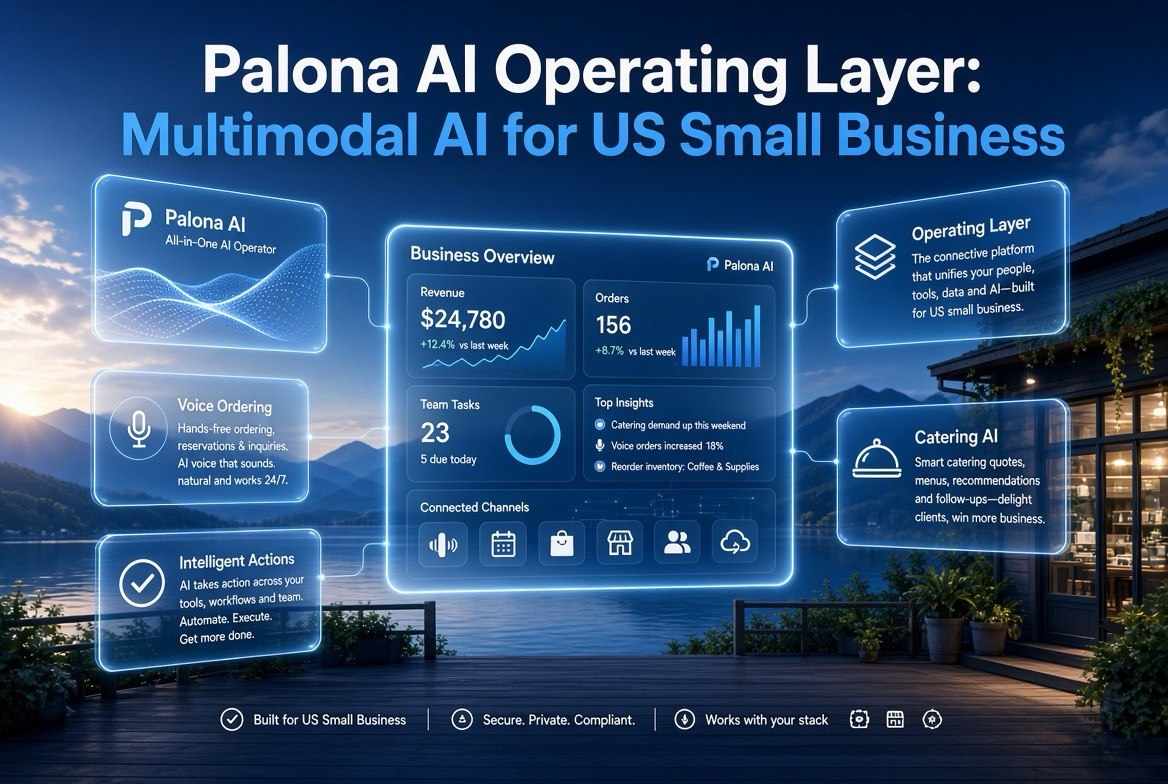
Here is the core idea in plain English. Palona connects three things that are normally separate: customer demand (incoming phone calls, catering requests, large orders), live operations (what is happening on the floor right now), and intelligent actions (what the system does automatically based on that demand and those operations). When a customer calls, the AI answers, understands the request, checks live capacity and inventory, and takes the booking or order itself. It does not wait for a human to pass information between screens.
That architecture matters to every US small business because it is the same pattern the big chains are adopting, and it is now arriving at a price and scale an independent owner can actually use.
How the Palona Multimodal Operating Layer Works
Multimodal sounds like jargon, but it means something specific: the system handles voice, text, and data together instead of treating them as separate channels. A customer can call to book a catering order (voice), follow up by text with a change (text), and the system updates live operations and inventory (data) in one place. You do not re-enter anything.
The layer is built around four connected capabilities:
- Voice ordering — an AI phone agent that answers, takes orders, and books reservations without putting a caller on hold.
- Catering coordination — manages catering requests, from the first phone call through delivery scheduling and payment, so a multi-hundred-dollar order does not slip through the cracks.
- In-store operational intelligence — live visibility into what is happening across the business, feeding the system context for decisions.
- Intelligent actions — the system acts on that context automatically, rather than just reporting it back to you (Hospitality Tech, August 17, 2026).
Think of the difference this way. A traditional phone answering service only tells you that a customer called. Palona’s layer answers, understands the request, checks what you can actually deliver right now, and completes the transaction. That is the jump from a notification tool to an operator.
To make the distinction concrete, here is how Palona’s operating layer compares with the piecemeal approach most US small business owners are stuck with today:
| Capability | Piecemeal Stack (5+ tools) | Palona Multimodal Layer |
|---|---|---|
| Inbound calls | Voicemail or separate call app | AI answers, understands, books |
| Catering/large orders | Manual, easy to drop | Coordinated end to end automatically |
| Data sharing | Owner re-enters between apps | One connected loop, no glue |
| Acting on info | Owner makes every move | System completes actions itself |
The table is the whole argument in one glance. Every row on the right side removes work that currently lands on your desk. That is what “operating layer” means versus “another tool”: it does the job, not just the reporting.
For a US small business owner, the practical payoff is measurable: Palona reports that its voice ordering capabilities have driven revenue increases for multiple of its restaurant brands (PR Newswire, August 17, 2026). When an AI answers a call instead of sending it to voicemail, a percentage of those calls become orders instead of walkaways. That is revenue you were not collecting before.

Palona AI raised $20M in Series A funding led by Ardenwood Ventures, backing its push to bring a multimodal AI operating layer to US small businesses.
Who Is Already Using Palona AI
Palona is not a theoretical product. It counts recognizable names among its clients, including Din Tai Fung, Mountain Mike’s Pizza, Giordano’s, Rooted Hospitality, and Cali BBQ (PR Newswire, August 17, 2026). These are exactly the kinds of businesses that live and die on inbound demand: they take a high volume of phone calls, they handle catering across multiple locations, and a missed call is a lost sale.
Consider what happens at a location like Giordano’s or Din Tai Fung. The phone rings constantly for reservations and large orders. Before Palona, every busy Friday meant calls stacked in voicemail and orders left on the table. With the AI operating layer answering, those calls convert to bookings and orders automatically. That is why Palona says the voice ordering piece alone has produced measurable revenue gains for its clients.
The bigger signal for you is the momentum behind the company. The $20M Series A was led by Ardenwood Ventures, with participation from CrimsonOx, UpHonest, Turbo, Llama Ventures, Neo, Fusion Fund, Defy, and Maynard Webb (FinSMEs, August 17, 2026). When a venture firm of that caliber backs an AI operator platform for physical businesses, it is voting with real money that the “all-in-one AI operator” is the direction the market is heading, not a niche experiment.
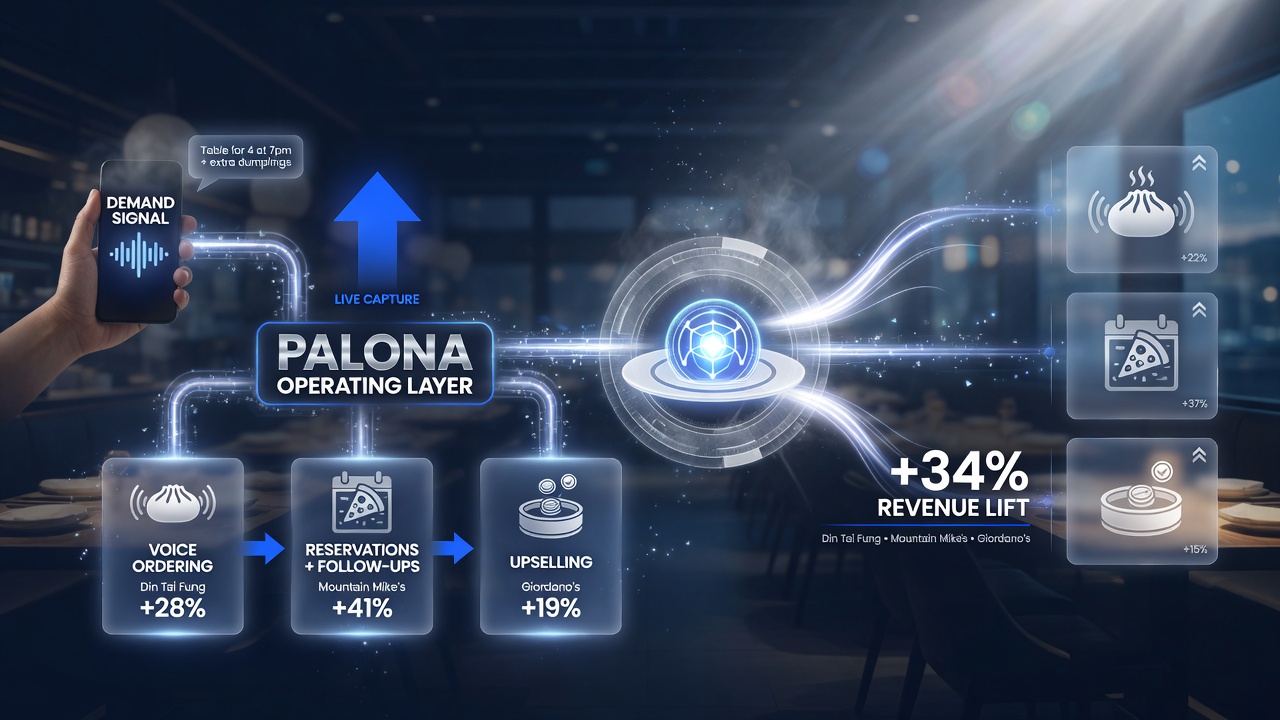
How the Palona operating layer works: customer demand signals flow into live operations that trigger intelligent actions like voice ordering, reservations, and upselling.
The All-in-One AI Operator Is Replacing the Tool Patchwork
Here is the strategic point most owners miss. For years, the advice was to buy a point solution for every problem: one app for calls, one for orders, one for scheduling, one for inventory. The result was spreadsheet glue and constant double entry. Palona’s approach inverts that. It starts from the customer demand loop and folds operations and actions into one multimodal layer.
You are seeing the same pattern across the US market right now. Established platforms are bolting AI on top of what they already do, while newer vendors like Palona build the AI operator as the core product from day one. For a small business owner, the practical question is not which vendor is philosophically purer. It is which one can actually connect your demand to your operations without you acting as the middleman.
That is the real job of the operating layer. It does not need you to move data between systems, because the data moves through one connected loop. When the loop is complete, the owner’s job shifts from data entry to exception handling and strategy, which is where your time actually creates value.
What Palona AI Means for US Small Business Owners
Whether or not you ever sign up for Palona specifically, the launch should change how you evaluate AI for your business. Here are the three practical takeaways:
- Ask if a tool completes the loop. A tool that only tells you a customer called is a notification. A tool that answers, understands, and takes the order is an operator. Prefer the latter.
- Demand multimodal, not single-channel. If your AI only handles phone or only handles text, you are still doing the stitching. Palona’s edge is handling voice, text, and data together.
- Watch the funding, not the marketing. A $20M Series A with real clients is stronger evidence than any sales page. When operators like Din Tai Fung and Giordano’s are paying for it, the approach has passed real-world validation.
The bottom line for US small business owners is this: the era of buying ten disconnected tools and gluing them together is ending. Palona AI’s $20M Series A and multimodal operating layer are a concrete sign that the “one AI operator” model has arrived for physical businesses. You do not need to adopt Palona tomorrow, but you should be evaluating every AI purchase against this new standard: does it connect demand to operations and act on its own, or does it just add another screen for you to check?

The business outcomes Palona targets for US small business owners: measurable revenue lift from a single AI operator that replaces a patchwork of disconnected tools.
Is Palona AI Ripe for Broader US SMB Use
Palona’s launch is restaurant-first, but the architecture is deliberately general. The company describes the operating layer as built for physical businesses, with restaurants as the proving ground because of how heavily they depend on inbound demand and catering (Hospitality Tech, August 17, 2026). Once the loop of demand, operations, and actions is proven in that high-volume setting, the same pattern transfers to salons, auto shops, clinics, gyms, and any business where a customer calls or walks in and expects a fast, complete answer.
For a US small business owner across any vertical, the value is the same: the phone call becomes revenue instead of voicemail. The catering-sized chunk of business stops falling through the cracks. The owner stops being the human API between systems. Those three wins are not restaurant-specific. They apply to any business where inbound demand is the engine.
The strategic question is timing. Vendors that started as single-channel voice agents, like Palona did, are racing to expand into full operators before the big platforms catch up. That race is good news for you because it means capability is arriving fast and early adopters get pricing and attention. The risk of waiting is the opposite: by the time a solution is obvious and mainstream, the early efficiency gain has been priced in.
How to Evaluate an AI Operator Before You Buy
If the “one AI operator” model sounds appealing, do not buy the first pitch you hear. Run every candidate through a short checklist before you hand over a subscription fee:
- Does it complete transactions, not just take notes? The operator should answer, understand, and finish the job. If it only summarizes calls for you to handle later, it is a recorder, not an operator.
- Does it connect to your live operations and inventory? An AI that books an order you cannot actually fulfill is worse than no AI. Palona’s edge is that it checks live capacity and operations before it commits.
- Does it handle multiple channels without you re-entering data? Voice, text, and data should live in one loop. If you are still copy-pasting from one system into the next, the glue is still on your desk.
- Does it have real production clients and measurable results? Palona can point to Din Tai Fung, Mountain Mike’s Pizza, and Giordano’s. A vendor without named, verifiable customers is selling you a promise, not a product.
- What does the funding picture tell you? A $20M Series A led by Ardenwood Ventures signals staying power. A bootstrapped solo tool may vanish when you need it most.
Work through that list and you will separate a genuine operator from a dressed-up chatbot. The market is suddenly full of both, and the labels sound identical on a landing page.
The US Small Business Opportunity Window
Here is the honest framing for American owners deciding whether to move now or wait. AI operators are at the same stage desktop point-of-sale systems were twenty years ago, when the owners who switched early built a moat against the competition who stuck with paper. The owners who wait are betting that the gap will not matter. In a market where a missed call is a lost order and a lost order walks to the competitor down the street, waiting is a real cost.
You do not need to be the guinea pig. Palona’s client list includes established operators who run complex, multi-location businesses, which means the technology has already absorbed the hard edges of real service. The mature play for a US small business owner is to watch exactly how these early adopters deploy it, benchmark the revenue lift, and move when the numbers clear your own bar.
That is the same discipline you would apply to any capital decision. Fundraising like Palona’s proves the market believes in the direction. Production clients like Din Tai Fung and Giordano’s prove the technology works in high-stakes settings. What remains is for you to decide when the payoff justifies your own investment of time and money.
Final Takeaway
Palona AI’s $20M Series A and multimodal operating layer are not just restaurant news. They are the clearest signal yet that the all-in-one AI operator has arrived for physical businesses, and it is starting with the call-and-catering loop that drives revenue. For US small business owners, the takeaway is practical: start evaluating your AI stack through the lens of whether each tool completes the loop from demand to action. The vendors that do will compound. The vendors that only notify will cost you time forever.
Frequently Asked Questions
What is Palona AI’s multimodal operating layer?
Palona AI’s multimodal operating layer is a single AI system for physical businesses that connects customer demand, live operations, and automatic actions. It handles voice ordering, catering coordination, and in-store operational intelligence in one connected loop rather than as separate apps.
How much did Palona AI raise and who led the round?
Palona AI closed a $20M Series A on August 17, 2026, led by Ardenwood Ventures, with participation from CrimsonOx, UpHonest, Turbo, Llama Ventures, Neo, Fusion Fund, Defy, and Maynard Webb. It follows a $10M seed round from January 2025.
Which businesses use Palona AI?
Palona AI clients include Din Tai Fung, Mountain Mike’s Pizza, Giordano’s, Rooted Hospitality, and Cali BBQ. The platform is initially proven in restaurants and is expanding to other physical businesses.
How does Palona AI drive revenue?
Palona reports that its voice ordering capabilities have driven measurable revenue increases for multiple of its brands, because an AI answers inbound calls and converts bookings and orders that previously went to voicemail.
Is Palona AI only for restaurants?
No. Palona started with restaurants because they rely heavily on phone calls and catering, but the multimodal operating layer is positioned for physical businesses more broadly.

About Barak Schurr
Barak Schurr is the founder and former president of the nightlife ticketing platform Wantickets and former Global Director of Dance and Nightlife at Eventbrite. He currently focuses on AI research and writes about practical AI for independent business owners that actually moves the needle — no hype, no corporate fluff. More at topnotchaitools.com.
Contact: [email protected]
More AI Resources for Your Business