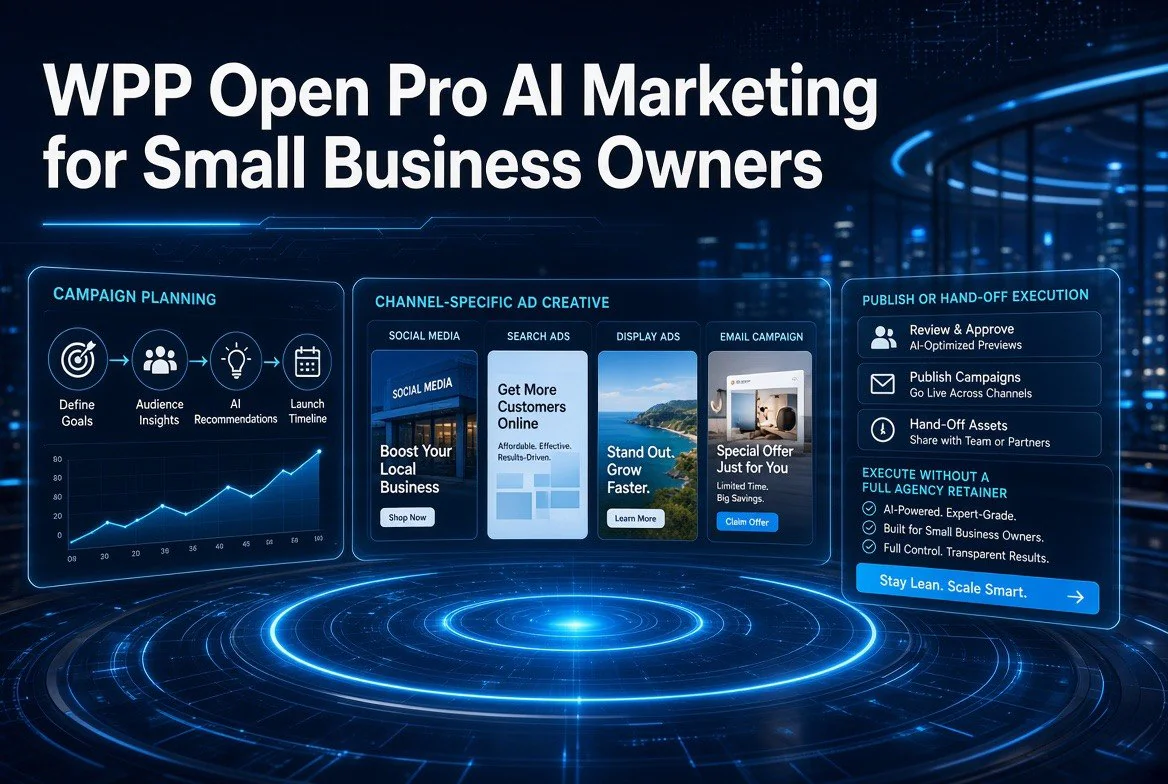
WPP Open Pro AI Marketing for Small Business Owners
⚡ Expert Summary: WPP Open Pro is the world’s largest agency network going self-serve: it puts AI-run campaign planning, content creation, and publishing directly in a business owner’s hands. For US small businesses and startups priced out of full-service agencies, it’s a signal that “run your own marketing with AI” is now realistic — but the real win is understanding what to hand to AI, what to keep, and which leaner tools do the same job first.
Here’s the uncomfortable truth most small business owners already feel: the marketing help you can afford is either too expensive, too slow, or too generic — and the help that’s actually good won’t take a client your size. That gap is exactly what WPP Open Pro is aiming at.
WPP is the advertising holding company behind some of the biggest agency brands on earth. When a network like that ships a self-serve AI platform that lets clients plan, create, and launch campaigns without hiring an agency, it’s not a niche toy. It’s the largest possible confirmation that the “do it yourself with AI” model small operators have been experimenting with for the last eighteen months is now mainstream enough for the giants to sell it back to them.
This review breaks down what WPP Open Pro actually does, who it’s really for, what it costs, and — most usefully — how a US small business owner should think about it versus cheaper, faster AI marketing tools that solve the same problem today.
What WPP Open Pro Actually Is
WPP Open Pro is a self-serve version of WPP Open, the agency group’s enterprise AI operating system. The enterprise version is what WPP’s own agencies and their biggest brand clients use internally. Open Pro takes that same underlying technology and exposes it directly to businesses that can’t afford — or don’t want — a full-service integrated agency relationship.
WPP first announced Open Pro in late October 2025, positioning it as the first model of its kind from a major agency holding company. It covers three stages of getting a campaign off the ground:
1. Planning and strategy. AI agents help you define the campaign, drawing on WPP’s proprietary data, partner data, and industry benchmarks to shape positioning and channel strategy.
2. Content creation at scale. The platform generates brand-appropriate, channel-specific ad creative — copy, design, and video variations built to fit each placement rather than one asset slapped everywhere.
3. Media execution and publishing. You either publish your finished campaigns directly to ad platforms or hand them to WPP’s Open Media Studio team to run the media buying.
That last part is the key distinction. Open Pro is not purely a do-it-yourself tool — it’s a hybrid. You can run the whole thing yourself, or you can let WPP’s people execute the parts you don’t want to touch. For an owner who wants control over creative but not over media buying complexity, that hybrid is genuinely useful.
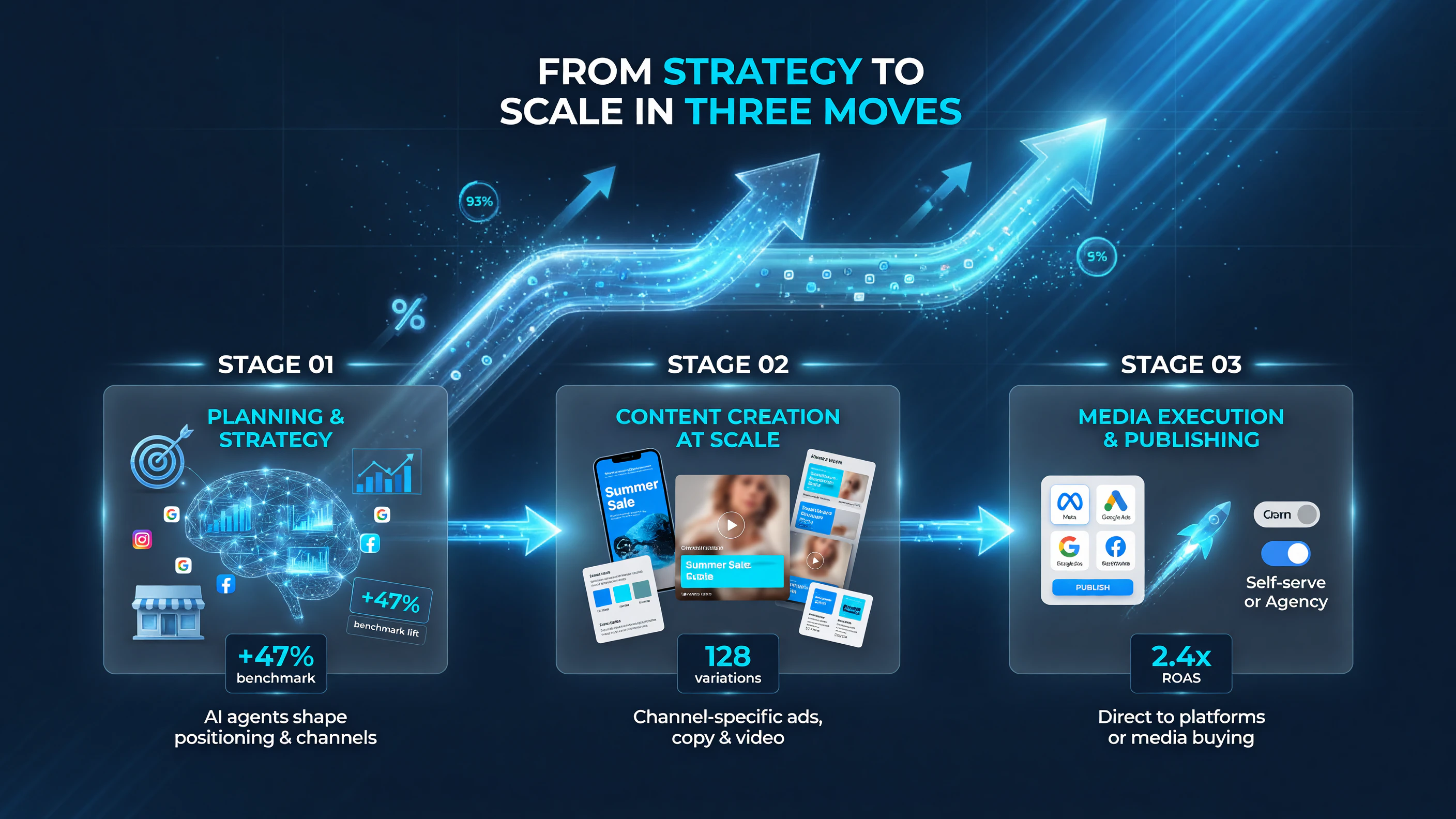
From strategy to scale in three moves: WPP Open Pro walks a business through planning, channel-specific content creation, and media execution — DIY or handed off.
Why a Giant Agency Network Going Self-Serve Matters to You
To understand why this matters for a business your size, it helps to look at the money behind the decision. A typical US small business that wants professional marketing faces a brutal math problem. A full-service agency retainer routinely runs $3,000 to $10,000 a month — often on a minimum six-month commitment. That is $18,000 to $60,000 a year before you spend a dollar on actual ad placements, paid media, or campaign budget. For a company doing $200,000 to $2,000,000 in annual revenue — the sweet spot of the American independent business — that retainer eats margin that most owners simply do not have.
Now look at what that same business can assemble with modern AI tools. A single subscription stack covering ad creative, email, social scheduling, and analytics typically lands between $100 and $600 a month — a fraction of one agency invoice. The gap between $600 a month and $5,000 a month is precisely the market WPP is trying to address with Open Pro. It wants to capture the businesses that have outgrown cheap template tools and are tempted by agency service, but will not — and arguably should not — pay a full agency retainer.
That middle ground is real, and it is growing fast. Industry data has repeatedly pointed one direction: marketers keep shifting budget toward plug-and-play AI and automated tools, while bespoke spend concentrates among the largest brands. The businesses squeezed in the middle are exactly the ones that need the most help making a choice — because the wrong choice is expensive in opposite ways. Paying agency rates for work a tool can do is wasted margin. Trusting a template tool with strategy that needs judgment is wasted time. Open Pro is WPP’s attempt to sit in that middle and sell a hybrid that hedges both directions.
Here’s the angle most coverage misses: WPP isn’t building Open Pro for hobbyists or solopreneurs tinkering with AI. It’s building it because the mid-market of marketing services is being hollowed out from both ends. Big brand clients have the budget for bespoke, high-touch agencies. Small businesses have increasingly adopted plug-and-play AI tools. The middle — businesses that are too big for generic template tools but too small for a retained agency — is where the money and the pain both live.
By letting those mid-sized and startup clients use its AI models directly, WPP is trying to capture revenue it would otherwise lose to two directions at once: to cheaper automated tools below it, and to boutique specialist agencies above it. That’s a strategic hedge — but it’s also a quiet admission that the tools small operators have been using actually work.
For an American small business owner, the practical takeaway is clearer than the corporate strategy. If a holding company the size of WPP believes the AI “run your own marketing” workflow is credible enough to sell at scale, then the AI marketing stack you’ve been testing isn’t a fad. The question is whether Open Pro is the right on-ramp for you — or whether a leaner tool gets you the same outcome for a fraction of the complexity and cost.
How WPP Open Pro Compares to Leaner AI Marketing Tools
Before you sign up for anything from a giant agency network, it’s worth being honest about what problem you’re actually solving. WPP Open Pro is built for performance-oriented marketers and growing brands that want agency-grade strategy without the agency retainers. Most US small businesses — a regional service company, a local retailer, an e-commerce brand doing $50,000 to $500,000 a year — have a different problem. They don’t need a campaign strategy engine. They need to stop wasting hours and money on disconnected, low-converting marketing.
Here is how the two approaches stack up for a typical independent operator.
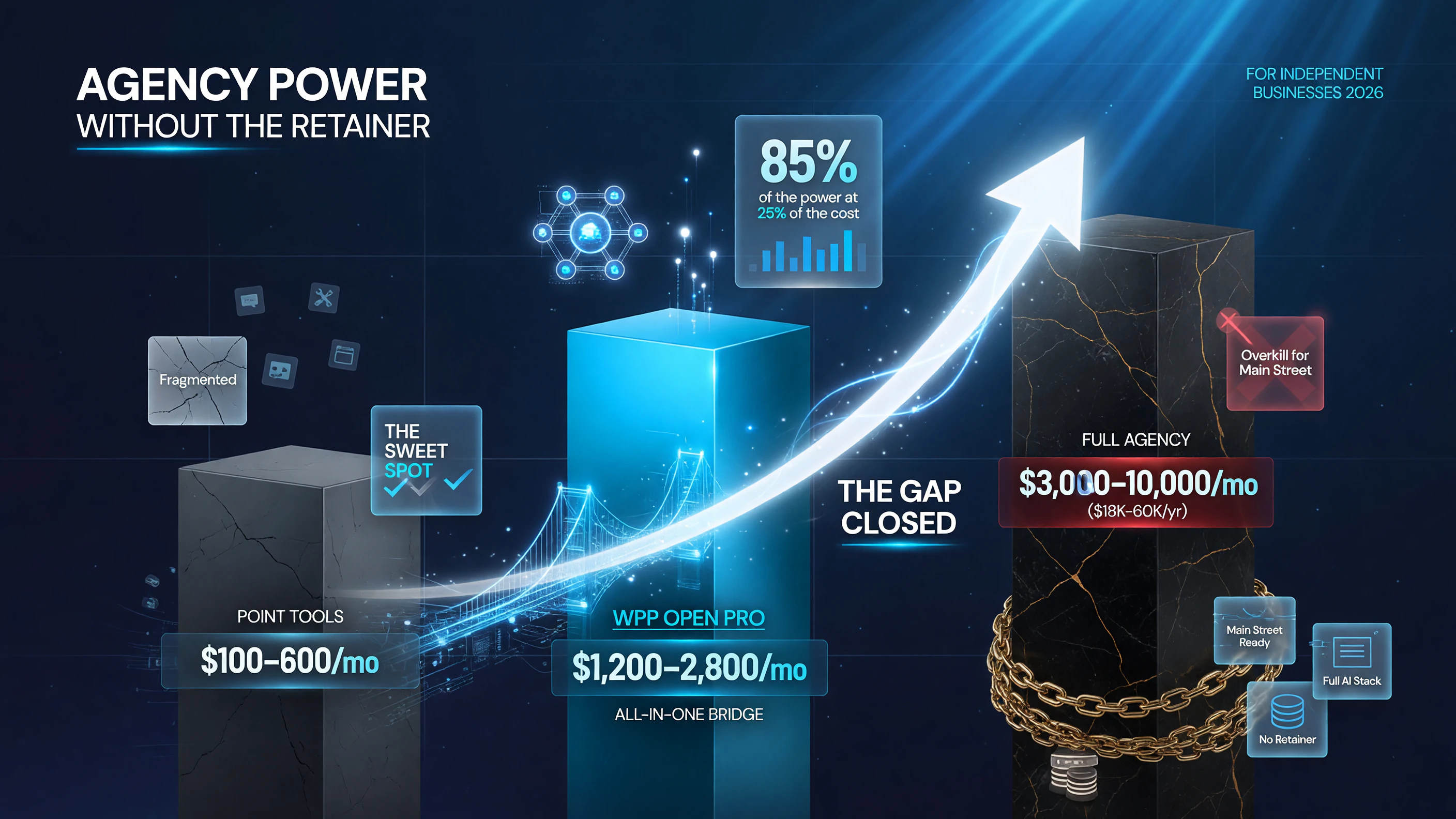
The money gap WPP Open Pro targets: point-tools at $100-600/mo on one end, full-service agency retainers at $3,000-10,000/mo on the other.
| Factor | WPP Open Pro | Lean AI Marketing Stack |
|---|---|---|
| Best for | Growing brands, e-commerce, regional teams needing strategy scale | Owner-operators wanting fast, channel-ready output now |
| Strategy depth | High — WPP proprietary + industry data | Varies — strong on execution, lighter on strategy |
| Content + publishing | Built-in, channel-specific, or hand off to WPP studio | Built-in, channel-specific, publishes directly |
| Cost profile | Agency-adjacent; quote/scale based | Monthly subscription, often moderate |
| Time to first campaign | Days (strategy + onboarding) | Hours (upload assets, generate, publish) |
| Hands-off media buying | Yes — via WPP Open Media Studio | No — you place or use the platform’s managed ads |
What Small Business Owners Should Actually Do
The honest answer for most US small businesses is not “sign up for WPP Open Pro.” It’s to understand the direction of travel, then use the leanest tool that delivers a real result this week. Here is a practical way to think about it.
The Agency-Standard Tasks You Should Automate First
When owners ask whether AI can replace an agency, they usually mean one of a handful of concrete jobs. Break it down task by task and the answer becomes obvious. Ad creative generation — headlines, images, video variations — is now done well by AI in minutes, and this is where lean tools and platforms like WPP Open Pro both shine. Campaign copy for email and landing pages is another fast win; AI drafts the variations, a human picks the strongest. Social publishing and scheduling is almost fully automatable today. Where a human editor still earns their keep is the high-stakes layer: overall brand strategy, complex B2B positioning, and media buying at meaningful scale where waste is measured in thousands of dollars.
So the practical shortcut is to automate the routine 80 percent with AI and reserve your own attention — or an expert’s — for the judgment-heavy 20 percent. That is the workflow a lean stack supports well, and it is also exactly the structure Open Pro offers, with the added option to hand the expert layer to WPP’s paid studio. The difference is cost and flexibility, not capability.
If You’re Just Getting Marketing Working, Start Lean
If you are a solo owner or a small team still assembling your first coherent marketing motion, you do not need an agency-grade planning engine. You need output you can ship this week and a system you will actually keep using. Tools that turn your product page or a short prompt into channel-ready ads, that schedule and publish your content, and that let you test without a designer are the right starting point. The goal is to get one channel producing predictable results before you add strategic depth.
When a Bigger Platform Makes Sense
Once you are doing meaningful paid media — say a few thousand dollars a month in ad spend and climbing — the calculus changes. That is the point where campaign strategy, consistent creative at volume, and someone to actually manage the media buying start to pay for themselves. If you are in that range and you want agency-caliber execution without a full-service retainer, a platform that includes managed or hybrid support starts to look genuinely relevant. This is the honest case for considering something like WPP Open Pro: not as a beginner tool, but as the step up when lean DIY tools hit their ceiling on strategy and at-volume execution.
| Your Stage | Smartest First Step | Why |
|---|---|---|
| Under ~$1,000/mo ad spend | Lean AI marketing tool; test one channel | Builds a repeatable motion before adding cost and complexity |
| $1,000–$5,000/mo ad spend | Upgrade stack: better creative volume + scheduling | Volume of consistent creative is what scales performance here |
| $5,000+/mo ad spend | Evaluate hybrid/managed platform or dedicated help | Strategy + hands-on media management start to pay for themselves |
A Worked Example: Where the Savings Actually Land
Let’s make the decision concrete with a realistic US example. Imagine a regional service company doing $800,000 a year, spending $3,000 a month on a part-time marketing arrangement and another $2,000 a month on ads. It produces campaign assets and gets them published, but slowly — creative turns take days, and the owner has little visibility into what is working until invoices arrive.
Moving that $3,000-a-month production layer onto an automated AI stack does not eliminate the need for judgment, but it collapses the production timeline and the cost. Ad creative that took two days now takes an hour. Email campaigns scheduled weeks out now draft and queue in an afternoon. The direct subtraction is real: marketing production cost drops from $36,000 a year toward a few thousand in subscriptions. That $30,000-plus in annual savings can fund better ads, a higher-margin hire, or simply stay on the bottom line.
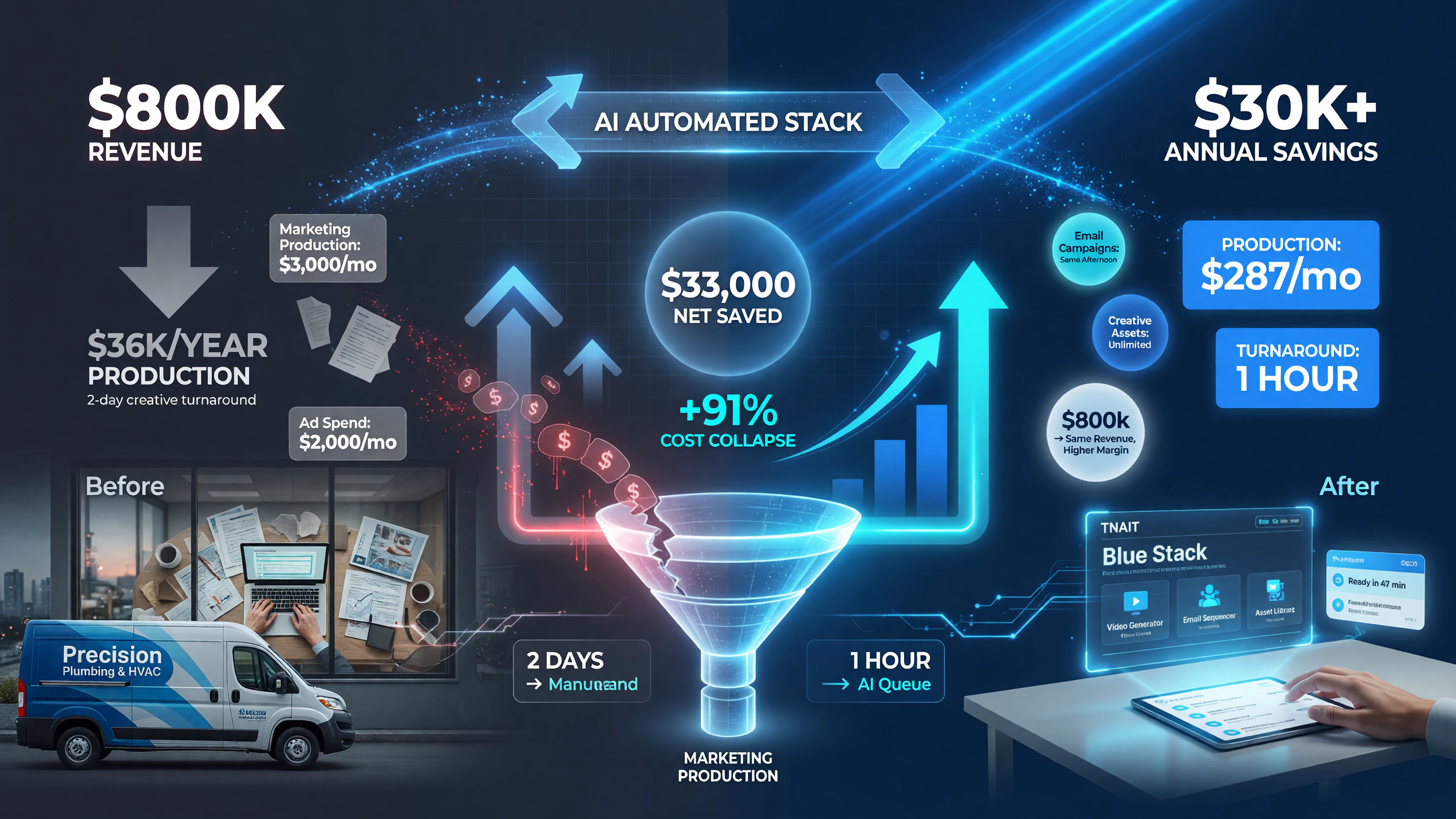
Where the savings land in the worked example: marketing production collapses from $36,000 a year toward a few thousand in subscriptions — real bottom-line money.
The catch, and the reason the big platform conversation matters, is that the same owners who save that money often hit a wall once they try to scale. Producing more creative is easy with AI. Knowing which message, audience, and channel deserve the next dollar is harder. That is precisely the point at which a strategy-capable or managed option — whether WPP Open Pro or a specialist — earns a second look. Automate the production first, bank the savings, and only then decide whether the strategic layer is worth paying for.
The Bottom Line for US Small Business Owners
WPP Open Pro matters less as a product you must buy and more as a signal about where the market is heading. When the largest agency network in the world starts selling AI to businesses directly, it confirms two things. First, the “market yourself with AI without an agency” model is now mainstream. Second, the giants are coming for the same value small operators have been capturing with lean tools — which means those lean tools are validated, and the window to build your own repeatable marketing motion is wide open.
Start with the workflow, not the brand. Get one channel producing results with a tool you can afford and actually use. Revisit the agency-grade platforms only when your ad spend and your ambition have outgrown what the lean stack can deliver. That is the order that keeps you in control of your marketing and your budget — no matter how big the agency network knocking on your door gets.
Frequently Asked Questions
What is WPP Open Pro?
WPP Open Pro is a self-serve version of WPP’s enterprise AI operating system. It lets businesses plan, create, and publish marketing campaigns using AI tools for strategy, content, and media execution, without needing a full-service agency relationship.
Is WPP Open Pro for small businesses?
It is positioned for performance-focused marketers, startups, and smaller clients — including regional teams within bigger brands — that want agency-grade AI but don’t have resources for a fully integrated agency. For very small US businesses it can be more than is needed versus leaner tools.
How is WPP Open Pro different from hiring an agency?
With Open Pro you use WPP’s AI models directly for planning, content, and publishing. You can run everything yourself or hand media execution to WPP’s Open Media Studio. It is priced as a self-serve or hybrid option rather than a full-service retainer.
Can AI really replace a marketing agency for a small business?
For many routine marketing tasks — content, ads, scheduling, publishing — yes, AI tools can replace a large share of what an agency does, and at far lower cost. Where agencies still matter is high-stakes strategy, complex media buying at scale, and brand work that needs senior judgment. See this guide to which marketing tasks AI handles best.
What should a small business use instead of a big AI platform first?
Most owners should start with a lean AI marketing tool that turns their assets into channel-ready output, publishes directly, and lets them test quickly. Add strategic depth or managed support only once ad spend reaches a level where that investment clearly pays for itself.

About Barak Schurr
Barak Schurr built and sold a major ticketing platform, ran global nightlife operations at Eventbrite, and now spends his time figuring out which AI tools actually move the needle for independent business owners — and which ones are just noise. No hype. No fluff. Just what works.
Email: [email protected]
More AI Resources for Your Business