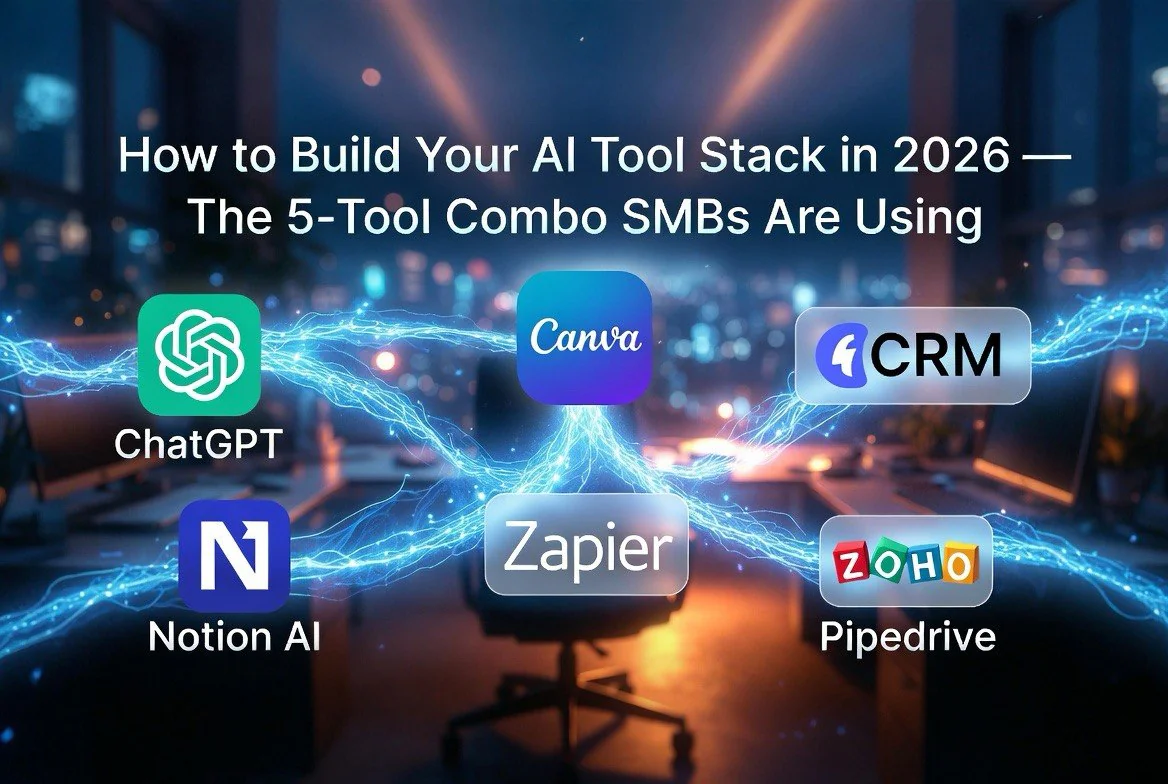
How to Build Your AI Tool Stack in 2026 — The 5-Tool Combo SMBs Are Using
⚡ Expert Summary: The median US small business now runs five AI tools in an integrated stack. Not one tool. Not three. Five. The ones winning aren’t the ones using the most AI — they’re the ones that connected everything. Here’s the exact 5-tool stack that works in 2026, what each tool does, and how to connect them without a developer.
Your Competitors Are Running a Stack. Are You?
A 2026 SBE Council survey of 3,400 US small businesses found that the median AI-adopting business uses exactly 5 AI tools. Not one chatbot. Not a single content generator. An integrated stack of five tools that talk to each other.
That same survey revealed something more important: businesses running integrated AI stacks reported 70% higher revenue growth than those using standalone AI tools. The difference wasn’t the tools — it was the connections between them.
Here is the exact 5-tool stack that keeps showing up in the data. It covers content, design, automation, knowledge management, and customer relationships. Every tool in this stack connects to every other tool. And the whole thing costs less than one part-time employee.
The AI Stack That SMBs Are Actually Using in 2026
Tool 1: ChatGPT — The Brain of Your Stack
Cost: $20/month (ChatGPT Plus) or $25/user/month (ChatGPT Team)
ChatGPT is the central nervous system of the modern SMB AI stack. In 2026, GPT-5.6’s tri-tier model (Sol, Terra, Luna) means you only pay for the reasoning power you need. For daily ops — drafting emails, writing copy, analyzing spreadsheets, brainstorming campaigns — Terra hits the sweet spot between capability and cost.
What it connects to: ChatGPT’s GPTs and custom actions interface with virtually everything. Connect it to your CRM for client research, to your calendar for scheduling, to your email for drafting, and to your analytics for reporting.
Pro tip: Build one GPT per business function. A content GPT with your brand voice. A customer service GPT with your FAQ database. An analytics GPT connected to your reporting dashboards. Three GPTs cover 80% of your daily AI needs.
Tool 2: Canva Magic Studio — The Design Engine
Cost: $13/month (Canva Pro)
Canva’s 2026 Magic Studio suite includes text-to-image generation, real-time collaborative editing, AI video creation, background removal, brand kit management, and a scheduling tool for social posts. For a small business, this replaces a graphic designer, a video editor, and a social media scheduler. Combined, those roles cost $4,000-8,000/month. Canva replaces them for $13.
What it connects to: Canva integrates directly with ChatGPT for prompt-based design generation. Type “create a Facebook ad for our new service” in ChatGPT, and Canva generates the visual asset. It also connects to Zapier for automated social posting, to Google Drive for asset storage, and to HubSpot for campaign management.
The 2026 upgrade: Canva’s AI video tools now include Seedance 2.5 integration, allowing 30-second 4K video generation with 50 reference images for brand consistency. For SMBs creating video content, this alone justifies the Pro subscription.
Tool 3: Zapier — The Integration Layer
Cost: $20/month (Starter plan)
Zapier is the glue that holds the stack together. In 2026, Zapier’s AI Actions let you describe automations in natural language. “When a new lead comes in through my website form, create a contact in my CRM, send a welcome email, and add a task to follow up in 24 hours” — built in 30 seconds, no code.
What it connects to: Everything. Zapier connects 6,000+ apps. The SMB stack — ChatGPT, Canva, Notion, CRM — all plug into Zapier. Data flows between them automatically.
The killer automation: When ChatGPT generates new content, Zapier sends it to Canva for design, posts it to social media, logs it in Notion, and notifies your team in Slack. This one automation, built once, eliminates 8-10 hours of manual transfer work per week.
Tool 4: Notion AI — The Knowledge Hub
Cost: $10/user/month (Notion AI add-on)
Notion AI serves as your business memory. Every document, SOP, client note, project plan, and meeting transcript lives here. The AI layer — writing assistance, summarization, Q&A over your documents — means your entire business knowledge is searchable and actionable.
What it connects to: Zapier pipes ChatGPT outputs (meeting summaries, research, client briefs) directly into Notion. Slack conversations get logged. Project updates auto-populate from your tools. Over 6 months, Notion becomes a searchable business brain that any team member or AI tool can query.
Why this matters for the stack: The biggest bottleneck in small business AI adoption isn’t tool access — it’s context. When every tool produces output in a different location, your AI stack has no memory. Notion solves that. It’s the single source of truth that every other tool writes to and reads from.
Tool 5: A CRM with AI — The Revenue Engine
Cost: Variable ($0-45/month per user depending on platform)
The final piece is a CRM with embedded AI. HubSpot’s Breeze AI ($45/month for Sales Hub), Zoho Bigin with Zia AI ($14/user/month), or Pipedrive’s Sales Assistant ($29/month) all offer AI-powered lead scoring, follow-up reminders, email sequence automation, and pipeline forecasting.
What makes this critical for the stack: The CRM is where revenue data lives. When your ChatGPT analyzes leads, your Canva creates sales materials, your Zapier automates follow-ups, your Notion stores the playbook — the CRM is the central conductor. It tells the stack who to prioritize, when to reach out, and what message to send.
The 2026 shift: Modern CRMs now accept AI agent inputs directly. A ChatGPT agent can create and update CRM records, log call notes from your AI phone answering service, and trigger follow-up sequences — all without human intervention.
How to Connect the Stack in One Afternoon
Here is the exact setup sequence. Block 3 hours. Follow these steps in order.
Step 1: Set up your Notion workspace. Create folders for: Clients, Projects, Operations, Content, Finance. Import any existing documents. Spend 60 minutes on this — it’s the foundation everything else builds on.
Step 2: Connect Zapier to Notion. Create three core Zaps: (a) ChatGPT output → Notion database entry, (b) CRM new contact → Notion client record, (c) Email attachment → Notion document. This takes 30 minutes.
Step 3: Build your ChatGPT GPTs. Create three GPTs — Content Writer (fed your brand voice document), Customer Support (fed your FAQ database), and Data Analyst (connected to your reporting spreadsheets). 45 minutes.
Step 4: Connect ChatGPT to Canva. Enable the Canva integration in ChatGPT. Create a Zap that takes ChatGPT-generated content and sends it to Canva as a new design. 15 minutes.
Step 5: Connect your CRM to everything. Set up Zapier connections between your CRM and ChatGPT (for lead research), your CRM and Canva (for personalized sales assets), and your CRM and Notion (for client record creation). 30 minutes.
What This Stack Costs vs What It Replaces
| Role | Monthly Cost | AI Stack Replacement |
|---|---|---|
| Content writer (junior) | $3,000-4,000 | ChatGPT Plus ($20) |
| Graphic designer | $3,000-5,000 | Canva Pro ($13) |
| Virtual assistant (admin) | $1,500-2,500 | Zapier ($20) + Notion AI ($10) |
| Sales admin | $2,500-3,500 | CRM with AI ($29-45) |
| Total replaced | $10,000-15,000 | $72-88/month |
These roles aren’t eliminated — they’re augmented. The businesses winning in 2026 don’t fire their writers and designers. They give them AI tools that accelerate their output by 3-5x. The cost savings come from not hiring more people as the business grows. Your revenue doubles but your headcount stays flat.
3 Stack Mistakes That Kill ROI
Mistake 1: Too Many Tools That Don’t Talk
The average SMB uses 8-12 SaaS tools. The ones with the highest AI ROI use 5 and have them fully integrated. Every tool you add that doesn’t connect to the stack is a tool that drains time instead of saving it. If a new tool doesn’t have a Zapier integration, question whether it belongs in your stack.
Mistake 2: Skipping the Integration Setup
The most common failure pattern: businesses sign up for all five tools, use them individually for a month, see marginal improvement, and give up. The stack only works when the tools talk to each other. The 3-hour setup investment is what separates a 30% productivity gain from a frustrating experiment.
Mistake 3: No Maintenance Schedule
AI tools update constantly. GPTs get deprecated. Integrations break. Set a recurring 60-minute monthly review. Check that all connections are active, update your GPTs with fresh business data, and review your Zapier logs for errors. This one hour per month keeps your stack running at full efficiency.
Frequently Asked Questions
How many AI tools does the average small business use in 2026?
The median US small business using AI runs five integrated tools, according to a 2026 SBE Council survey. Businesses with integrated stacks report 70% higher revenue growth than those using standalone AI tools.
What is the minimum AI stack a small business needs in 2026?
The minimum viable AI stack for a small business in 2026 includes ChatGPT ($20/month) for content and analysis, Canva Pro ($13/month) for design, Zapier ($20/month) for automation, Notion AI ($10/user/month) for knowledge management, and a CRM with AI ($0-45/month) for sales and customer management. Total: $63-108/month.
How long does it take to build an AI tool stack?
Building a complete 5-tool AI stack takes approximately 3 hours. Most of that time is spent setting up your Notion workspace (60 minutes) and configuring Zapier integrations (30 minutes). ChatGPT GPTs take 45 minutes to build, and CRM connections take another 30 minutes.
Do small businesses really need five AI tools?
The data says yes. The 2026 SBE Council survey found that SMBs running five integrated AI tools saw significantly higher revenue growth than those using one or two. The key is integration — five tools that talk to each other outperform ten standalone tools every time.
What is the most common mistake small businesses make with AI stacks?
The most common mistake is signing up for multiple AI tools without connecting them. Businesses that use five tools independently see marginal gains. Businesses that integrate through Zapier see compounding returns. The second most common mistake is skipping monthly maintenance, which leads to broken integrations and stale GPTs.

About Barak Schurr
Barak Schurr is the founder and former president of the nightlife ticketing platform Wantickets and former Global Director of Dance and Nightlife at Eventbrite. He currently focuses on AI research and writes about practical AI for independent business owners that actually moves the needle — no hype, no corporate fluff. More at topnotchaitools.com.
Contact: [email protected]
More AI Resources for Your Business