Get The Solo Business OS — Free
The AI workflow that replaces a part-time employee for solo operators and small business owners.
AI News Aggregators 2026: Tools That Summarize the Day’s Business News in Minutes
⚡ Expert Summary: AI news aggregators like Brief, Particle, and Last24.ai are replacing the daily scroll with machine-generated summaries that cluster related stories, filter out noise, and deliver a personalized briefing in under five minutes. For US business owners drowning in tabs and newsletters, these tools turn hours of reading into a focused daily digest — with cited sources you can verify. This guide breaks down the top options, what each one actually costs, and how to set up a morning routine that keeps you informed without burning your day.
Your Competitors Read the Headlines. You Can Read the Whole Market.
Every morning, thousands of US business owners do the same thing: open ten tabs, skim five newsletters, check three social feeds, and still feel like they missed the story that matters. The problem isn’t that the news is scarce — it’s that there’s too much of it, and none of it arrives filtered for what you actually care about.
The National Restaurant Association’s 2026 report found that over 25% of operators now use AI tools in their business, and marketing leads the list at around 15-19% of operators. But that same wave of AI that’s reshaping restaurants is also built to solve the information overload problem in the office. A 2026 survey of U.S. restaurant leaders from Popmenu showed 44% already running AI tools, with another 25% planning to adopt that year — and the number-one complaint among the holdouts isn’t cost, it’s “there’s too much to track.”
AI news aggregators attack that specific problem. They pull from thousands of sources, read the full articles, summarise what matters, and present you a brief that a trained analyst would be proud of — in the time it takes to finish your coffee. Here’s what’s actually worth your time in 2026.
What an AI News Aggregator Actually Does
Before the tool names, understand the mechanics. A real AI news aggregator does four things a traditional feed reader never could:
- Reads the full article, not just the headline. The AI ingests entire pieces and writes original summaries that capture the thesis, the numbers, and the implications — not a truncated first paragraph.
- Clusters related stories. Instead of ten separate tabs about the same Fed announcement, you get one entry with all ten sources linked beneath it. You read one summary, then decide how deep to go.
- Learns your priorities. Tell it you care about AI, competitors, and hiring. It weights those topics higher and quietly drops the celebrity gossip and sports noise.
- Shows its work. Every summary links back to the original source, so you can fact-check a claim or open the full article when a story matters enough to read in full.
That last point matters more than it sounds. “Trust but verify” is the standard a good tool holds itself to, and the ones that survive the 2026 shakeout all have transparent source linking baked in.
The Top AI News Aggregators in 2026 — Tested and Compared
| Tool | Best For | Starting Price | Standout Feature |
|---|---|---|---|
| Brief | Personalized daily briefings | Free tier + premium | Email digest of clustered top stories |
| Particle | Fast multi-source catch-up | Free tier + premium | Transparent source links on iOS, Android, web |
| Last24.ai | Visual news discovery | Free tier | Interactive mind-map topic navigation |
| Feedly | Ongoing industry monitoring | Free tier + Pro from ~$8/mo | AI summarization + smart topic discovery |
| Ground News | Bias-aware balanced reading | Free tier + Plus ~$5/mo | Blind-spot and ownership mapping across 50,000+ sources |
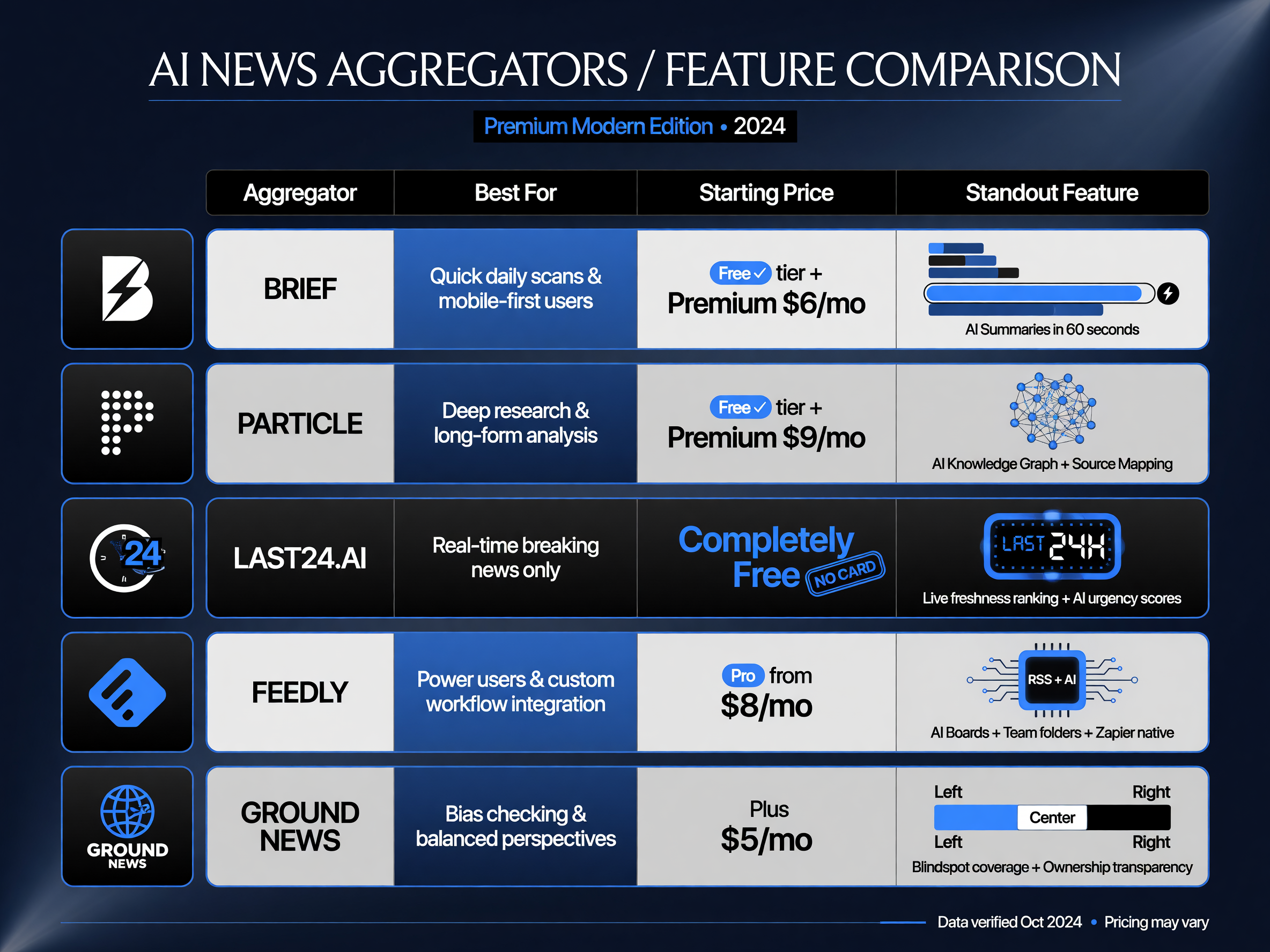
The five leading AI news aggregators compared by purpose, price, and standout feature — so you can match the right tool to how you consume news.
Brief: The Daily Digest Your Inbox Actually Wants
Brief built its reputation on one thing: a morning email that respects your time. It aggregates from multiple sources, generates AI summaries of the top stories, clusters related coverage into single entries, and tailors the feed to the industries you follow.
For an executive tracking specific markets, this is the closest thing to having a research analyst on staff. You set your topics once, and every morning you wake up to a brief that assumes you haven’t read anything yet — because you haven’t. The email digest format also means you never have to remember to open an app; it comes to you.
Particle: Catch Up Fast Without Losing the Thread
Particle is the tool for the person who needs to get current on a big story in the next ten minutes. It groups multiple sources on the same event into a single clear summary, with transparent source links so you can see exactly where each paragraph came from. It’s available on web, iOS, and Android, and it offers a genuinely useful free tier with premium options if you want deeper analysis.
Its strength is velocity. When a major business story breaks midday, Particle gives you the “what happened, who said what, why it matters” version in one place instead of you tab-hopping between nine outlets that each tell the same story differently.
Last24.ai: When You Need to See the Shape of the News
Last24.ai takes a different angle: visual discovery. It builds interactive mind maps where connected stories branch off a central topic, letting you grab the shape of the day’s developments at a glance instead of reading a linear list. Search is topic-based, aggregation is real-time, and the summaries are concise enough to scan.
This is arguably the best tool for grasping a complex, multi-threaded business development — a merger collapse, a regulatory ruling that ripples across dozens of companies — without reading the full articles. You see the map, you identify the branches worth your attention, and you drill in only where it counts.
Feedly: The Workhorse for Ongoing Monitoring
Feedly isn’t new, but its AI layer has quietly made it the default for people who monitor industries continuously. It tracks the topics you define, surfaces new coverage with AI summarization, and organizes everything into a clean reading experience. The free tier covers basic tracking; Pro pricing starts around $8 a month and unlocks more feeds and AI features.
Where Feedly wins is endurance. It’s less flashy than the newcomers, but it’s the tool you can leave running for a year tracking a competitor, a category, or a regulation — and it won’t bury you in duplicates or drift off-topic.
Ground News: The Bias-Aware Option for Balanced Decisions
Ground News is worth a category of its own because it solves a problem the others don’t touch: media bias. It highlights which outlets are covering a story, notes the political lean of each source, maps ownership, and flags blind spots — where coverage simply isn’t happening. It draws from 50,000+ sources to show you the full spectrum on any given topic.
For business owners making decisions from what they read, this matters. If every headline about a supplier, a regulator, or a market shift comes from outlets with the same slant, you’re making decisions on half the information. Ground News shows you what you’re not seeing, which is often the most valuable part of the briefing.
Think of the ones you recognize against the ones that fall in the “not covered” column. That gap is your blind spot, and it’s exactly where surprises hide.
Which One Should a US Business Owner Pick?
There’s no single right answer; it depends on how you consume information. Use this quick decision guide:
- You read on email and want a morning ritual → Brief. Set it once, get a digest daily, never open an aggregator app again.
- You need to catch up fast on breaking stories → Particle. Velocity and transparent sourcing for the midday “what actually happened.”
- You want to grasp complex, multi-threaded developments → Last24.ai. The mind-map view shows cause and effect that a linear feed hides.
- You monitor a competitor or industry for months → Feedly. Continuous, organized, low-maintenance tracking.
- You make high-stakes decisions from the news → Add Ground News. Pair it with any of the above to cover your bias blind spot.
How to Set Up a Five-Minute Morning News Routine
Tools only help if you build a habit around them. Here’s the routine that works:
- Pick one primary aggregator and one bias-checker. Start with Brief or Particle as your daily driver, add Ground News once a week for the blind-spot scan.
- Define your topics in the first session. Spend ten minutes on day one telling the tool exactly what to weigh: your industry, your competitors, AI tools, hiring, regulation. This one-time setup is what separates a useful feed from a filter bubble.
- Set a fixed time. Attach it to an existing habit — first coffee, commute, or the walk to your desk. 8:00 a.m. works for most owners; the key is consistency, not the specific hour.
- Drill down only when a story affects you. The summary tells you what happened; open the full article only when it changes a decision you’re facing. That discipline is what keeps the routine at five minutes instead of fifty.
- Review your coverage weekly. Once a week, check what the tool is weighting. Rebalance topics as your priorities shift — the tool learns, but it learns from what you feed it.
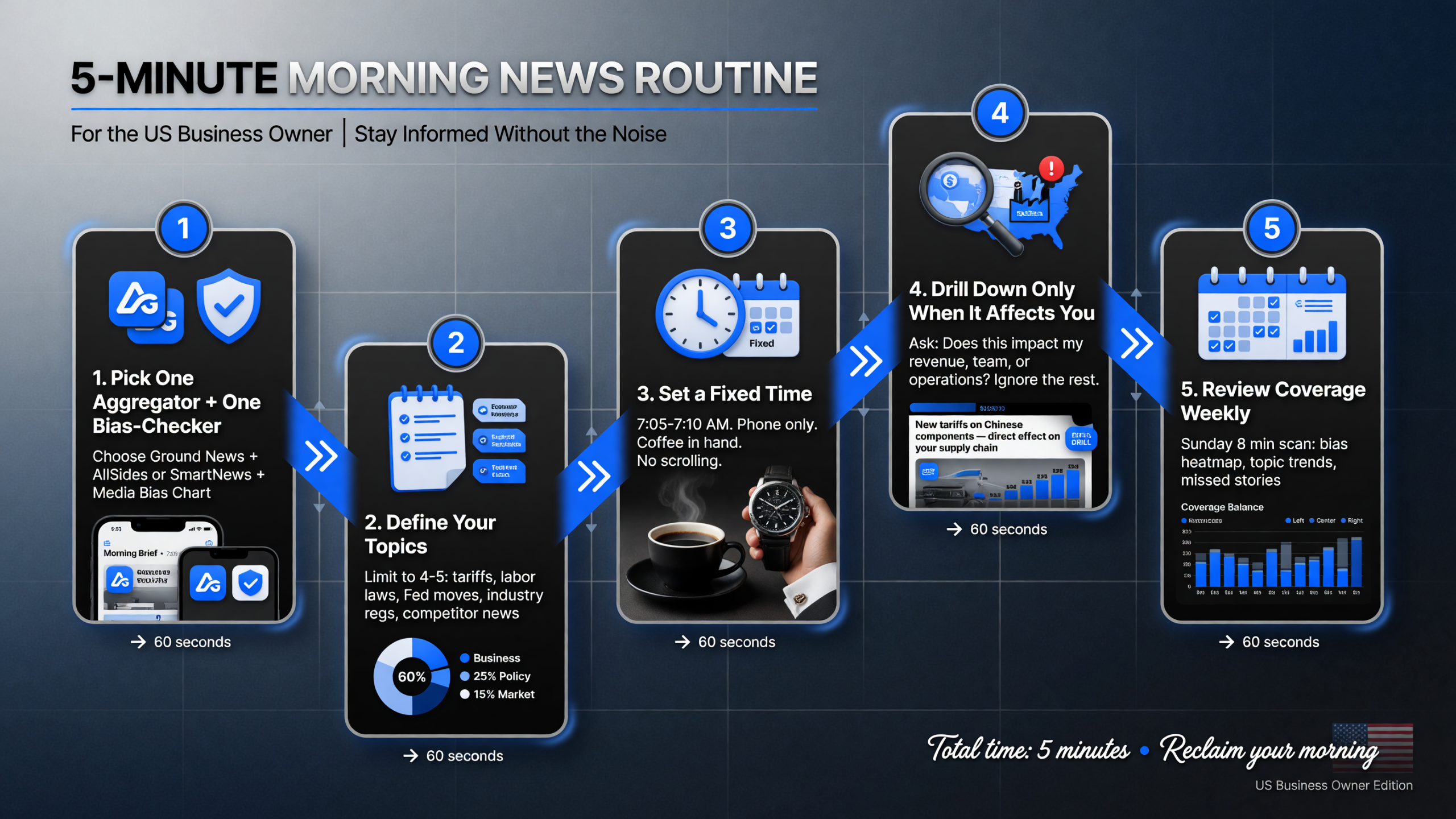
A repeatable five-step routine turns any aggregator into a five-minute daily briefing instead of a fifty-minute scroll.
What These Tools Cost — and What They Save You
Most serious options start free and cost $5 to $10 a month for the premium tier that unlocks your full topic set and deeper AI analysis. That’s a rounding error against the alternative, which is hours a week of un-filered scrolling.
If your time is worth $50 an hour and these tools save you even one hour a week, that’s $200 a month of value for a $10 subscription — a 20x return. And the better the tools get at clustering and summarising, the wider that gap grows. In 2026 the smart play isn’t reading more; it’s reading the right five stories with full context.
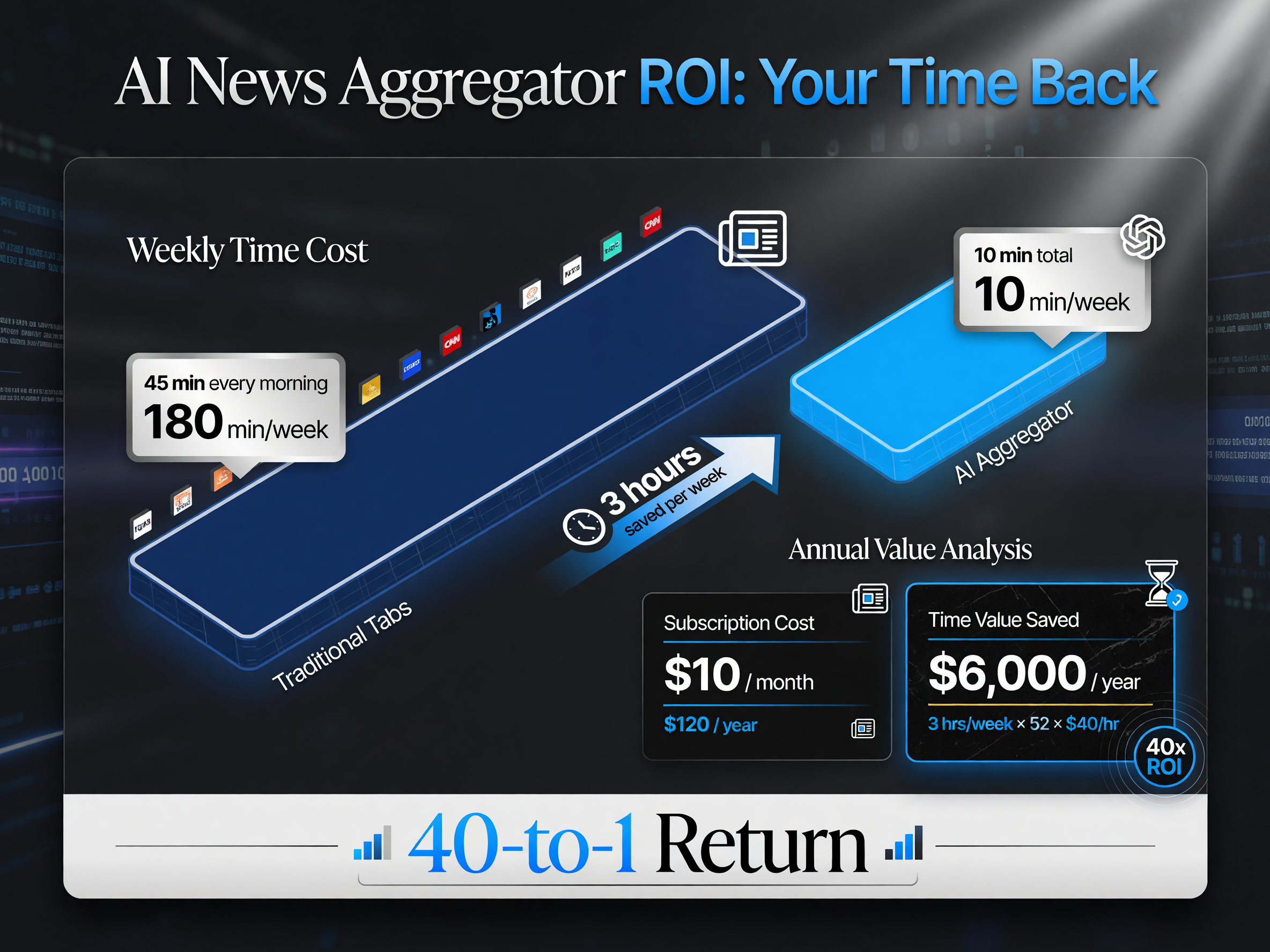
The math behind switching: three hours saved per week at $40 an hour is worth $6,000 a year against a $10 monthly subscription — a forty-to-one return.
Common Mistakes That Kill an AI News Setup
Most owners who try an AI news aggregator and abandon it within a month make the same handful of errors. Avoid them and the tool sticks:
- Overloading topics on day one. Adding forty keywords sounds thorough, but it dilutes the feed until nothing feels relevant. Start with five to eight genuinely important topics and expand only after the tool proves it can serve those well.
- Never telling the tool what to ignore. The quiet secret of the best tools is negative tuning. Explicitly mute sectors, companies, or types of story you never act on. A feed that shows you what to skip is half as valuable as one that filters it out.
- Skipping the source check. If a summary grabs you, open the underlying article and confirm the aggregator’s framing matches the evidence. Over time this builds trust in the tool’s judgment — or reveals which tools paraphrase sloppily so you can drop them.
- Checking it like social media. The tools are built for a fixed daily cadence, not compulsive refreshing. Treat your aggregator like a newspaper with a publication time, not a feed to refresh every fifteen minutes.
- Ignoring the bias layer. Even the best summarizer only reads the sources it subscribes to. If those sources lean one way, your summaries lean that way too. The weekly Ground News scan catches the angle you’re missing.
Fix these five friction points and the five-minute routine in the previous section actually holds. That consistency — not the tool choice — is what compounds into the edge you’re after.
Real Numbers: What the Time Back Is Worth
It’s easy to hand-wave the value of these tools, so put a real number on it. A 2026 survey of U.S. restaurant leaders found the average operator spends meaningful chunks of the week on admin and tracking — and the National Restaurant Association report put marketing and admin as the two heaviest AI-use areas for operators who adopted it. The connective tissue is the same across industries: information tracking is a tax on every owner’s calendar.
Run the math for your own situation. If you currently spend forty-five minutes a morning opening tabs and scanning newsletters, and an aggregator cuts that to ten minutes with better recall, you’ve freed nearly three hours a week. At a modest $40-an-hour value for an owner’s time, that’s $6,000 a year back — against a $10 monthly subscription that’s a forty-to-one return before you even count the better decisions that come from seeing the full picture instead of the loudest headline.
The tools that make this work are not exotic. Brief, Particle, Last24.ai, Feedly, and Ground News are all live today, all offer free trials or free tiers, and all can be up and running this afternoon. The only real cost is the ten minutes of setup and the discipline to treat it as a fixed part of your week. Every day you skip that, you’re back to the tabs, the noise, and the fear that you missed the one story that mattered.
FAQ
Are AI news aggregators reliable?
Yes, when they show their sources. The reliable ones link every summary back to the original article so you can verify claims. Treat any tool that won’t show its sources with suspicion. Pair a good aggregator with a bias-checker like Ground News to cover the biggest reliability risk.
Do AI news aggregators replace trade publications?
No. They surface stories from trade publications and mainstream outlets alike, but they don’t replace the deep reporting a specialist outlet does. Use them to find the story, then open the full article in the source publication when a topic matters to your business.
Can I use an AI news aggregator for free?
Most offer a usable free tier, including Brief, Particle, and Ground News. Premium tiers ($5-$10 monthly) unlock larger topic sets, more sources, and advanced AI features. The free tiers are enough to test whether the workflow fits before you pay.
What’s the best AI news app for small business owners?
For a morning email digest, Brief. For fast catch-up on breaking stories, Particle. For visual discovery of complex topics, Last24.ai. For continuous industry monitoring, Feedly. For bias awareness, Ground News. Pick based on how you consume news, not on brand popularity.

About Barak Schurr
Barak Schurr is the founder and former president of the nightlife ticketing platform Wantickets and former Global Director of Dance and Nightlife at Eventbrite. He currently focuses on AI research and writes about practical AI for independent business owners that actually moves the needle — no hype, no corporate fluff. More at topnotchaitools.com.
Contact: [email protected]
More AI Resources for Your Business