Get The Solo Business OS — Free
The AI workflow that replaces a part-time employee for solo operators and small business owners.
Ground News and the Bias Blindspot: How AI News Tools Help You Read the Market Without Propaganda
⚡ Expert Summary: If every headline you read comes from sources with the same political or commercial lean, you’re making business decisions on half the information. Ground News maps the bias, ownership, and coverage gaps behind 50,000+ news sources so you can see exactly which outlets are covering a story — and which ones aren’t. For US business owners who buy decisions from the news, this bias-aware tool is the difference between reading a trend and reading every side of it. Here’s how it works, what it exposes, and how to pair it with an AI aggregator for genuinely balanced market intelligence.
You’re Not Reading the Market. You’re Reading One Slant of It.
Every US business owner has felt the version of this: a story breaks in your industry, you read five headlines, and they all say roughly the same thing. It feels like consensus. Then a competitor makes a move that seems to come out of nowhere — and you realize the consensus you were reading had a blind spot you couldn’t see.
The uncomfortable truth is that most people don’t read “the news.” They read one political and commercial slice of it, because the feeds they use — and the algorithms behind them — keep feeding them sources that reinforce their existing view. A 2023 report by the Reuters Institute for the Study of Journalism found that a growing share of readers across Western markets rely on only a handful of outlets, often all with similar editorial leanings, and that trust in media is sharply polarized along those lines.
Ground News attacks that exact problem. It doesn’t just summarize; it shows you the bias map of every story — which outlets covered it, where each one sits on the political spectrum, who owns them, and which sides left it uncovered entirely. For a business owner, that last piece is gold. The missing coverage is often where the real story is hiding.
Why Media Bias Is a Business Problem, Not Just a Politics Problem
It’s tempting to dismiss bias-checking as a political hobby. It isn’t. When you use the news to make sourcing decisions, hiring calls, pricing moves, or expansion plans, the slant of your sources becomes a business risk:
- You miss risk signals. If the outlets you read share a bullish lean on your sector, they under-report the regulatory and competitive threats. You find out late.
- You amplify noise. A single source’s framing repeated across five outlets reads as a trend, when it’s really one editorial stance echoed. Bias tools cluster that and show you it’s one voice, not five.
- You misread sentiment. The market isn’t a monolith. Ground News shows the left-right (and non-partisan) split on every story, so you see when a “market consensus” is actually one faction’s narrative.
- You act on half information. Blind spots — topics some outlets simply don’t cover — are where surprises hide. Seeing the coverage map closes that gap.
This is not about agreeing or disagreeing with any outlet. It’s about knowing which lens you’re looking through, so your business decisions rest on the full picture rather than a filtered one.
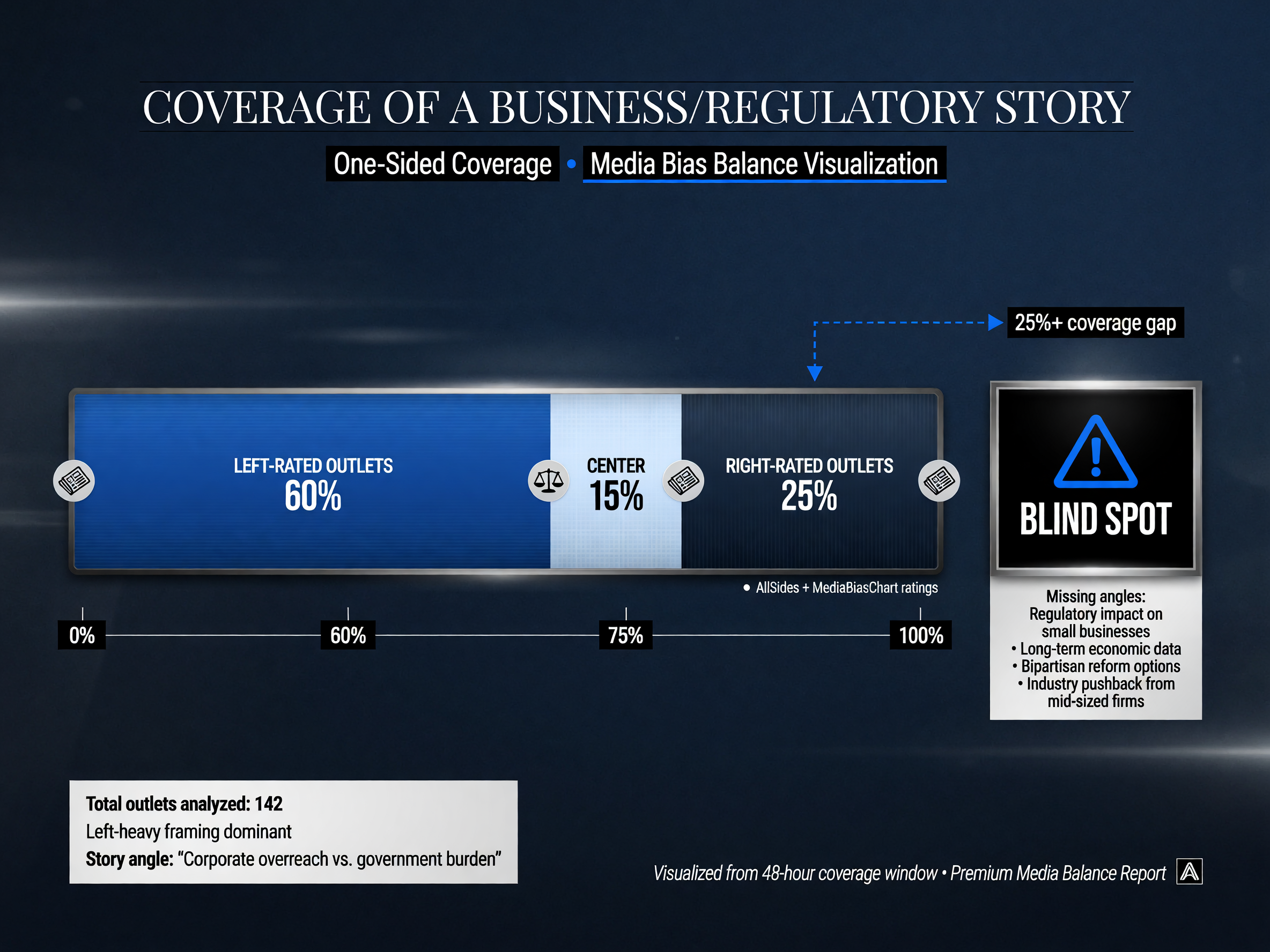
The bias map at a glance: when coverage of a story breaks lopsided across the spectrum, the framing you’re reading is only part of the picture.
How Ground News Actually Works
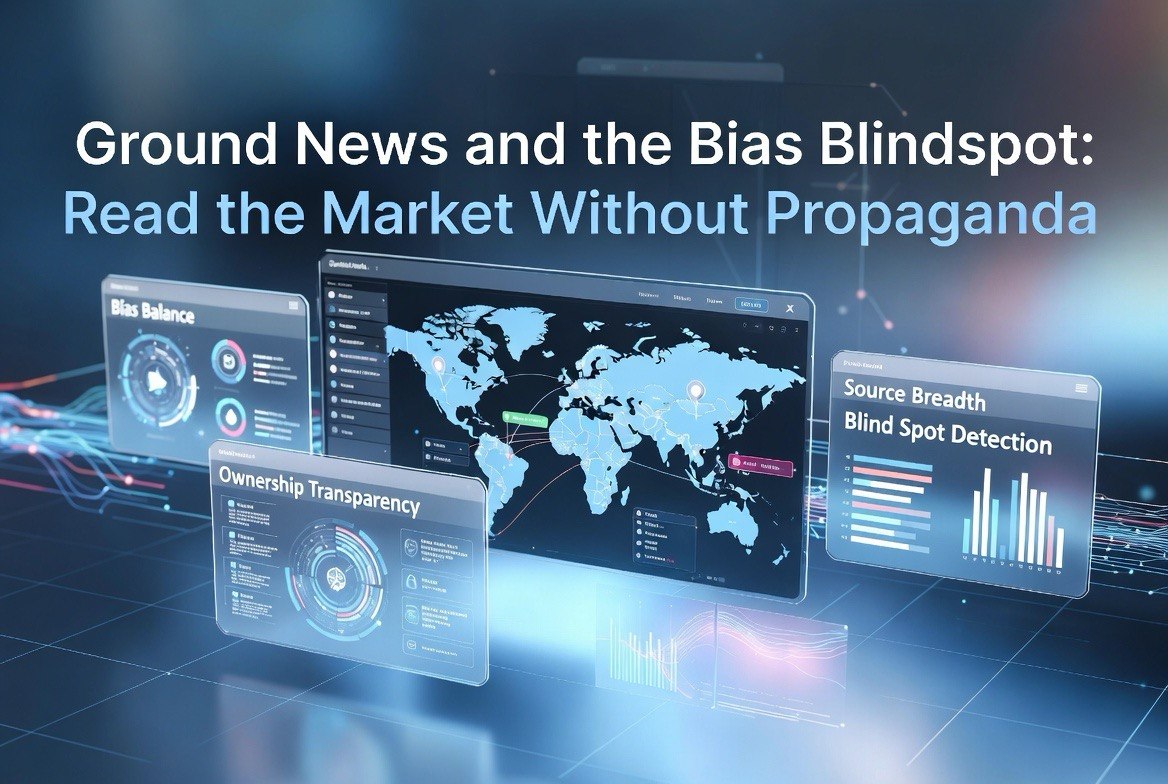
Ground News pulls from more than 50,000 sources and classifies each one on a political spectrum, then applies that map to every story it aggregates. When you open a story, you get a dashboard with four powerful signals:
- The Bias Balance. A bar showing how many left, right, and center-rated outlets covered the story. If coverage is 80% one side, you know the framing you’re getting is lopsided before you read a word.
- Ownership Transparency. Who actually owns the outlet reporting the story. This matters because corporate ownership shapes editorial priorities — a tech company’s media arm covers tech news differently than an independent outlet does.
- Blind Spot Detection. The tool flags stories where coverage is one-sided or missing on one end of the spectrum. These “blind spot” flags are where conventional feeds fail you, because they show you what the loudest outlets are NOT saying.
- Source Breadth. At a glance you see how many different outlets carried the story and their spread across the spectrum, so a “big story” that only got one-sided coverage reads differently than one that genuinely crossed the aisle.
The genius is simplicity: it doesn’t tell you what to think. It shows you who else is thinking, who’s not, and who’s paying for the mics. That visibility is the whole value.
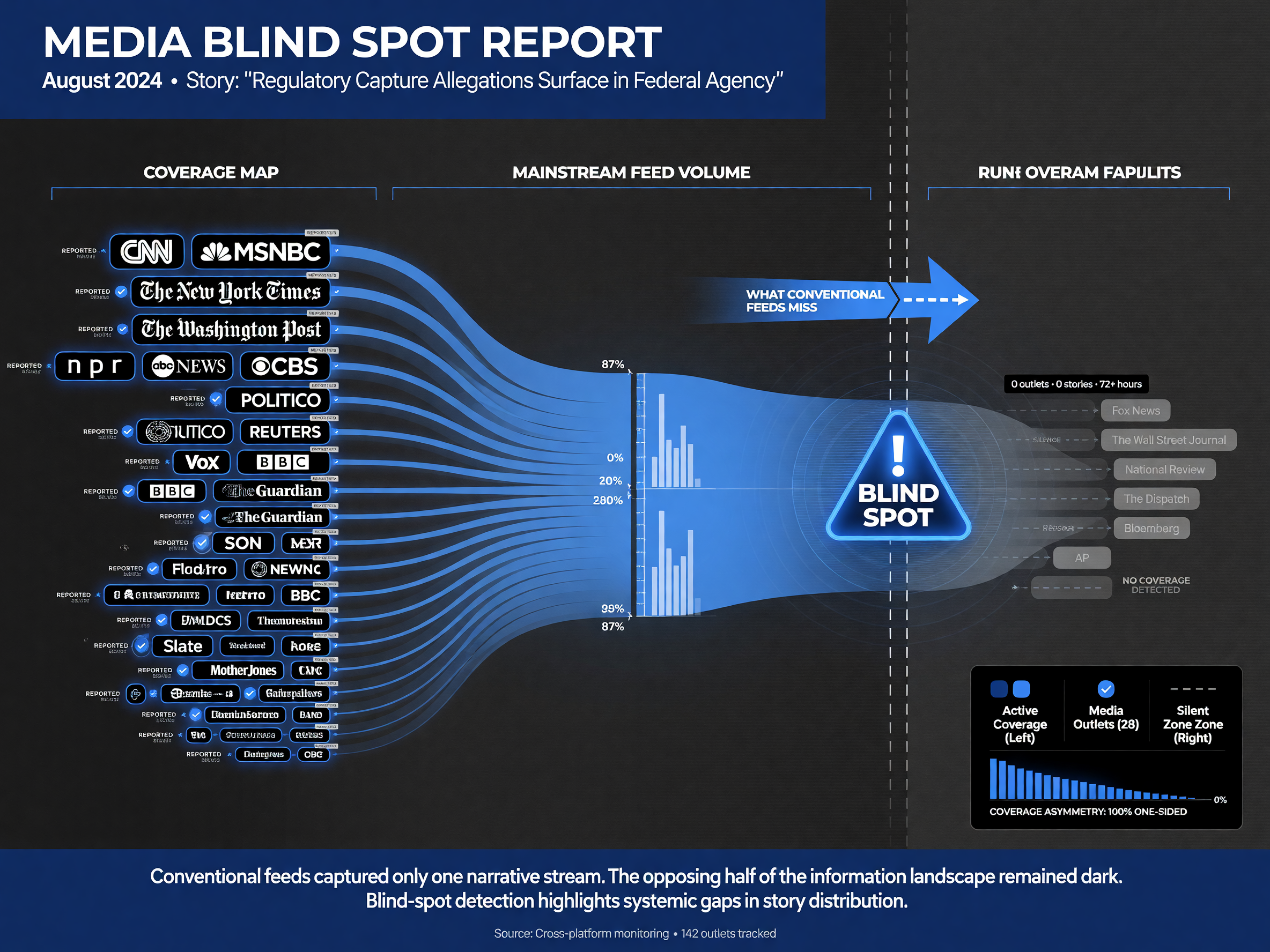
Blind-spot signals are where the real story hides: coverage that breaks one way usually means a competing interpretation is going unreported — and that gap is exactly what conventional feeds miss.
The Blind Spot Signal: Where the Real Story Hides
Ground News’s blind-spot feature deserves special attention for business users. It identifies stories where coverage breaks sharply one way — say, 90% of sources rating to one side of the spectrum are on it, while the other side is silent.
Consider what that means in practice. A sector-wide labor story, a supply-chain disruption, or a regulatory ruling often gets covered heavily by outlets with one editorial agenda and ignored by the other. If you only read the loud side, you’d never realize there’s a competing interpretation worth weighing. The blind-spot flag is a warning light: “what you’re seeing is only part of the map — dig here before you decide.”
For a business owner weighing a supplier, a market entry, or a hiring strategy, that one signal can be the difference between moving early on solid intel and moving late on a one-sided read.
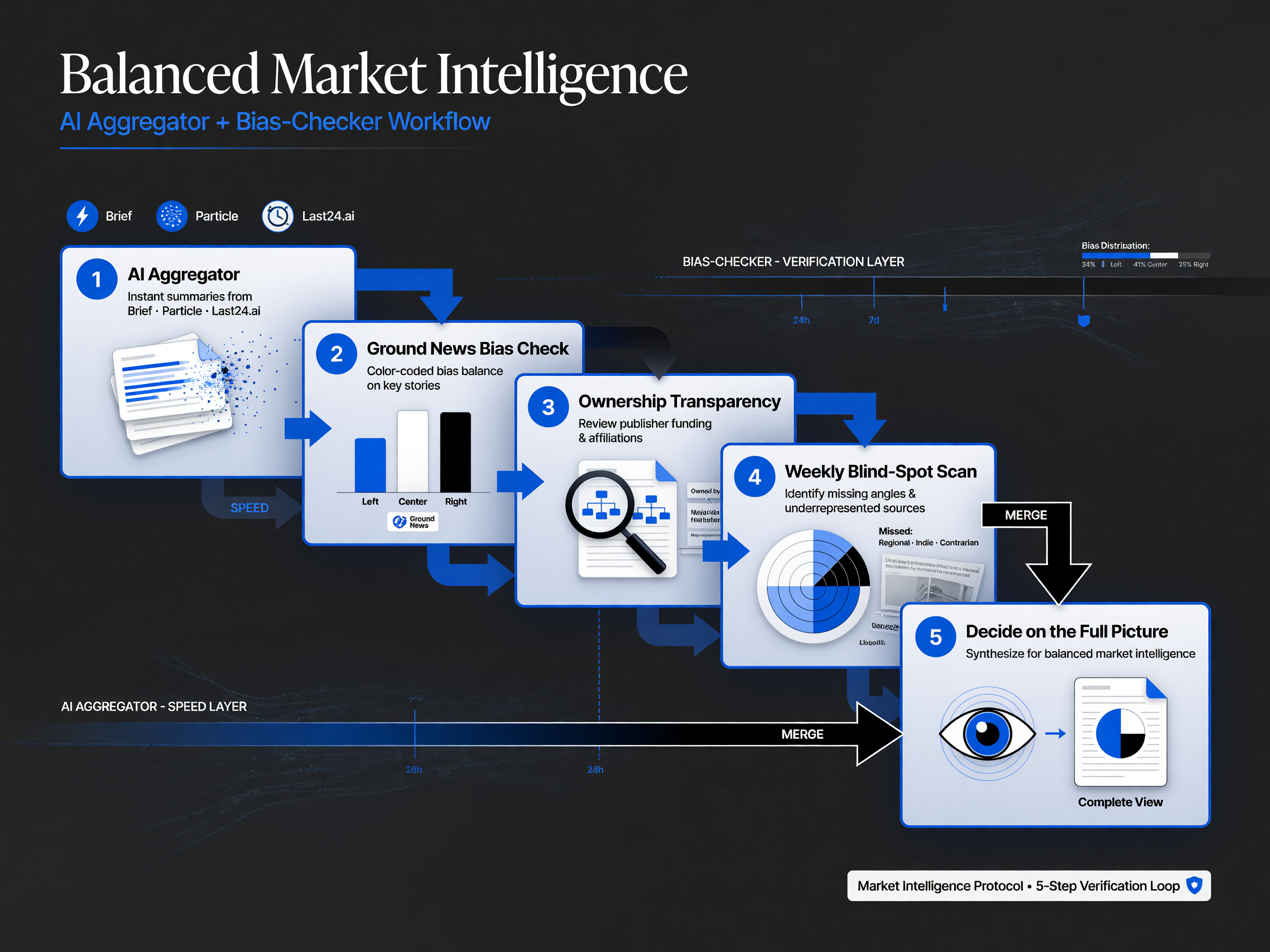
The balanced-intelligence routine: let an AI aggregator handle speed and volume, then use Ground News to verify bias, ownership, and coverage gaps before you decide.
Pairing Ground News With an AI Aggregator for Full Coverage
Ground News is powerful on its own, but it shines when paired with a source-agnostic AI aggregator. Here’s the combination that gives you genuinely balanced market intelligence:
- Let an AI aggregator handle speed and volume. Tools like Brief, Particle, or Last24.ai compress thousands of stories into a scannable daily digest, so you’re not drowning in raw feeds.
- Let Ground News handle perspective and verification. When a story from your digest matters, pull it up in Ground News to see the bias balance, the ownership, and the coverage gaps before you act on it.
- Add a weekly blind-spot scan. Once a week, open Ground News’s blind-spot view and read a story you normally wouldn’t see. That deliberate exposure is the antidote to the filter bubble.
Aggregators answer “what happened?” fast. Ground News answers “who’s telling me, and what aren’t they telling me?” — which is the question that keeps your decisions honest. Both together beat either one alone.
Pricing: What Balanced Reading Costs
Ground News offers a free tier that includes bias ratings and coverage maps on individual stories. The Plus subscription, roughly $5 a month, unlocks the full bias meter, blind-spot detection, ownership transparency across all sources, and personalized feeds.
At that price, this is one of the cheapest business intelligence tools you can buy. Compare it to a single dinner or a monthly software subscription you barely use — for the same money, you’re adding a verification layer to every decision you make from the news. If your calls are worth anything, the $5 is a fraction of the cost of being wrong because you read one side of a story.
Steps to Start Reading Bias-Aware Today
Getting value from Ground News takes five minutes of setup and a small habit change:
- Create your account. Start with the free tier to test the bias maps; upgrade to Plus only if you find the blind-spot and ownership features worth the $5.
- Run a bias audit on your current sources. Search the topics you care about and look at where the coverage lands. You’ll likely spot that your usual reads skew one way — that’s the wake-up call.
- Add it beside your aggregator. Keep your AI digest for speed, and use Ground News as the verification layer for any story that might change a decision you’re facing.
- Set a weekly blind-spot review. Block fifteen minutes a week to read one flagged story. It’s a small investment that steadily widens the picture you operate on.
- Track one real decision with it. Pick a live sourcing, hiring, or expansion call and note what the bias map added. The concrete payoff is what makes the habit stick.
Real Numbers: The Cost of Reading One-Sided
Put a dollar figure on the problem. The Reuters Institute’s research consistently shows most readers across Western markets get their news from a small cluster of top outlets with overlapping leans — and that polarized media consumption tracks with distorted perceptions of major issues. When a business owner’s understanding of a sector shift is filtered through a single editorial slant, every decision built on that understanding carries hidden risk.
Now add the fix. For $5 a month, you gain visibility into the bias map of your sources, ownership behind the stories, and coverage gaps you’d otherwise never see. If that awareness changes even one sourcing call, one hiring decision, or one expansion move over the course of a year, the tool has paid for itself thousands of times over — in avoided cost rather than captured revenue, which is often the better trade.
The news you’re reading right now is not neutral. Neither is your competitor’s. The question isn’t whether bias exists in your feed — it’s whether you can see where it’s pointing before you decide.
What the Bias Map Reveals About Your Industry Feed
Run a Ground News bias audit on the topics you follow and patterns jump out that are invisible in a normal feed. The value isn’t abstract; it shows up in four concrete ways that map directly onto how you run a business:
- Competitor coverage skew. When a rival makes a move, check the bias balance on the story. One-sided coverage can overstate or understate the significance of what they did, sending you chasing a story that matters less than it looks — or missing one that matters more.
- Regulatory and policy signals. Rules that hit your sector — labor, food safety, data privacy, shipping — often break across the political spectrum unevenly. The bias map shows you which faction is driving the framing, which tells you how it’s likely to land and what to prepare for.
- Supplier and partner vetting. Before you sign a contract, run the company through Ground News. Ownership transparency reveals whether the coverage you’ve seen is truly third-party or partly self-interested. That’s a due-diligence shortcut most owners never use.
- Customer sentiment context. Stories about your industry that dominate one side of the spectrum are often harbingers of consumer backlash or momentum you should read early. The coverage gap is the tip-off.
None of these require you to change your politics. They require you to see the landscape honestly, and a bias tool is the fastest honest lens you can put between your eyes and the feed.
Common Mistakes When Starting Bias-Aware Reading
Owners who try a tool like Ground News and quietly drop it usually trip on a few habits. Avoid them and the practice sticks:
- Treating it like an argument referee. Ground News isn’t telling you which side is right. If you open it looking for ammunition, you’ll miss the point. The goal is to see the full map, not to win a debate.
- Ignoring the blind-spot flag. It’s tempting to scroll past the stories that break lopsided because they feel familiar. Those are exactly the ones worth opening; they’re where your conventional feeds are thinnest.
- Skipping ownership checks. The bias bar gets the attention, but ownership transparency quietly matters just as much. A story sourced entirely from one corporate-owned chain carries a commercial agenda a bias rating alone won’t show.
- Checking it daily instead of weekly. The blind-spot scan is most useful on a rhythm, not as another tab to refresh. A fixed weekly review beats compulsive daily peeks that you abandon.
- Expecting it to replace your sources. Ground News adds a verification layer; it doesn’t replace the trade publications and specialists you trust. Keep those, and add this on top to check the angles they share.
Frequently Asked Questions
Is Ground News free?
Yes, there’s a free tier with bias ratings and coverage maps on stories. The Plus subscription, around $5 a month, unlocks the full bias meter, blind-spot detection, ownership transparency, and personalized feeds. The free tier is enough to test the value before you pay.
Is Ground News politically biased itself?
Ground News aims to be neutral by showing you where outlets sit on the spectrum rather than telling you what to think. It rates sources across the political range and displays the balance of coverage on every story, so the bias map is the feature — not an editorial stance.
How is Ground News different from an AI news aggregator?
An aggregator like Brief or Particle answers “what happened” fast by summarizing and clustering stories. Ground News answers “who’s telling me and what aren’t they telling me” by mapping bias, ownership, and coverage gaps. They complement each other: use an aggregator for speed and Ground News for perspective.
Can Ground News help small business owners make better decisions?
Yes. When you use the news for sourcing, hiring, pricing, or expansion calls, the slant of your sources becomes a business risk. Ground News surfaces one-sided coverage and blind spots so you weigh decisions against the full picture instead of a filtered one.

About Barak Schurr
Barak Schurr is the founder and former president of the nightlife ticketing platform Wantickets and former Global Director of Dance and Nightlife at Eventbrite. He currently focuses on AI research and writes about practical AI for independent business owners that actually moves the needle — no hype, no corporate fluff. More at topnotchaitools.com.
Contact: [email protected]
More AI Resources for Your Business