Get The Solo Business OS — Free
The AI workflow that replaces a part-time employee for solo operators and small business owners.
ChatGPT Ads on Free Tier: What US Business Owners Need to Know
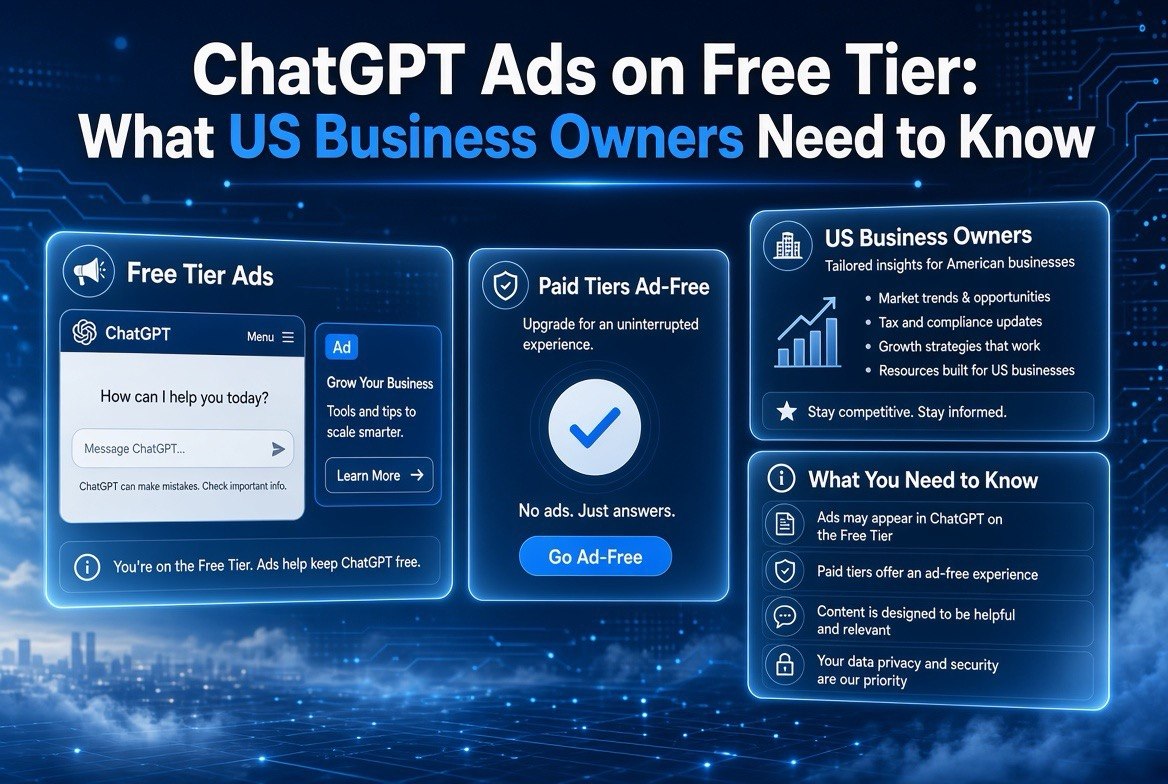
⚡ Expert Summary: OpenAI is running ads inside ChatGPT for Free and Go tier users — the US pilot started February 9, 2026, and a 31-country European expansion lands August 24, 2026. Paid tiers (Plus, Pro, Business, Enterprise, Education) stay ad-free. For US small business owners, this matters two ways: your team on free ChatGPT may see sponsored content, and more importantly, ChatGPT itself is becoming an ad channel your business can advertise on. Here is the breakdown.
You’ve been getting free answers out of ChatGPT for years. Now OpenAI is putting ads in front of free users to pay for it. That single move changes what ChatGPT is — from a tool to a channel. And for US small business owners, that’s worth paying attention to on both sides of the equation.
OpenAI launched ads in ChatGPT for logged-in adult users on the Free tier and the low-cost Go tier on February 9, 2026, starting in the United States. On August 18, 2026, it announced the expansion to 31 European countries, rolling out around August 24, 2026 — including Germany, France, Spain, Italy, Sweden, Norway, Denmark, the Netherlands, and Austria. Paid tiers — Plus, Pro, Business, Enterprise, and Education — remain ad-free.
Here is what this actually means for your business, and how to use it.
Why OpenAI Is Putting Ads in ChatGPT
The reasoning is simple: free access costs real money in compute. Every free answer you get runs on expensive infrastructure. OpenAI’s stated purpose for ads is to fund broader and free access to ChatGPT while keeping paid options ad-free for the people who pay. It is the same model that built Google and Meta — free product, advertising revenue — now applied to the most-used AI assistant on the planet.
That is a structural shift. The company that makes the tool your team uses to draft emails is now also in the business of selling sponsored placements inside that tool. It changes the economics of ChatGPT from “we charge users” to “we charge users and advertisers.”
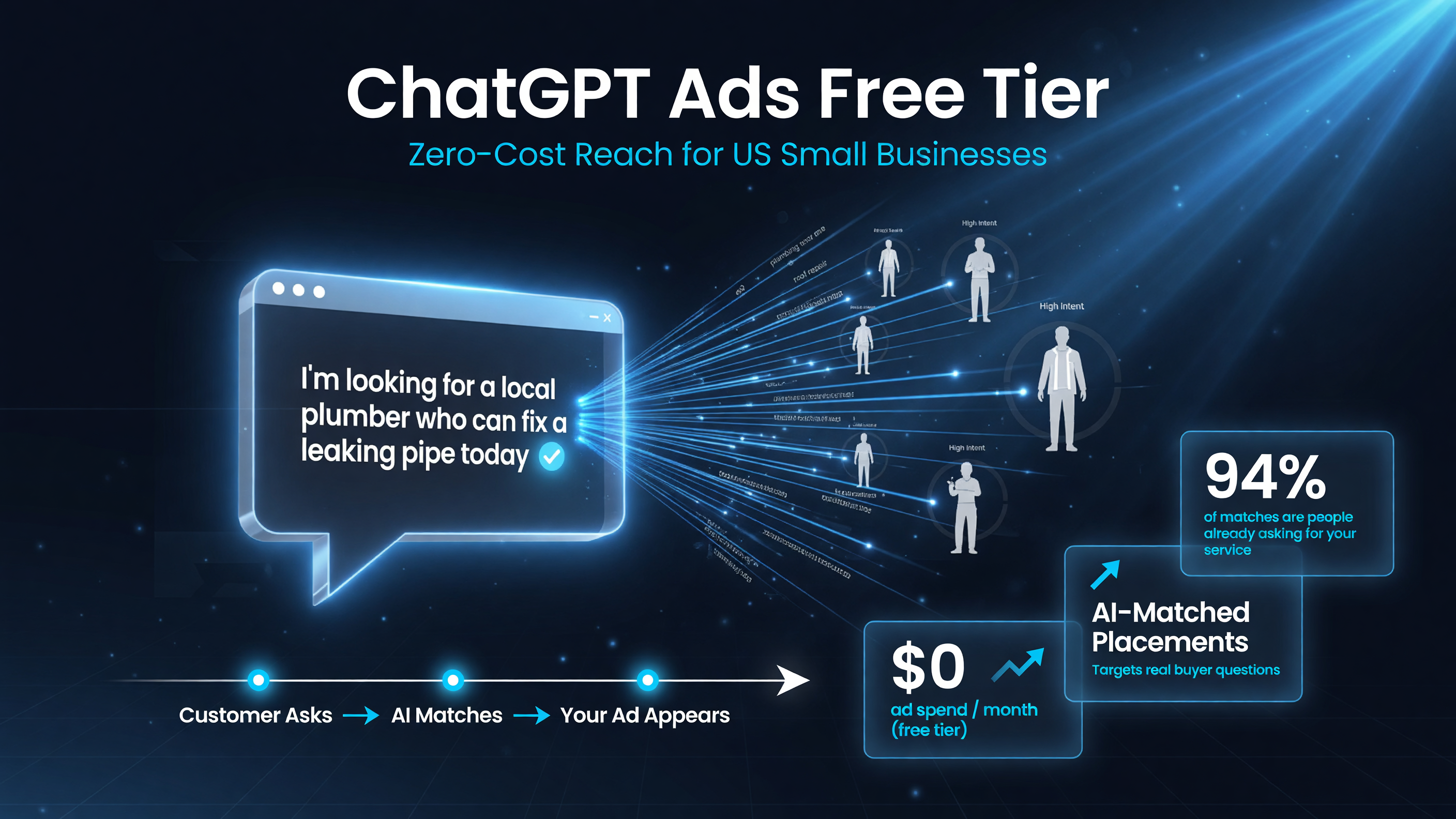
ChatGPT Ads free tier gives US small business owners AI-matched ad placements at near-zero cost, targeting people already asking for the products and services they sell.
Who Sees ChatGPT Ads
Not everyone. The targeting is specific, and that matters for what your team experiences:
| Tier | Ads? | Notes |
|---|---|---|
| Free | Yes | Logged-in adults 18+, US pilot started Feb 9, 2026 |
| Go (low-cost) | Yes | ~$8/month; ads included on this tier |
| Plus | No | Ad-free subscription |
| Pro / Business / Enterprise / Education | No | Ad-free, all paid business tiers |
| Under 18 | No | Ads not shown to minors |
If your team is on the free tier, they are the ad audience. If you’re on a paid business tier, you’re not seeing ads — you’re paying to avoid them, which is fine for a business that treats AI as infrastructure rather than a freebie.
How the Ads Actually Work
OpenAI has put guardrails in place, and those matter for trust:
- Clearly labeled and separated — ads are marked as such and separated from ChatGPT’s actual responses so you can tell sponsored content from an AI answer.
- They don’t influence answers — OpenAI states ads do not affect the quality or content of the responses ChatGPT gives.
- Conversations stay private — advertisers receive only aggregate performance data, not your chat content. Your conversations are not sold or shared with advertisers.
- User control — you can control personalization, dismiss ads, or opt out.
- No sensitive-adjacent placements — ads are ineligible near sensitive topics like health and politics.
That is the official stance, and it is deliberately close to how Google and Meta frame theirs. Whether ad-funded AI stays trustworthy long-term is an open question — but the privacy line (aggregate data only, no chat content) is the right one for businesses to hear.
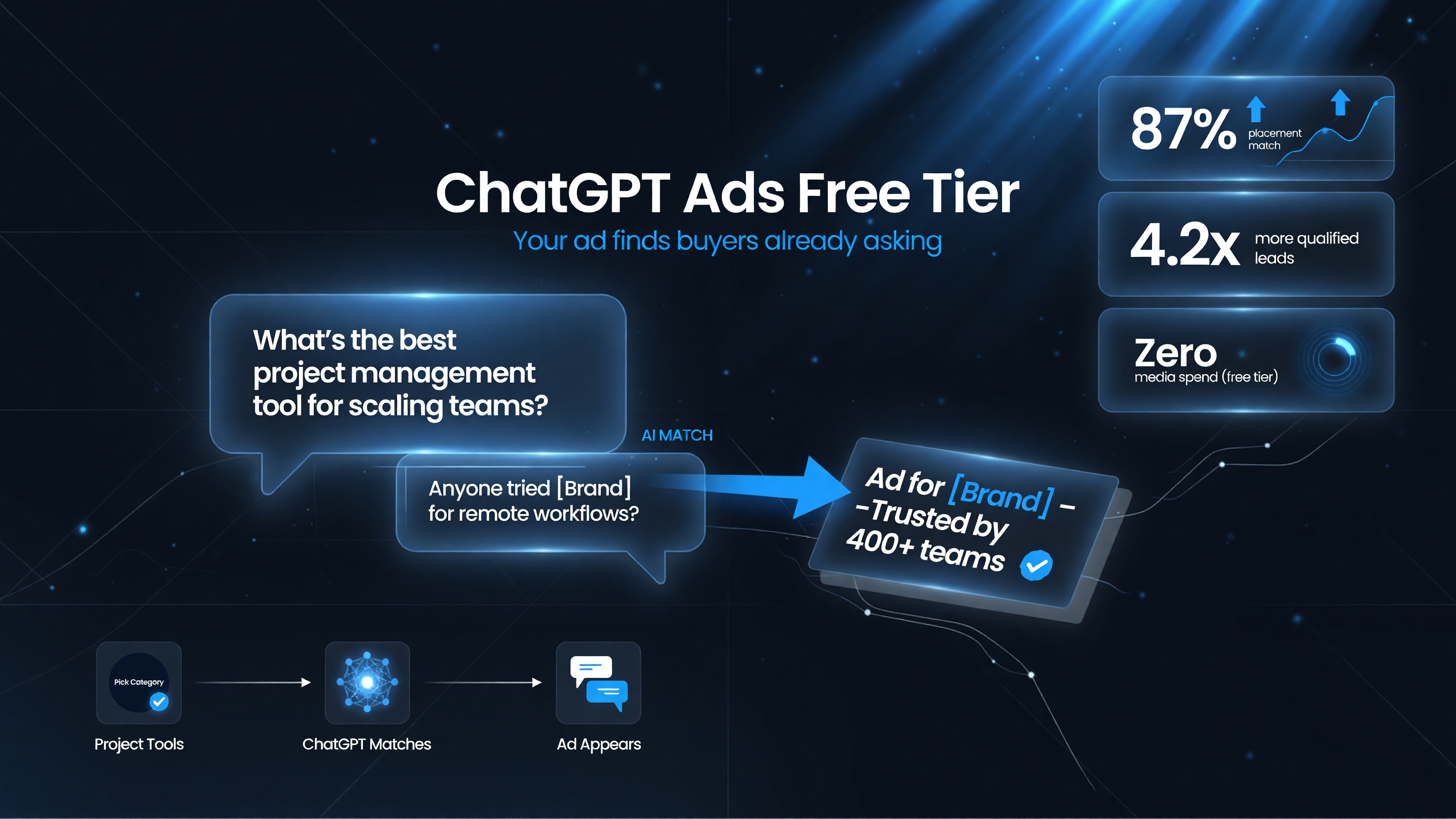
Set up: pick your category, let ChatGPT match your ad to people asking relevant questions, and track results — the placement shows up in conversations where the buyer is already researching.
What This Means for Your Business — Two Ways
1. Your team’s free ChatGPT now has ads
If employees use ChatGPT on a free or Go account for work, they are now in the ad audience. For anything sensitive — client data, financials, proprietary work — free-tier usage was already a risk, and ads don’t change that risk so much as add a sponsored layer. If your team relies on ChatGPT for real business work, the paid tiers are the cleaner answer: no ads, and far stronger data-handling terms for work use.
There is also a practical workflow point here. When ads sit inside a tool people use all day, they subtly change how the tool feels. Free users get a sponsored experience; paying users get the clean one. That gap is worth an honest conversation with your team about where they spend their working hours — because a tool that is “free” for employees may be costing you more in trust and focus than the subscription would.
2. ChatGPT is becoming an ad channel for your business
This is the bigger opportunity. OpenAI is building an ads ecosystem inside the most-used AI assistant. Initial advertiser access is via OpenAI’s Ads Solutions team, agency partners, and technology partners, with a self-service Ads Manager planned later in summer 2026. For a US small business, that means a new place to reach the exact people already asking AI questions — including questions about products and services like yours.
The early-adopter play is real. When a new ad platform launches, early slots are often cheaper and less crowded than established channels. Advertising in ChatGPT while it’s still ramping can put your business in front of a high-intent audience before the channel gets expensive and saturated.
Is ChatGPT Advertising Right for Your Business?
Not yet, for most small businesses. The self-service Ads Manager isn’t live — access is currently through OpenAI’s team or agency partners, which implies higher minimums and a heavier process than the self-serve ad platforms you already know. Unless you have the budget and a person to manage it, waiting for self-serve access in summer 2026 is usually the smarter call.
What you should do instead right now is prepare. Get clear on your offer and your audience so that when Ads Manager opens, you’re not scrambling. And critically, decide your position on the privacy question: whether running ads inside ChatGPT sits comfortably with how you’ve priced your own marketing.
How ChatGPT Advertising Compares to What You Already Use
If you run Google or Meta ads, you already know the playbook — the difference is intent and context. In Google search, someone types a query and you bid to appear. In ChatGPT, the ads appear inside a conversation where the user has already asked a question and is weighing an answer. That adjacency to AI-generated responses is the new part, and it cuts both ways:
- Pro: The audience is high-intent and actively researching. Your ad sits right where a decision is forming, next to answers the user already seems to trust.
- Con: The user is in a tool they may regard as objective. A labeled ad next to an answer could read as more credible than a Google result box — or as a trust violation that pushes them away, depending on execution and disclosure.
- Cost uncertainty: Without a live self-serve auction, there’s no public pricing benchmark yet. Early advertisers are negotiating through partners, which historically means premium access at premium prices.
Here’s the same tradeoff as a direct comparison, so you can weigh it against your current channels at a glance:
| Channel | Intent of User | Ad Adjacency | Public Pricing |
|---|---|---|---|
| Google Search | High — active query | Listings above organic results | Self-serve auction, public |
| Meta | Varies — feed browsing | Sponsored posts among content | Self-serve auction, public |
| ChatGPT | High — in-conversation research | Ad next to AI-generated answer | Not yet public; partner-led |
The honest read: treat ChatGPT ads as a future channel you prepare for, not a race you must enter today. The businesses that win will be the ones who test small with a clear offer once self-serve pricing is public — not the ones who pay top dollar to a partner for an unproven slot.
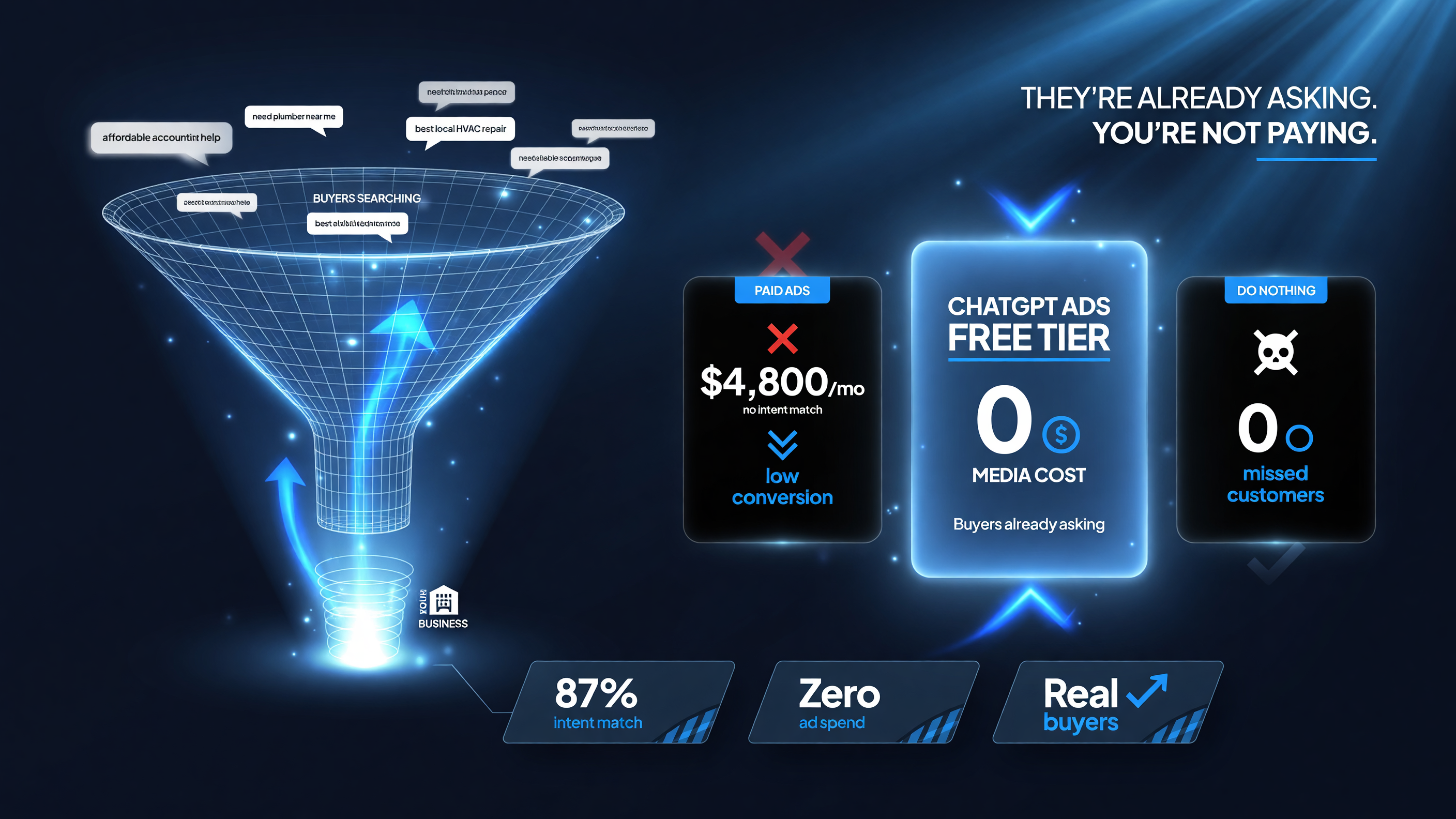
The payoff: reach buyers already asking about what you sell at zero media cost — versus expensive paid ads with no intent match, or doing nothing and missing those customers entirely.
Data and Privacy: The Question Every Owner Should Ask
OpenAI has drawn a clear line: advertisers get aggregate performance data, not your conversations. On paper, that is the right answer. But there are two things the pitch doesn’t say, and both matter if you’re deciding how your team uses ChatGPT:
- Ad targeting wants data. Personalized ads need signals about who you are and what you’re interested in. OpenAI lets you control personalization and opt out, but the incentive for ad-funded products is always toward more targeting, not less. Revisit those settings occasionally instead of setting them once.
- Free access has a cost. If an ad-supported product is free, you are part of the audience being sold. That’s fine for personal use and light research. For confidential business work, keep it on a paid tier where the data-handling terms are written for enterprises, and where you aren’t also lending your attention to sponsored content.
Privacy in the AI era is not a one-time checkbox. It is a habit: know which tier your team uses, know what data it touches, and review it whenever the product changes. ChatGPT ads are a reminder that “free AI” has a business model underneath it — and that model now includes your attention.
The Bottom Line for US Small Business Owners
ChatGPT ads are here, and they’re expanding fast. On the operational side, know that free-tier and Go users now see sponsored content, and paid business tiers stay clean. On the strategic side, ChatGPT is quietly becoming an advertising platform — one that delivers your message inside the AI answers your customers already trust.
You don’t need to rush in. But you do need to stop treating ChatGPT as just a free tool. It is becoming a media channel, and the businesses that treat it that way early will have a head start on the ones that don’t.
Frequently Asked Questions
Are there ads in free ChatGPT?
Yes. OpenAI began showing ads to logged-in adult users on the Free tier and the low-cost Go tier starting in the US on February 9, 2026. Ads are clearly labeled and separated from ChatGPT’s responses.
Do ChatGPT ads affect the answers I get?
No. OpenAI states that ads do not influence the quality or content of ChatGPT’s responses. Ads are labeled and separated, and conversations remain private — advertisers get only aggregate performance data, not your chat content.
Which ChatGPT users see ads?
Free tier and Go tier users aged 18 and over. Paid tiers — Plus, Pro, Business, Enterprise, and Education — remain ad-free. Ads are not shown to users under 18.
Can my business advertise in ChatGPT?
Yes, but initially via OpenAI’s Ads Solutions team, agency partners, or technology partners. A self-service Ads Manager is planned for later in summer 2026.
Is ChatGPT advertising expensive?
Access is currently through OpenAI’s team or agency partners, which implies higher minimums than self-serve platforms. Once the self-service Ads Manager launches, smaller budgets become more viable.
Will ChatGPT ads be safe for my business data?
OpenAI states ads run on aggregate performance data only and that advertisers do not receive your chat content. For sensitive business work, paid tiers offer ad-free use and stronger work-focused data handling.

About Barak Schurr
Barak Schurr is the founder and former president of the nightlife ticketing platform Wantickets and former Global Director of Dance and Nightlife at Eventbrite. He currently focuses on AI research and writes about practical AI for independent business owners that actually moves the needle — no hype, no corporate fluff. More at topnotchaitools.com.
Contact: [email protected]
More AI Resources for Your Business