Get The Solo Business OS — Free
The AI workflow that replaces a part-time employee for solo operators and small business owners.
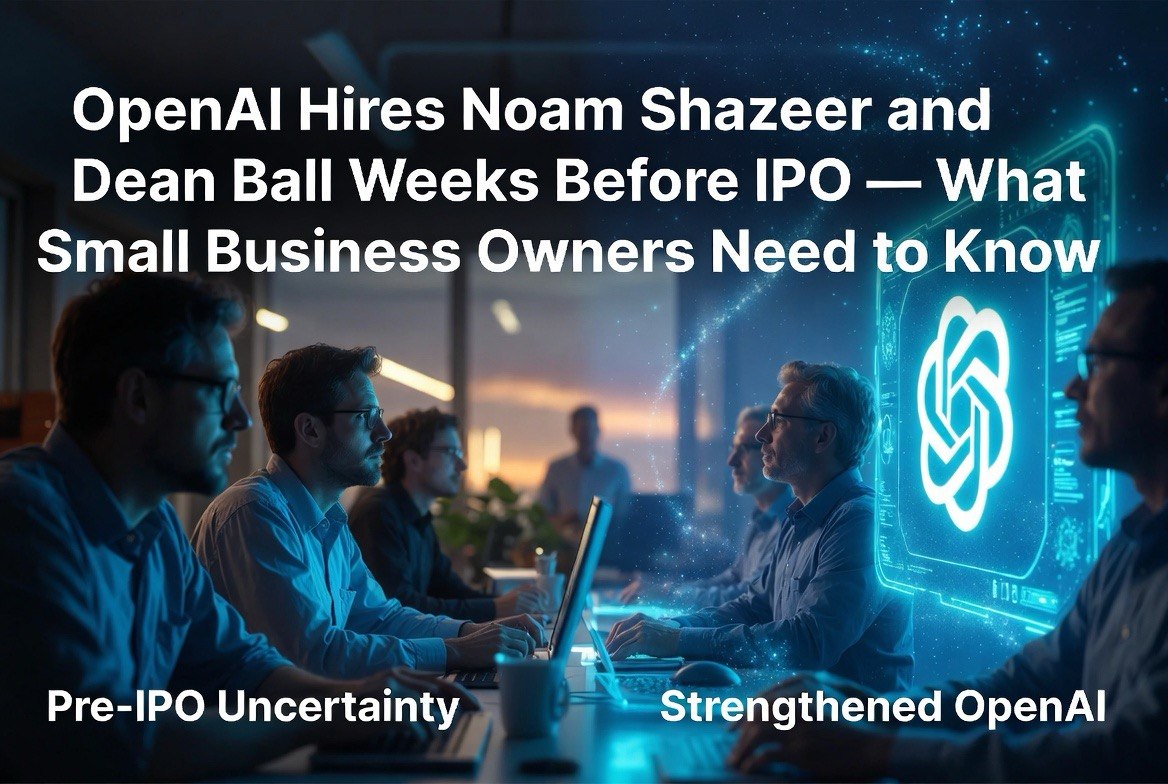
OpenAI Hires Noam Shazeer and Dean Ball Weeks Before IPO — What Small Business Owners Need to Know
⚡ Expert Summary: OpenAI just brought in two heavy hitters: Noam Shazeer, co-inventor of the Transformer architecture that powers every modern AI tool, and Dean Ball, former Trump administration AI policy official. These hires signal that OpenAI is stacking firepower for its reported IPO and pivoting hard toward enterprise credibility. For small business owners using AI tools, this means the tools you rely on may get more expensive, more enterprise-focused, and potentially more locked into OpenAI’s ecosystem. Here is what is actually changing and how you should prepare.
OpenAI hired two of the most strategically significant people in AI this week — and if you run a small business that depends on AI tools, you need to understand why this matters more than any product launch they will announce this year.
On June 17, Noam Shazeer joined OpenAI from Google DeepMind. Shazeer is not just another AI researcher. He is the co-author of the 2017 paper “Attention Is All You Need” that introduced the Transformer architecture — the technology behind ChatGPT, Claude, Gemini, and virtually every large language model in existence. If AI has a Mount Rushmore, Shazeer is on it.
Two days later, OpenAI confirmed that Dean Ball would join the company. Ball served as a senior policy advisor on AI during the first Trump administration and later founded Hyperdimensional, a think tank focused on AI governance. He is one of the most respected voices in AI policy, known for advocating balanced regulation that does not strangle innovation.
These two hires, announced within 72 hours of each other, paint a clear picture of where OpenAI is headed. The question for small business owners is: what does this mean for the tools you rely on every day?
This article is part of our ongoing AI Tools coverage, where we track how major AI developments affect independent businesses.
Why the Shazeer Hire Matters for Business Tools
Shazeer spent the last several years at Google DeepMind working on what the industry calls “frontier models” — the next generation of AI that goes beyond simple text generation into reasoning, planning, and tool use. His expertise in model architecture means he can directly influence how OpenAI builds its next-generation systems. For businesses using ChatGPT, OpenAI’s API, or tools built on top of OpenAI’s models, this likely means more capable, more reliable systems in the next 12 to 18 months.
But there is a catch. Shazeer’s focus on frontier capabilities aligns with OpenAI’s push toward enterprise customers, not the individual user or small team. When a company hires a world-class researcher, they are not paying millions to optimize the $20/month ChatGPT Plus plan. They are building products that Fortune 500 companies will pay six figures per year for. Small businesses often get left behind in this shift, receiving stripped-down versions of enterprise tools or facing sudden price increases.
The Policy Angle: Why Dean Ball Changes the Regulatory Landscape
Dean Ball is not a technologist. He is a policy strategist who helped shape the United States’ approach to AI regulation during a critical period. His move to OpenAI suggests the company is getting serious about navigating the regulatory environment ahead of its US IPO.
The IPO, which was first reported in September 2025 and could value OpenAI at over $1 trillion, requires the company to demonstrate that it can operate responsibly at global scale. Ball’s job will likely involve shaping how OpenAI engages with regulators in the US and internationally — from the European Union’s AI Act to potential US federal AI legislation.
For small businesses, this is actually good news. A company that invests in regulatory compliance is less likely to face sudden shutdowns, data privacy scandals, or forced changes that break your existing workflows. The risk of OpenAI losing its operating license in key markets drops significantly when someone like Ball is managing the policy side.
How the IPO Timeline Shapes What Tools You Use
OpenAI’s IPO is expected to be one of the largest in technology history, with estimates ranging from $750 billion to $1 trillion. The company has been aggressively positioning itself as the “safe choice” for enterprise AI. The Shazeer hire signals technical leadership. The Ball hire signals regulatory responsibility. Both are designed to convince institutional investors that OpenAI is a stable, long-term bet.
What does this mean for your business? Three things:
1. Expect pricing changes post-IPO. Once OpenAI is a public company, it will face quarterly earnings pressure. The most lever it has to pull is pricing. If you rely on OpenAI’s API for your business tools, budget for a 20-40% increase in costs over the next 18 months. This is standard post-IPO behavior for enterprise SaaS companies.
2. Enterprise features will appear before consumer improvements. OpenAI will prioritize features that close enterprise deals: advanced compliance, team management, custom models, and dedicated support. Consumer-friendly features may slow down. If you run your business on ChatGPT or direct API calls, you will benefit from the infrastructure improvements but may not see the same pace of new features aimed at smaller operations.
3. Competitors will get more aggressive. Anthropic, Google, and open-source models like Meta’s Llama will use OpenAI’s IPO period to steal market share by offering better pricing or more flexible terms. This creates opportunities for small businesses to diversify their AI stack. February 2026 research from Stanford’s AI Index found that over 60% of small businesses now use at least two different AI providers, up from 34% in 2024.
Should You Diversify Away from OpenAI?
The honest answer: it depends on how deeply integrated OpenAI is in your operations. If you use ChatGPT for content, customer support, and basic analysis, you have time. The Shazeer hire almost certainly means better models are coming, not worse ones.
But if your entire business runs on OpenAI’s API — custom GPTs, fine-tuned models, or third-party tools that depend exclusively on OpenAI — you should start testing alternatives now. Claude from Anthropic offers comparable performance for many business tasks. Open-source models like Llama 4 or command-r can be run through providers like Groq at a fraction of the cost. The US AI Index 2026 report noted that inference costs for open-source models have dropped 73% year-over-year, making them genuinely competitive for business use.
The goal is not to replace OpenAI. The goal is to have options. Companies that lock themselves into a single AI provider consistently pay more and get less flexibility. The Shazeer-Ball hires make OpenAI stronger, but a stronger single provider is still a single provider.
How Competitors Are Responding to OpenAI’s Power Moves
The market is already reacting to OpenAI’s power moves. In the same week Shazeer and Ball were announced, startup Anthropic quietly inked a deal with consulting giant McKinsey to embed Claude into their client delivery framework. This is the kind of enterprise beachhead that OpenAI has dominated for the last 18 months, and it signals that competitors see OpenAI’s IPO focus as an opportunity to steal accounts.
OpenAI is not making these moves in a vacuum. Anthropic recently closed a $4 billion funding round and has been aggressively hiring policy staff of its own. Google DeepMind released Gemini 2.0 with enterprise features that directly compete with OpenAI’s business tier. Meta open-sourced Llama 4 with a permissive license that allows commercial use without royalties.
The competitive response to OpenAI’s IPO preparation has been telling. Anthropic announced in May 2026 that it would offer “IPO protection pricing” to enterprise customers — fixed-rate contracts that guarantee pricing for 36 months regardless of market changes. Google followed with a similar offer for its Vertex AI platform. These are not coincidences. They are direct plays for OpenAI customers who want pricing stability.
Open-source alternatives have also accelerated. The GLM-5.2 model, released under an MIT license by Zhipu AI in China, now matches or exceeds GPT-5.5 on several standard benchmarks while hallucinating at less than one-third the rate. For businesses building custom AI applications, the cost equation has shifted dramatically. Running inference on a competitive open-source model through a provider like Together AI or Fireworks can cost 80% less than OpenAI’s API for equivalent task performance. That is not a future projection. That is the market today.
This competitive pressure is ultimately good for small business owners. It means OpenAI cannot raise prices aggressively without losing customers. It means alternatives are getting better faster. And it means the era of having only one viable AI provider is ending.
What Forward-Looking Business Owners Should Do This Week
Here are four specific actions you can take right now:
Audit your AI dependency. Make a list of every tool and workflow that depends on OpenAI. Include direct API usage, third-party tools with OpenAI underneath, and any ChatGPT custom GPTs you have built. You cannot plan a migration if you do not know what you are running.
Test one alternative. Pick one low-risk workflow and run it through Anthropic’s Claude or an open-source model for a week. Compare speed, cost, and output quality. Most business owners are surprised at how close the alternatives have gotten. According to independent benchmarks published by Artificial Analysis in June 2026, Claude Sonnet 4 matches or exceeds GPT-5 in 8 of 12 standard business tasks.
Watch the IPO filing documents. When OpenAI files its S-1 with the SEC, it will disclose pricing strategy, customer concentration, and risk factors. This is public information that will tell you everything about where pricing is heading. Set a Google Alert for “OpenAI S-1 filing.”
Build a budget buffer. If you spend $500/month on AI tools today, plan for $700/month in 18 months. If the increase does not come, you win. If it does, you are prepared. That is the difference between reacting and planning.
FAQ
Who is Noam Shazeer and why is he important to OpenAI?
Noam Shazeer is the co-inventor of the Transformer architecture, the foundational technology behind every major AI model including ChatGPT, GPT-4, and GPT-5. He joined OpenAI from Google DeepMind in June 2026 to work on next-generation AI systems.
Who is Dean Ball and what is his role at OpenAI?
Dean Ball is a former Trump administration AI policy advisor who joined OpenAI in June 2026. He will help shape OpenAI’s regulatory strategy ahead of its IPO, working with US and international regulators.
Will OpenAI’s IPO affect pricing for small businesses?
Historically, post-IPO enterprise SaaS companies raise prices by 20-40% within 18 months of going public. OpenAI has not announced any price changes, but small businesses should budget for potential increases and diversify their AI providers.
Should I stop using OpenAI tools for my small business?
No, but you should test alternatives now. The Shazeer hire likely means better models are coming. The risk is not quality but pricing and lock-in. Build optionality without abandoning what works. Over 60% of US small businesses now use multiple AI providers (Stanford AI Index, February 2026).
When is the OpenAI IPO expected?
OpenAI filed for an IPO in September 2025 with an estimated valuation of $750 billion to $1 trillion. The exact listing date has not been announced, but the Shazeer and Ball hires signal preparations are accelerating.