OpenAI Launches Small Business Program With Dedicated ChatGPT Agent — What US Business Owners Get
⚡ Expert Summary: OpenAI launched a dedicated Small Business Program in July 2026, giving US entrepreneurs access to exclusive ChatGPT webinars, an AI academy with structured training, and a small-business-only AI agent designed for common operational workflows. Unlike the general ChatGPT rollout, this program is built specifically for companies with fewer than 50 employees — and it might be the most practical thing OpenAI has done for SMBs since ChatGPT itself.
What Is the OpenAI Small Business Program and Why Does It Matter?
In late July 2026, OpenAI made a calculated move that signals a strategic shift: rather than continuing to sell ChatGPT as a general-purpose productivity tool for everyone, the company created a dedicated program specifically for small and medium businesses.[1]
The program includes three core components that work together as a system rather than standalone features:
- Small Business Webinars — Live, structured sessions covering how to apply ChatGPT to specific business workflows including customer support, email drafting, inventory communication, and marketing copy
- AI Academy for SMBs — A self-paced curriculum that goes beyond prompting fundamentals and teaches actual business automation patterns designed for teams with no technical background
- Small Business Agent — A purpose-built ChatGPT configuration pre-tuned for common SMB operations with guardrails and integrations designed for non-technical teams
According to data shared on X in late July, the program aims to help SMBs boost productivity by automating repetitive workflows, with a particular focus on making AI accessible to businesses that do not have dedicated IT staff.[1] This is a meaningful distinction because the majority of US small businesses operate without any dedicated technology support — the owner wears every hat.
How This Differs From General ChatGPT for Small Business
This is not the same as “just using ChatGPT.” The program adds structure, training, and purpose-built tools that change how a business owner interacts with AI:
| Feature | Standard ChatGPT | SMB Program |
|---|---|---|
| Onboarding | Generic setup, no guidance | Business workflow assessment + guided configuration |
| Training | Self-directed learning curve | Structured webinars + AI Academy curriculum |
| Agent Configuration | Manual setup from scratch | Pre-built SMB agent with business guardrails |
| Target User | General consumers and professionals | Businesses with fewer than 50 employees |
| Cost | $20/month (ChatGPT Plus) | Included with Plus/Pro for eligible businesses |
The table above highlights the fundamental difference: OpenAI is not asking business owners to figure out AI on their own. They are providing a structured path from zero to productive use, which directly addresses the training gap that 73% of SMB owners say is holding them back.[3]
What the Small Business Agent Actually Does
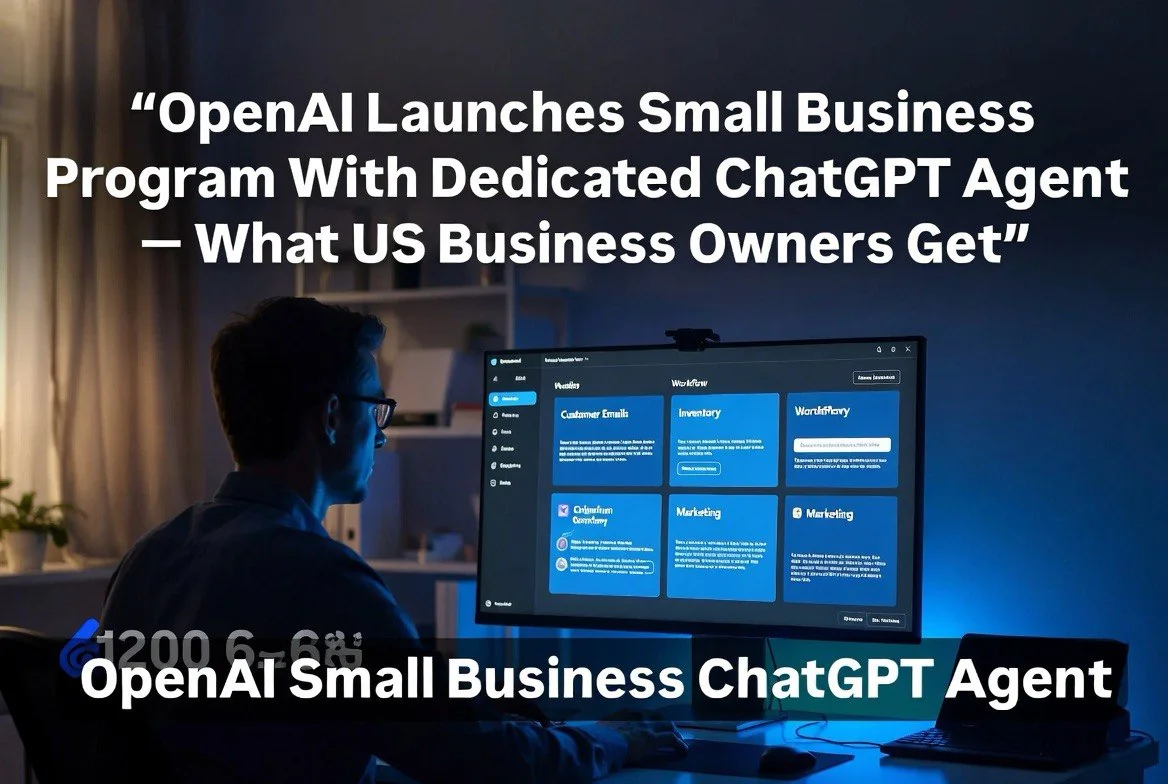
The SMB agent is the most practical piece of this rollout. Instead of giving business owners a blank chat interface and hoping they figure it out, OpenAI pre-configured the agent for the workflows small businesses actually deal with daily:
- Customer email triage — Reads, categorizes, and drafts responses to customer inquiries in the owner’s brand voice without requiring API setup
- Inventory and order communication — Drafts supplier emails and internal stock updates based on natural language descriptions of what changed
- Employee scheduling communication — Generates shift notes, policy updates, and team announcements from simple verbal instructions
- Marketing copy generation — Creates social posts, email blasts, and website updates from a stored brand guide with consistent tone and formatting
- Basic financial reporting summaries — Turns raw numbers into plain-English summaries for weekly review without needing spreadsheet skills
The key differentiator: these are not generic ChatGPT prompts. The agent comes with guardrails that prevent hallucinated numbers in financial tasks, maintains consistent brand voice across all outputs, and integrates with common business tools without requiring API access. For a business owner who has never written a line of code, this removes the primary barrier to productive AI use.
Why This Is the Right Move for US Small Businesses
The 2026 SBE Council survey found that 82% of small businesses have invested in AI, but the number one complaint is tool bloat — too many AI apps with none of them connected, and no structured way to learn how to use them effectively.[2]
OpenAI’s program addresses both pain points directly. The AI Academy provides the structured training that 73% of SMB owners say they want but cannot find elsewhere.[3] The dedicated agent eliminates the “blank canvas problem” where business owners open ChatGPT, stare at the cursor, and do not know what to ask because they have never been taught what is possible.
For US business owners specifically, the timing matters. According to the QuickBooks 2026 study, 60% of aspiring US entrepreneurs plan to use AI to launch their business this year.[4] Having a structured program from the single most recognized AI brand removes the paralysis of choice that comes with evaluating dozens of tools.
How the SMB Agent Compares to What Else Is Available
OpenAI is not the first to target this gap, but it is approaching it differently. Anthropic launched Claude for Small Business earlier in 2026 with 15 pre-built workflows for QuickBooks, HubSpot, and Canva.[5] The approach there was integration-first — connect specific tools and run workflows directly inside them.
OpenAI’s approach is training-first. The AI Academy teaches business owners how to apply AI to their specific problems, then the SMB agent handles the execution. The difference is subtle but important: one teaches you to fish, the other hands you a fishing rod with a specific brand on it.
Both are valid strategies, and in practice, most business owners will benefit from both. If you already run QuickBooks and HubSpot, Claude’s pre-built workflows will save you setup time. If you want to understand how AI can help across your entire business — including areas you have not thought of — OpenAI’s program wins on breadth and educational depth.
Where the Program Falls Short
The SMB agent is not a full business operating system. It has clear limitations that business owners should understand:
- No deep CRM integration — It cannot replace your customer relationship management platform or sync directly with Salesforce, HubSpot, or similar tools at launch
- Limited to communication and content workflows — It handles drafting, summarizing, and generating, but not executing actions within other platforms
- No multi-step agent chains — It is a single agent, not an orchestrated system of agents that can handle complex interdependent tasks
- No industry-specific vertical features — It does not integrate with restaurant POS systems, medical practice management software, construction estimating tools, or other vertical-specific platforms
This is by design. OpenAI is targeting the 80% use case — the repetitive communication and marketing tasks that consume hours each week — not building a vertical solution for any specific industry. That leaves room for specialized tools like the AI agents and automation tools covered on Top Notch AI Tools that target specific industries and workflows.
How to Get Access and Prepare for the Rollout
OpenAI has not published a full enrollment page yet, but early access appears to be rolling out to ChatGPT Plus and Pro subscribers whose accounts are registered as business entities. The webinars started around July 21-23, 2026.[1]
If you already have a ChatGPT Plus account at $20/month, check the ChatGPT interface for the Small Business Program section. If it is not showing yet, the rollout appears to be phased, with wider access expected in August 2026.
To prepare for access and hit the ground running:
- Ensure your ChatGPT account is registered with a business email domain rather than a personal Gmail address
- Complete your business profile in ChatGPT settings including your industry and company size
- Identify 3 to 5 specific workflows you want to automate before the agent arrives — the more specific, the better
- Review the existing AI tools and agent guides to understand what setup patterns work best for US small business operations
What This Means for the AI Tool Market
OpenAI’s move into structured SMB offerings puts pressure on every other AI company targeting small businesses in the United States. Google has Gemini for Workspace but no dedicated SMB program that provides structured training and pre-configured agents. Anthropic has Claude workflows but no training academy component. Microsoft has Copilot but it remains tied to Microsoft 365 subscriptions and does not offer a standalone SMB program.
The winner of the SMB AI market will not be the company with the best model. It will be the company that best solves the onboarding and training problem — the gap between having a tool and knowing how to use it productively. OpenAI just made its opening move, and the rest of the industry will have to respond.
Real-World Use Cases: Three Scenarios Where the SMB Agent Makes Sense
To understand whether OpenAI’s Small Business Program is worth your time, it helps to map it to real situations US business owners face every day.
Scenario 1: The Solo Consultant — You run a marketing consultancy with just yourself and one part-time assistant. Your inbox gets 40 to 60 emails per day from prospects, clients, and vendors. You spend about 90 minutes each morning just triaging and responding. With the SMB agent handling the first pass — categorizing urgency, drafting responses in your brand voice, flagging anything that requires personal attention — you cut that to 20 minutes. The AI Academy webinars teach you patterns for client communication that you apply directly to your workflow.
Scenario 2: The Retail Owner With 12 Employees — You manage a boutique retail operation with a small team. Your biggest time sink is not customers — it is communicating schedule changes, inventory updates, and supplier coordination to your staff. The SMB agent drafts shift notes, generates supplier restock emails from your verbal description, and creates the weekly team update post for your internal Slack channel. You do not need to learn a new tool. You just tell the agent what changed and it handles the formatting.
Scenario 3: The E-Commerce Operator Growing Fast — Your online store went from 20 orders a day to 80 a day in three months. Customer service emails are piling up, supplier communication has become a daily chore, and you need to start creating content for social media but have no time. The SMB agent handles customer email triage, drafts supplier reorder communications, and generates social media posts from your product descriptions. The webinars teach you how to tune the agent to your specific product categories and customer base.
These scenarios highlight the program’s strength: it works best for business owners who need help with the communication layer of their operation — the emails, updates, descriptions, and announcements that eat hours every week. It is less useful for businesses that need deep integration with specific operational software or complex multi-step automation.
What Business Owners Should Do Right Now
OpenAI’s Small Business Program is not going to transform your business overnight. What it does is provide a structured on-ramp to using AI productively — something that the 2026 SBE Council survey showed 82% of small businesses have invested in but few have mastered.[2]
The smartest move right now:
- Check if you already have access through your ChatGPT Plus or Pro account
- If not, ensure your account uses a business email domain to improve your chances of early access
- Spend 30 minutes identifying the three communication workflows that consume the most of your weekly time
- When the agent becomes available, start with one workflow, not all five
- Use the AI Academy webinars to build foundational knowledge that applies beyond this single tool
The businesses that see ROI from AI are not the ones with the best tools. They are the ones with the best onboarding. OpenAI just made that onboarding more accessible for every US small business owner.
FAQ
Is the OpenAI Small Business Program free?
The program appears to be included with existing ChatGPT Plus ($20/month) and Pro subscriptions for eligible business accounts. There is no separate fee reported as of July 2026.
What does the Small Business Agent do differently from regular ChatGPT?
The SMB agent is pre-configured for business workflows like email triage, inventory communication, marketing copy generation, and financial reporting summaries. It includes guardrails to prevent hallucinated numbers and maintains consistent brand voice across all outputs.
Can I use the OpenAI Small Business Program if I am a sole proprietor?
Yes. The program targets businesses with fewer than 50 employees, which includes sole proprietors and freelancers in the United States. Early access started rolling out in July 2026.
How does the OpenAI program compare to Claude for Small Business?
OpenAI focuses on training through webinars and an AI Academy with a pre-configured SMB agent, while Claude for Small Business offers pre-built workflows for specific tools like QuickBooks and HubSpot. Both serve different needs and many businesses benefit from both.
When will the OpenAI Small Business Program be widely available in the US?
Rollout appears to be phased starting July 2026. Wider availability is expected by August 2026 based on current announcements.

About Barak Schurr
Barak Schurr is the founder and former president of the nightlife ticketing platform Wantickets and former Global Director of Dance and Nightlife at Eventbrite. He currently focuses on AI research and writes about practical AI for independent business owners that actually moves the needle — no hype, no corporate fluff. More at topnotchaitools.com.
Contact: [email protected]
More AI Resources for Your Business