PHP Flaw Exposes 70% of the Web: The php2shell Story
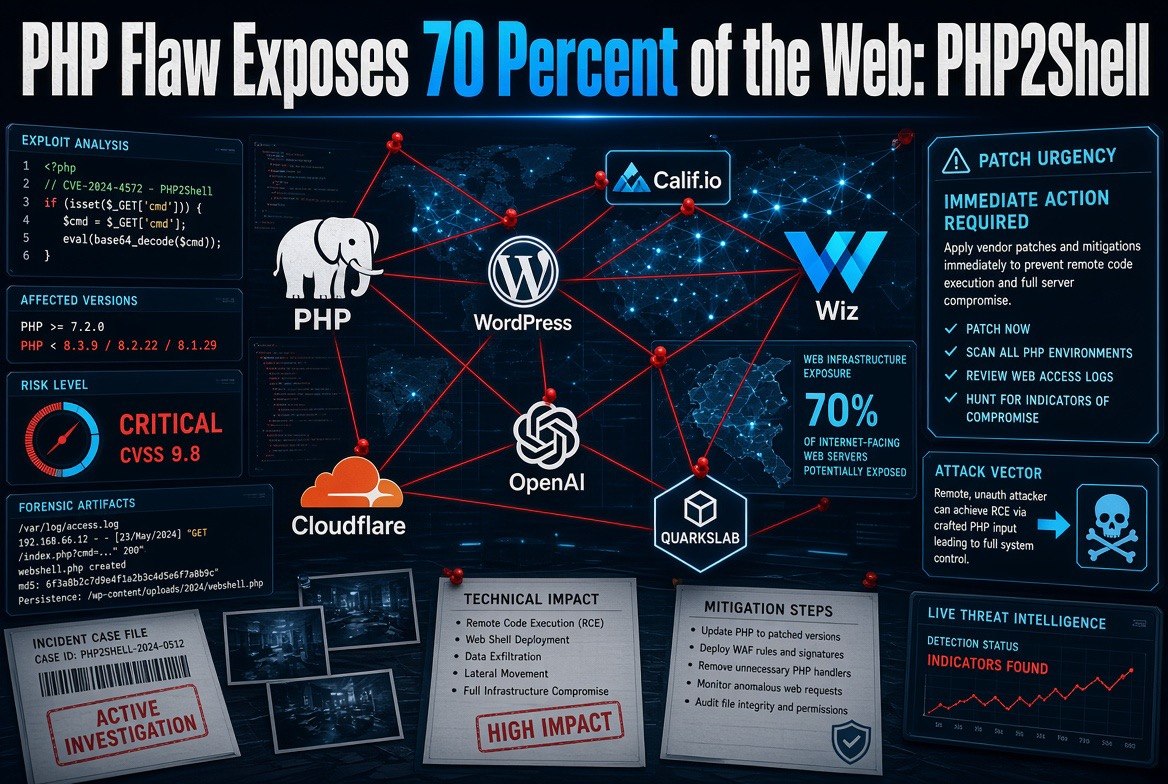
⚡ Expert Summary: Two vulnerabilities in PHP, tracked as CVE-2026-109618 and CVE-2026-109619 and nicknamed php2shell, were disclosed on 21 October 2026 by Calif.io, Wiz, OpenAI and Quarkslab. PHP runs roughly 70% of the web, including WordPress, and the flaw enables remote code execution, meaning an attacker can turn a PHP page into a working shell. Cloudflare confirmed it deployed mitigations before the official release date because the vulnerability leaked early and attack traffic was already hitting its customers. The practical takeaway for a small-business owner: if your site runs on WordPress or any PHP stack, your hosting provider’s patch status is now a business risk, not an IT footnote. The US angle is direct — American small businesses host millions of these sites, and most have no idea which PHP version they are running.
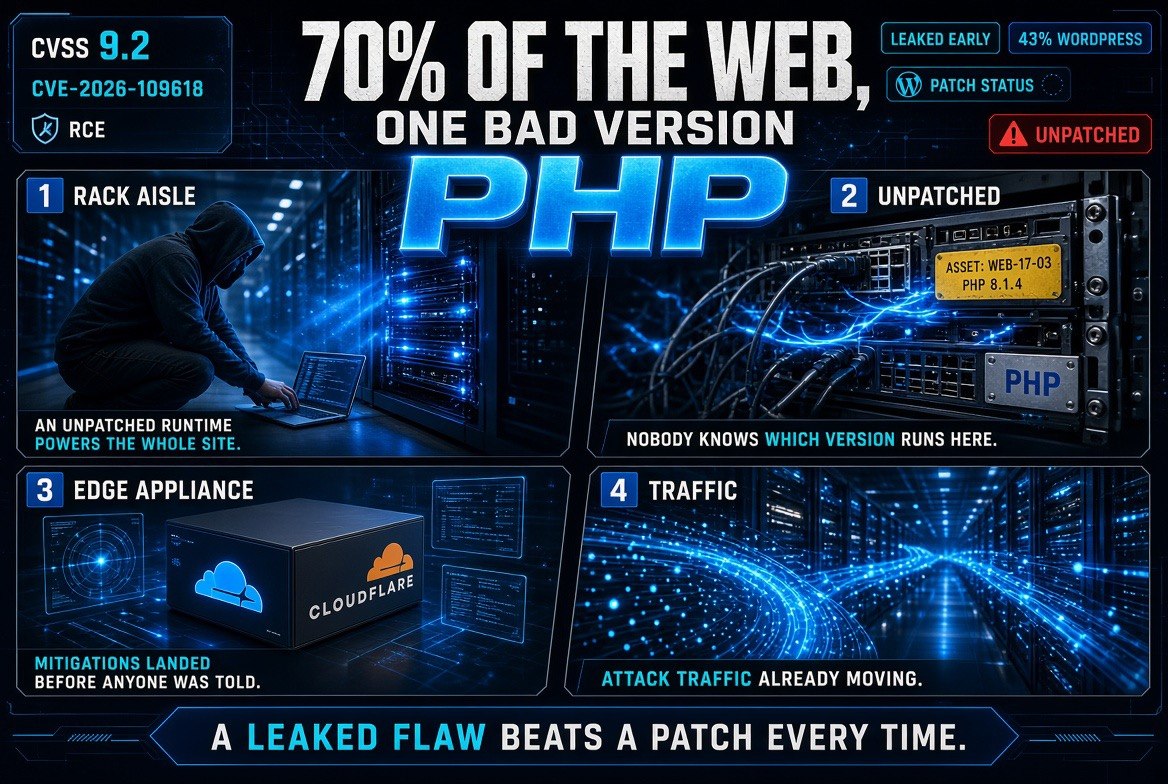
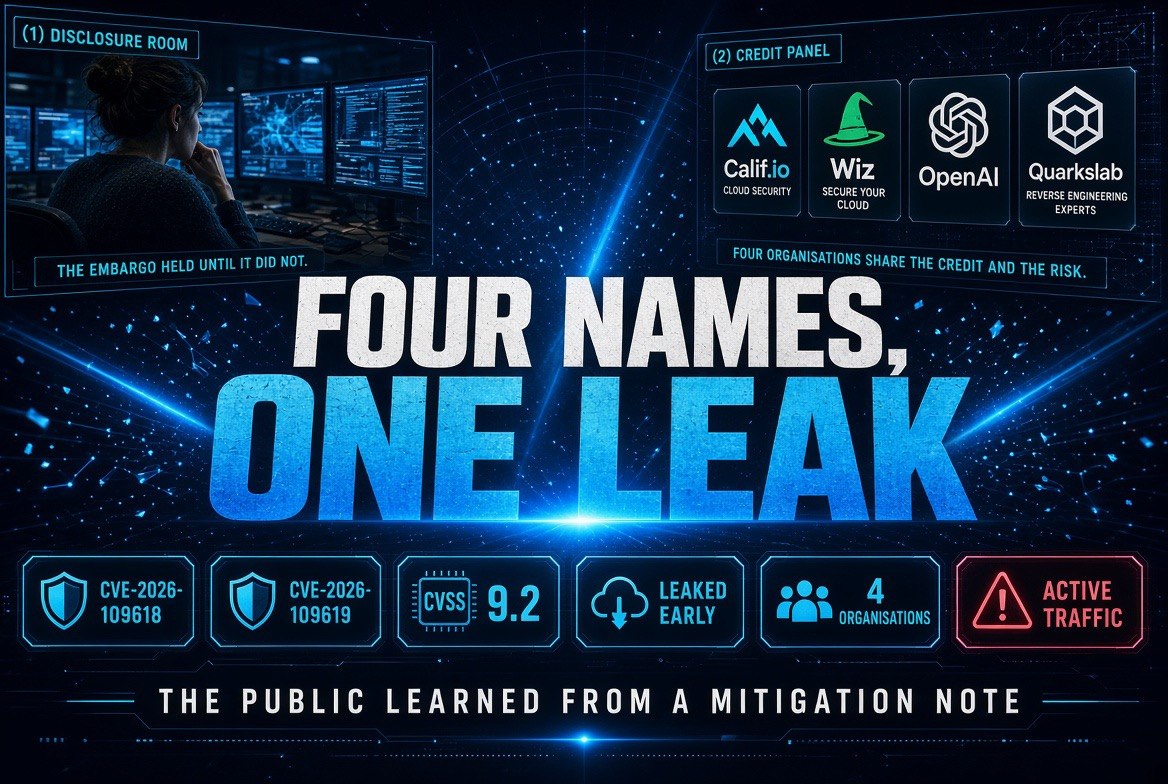
On 21 October 2026, four separate organisations published the same unpleasant news on the same day. Calif.io, Wiz, OpenAI and Quarkslab disclosed two vulnerabilities in PHP — the server-side scripting language that quietly powers most of the internet — and gave them a name that sounds like a band: php2shell.
It is not a band. It is a remote code execution bug in software that runs roughly 70% of the web, with a CVSS score of 9.2 and a working exploit already demonstrated against real targets. If you run a small business in the United States and your website was built on WordPress — as about 43% of the web is — this story is about your storefront.
What Is php2shell and Why Does It Matter to a Small Business
The name is a compression of the outcome: PHP in, shell out. An attacker who can reach the vulnerable code path can get the server to execute commands of their choosing. A shell on a web server means the attacker can read your customer database, install a skimmer on your checkout page, send mail as your domain, or simply encrypt everything and ask for money.
Cloudflare described the mechanics plainly in its own disclosure note, and one line in it matters more than the technical detail:
“Cloudflare successfully deployed multiple mitigations for all its customers while the vulnerability was leaked before the official release date and we observed attack traffic targeting our customers.”
Read that twice. The flaw was leaked before disclosure. Attack traffic was already flowing against Cloudflare customers. So there was a window — hours or days, the company has not specified — in which people who knew about the bug were probing and exploiting sites whose owners had never heard of it.
That is the story. Not the CVE numbers. The fact that something this large got out early, and that the first anyone heard about it was a mitigation deployment note posted after the fact.
The Disclosure Race: Four Names, One Announcement
Security research has a standard courtesy: the finder notifies the vendor, the vendor patches, and everyone announces together on an agreed date. The system is imperfect but it exists because coordinated disclosure protects users.
When four separate organisations are credited on the same disclosure, it usually means the finding was independently reproduced or shared across teams. That is good for confidence in the technical claim and bad for secrecy. Each additional party is an additional place a detail can escape from, and Cloudflare’s note says a detail did escape.
What we know about the participants, insofar as public statements go:
- Calif.io — an AI-native security research firm. It appears first in the credit list on the joint disclosure.
- Wiz — a cloud security vendor with a large enterprise customer base and a well-established research arm. Being on the list gives the finding immediate credibility with CIOs.
- OpenAI — the model company. Its presence is the detail that reframes this as an AI story rather than a routine patch cycle.
- Quarkslab — a French reverse-engineering and offensive security firm with a long record in binary analysis.
An AI lab on the credit line of a PHP memory-safety disclosure is not a coincidence. Security research has become a demonstration ground for model capability, and firms that want to prove their systems can find real bugs have every incentive to find real bugs — and to be seen finding them.
Why an AI Company Is on the Credit Line
Every major model provider now claims its systems can audit code. Those claims are hard to evaluate from a demo. The way to settle it is a disclosure with your name on it, against software that every enterprise already runs.
There is nothing dishonest about that. A real vulnerability found and responsibly disclosed is a public good regardless of the finder’s motive. But the motive shapes the announcement. When a finding is also a marketing asset, the disclosure becomes an event: a coordinated date, a name, a logo lockup, four organisations publishing on the same morning.
And that is exactly the pressure that produces leaks. The more people who know, and the more valuable the knowledge, the harder the embargo is to hold. Cloudflare’s note tells us it did not hold.
The Real Damage: Who Pays When a Disclosure Leaks
Here is the uncomfortable arithmetic of this story. The people who find the bug get credit. The vendors who mitigate it get praised for speed. The users who were exposed during the leak window get the bill.
| Party | What They Get | What They Carry |
|---|---|---|
| Research firms credited | Credit, credibility, a capability proof | Nothing operational |
| Security vendors | Demonstrated value to their customer base | Mitigation load, reputational risk if it fails |
| Hosting providers | A patch cycle they must run at speed | Churn risk when customers leave over it |
| Small-business site owners | A notification, if they are lucky | Breach cost, downtime, lost bookings |
A single compromised WordPress install on shared hosting is not just the owner’s problem. It becomes a spam relay, a phishing host, a launchpad for attacks on the same datacentre. The cost radiates outward from the smallest party in the table above.
What Actually Protects You Now
The honest answer is that most of this is out of your hands, and the part that is in your hands is small but real. Here is the practical sequence, in the order that matters.
1. Find out who patches PHP for you
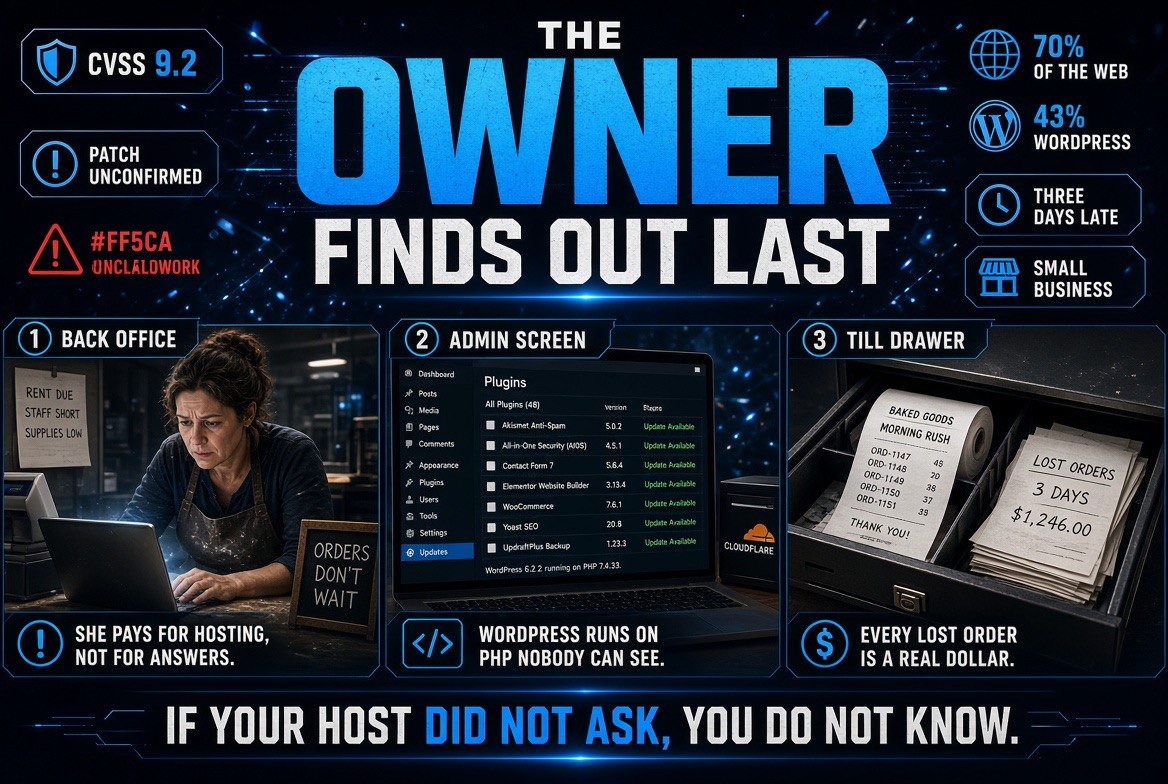
If you pay for managed WordPress hosting, your host patches the runtime. That is the entire value proposition of managed hosting, and this is the week to confirm they actually do it. If you are on a cheap shared plan, ask directly: which PHP version is my site on, and who applies security updates to it?
2. Confirm your PHP version was updated
Hosting dashboards usually show the runtime version. If the number has not moved since before 21 October, the patch has not landed. Ask again, in writing.
3. Check the plugin surface
The PHP flaw is not the only way in. Small-business sites carry a dozen plugins, several of them abandoned. Every abandoned plugin is an unpatched door in the same building. Audit them and remove what you do not use.
4. Put a firewall in front
Cloudflare‘s free tier put mitigations in place before most site owners had read a single headline about php2shell. That is the argument for a reverse proxy in plain terms: someone else’s security team watches the traffic so you do not have to.
5. Back up somewhere the attacker cannot reach
Remote code execution means the attacker can run backup commands too. A backup on the same server is not a backup. If your only copy lives on the host that just got shelled, you have none.
6. Watch for the boring symptoms
Unexpected admin accounts, traffic spikes from one country, mail queue warnings from your host, pages that load slowly for no reason. post-exploitation is usually less dramatic than the movies. It looks like a support ticket nobody opened.
Timeline: What Happened and When
| When | What | What It Meant for Site Owners |
|---|---|---|
| Before 21 Oct 2026 | Vulnerability leaked ahead of the official release date | Attack traffic observed against Cloudflare customers — nobody else knew |
| 21 Oct 2026 | Joint disclosure: CVE-2026-109618 and CVE-2026-109619 | First public warning most owners received |
| 21 Oct 2026 | Cloudflare confirms mitigations were already deployed for all customers | Those behind the proxy were covered before they knew they needed cover |
| Now | Patch rollout in progress across hosts and distributions | Your exposure depends entirely on your host’s speed |
Why “It Only Affects Big Companies” Is Wrong
The instinct after a story like this is to assume the targets were valuable. Banks, hospitals, government portals. Some of them were, and they have teams of people who already know about this.
The better assumption is the opposite. Attackers are economic actors. They scan the whole internet for vulnerable versions, harvest everything reachable, and sort by value later. A small business site is a perfectly good target because there are millions of them, most are unpatched, and the owner’s first notification is usually a customer reporting that the checkout page is asking for card details twice.
There is no such thing as too small to be scanned. Scanning is automated and costs the attacker nothing per site.
What This Means for Small Business Owners in the US
American small businesses run a disproportionate share of the web’s WordPress installs, largely on shared or reseller hosting where the technical layer is invisible to the owner. The practical consequence is that the most exposed segment of the web has the least visibility into its own patching.
Two structural problems make it worse. First, there is no notification channel from a vulnerability database to a small-business owner. The CVE exists; the owner does not know it exists. Second, the person who could fix it — the host — is usually incentivised to keep the site running, not to explain its internals.
The fix is unglamorous. Ask your host direct questions and require direct answers. Move to managed hosting if your current provider cannot name the PHP version they run. And treat “we handle security” as a claim to be verified, not a service to be trusted.
The Bigger Question This Story Leaves Open
php2shell will be patched. In a few weeks the CVSS score will stop being news and the flaw will join the long list of things that are handled. That is how this goes.
The part that will not resolve on its own is the disclosure problem. A vulnerability affecting a majority of the web leaked before its coordinated release date, and the public learned about the leak from the mitigation note rather than from an announcement. Nobody has explained how it escaped, and the parties with the most information have the least incentive to detail the failure.
That is a harder fix than a patch, because a patch is a technical problem and this is an incentive problem. The people racing to be credited with finding a catastrophic flaw are the same people with the most to gain from it being announced loudly. The users exposed in the gap are the only party with no say in the timing.
So the question worth holding onto: if a disclosure can leak, and the leak can be useful to whoever benefits from a dramatic announcement, what stops the next one from being leaked on purpose? Nobody has answered that, and it deserves an answer before the next CVSS 9.2 lands.
Frequently Asked Questions
What is php2shell?
php2shell is the nickname for two vulnerabilities in PHP, tracked as CVE-2026-109618 and CVE-2026-109619, disclosed on 21 October 2026. The name comes from the outcome: an attacker can turn a vulnerable PHP endpoint into a command shell on the server.
Does php2shell affect my WordPress website?
It can. WordPress runs on PHP, so a vulnerable PHP runtime under a WordPress install is exposed. Whether you are affected depends on whether your host has applied the patch, so ask your hosting provider directly which PHP version you are on and when it was updated.
How serious is CVE-2026-109618?
The flaw carries a CVSS score of 9.2, which falls in the critical range. Because PHP powers roughly 70% of the web, the exposed population is enormous, and a working exploit has already been demonstrated.
Who found php2shell?
Calif.io, Wiz, OpenAI and Quarkslab are credited on the joint disclosure published on 21 October 2026.
Was php2shell leaked before the official announcement?
Yes. Cloudflare stated in its disclosure note that it deployed mitigations while the vulnerability was leaked before the official release date, and that it observed attack traffic targeting its customers.
What should a small business do right now?
Confirm your host has patched PHP, remove plugins you do not use, put a firewall or reverse proxy in front of the site, and keep an off-server backup. Those four steps cover most of the practical exposure.

About Barak Schurr
Barak Schurr built and sold a major ticketing platform, ran global nightlife operations at Eventbrite, and now spends his time figuring out which AI tools actually move the needle for independent business owners — and which ones are just noise. No hype. No fluff. Just what works.
Email: [email protected]
More AI Resources for Your Business