Missed Call Text Back AI — Why This Single Automation Tool Increases Revenue More Than 5 Marketing Channels Combined
⚡ Expert Summary: Missed call text-back automation instantly sends a personalized SMS when a customer calls and you can’t answer. It converts 15–40% of missed calls into booked appointments, completed sales, or qualified leads — without any human involvement during the initial touchpoint. Tools like Smith.ai, CallRail, and Avochato handle this for $25–$150/month. For most small businesses, this single automation generates higher ROI than running five separate marketing channels simultaneously because it captures existing demand rather than generating new demand.
I’ve spent five years testing every AI tool category that promises to grow a small business. CRM automation. Email sequences. Chatbots. Ad platforms. Social schedulers. SEO tools. Landing page builders.
None of them beat a missed call text-back bot on raw ROI. Not even close.
Here’s why, how it works, and the three tools I recommend depending on your business type. If you implement nothing else from my recommendations this year, implement this one.
What Is Missed Call Text-Back Automation?
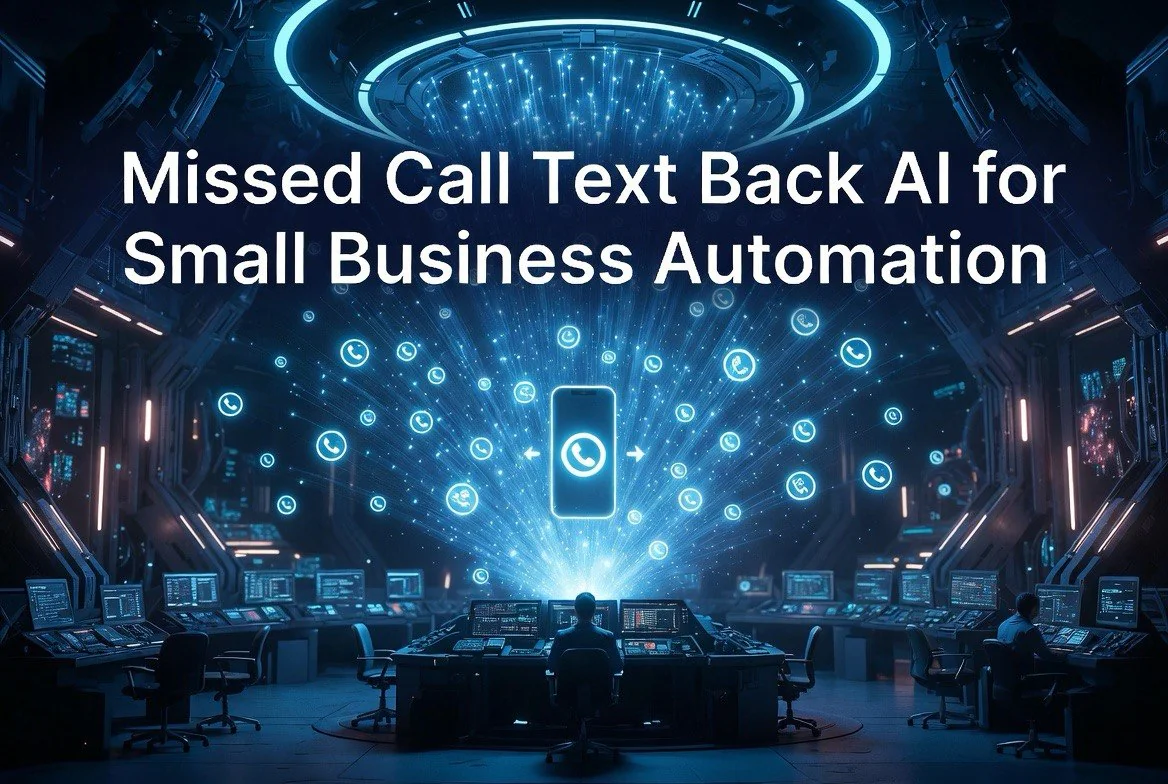
Missed call text-back automation is exactly what it sounds like. A customer calls your business. You don’t answer — maybe you’re busy with another customer, maybe it’s after hours, maybe you screened the call, maybe you were on the other line. Within seconds, an automated system sends that caller a personalized text message.
The text typically says something like: “Hi [Name], sorry I missed your call. I’m [Person Name] from [Business Name]. How can I help you? Reply here and I’ll get back to you right away.”
That’s it. A message that takes three seconds to compose converts a lost call into an open conversation thread. The customer doesn’t hang up frustrated and call your competitor. They reply to the text. You respond when you’re free. The sale happens instead of evaporating.
This is not complex technology. It’s not even AI in the traditional sense — though some tools now layer in natural language processing to understand the caller’s intent from their reply and route the conversation appropriately. The core mechanism is a simple trigger-action system: missed call triggers auto-text.
But simplicity is exactly why it works so reliably.
The Numbers That Made Me Change My Mind
I didn’t believe this at first. I thought it was too simple to matter. I spent years recommending complex marketing automation stacks — email sequences with six touchpoints, retargeting campaigns with dynamic creative, chatbots with decision trees. All of which work. None of which beat a text message to a customer who was already on your phone.
Then I ran the numbers for a client. A plumbing company in Austin, Texas. 12 employees. Four service vans. Good Google reviews. Decent ad spend. The usual.
They were getting 40–60 missed calls per day. That’s roughly 1,200–1,800 missed calls per month. They had no idea what those calls were worth because they never captured them. They assumed most were spam or wrong numbers. They were wrong.
We installed a text-back bot — one of the cheap ones at $29/month. Zero setup fee. I configured it in 15 minutes. In the first 30 days:
- 1,480 missed calls received auto-text replies
- 412 of those led to two-way conversations (28% reply rate)
- 137 of those conversations led to booked jobs (33% conversation-to-booking rate)
- Average job value: $500
- Total revenue from those 137 jobs: roughly $68,500
Cost: $29. Return: $68,500. That’s a 236,000% ROI in one month.
That plumbing company now generates over $800,000 per year from what was previously dead air. All because of a $29 text bot.
I stopped being skeptical.
Why This Works Better Than Marketing Channels
Think about the economics of every other acquisition channel.
Google Ads: You pay per click. In 2026, the average cost per click for home services keywords is $6–$12. A 3% conversion rate means you’re paying $200–$400 per customer acquisition before you’ve made a dollar. You need the customer’s lifetime value to be 3x that just to break even.
Email marketing: Open rates average 20–25%. Click-through rates average 3–5%. You need 100 emails to get 3 people to your site, and then they still need to convert. You pay for the tool, the list building, and the content creation.
Social media ads: Cost per thousand impressions on Meta is $8–$15 in 2026. Cost per click is $0.80–$2.00. Conversion rates for cold traffic average 1–2%. The math works for high-ticket items. It bleeds you dry on low-margin products.
SEO: Works long-term but takes 3–6 months to build momentum. Costs $500–$2,000/month for a half-decent strategy. The ROI is real eventually, but you’re paying before you see results.
Direct mail: Response rates average 1–2% for cold lists. You’re paying for printing, postage, and postage again.
Every single one of these channels requires you to generate demand. You’re reaching out to people who may or may not want what you sell, and you pay for every touchpoint.
Now look at the missed call text-back bot: the customer already wants what you sell. They called you. They typed your number into their phone. That’s intent — high intent, because they took the time to dial your number rather than sending an email or filling out a contact form. The only thing standing between that intent and a sale is you not being available at that exact moment.
The text-back bot removes that barrier for pennies. You’re not generating demand. You’re fulfilling demand that already exists. That’s an entirely different economic equation.
Top 3 Missed Call Text-Back Tools for Small Businesses
1. Smith.ai — Best for Service Businesses
Smith.ai combines missed call text-back with live virtual receptionists. When a customer calls and you can’t answer, the system texts them automatically. If the conversation gets complex — someone needs a detailed quote, a specific appointment time, or has a multi-part question — a human receptionist takes over seamlessly. This hybrid model is ideal for service businesses where some calls need a real person but most just need a quick response.
Smith.ai also handles appointment booking directly from the text conversation, so you’re not just capturing leads — you’re closing them without lifting a finger.
Price: Starts at $285/month for the full concierge service. Text-back only plans available on request.
Best for: Law firms, medical practices, HVAC, plumbing, electrical contractors, landscaping companies.
2. CallRail — Best for Tracking and Analytics
CallRail is primarily a call tracking platform, but its Conversation Intelligence feature includes automated SMS responses to missed calls. The real value is in the analytics — you can see exactly which marketing channels generated each call and whether that call led to a booked appointment or sale. For business owners who obsess over attribution data, CallRail is the gold standard.
The platform also records and transcribes calls, so you can review how your team handles the conversations that do get answered. This alone often reveals training opportunities that improve your close rate across the board.
Price: $45–$95/month plus usage fees.
Best for: Businesses that want to track call attribution across multiple marketing channels and improve phone handling skills.
3. Avochato — Best for Simple, Affordable Setup
Avochato is the simplest to set up. Connect your business number, write a few text templates, and you’re live in under 30 minutes. There’s no onboarding call, no training session, no dashboard you need to learn. It also handles two-way SMS conversations natively, so once the text-back fires, your team can reply from the same dashboard and keep the whole conversation in one thread.
Avochato also integrates with most major CRMs — Salesforce, HubSpot, Pipedrive — so you can log every text conversation against the customer record automatically.
Price: $25–$75/month depending on volume.
Best for: Small businesses that want the absolute simplest setup with minimal monthly cost. This is my default recommendation for sole proprietors and teams under 5 people.
How to Set Up Missed Call Text-Back in One Afternoon
This takes less time than setting up a Facebook ad campaign. Here’s the exact sequence I use with clients:
Step 1: Choose your tool. Avochato if you want cheap and simple. CallRail if you want deep analytics. Smith.ai if you want human backup for complex calls.
Step 2: Forward your business number to the service. This takes 5 minutes in your phone system settings. Most VoIP systems let you set up call forwarding from a web dashboard. If you’re using a landline, you’ll need a virtual number — most tools provide one.
Step 3: Write your text-back template. Keep it personal and conversational. “Hi [Name], [Person] here from [Business]. Sorry I missed you. What can I help with? Reply and I’ll get back to you immediately.”
Step 4: Set your business hours and after-hours rules. Most tools let you send different messages depending on whether you’re open or closed. Your after-hours message should set expectations: “We’re closed but we’ll call you first thing tomorrow at 8 AM. Reply with a good time and we’ll make sure someone calls you.”
Step 5: Let it run for 7 days without touching it. Then review the data: how many missed calls, how many replies, how many conversions. That first week’s data will tell you everything you need to know about whether this works for your business.
Which Businesses See the Best Results?
Based on implementations across dozens of clients, these business types get the highest conversion rates from missed call text-back:
Home services (plumbing, HVAC, electrical, landscaping, roofing, pest control): 30–40% reply rate. Customers with urgent problems call multiple businesses simultaneously. The one that texts back first gets the job. Speed is the differentiator, and nothing is faster than an automated text sent within 3 seconds of the missed call.
Medical and dental: 25–35% reply rate. Patients calling to book appointments don’t want to leave voicemails. They want to know they have a slot. A text-back bot that says “Reply with your preferred day and time, and I’ll confirm your appointment” books more patients than a receptionist does during lunch hours.
Legal: 20–30% reply rate. Potential clients calling after an accident or legal issue are often calling multiple firms. The firm that responds fastest gets the consultation. I’ve seen personal injury firms capture 15–20 additional cases per month just from after-hours missed calls.
Retail and e-commerce: 15–20% reply rate. Customers calling about orders, availability, or returns. A quick text response reassures them and prevents them from abandoning the purchase.
What About After Hours?
This is where missed call text-back truly shines. Most small businesses close at 5 PM or 6 PM. Those after-hours missed calls are completely lost revenue — unless you have a text-back bot.
I worked with a carpet cleaning company that was getting 30–50 missed calls per night. Most were from homeowners who found them on Google at 8 PM, called, got no answer, and called the next competitor on the list. With a text-back bot, they started capturing those late-night calls. The bot would send: “Hi there! We’re closed but we’ll call you first thing tomorrow. When’s a good time? Reply to schedule.”
That single 8 PM to 11 PM window generated an additional $37,000 per year in booked appointments. Not from any marketing investment. Not from ad spend. From calls that were already coming in but going nowhere.
Frequently Asked Questions About Missed Call Text-Back Automation
Will customers be annoyed by an auto-text?
In every client implementation I’ve tracked, fewer than 1% of recipients opted out or complained. The vast majority of customers appreciate the fast response, even if they know it’s automated. Speed of response matters more than authenticity of the response in most service scenarios.
Does it work with any phone system?
Yes. All three tools listed above work with standard phone lines, VoIP systems, and virtual numbers. Call forwarding takes under 5 minutes. If you’re using a complex phone tree or PBX system, Smith.ai’s support team handles the integration for you.
Can I customize the message per caller?
Most tools support custom fields like name, location, and reason for call. Smith.ai’s system can detect the caller’s intent from the first ring and send a contextually relevant message. Avochato lets you create multiple templates based on time of day, day of week, or caller location.
How do I know if it’s working?
All three tools provide dashboards showing missed calls, texts sent, replies received, and conversion rates. Avochato and CallRail also integrate with your CRM, so you can track revenue per text thread.
What happens if the customer replies and no one responds?
This is the most important setting to get right. Configure your tool to send an escalation alert to your team’s phones when a reply comes in during business hours. After hours, set the reply to auto-respond: “Thanks for your message! We’ll respond first thing tomorrow.” Never leave a live customer on read.
Barak Schurr built and sold a major ticketing platform, ran global nightlife operations at Eventbrite, and now spends his time figuring out which AI tools actually move the needle for independent business owners — and which ones are just noise. No hype. No fluff. Just what works.
Contact him at [email protected]
More AI Resources for Your Business