Get The Solo Business OS — Free
The AI workflow that replaces a part-time employee for solo operators and small business owners.
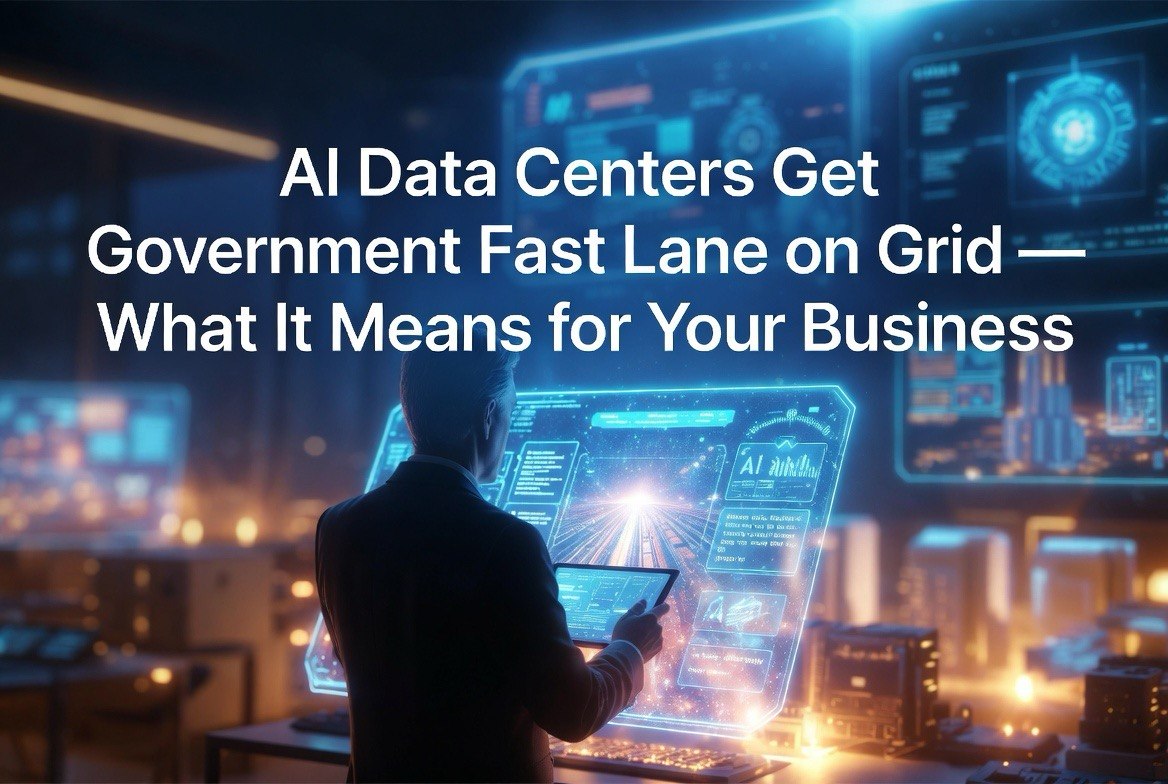
AI Data Centers Just Got a Government Fast Lane to the Grid — What It Means for Your Business Tools
⚡ Expert Summary: The U.S. government just mandated priority grid access for AI data centers through new federal policy, treating them as critical infrastructure. For small business owners using AI tools, this means more reliable access to the SaaS platforms you depend on — but potential rate increases downstream as energy costs get passed through. The policy signals that AI is no longer experimental; it’s essential infrastructure that the government is betting the grid on.
The Grid Just Got a New VIP Lane — and AI Is Driving It
On June 18, 2026, the U.S. government announced sweeping new regulations that give AI data centers priority access to the electrical grid. The policy classifies data centers powering AI workloads as “critical national infrastructure,” fast-tracking their interconnection requests and guaranteeing minimum power allocations even during peak demand periods.
For most small business owners, “grid interconnection” sounds like utility jargon. Here’s what it actually means: right now, data centers compete with hospitals, factories, and residential neighborhoods for the same electricity. When a new data center wants to plug into the grid, it can wait 3-5 years for interconnection approval. Under the new rules, AI data centers skip that line.
That matters because every AI tool you use — ChatGPT, Claude, Midjourney, the AI features inside your CRM, your email platform’s smart compose, your accounting software’s automated categorization, the video generation tools creating your marketing content — runs on computing power inside those data centers. If the data centers can’t get power, your AI tools slow down, get unreliable, or become more expensive as providers scramble for scarce compute.
The government’s calculation is straightforward: AI is becoming economically strategic on the level of semiconductor manufacturing and defense technology. If the United States wants to lead in AI, the infrastructure supporting it needs government-backed priority access. The policy essentially declares that AI compute is too important to leave to market forces alone when it comes to grid access.
How We Got Here: From Experimental Technology to Grid Priority
To understand why the government stepped in, it helps to trace the trajectory. In 2022, AI data centers were a niche category in utility planning. By 2025, AI workloads had become the primary driver of new data center construction in the United States. The Energy Information Administration (EIA) reported that in 2025 alone, data center electricity consumption grew 28% year-over-year, with AI workloads accounting for roughly two-thirds of that growth.
The breaking point came when utilities in Northern Virginia — the world’s largest data center market — began rejecting new interconnection requests because the local grid simply couldn’t handle the load. Dominion Energy, the primary utility serving that region, told regulators in early 2026 that it had a backlog of over 30 gigawatts in data center interconnection requests, the vast majority driven by AI compute. Thirty gigawatts is roughly equivalent to adding 30 coal-fired power plants’ worth of demand to a single grid region.
That backlog triggered a cascade of problems. AI companies couldn’t build new compute capacity. Cloud providers couldn’t fulfill customer contracts. And the bottleneck was entirely on the grid side — the data centers themselves were ready to build, but they couldn’t get permission to plug in.
The Numbers Behind the Policy: Why AI’s Energy Appetite Broke the Status Quo
The scale of AI’s energy demand forced the government’s hand. According to the International Energy Agency (IEA), global electricity consumption from data centers could reach 1,000 terawatt-hours by 2027 — roughly the entire electricity consumption of Japan. The agency attributes roughly 80% of that growth to AI workloads.
Key data points driving the policy:
– A single ChatGPT query consumes approximately 10x the electricity of a standard Google search, according to estimates from the Electric Power Research Institute
– Training a frontier AI model like GPT-5 or Claude-4 can consume as much electricity as 130 U.S. homes use in a year
– Goldman Sachs projects that data center power demand in the United States will grow 160% by 2030
– The North American Electric Reliability Corporation (NERC) warned in late 2025 that data center growth could strain grid reliability in 15 U.S. regions within 3 years without policy intervention
How the Policy Actually Works: Priority Classification in Practice
The new federal framework introduces a tiered classification system for data center interconnections. AI data centers that meet specific criteria — minimum compute density thresholds, demonstrated uptime requirements, and certification from the Department of Energy — qualify for Class A interconnection status. Class A facilities are fast-tracked through utility review processes, guaranteed minimum power allocations, and given priority during load-shedding events.
The policy also requires utilities to file AI-specific grid capacity plans with FERC, detailing how they will accommodate projected AI data center growth over 5-year and 10-year horizons. This planning requirement is arguably the most consequential part of the policy. For the first time, utilities must explicitly forecast and plan for AI-driven demand rather than treating it as a generic commercial load category.
Critically, the policy doesn’t exempt AI data centers from paying for their grid connections. The priority lane comes with a premium: Class A facilities pay accelerated interconnection fees designed to recover the cost of grid upgrades faster. Those fees are priced into the colocation and cloud compute contracts that AI companies buy, which means they eventually flow down to small business subscribers.
The new policy didn’t emerge from nowhere. In 2025, several major tech companies — including Amazon, Google, and Microsoft — began negotiating directly with utilities for dedicated power allocations, bypassing standard interconnection queues. The Federal Energy Regulatory Commission (FERC) recognized that the ad-hoc approach was creating an uneven playing field and threatening grid stability. The new rules create a standardized priority lane rather than letting the biggest companies cut their own private deals.
“This is the first major recognition that AI compute has joined hospitals, military installations, and emergency services as a category of load that receives priority grid treatment,” wrote energy analyst Clara Montgomery in a research note following the announcement.
What This Means for Your AI Tool Costs and Reliability
If you’re running a business using AI tools daily, here’s what changes and what doesn’t.
Short-term positive: The AI services you subscribe to — ChatGPT Plus, Claude Pro, Midjourney, Canva AI, your video generation subscription, your AI-powered email and CRM tools — should become more reliable. Providers like OpenAI, Anthropic, Adobe, and Google have been quietly warning that compute constraints could force service limitations during peak hours. The grid priority policy removes that bottleneck. For small business owners running marketing campaigns, generating content, or processing customer data through AI pipelines, the immediate effect is stability.
Medium-term cost pressure: The policy doesn’t address who pays for the grid upgrades. AI data centers getting priority access means utilities will need to build transmission capacity faster. Those costs get recovered through rate increases spread across all commercial customers. Small businesses could see electricity rate increases of 3-8% over the next 24 months as utilities recover the cost of infrastructure built to serve AI data center demand, according to preliminary analysis from the Edison Electric Institute.
Geographic shifts: The policy creates incentives for data centers to locate in regions with excess grid capacity. That could mean more AI compute infrastructure in the Midwest and South, where grid capacity currently exceeds demand. For business owners, this could eventually translate to regional pricing differences in AI services — a pattern already emerging in cloud computing.
How AI Companies Are Responding
Major AI providers have responded predictably. OpenAI’s statement called the policy “a necessary step to secure America’s AI leadership.” Google’s cloud division noted that “reliable, clean power is the foundation of useful AI.”
But the real action is happening behind the scenes. Meta and Microsoft have both announced plans to co-locate AI data centers at existing power plant sites — effectively building compute clusters directly at the source of generation to bypass grid constraints entirely. Amazon Web Services is reportedly negotiating with small modular reactor (SMR) developers to power future AI data centers with nuclear energy.
For small business owners, the takeaway is that AI infrastructure is being treated as strategically critical at the highest levels of government. That’s a strong signal that the AI tools you’re building your business around aren’t going away. But it also signals that AI is entering a phase where infrastructure costs — energy, transmission, cooling — will increasingly be passed down the stack to end users.
What Business Owners Should Watch Over the Next 12 Months
The policy creates a predictable set of developments that will affect how you buy and use AI tools:
1. AI pricing will decouple from model improvements. Right now, AI subscription prices are mostly driven by model development costs. As energy and infrastructure costs grow as a percentage of total operating expenses, expect providers to introduce separate infrastructure fees, tiered pricing based on compute usage, or regional pricing based on local energy costs.
2. Long-term contracts will become more attractive. If grid priority guarantees stable compute access, AI providers will have more confidence in their ability to deliver consistent service. That stability makes annual contracts more appealing. Some providers may offer discounts for 12-month commitments similar to how cloud providers price reserved instances.
3. Carbon-aware AI scheduling may become a feature. Several providers are already experimenting with running non-urgent AI tasks during periods of renewable energy abundance. Business owners who can tolerate delayed batch processing (content generation, data analysis, report generation) may see cost advantages from flexible scheduling.
4. The energy story will become part of AI brand positioning. Expect AI providers to differentiate on energy efficiency — advertising how many queries per kilowatt-hour their models can deliver. For small business buyers, this creates a new evaluation criterion when choosing between AI tools: it’s not just which model performs better, but which one delivers that performance more efficiently.
The Bottom Line for Small Business Owners
The new grid priority policy for AI data centers is one of those government actions that doesn’t make headlines but quietly reshapes an entire industry. For small business owners, it removes one of the biggest existential risks facing AI tools: that infrastructure constraints would make them unreliable or unaffordable at scale.
The new normal is that AI compute gets priority treatment on the grid. That’s good for reliability. But the cost of building that priority lane will eventually show up in your subscription bills. The smart play is to lock in annual subscriptions where possible, evaluate AI tools on energy efficiency as well as output quality, and expect infrastructure costs to become a visible line item in your AI spending within the next 18 months.
The policy also signals something deeper about where AI is heading as an industry. When the government treats your infrastructure like highways and hospitals, AI has officially moved from optional productivity tool to essential utility. The question for small business owners is no longer whether AI is here to stay. It’s how much of your operating budget you’re willing to commit to the infrastructure that powers it.
Frequently Asked Questions
What does the AI data center grid priority policy actually do?
It classifies AI data centers as critical national infrastructure, giving them priority access to the electrical grid for interconnection requests. This means AI data centers get faster approval to connect to the grid and guaranteed minimum power allocations, even during peak demand periods.
Will my AI subscription costs increase because of this policy?
Indirectly, yes. Utilities will recover the cost of grid upgrades through rate increases. Small businesses could see electricity rate increases of 3-8% over 24 months. AI providers may also pass through infrastructure costs as separate fees or tiered pricing.
Will my AI tools become more reliable with grid priority for data centers?
In the short term, yes. The policy removes one of the biggest bottlenecks for AI service providers. Tools like ChatGPT, Claude, Midjourney, and Adobe’s AI features should see more stable performance and fewer service interruptions. Without this policy, some providers warned they might need to limit services during peak usage.
How much energy do AI data centers actually use?
The International Energy Agency projects global data center electricity consumption could reach 1,000 terawatt-hours by 2027 — roughly Japan’s total electricity usage. A single ChatGPT query uses about 10x the energy of a standard Google search. Training a large AI model can consume as much electricity as 130 homes use in a year.
Should I switch which AI tools I use because of energy costs?
Not immediately, but energy efficiency should become a criterion in your evaluation process. Some providers are more efficient than others. Over the next 12-18 months, expect AI brands to differentiate on how many queries they can serve per kilowatt-hour, and that efficiency advantage may translate to pricing advantages.