Get The Solo Business OS — Free
The AI workflow that replaces a part-time employee for solo operators and small business owners.
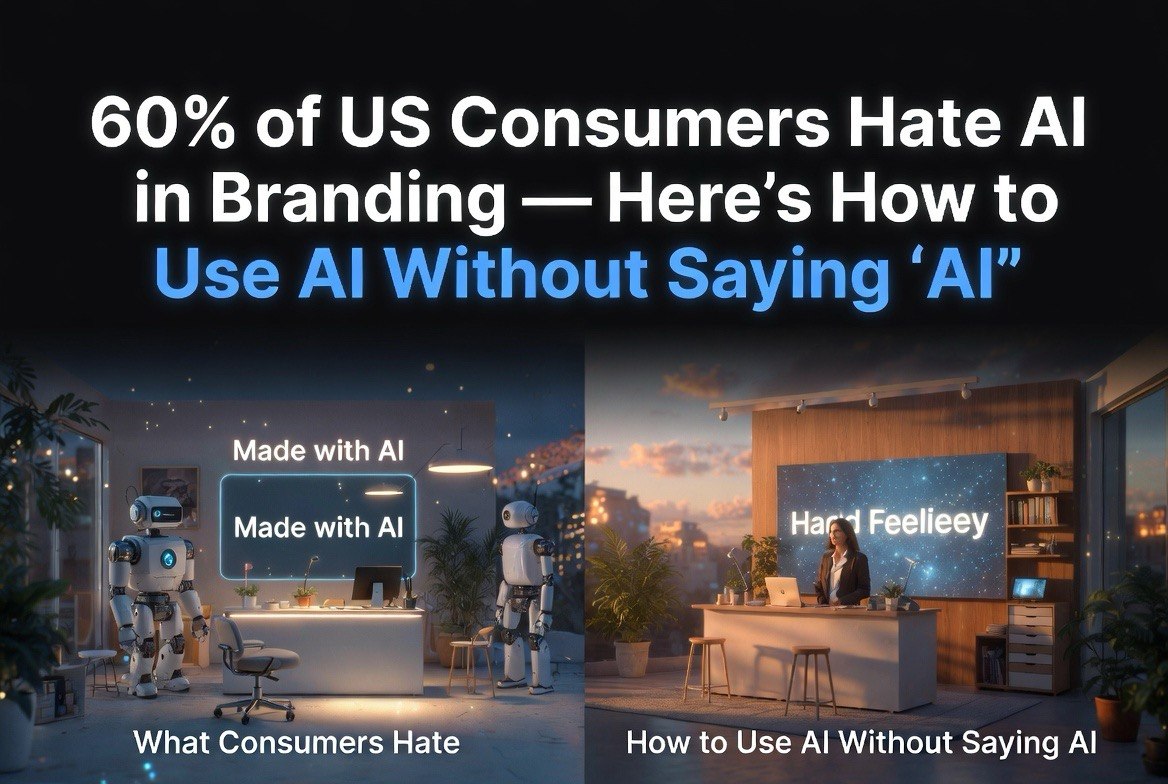
60% of US Consumers Hate ‘AI’ in Branding — Here’s How to Use AI Without Saying AI
⚡ Expert Summary: A new WordPress VIP survey found that 60% of American consumers say brands using “AI” in their messaging is a turnoff, and 86% don’t fully trust AI-generated answers without seeing original sources. For small business owners, this creates a paradox: AI tools can dramatically improve your operations, but advertising that fact actively hurts your brand. Here’s how to leverage AI without turning customers off.
The AI Branding Trap
WordPress VIP’s 2026 “Future of the Web” report dropped a number that should make every business owner stop and think. Sixty percent of US consumers say that brands using “AI” in their messaging is a turnoff. Not a minor annoyance — an actual negative signal that makes them less likely to engage with your brand.
The data gets worse. Forty-two percent of consumers said they trust AI-generated answers without clear attribution less than they trust airline fees, confusing privacy policies, and medical bills. That’s the company AI keeps in the consumer trust hierarchy.
Nearly three in four respondents said the internet feels “less human” than it did 10 years ago. That perception isn’t random — it’s a direct response to the flood of AI-generated content, generic chatbot responses, and hollow “AI-powered” claims that have saturated every industry.
For small business owners, the lesson is painful but clear: the AI arms race is hurting your brand, not helping it. Every competitor slapping “AI-powered” on their website is actively training customers to distrust that label.
Why “AI” Became a Dirty Word
The word “AI” hasn’t always been a turnoff. Two years ago, it was a signal of innovation. Companies proudly announced they were using AI, and customers interpreted that as cutting-edge service.
What changed? The market flooded. Every SaaS product, every agency, every freelancer started claiming AI capabilities. AI writing, AI design, AI customer service, AI email marketing, AI bookkeeping. The term became meaningless — and worse, it became a red flag for low quality.
Customers have learned that “AI-powered” often means “a generic chatbot that can’t solve your problem.” They’ve received enough robotic responses and hallucinated answers to associate AI with unreliable, impersonal service. The technology is genuinely powerful, but the marketing has poisoned the well.
The Contradiction Consumers Are Missing
Here is the irony consumers don’t see: they actually trust AI-powered search results. The same WordPress VIP survey found that consumers trust AI search citations more than they trust companies advertising “AI-powered” products. People want AI to help them find information — they just don’t want businesses to tell them they’re using it.
This is the same dynamic that plays out in cooking. Diners want great food, and they’re happy if a chef uses a sous vide machine. But they don’t want the menu to say “sous vide steak.” They just want the steak to be good.
Five Ways to Use AI Without Mentioning It
1. Improve Your Customer Service — Silently
AI-powered customer service tools have gotten dramatically better. Modern systems can handle 70-80% of routine inquiries without human intervention. They respond instantly, 24/7, and escalate complex issues to human staff.
The right approach: implement the AI, train it on your specific products and policies, and let your customers experience faster service. Don’t put “AI-powered support” anywhere on your site. Just deliver faster, better responses. Your customers will notice the improvement, not the technology behind it.
2. Automate Internal Operations
The best place to use AI is where customers never see it. Automate your inventory management, email filtering, appointment scheduling, report generation, and data entry. These are high-value use cases that save hours per day.
Your customers don’t care how you manage your inventory. They care that their order ships on time. Use AI to make that happen reliably, and keep the implementation details to yourself.
3. Generate Ideas — Not Final Content
AI is excellent for brainstorming. Use it to generate content ideas, email subject lines, social media hooks, and campaign concepts. But the final product should pass through a human who removes the AI fingerprints.
Readers can spot AI-generated content. The WordPress VIP data confirms 86% of consumers want original sources. If you publish AI-generated blog posts without editing, you’re training your audience to distrust your entire site. Use AI as a thought partner, not a writer.
4. Personalize Without Creeping Out Your Customers
AI-driven personalization is one of the most powerful tools in marketing. Dynamic content, product recommendations, and personalized email sequences all increase conversion rates significantly.
The key: personalize the experience, not the messaging. Don’t say “We used AI to find these recommendations for you.” Just show better recommendations. Don’t mention the algorithm — let the relevance speak for itself.
5. Use AI for Data Analysis, Then Present Human Insights
AI can analyze customer data, sales trends, and market shifts faster than any human team. Use it to find patterns, identify opportunities, and flag problems.
But present those findings in a human voice. “Our data shows customers who buy X are 40% more likely to need Y” is fine whether or not an AI found that correlation. The insight matters, not the process that discovered it.
What to Say Instead of “AI-Powered”
| Don’t Say | Say Instead |
|---|---|
| “AI-powered customer service” | “Get answers instantly, 24/7” |
| “Our AI recommends” | “Based on what our customers love” |
| “AI-generated content” | “Researched and written by our team” |
| “AI inventory management” | “Always in stock, always on time” |
| “AI-powered marketing” | “Relevant offers, no spam” |
Notice the pattern. The “say instead” column focuses entirely on customer outcomes. Nobody cares about your technology stack. They care about faster service, better recommendations, and reliable delivery.
Why the Numbers Are Worse for Small Businesses
The 60% figure is a survey average. For small businesses, the penalty for using “AI” language is likely higher. Large brands have established trust that buffers them against messaging mistakes. Small businesses don’t have that luxury.
When a customer sees a local bakery advertise “AI-powered pastry selection,” they don’t think innovation. They think “the owner is cutting corners.” When a boutique hotel says “AI-enhanced guest experience,” guests picture a chatbot instead of a front desk person.
Small businesses win on personal connection. That’s your competitive advantage against chains and big-box stores. Every time you insert “AI” into your marketing, you undercut that advantage.
A 2025 study by the National Federation of Independent Business found that 72% of consumers prefer buying from small businesses because of personalized service. If your marketing sounds like a technology press release, you lose exactly what makes you different.
Real Examples: Brands That Get It Right
Some of the most successful American businesses are quietly using AI while never mentioning it. Domino’s uses AI for order prediction and delivery route optimization. You never see “AI-powered pizza” in their ads. You see “30-minute delivery” and “track your order.”
Amazon uses AI for product recommendations, inventory management, and warehouse robotics. Their marketing says “Customers who bought this also bought” — not “Our AI algorithm recommends.” The technology is invisible, and the customer experience is seamless.
Your local coffee shop can do the same thing. Use AI to predict which pastries will sell out on Saturday morning and bake accordingly. Customers experience fresh pastries and shorter lines. They don’t need to know an AI model analyzed last month’s sales patterns.
The pattern is consistent across every industry. The best AI implementation is the one customers never notice.
The Cost of Getting It Wrong
Some companies have learned this lesson the hard way. When a fast-food chain rolled out AI-powered drive-through ordering in 2024, the press releases highlighted the technology. Customers immediately found edge cases — wrong orders, confused responses, robotic interactions. The AI was technically impressive, but the branding made it a target.
When the same chain scaled back the program and removed “AI” from the messaging, the backlash stopped. The technology is still in use behind the scenes, but the marketing focuses on speed and accuracy.
Chegg, the education company, lost 70% of its market value after investors and customers reacted negatively to its AI pivot. The problem wasn’t the AI. It was the messaging. “AI-powered tutoring” didn’t inspire confidence.
The Long-Term Strategy
The “AI” backlash is likely to intensify before it improves. As more consumers learn to identify AI-generated content, trust will continue to shift toward brands that sound human.
The smart long-term play for small businesses is simple: use every AI tool you can get your hands on to improve your operations, your marketing, and your customer experience. But filter everything through a human voice and don’t lead with the technology.
This is the same principle that successful businesses have always followed. Customers don’t buy technology — they buy outcomes. The restaurant that advertises “AI-optimized kitchen workflow” sounds ridiculous. The restaurant that serves better food faster with fewer errors is successful. The technology is invisible.
Build your AI advantage where it counts. Let your competitors shout “AI-powered” from the rooftops while delivering mediocre results. You’ll be too busy outperforming them to join the noise.
How to Audit Your Current Marketing for AI Language
Take 30 minutes this week to review your website, email templates, social media bios, and any customer-facing materials. Search for the word “AI” in every piece of marketing. For each instance, ask: does mentioning AI help the customer make a decision or does it make you sound generic?
Check your email signature — many email marketing tools auto-append “Sent with AI-powered [platform name]”. Turn that off.
Review your chatbot greeting. If it says “Hi, I’m an AI assistant,” change it to “Hi, I’m here to help.” Your customers care about getting help, not about the technology providing it.
Check your product descriptions. If you sell a service that uses AI, describe the outcome. “We create personalized workout plans” is better than “AI-powered fitness coaching.”
Start Now While the Window Is Open
The AI branding backlash is still in its early stages. Most businesses haven’t adjusted their messaging yet. If you remove “AI” from your marketing now, you get ahead of the trend.
In 12 to 18 months, the companies still leading with “AI-powered” will be fighting an uphill battle against consumer skepticism. The businesses that focused on outcomes instead of technology will have built trust that competitors can’t replicate.
This is a rare moment in marketing where the right move is also the contrarian move. Everyone else is adding AI badges to their logos. You can be the brand that sounds human.
The One Exception: When to Say AI
The rule isn’t absolute. There are times when mentioning AI strengthens your position.
If you’re selling AI tools or services to businesses, your buyers want to know the technology stack. Enterprise clients evaluating a vendor need technical details. In B2B contexts, burying your AI capabilities costs you credibility.
If you’re building thought leadership or positioning yourself as an expert, discussing AI frameworks and methodologies is appropriate. Your audience in that context is sophisticated and expects technical information.
If you’re running a paid ad or landing page for a specific AI service, name the technology. The people searching for that solution want to find it.
The rule applies to consumer-facing marketing. If your customer is an end consumer who doesn’t care how the sausage is made, don’t show them the sausage factory.
Frequently Asked Questions
Should I remove “AI” from my current marketing materials?
If you’re actively advertising AI capabilities to consumers, yes. Test removing AI language and measuring the response. The WordPress VIP data suggests most consumers will respond better to outcome-focused messaging.
Can I still mention AI on my website?
For B2B services or technical documentation, mentioning AI is appropriate. Your enterprise clients may want to know your technical capabilities. For consumer-facing marketing, focus on benefits, not technology.
What about AI-generated content on my blog?
AI-assisted content is fine if you edit it thoroughly. Pure AI-generated content without human editing will damage your credibility. The 86% of consumers who don’t fully trust AI content can often tell the difference.
How do I compete with competitors bragging about AI?
Let them. The survey data shows consumers are turned off by AI claims. Your advantage is sounding human while delivering better results. Focus on outcomes, not technology.
Will consumer attitudes toward AI change?
They may, but the current trend is negative. Until consumers consistently have positive, transparent experiences with AI-powered services, the skepticism will remain. The best strategy is to build trust first and disclose technology details when it serves the customer relationship.

About Barak Schurr
Barak Schurr is the founder and former president of the nightlife ticketing platform Wantickets and former Global Director of Dance and Nightlife at Eventbrite. He currently focuses on AI research and writes about practical AI for independent business owners that actually moves the needle — no hype, no corporate fluff. More at topnotchaitools.com.
Contact: [email protected]
More AI Resources for Your Business