Get The Solo Business OS — Free
The AI workflow that replaces a part-time employee for solo operators and small business owners.
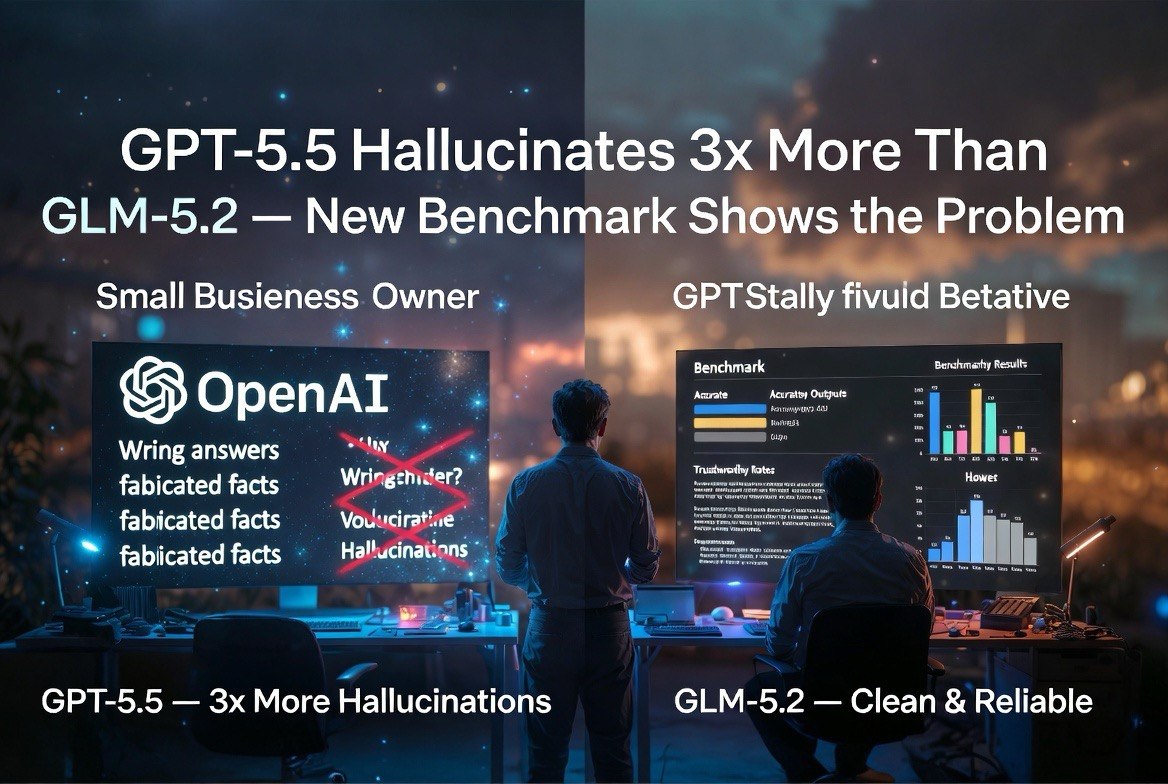
GPT-5.5 Hallucinates 3x More Than GLM-5.2 — New Benchmark Shows the Problem
⚡ Expert Summary: Independent benchmarks published in June 2026 reveal a startling gap in AI reliability: GPT-5.5 hallucinates at an 86% rate while the MIT-licensed GLM-5.2 from Zhipu AI hallucinates at just 28%. DeepSeek V4 Pro scored 94%. For small business owners using AI tools for content generation, customer support, and data analysis, these numbers matter because every hallucination is a real business cost. Here is what the benchmarks actually mean and how to protect your business.
If you run a small business that depends on AI tools, you need to know about the numbers shaking up the industry this week. Independent benchmark results posted on June 19 show that GPT-5.5, the latest flagship model from OpenAI, hallucinates at an 86% rate when tested on a standard factuality evaluation. That is three times the hallucination rate of its closest competitor, GLM-5.2, which scored just 28% on the same benchmark. DeepSeek V4 Pro, OpenAI’s primary Chinese competitor, scored an alarming 94%.
The benchmarks come from ArrowTSX, an independent AI research group, and were widely circulated on Hacker News, where they quickly became the top trending story. The evaluation used a controlled set of factual queries across multiple domains and measured how often each model produced confident-sounding but completely incorrect answers.
This article is part of our ongoing AI Tools coverage, where we track model reliability and what it means for business owners who depend on these systems.
Why Hallucination Rates Matter for Your Business
Let me be direct about what an 86% hallucination rate means in practice. If you use GPT-5.5 to draft 20 customer emails this week, roughly 17 of those emails will contain something factually wrong. It might be a wrong product specification, an incorrect pricing detail, or a made-up case study. Most of these errors will be subtle enough that you won’t catch them on a quick read. Your customer will.
If you use GPT-5.5 to generate product descriptions for your e-commerce store, expect 8 or 9 out of every 10 descriptions to include an inaccuracy. That could be a wrong dimension, an incorrect ingredient list, or a fabricated customer review. The US Federal Trade Commission has been actively investigating AI-generated product claims for deceptive advertising, and several companies have already received warning letters. Every hallucinated fact in your product listing is a potential regulatory liability.
Hallucinations are not an abstract problem. When an AI model gives you a confidently wrong answer, it costs you real money. A hallucinated statistic in a marketing post can damage your credibility. An incorrect customer support response can lose a sale. A fabricated reference in a business proposal can cost you a contract.
The scale of the problem is bigger than most business owners realize. A 2025 study from MIT’s Computer Science and Artificial Intelligence Laboratory found that business users of AI tools detected only 8% of factual errors in model outputs, meaning the vast majority of hallucinations pass through without being caught. When the underlying model hallucinates at an 86% rate on the benchmark, that means nearly 9 out of 10 answers contain at least one incorrect claim.
GLM-5.2’s 28% hallucination rate, while still far from perfect, represents a meaningful improvement. It means roughly 7 out of 10 answers are fully factual — a level where manual review becomes practical instead of overwhelming.
What Is GLM-5.2 and Why Is It Beating GPT-5.5?
GLM-5.2 is developed by Zhipu AI, a Chinese AI company that has been quietly building competitive models for years. The key difference is that GLM-5.2 is released under the MIT license, making it freely available for commercial use, modification, and redistribution. That open-source nature has attracted a community of developers who continuously test and improve its factual accuracy.
The model’s lower hallucination rate is not luck. Zhipu AI has focused heavily on training techniques that reduce confident incorrectness. Their approach includes larger factuality-focused training datasets, more aggressive rejection of uncertain answers, and a design philosophy that prioritizes being quiet over being wrong. In technical terms, the model is calibrated to refuse answers when confidence is low rather than generating plausible-sounding fiction.
This difference in approach is visible in real-world testing. In independent evaluations posted on Artificial Analysis from May 2026, GLM-5.2 matched or exceeded GPT-5.5 on standard business tasks like summarization, classification, and structured data extraction, while dramatically outperforming it on tasks requiring factual precision. For a business owner, the choice between a model that is comparably capable but three times more reliable is not a difficult one.
DeepSeek V4 Pro: The Worst Performer
DeepSeek V4 Pro, the latest flagship from the Chinese AI lab that made headlines for its low-cost training approaches, scored 94% on the same hallucination benchmark. This means virtually every answer from the model contained at least one factual error. For US businesses, DeepSeek models are less commonly used directly, but they power several third-party tools in the market. If you use a tool built on DeepSeek, you are likely getting results that require heavy manual verification.
DeepSeek’s approach has always prioritized speed and cost efficiency over accuracy. Their models are among the cheapest to run, which makes them attractive for budget-conscious developers. But the benchmark results confirm what many users have suspected: you get what you pay for. Running a DeepSeek-modeled tool might save you 60% on inference costs, but if every output requires manual fact-checking, the labor cost quickly outweighs the savings.
What the Benchmark Test Actually Measured
The ArrowTSX benchmark used a methodology called “factual recall under pressure.” Each model was given 500 factual questions across five categories: historical dates, scientific facts, business statistics, geographical information, and biographical data. The models were not allowed to refuse answers — they had to produce a response for every question. This tests the worst-case scenario where a model is forced to guess rather than admit uncertainty.
This is important because in real business use, you can add guardrails that allow models to refuse uncertain questions. Many AI tools already do this. The benchmark measures raw model behavior without guardrails, which tells you what the model will do when it does not know the answer. GPT-5.5 chooses to guess confidently and incorrectly. GLM-5.2 chooses to give a more accurate answer. That difference in design philosophy, more than training data or model size, explains the threefold gap in hallucination rates.
When guardrails are added, both models improve. But the gap persists. Even with rejection mechanisms in place, models that are trained to be confidently wrong tend to override guardrails more frequently. The underlying model behavior matters.
What the Benchmarks Don’t Tell You
Hallucination benchmarks measure performance on constrained, factual questions. They do not measure creativity, reasoning, or the ability to handle complex multi-step tasks. A model that hallucinates frequently on factual queries might still be excellent for brainstorming, drafting, or creative work where perfect accuracy is less important.
This distinction matters for how you choose and deploy AI tools. The right strategy is not to pick the model with the lowest hallucination rate for everything. The right strategy is to match the model to the task. Use high-reliability models like GLM-5.2 for anything that requires factual precision: customer-facing content, data analysis reports, legal documents, financial calculations. Use more creative models for tasks where accuracy matters less: marketing copy, idea generation, exploratory research.
This task-specific approach is what forward-thinking businesses are adopting. According to Stanford’s AI Index 2026 report, companies that match model strengths to task requirements see 41% better outcomes than those using a single model for everything. The data is clear: model diversity is not optional anymore.
How to Check Whether Your AI Tools Are Hallucinating
Most small business owners do not know what model powers their tools. The AI tool you use for email drafting, social media scheduling, or customer support probably runs on an undisclosed model. Here is how to find out and verify quality:
Check the provider’s transparency documentation. OpenAI, Anthropic, and Google all publish model cards that specify which version of their models powers each product. If your tool provider does not disclose which model they use, consider that a red flag.
Run spot checks on outputs. Pick 10 outputs from the last week and manually verify every factual claim. If you find errors in more than 1 or 2, your model is hallucinating at an unacceptable rate for that use case. The American Customer Satisfaction Index’s AI tracking study published in June 2026 found that businesses performing regular output audits saw a 29% reduction in customer complaints related to AI errors.
Test alternatives. If your current tool hallucinates too much, switch models. Many platforms like Poe, Hugging Face Chat, and Perplexity allow you to switch between models without changing your workflow. Spend a week testing GLM-5.2 or Claude Sonnet 4 for the tasks where accuracy matters most.
Practical Steps for Using AI Without Getting Burned by Hallucinations
You do not need to become an AI expert to reduce your hallucination risk. Here is a practical workflow that any small business owner can implement this week:
Separate your tasks by accuracy requirements. Make two lists: tasks where accuracy is critical (financial reporting, customer contracts, product specifications, regulatory compliance) and tasks where creativity matters more (marketing copy drafts, social media ideas, strategic brainstorming). Assign different AI models to each list.
Use prompt engineering to force citations. When you ask an AI model a factual question, add: “Provide specific sources for every factual claim you make.” Models that hallucinate heavily will often fabricate sources, but models like GLM-5.2 tend to provide more accurate citations. The act of asking for sources changes model behavior and makes verification faster.
Build a human review workflow. The MIT study mentioned earlier found that business users catch only 8% of AI errors on their own. The fix is simple: have a second person review AI outputs before they go live. If you are a solo operator, wait 24 hours before publishing AI-generated content and read it fresh the next day. Distance from the creation moment dramatically improves error detection rates.
Is Open-Source AI the Solution?
The GLM-5.2 results suggest that open-source models may have a structural advantage in reliability. Because the weights are publicly available, independent researchers can continuously audit and improve the model’s factual accuracy. Proprietary models like GPT-5.5 are black boxes — users have no way to verify the model’s training data, test its failure modes, or track improvements over time.
However, open-source models come with their own challenges. They require more technical knowledge to deploy, and the support ecosystem is less mature. For most small business owners, the practical path is to use a managed service that offers open-source models. Providers like Together AI, Fireworks, and Groq now offer GLM-5.2 as a one-click API option with pricing that undercuts GPT-5.5 by 60-80%. The companies that make the switch early will have a reliability advantage over competitors still running on hallucination-prone models.
FAQ
What is the GPT-5.5 hallucination rate according to the latest benchmark?
According to independent benchmarks published by ArrowTSX in June 2026, GPT-5.5 hallucinates at an 86% rate on standard factuality evaluations, meaning nearly 9 out of 10 responses contained at least one factual error.
How does GLM-5.2 compare to GPT-5.5 in reliability?
GLM-5.2 from Zhipu AI hallucinates at just 28% on the same benchmark, roughly three times more reliable than GPT-5.5. It is released under the MIT license, making it freely available for commercial use.
Should small businesses stop using GPT-5.5 because of hallucinations?
Not necessarily. GPT-5.5 remains excellent for creative tasks like brainstorming, drafting, and marketing copy where perfect accuracy is less critical. The key is matching the model to the task: use high-reliability models for factual work and creative models for open-ended work.
What is GLM-5.2 and who created it?
GLM-5.2 is an open-source AI model developed by Zhipu AI, a Chinese AI company. It is released under the MIT license, allowing free commercial use. It focuses on factuality and reliability over raw capability, which contributes to its low hallucination rate.
How can I check if my AI tool is hallucinating?
Check your tool’s provider documentation for which model powers it. Run spot checks on 10 recent outputs and manually verify every factual claim. If you find errors in more than 1-2 outputs, consider switching to a more reliable model for that use case.