Get The Solo Business OS — Free
The AI workflow that replaces a part-time employee for solo operators and small business owners.
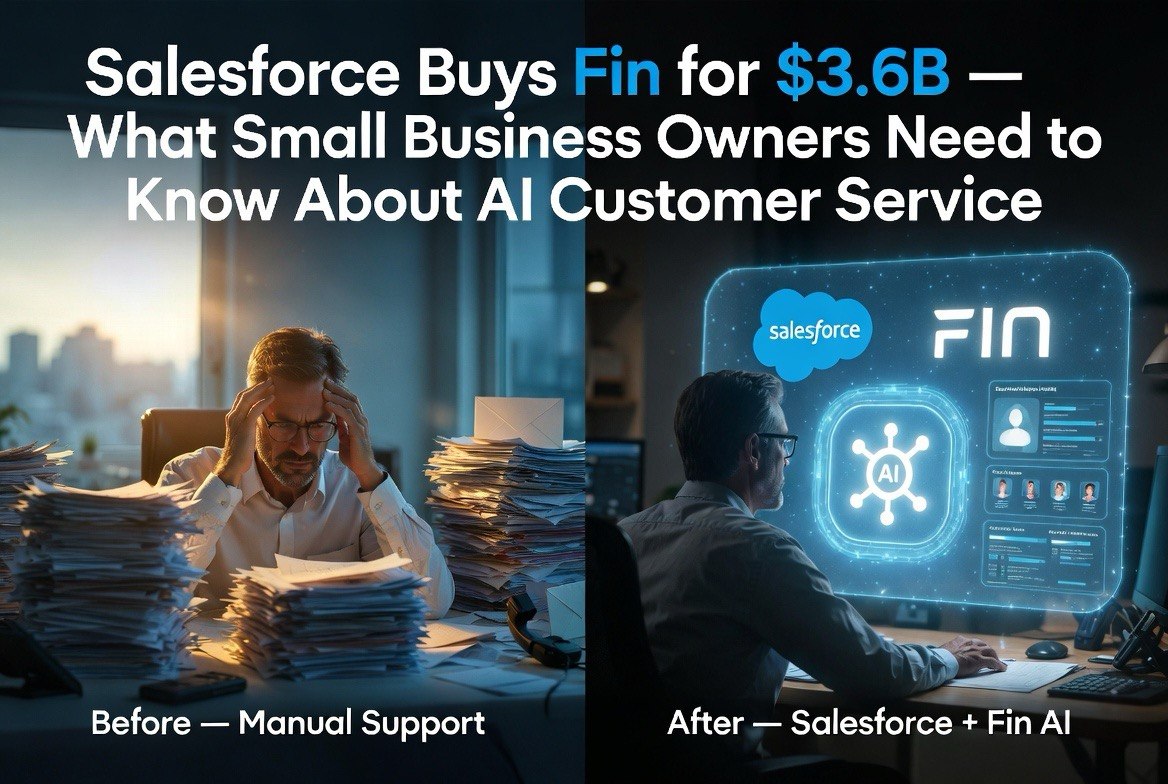
Salesforce Buys Fin for $3.6B: What Small Business Owners Need to Know About AI Customer Service
⚡ Expert Summary: Salesforce just acquired AI customer service platform Fin for $3.6 billion. If you run a small business, this matters more than you think. Enterprise AI customer service tools are consolidating fast, and the same technology that big companies pay millions for is being packaged for businesses of every size. But here is the catch — the tools that survive acquisition often change pricing, features, and availability. Here is what the Fin acquisition means for your customer service strategy and how to pick AI tools that won’t disappear or skyrocket in price.
Salesforce dropped $3.6 billion on Fin last week — an AI customer service platform that started life as Intercom before rebranding and pivoting to AI agents. It’s the latest in a string of massive AI acquisitions that are reshaping the business software landscape at a pace we’ve never seen before. And if you’re a small business owner using AI for customer support — or thinking about it — you need to understand what’s happening.
Marc Benioff, Salesforce’s CEO, said the company plans to use Fin’s technology to improve Agentforce, Salesforce’s existing platform for building custom AI agents. But here’s the thing about Salesforce acquisitions: they don’t always make tools cheaper or more accessible for small businesses.
The Big Picture: AI Customer Service Is Being Consolidated
Let’s look at what’s happened in just the last 90 days:
- Salesforce acquires Fin for $3.6B — AI customer service platform, June 2026
- Salesforce acquires Own Company for $1.9B — AI data management, May 2026
- SpaceX acquires Cursor for $60B — AI coding agent, June 2026
- Meta nearly acquired Manus for $2B — AI agent platform, scuttled by Beijing
According to TechCrunch, Fin offers AI agents that can resolve customer queries across live chat, WhatsApp, SMS, phone calls, Slack, and more. The platform was already a leader in AI customer service, handling millions of conversations per month for businesses of all sizes.
The consolidation tells you something important: AI customer service is no longer experimental. It’s a proven category that the biggest enterprise software companies are fighting over. When Salesforce, which already has its own AI customer service platform (Agentforce), drops $3.6 billion on a competitor, it means they see the market as too big to ignore.
What Fin Actually Does
Fin launched as Intercom in 2011, a customer messaging platform that grew into one of the most popular customer communication tools for SaaS businesses. In 2024, the company rebranded to Fin and pivoted hard into AI, building a platform that uses large language models to handle customer conversations autonomously.
According to Fin’s documentation, its AI agents can:
- Resolve support tickets autonomously — using your knowledge base, past conversations, and product documentation to answer customer questions without human intervention
- Route complex issues to human agents — with full context transferred, so customers don’t have to repeat themselves
- Handle multi-channel conversations — from live chat on your website to WhatsApp, SMS, and voice calls
- Learn from human agent corrections — the more your team uses it, the better it gets at handling similar questions in the future
- Integrate with your existing tools — CRM, help desk, e-commerce platforms, and payment systems
Fin’s AI agent is trained on a company’s knowledge base, past conversations, and product documentation. It doesn’t just answer questions — it can take actions like processing refunds, updating shipping addresses, and escalating complex issues to human agents with full context. The platform supports over 100 languages and can switch between them mid-conversation based on the customer’s language. According to TechCrunch, Fin was handling millions of autonomous conversations per month before the acquisition, with resolution rates exceeding 85% for standard support queries.
For a small business, the value proposition is straightforward: instead of hiring three customer support agents at $40,000 each per year, you can handle 80% of your customer queries with AI for a fraction of the cost. According to McKinsey, companies that have deployed AI customer service tools report a 30-45% reduction in support costs and a 25% improvement in customer satisfaction scores within six months of deployment.
Why Small Business Owners Should Care
Enterprise Tools Are Coming Downmarket
Here’s the pattern: a startup builds a great AI tool for small and medium businesses. A bigger company acquires it. The bigger company adds enterprise features, raises prices, and markets it to Fortune 500 clients. The original small business customers get priced out.
This happened with Mailchimp after Intuit acquired it. It happened with Shopify’s email tools. And it will happen with Fin under Salesforce. The $3.6 billion price tag means Salesforce needs to extract value — and that value will come from enterprise contracts, not $50/month small business plans.
Does that mean you shouldn’t use Fin? No. But it means you should evaluate AI customer service tools the same way you evaluate any business software investment: with an exit strategy.
The Alternatives Are Getting Better
The good news is that the AI customer service market is exploding. While Fin was getting acquired, competitors were launching and improving. Here are the ones worth watching:
- Tidio AI — Affordable AI chatbot for small e-commerce businesses, starts at $29/month
- Zendesk AI — Just launched autonomous agents for mid-market, competitive pricing
- Freshdesk Freddy AI — Integrated AI within the Freshworks ecosystem, strong for SMBs
- Intercom (the original Fin platform) — May still exist with different naming post-acquisition
Each of these has different strengths. Tidio is best for e-commerce with its product-specific automation flows. Zendesk is best if you already use their help desk and want seamless integration. Freshdesk is best if you need an all-in-one sales and support solution. There’s also Kustomer AI (owned by Meta, strong for omnichannel), Gorgias (dominant in e-commerce with deep Shopify integration), and Help Scout AI (best for small teams that want simplicity over features). The key is to pick one that fits your workflow today and test an alternative before you need one.
The Real Cost of Not Using AI Customer Service
Let me put this in dollars and cents. According to the National Restaurant Association, the average independent restaurant in the United States spends 28-35% of revenue on labor costs. For a restaurant doing $1 million in annual revenue, that’s $280,000 to $350,000 on staffing. A significant portion of that goes to front-of-house staff handling phone calls, reservations, and basic customer questions — all tasks an AI agent can handle.
The same math applies to every small business. An e-commerce store with 200 customer support tickets per week spends roughly 20-30 hours on repetitive answers. At $25/hour for a support agent, that’s $500-$750 per week — $26,000 to $39,000 per year — spent answering the same questions over and over. AI customer service tools like Fin (or its competitors) can handle 60-80% of those tickets for a fraction of the cost.
McKinsey’s 2025 research on AI in customer service found that companies deploying AI agents reduced average handle time by 40%, increased first-contact resolution by 25%, and cut operational costs by 30-45%. For a US-based small business with even modest support volume, that’s thousands of dollars in annual savings and a measurable improvement in customer experience.
But here’s the counterintuitive part: the businesses that benefit most from AI customer service aren’t the ones with the biggest support teams. They’re the ones with the most repetitive questions. If your support inbox is 70% “Where is my order?” and “What are your hours?” — AI can handle that today. If your support is mostly complex technical questions from enterprise clients, AI will help less.
How to Build an AI Customer Service Stack That Lasts
Step 1: Audit Your Current Support Volume
Before you invest in any AI customer service tool, know your numbers. How many support tickets do you get per week? What percentage are repetitive questions (password resets, order status, business hours, pricing)? If it’s more than 60%, AI can handle most of them.
According to Gartner, 80% of organizations will have deployed generative AI by 2026, and customer service is the top use case. If you haven’t started yet, you’re already behind your competitors.
Step 2: Test Before You Commit
Every AI customer service platform offers a free trial. Use it. Test with real customer conversations. Measure the resolution rate, the escalation rate, and — most importantly — customer satisfaction. If your customers hate talking to a bot, no amount of cost savings is worth it.
Step 3: Keep Your Knowledge Base Portable
The biggest lock-in risk with AI customer service tools is your training data. The AI learns from your knowledge base, past conversations, and product documentation. If you switch tools, you don’t want to start from scratch.
Keep your knowledge base in a format you can export (Markdown, HTML, or a standard CMS). Document your most common support workflows in a way that’s tool-agnostic. And run a backup of your help articles and responses every quarter.
What Comes Next
The Fin acquisition is part of a larger trend: enterprise software companies are buying AI startups at an unprecedented rate, and the customer service category is ground zero. By the end of 2026, it’s likely that every major CRM, help desk, and customer communication platform will have built-in AI agents as a standard feature, not a premium add-on.
Here’s what I tell every business owner I work with: AI customer service isn’t about replacing people. It’s about replacing the most mind-numbing, repetitive part of your team’s job so they can focus on the conversations that actually generate revenue, build relationships, and solve complex problems. The restaurants that use AI to handle reservation changes and order status questions aren’t firing their hosts — they’re giving them time to greet guests personally and build the kind of customer relationships that generate five-star reviews.
The winners in this transition won’t be the businesses that adopt AI first or buy the most expensive tools. They’ll be the ones that build flexible, portable workflows that can survive tool changes, acquisitions, pricing shifts, and platform migrations.
If you’re just getting started with AI tools for your business, check out our complete guide to AI tools for small businesses. We cover everything from AI customer service to content generation, automation, and analytics — all tested and reviewed for real-world business use, not just theoretical benchmarks.
Your AI customer service strategy should be built like your emergency fund: diversified, accessible, and designed for disruption. Because in the current M&A environment, disruption isn’t a possibility. It’s a guarantee.
Frequently Asked Questions
How much did Salesforce pay for Fin?
Salesforce acquired Fin for $3.6 billion. The transaction is expected to close in the last quarter of Salesforce’s 2027 fiscal year (early 2027).
What is Fin (formerly Intercom)?
Fin is an AI customer service platform that started as Intercom in 2011. It offers AI agents that can resolve customer queries across live chat, WhatsApp, SMS, phone calls, and Slack. The platform can handle conversations autonomously or route complex issues to human agents.
Will Fin’s pricing change after the Salesforce acquisition?
Pricing changes haven’t been announced, but Salesforce typically integrates acquired companies into its enterprise pricing model. Small business customers should monitor pricing closely and evaluate alternatives like Tidio AI, Zendesk AI, or Freshdesk Freddy AI.
What does the Fin acquisition mean for small businesses using AI customer service?
The acquisition signals that AI customer service is a proven, mainstream category. For small businesses, it means enterprise-grade AI support tools are becoming more accessible, but also that the tool landscape is consolidating. Diversify your AI stack and keep your training data portable.
What are the best AI customer service alternatives for small businesses?
Top alternatives include Tidio AI ($29/month, great for e-commerce), Zendesk AI (mid-market focused), Freshdesk Freddy AI (integrated with Freshworks ecosystem), and Intercom’s original platform. Each has different strengths depending on your business model and existing tool stack.