Get The Solo Business OS — Free
The AI workflow that replaces a part-time employee for solo operators and small business owners.
SpaceX Acquires Cursor for $60B: What It Means for Your Business
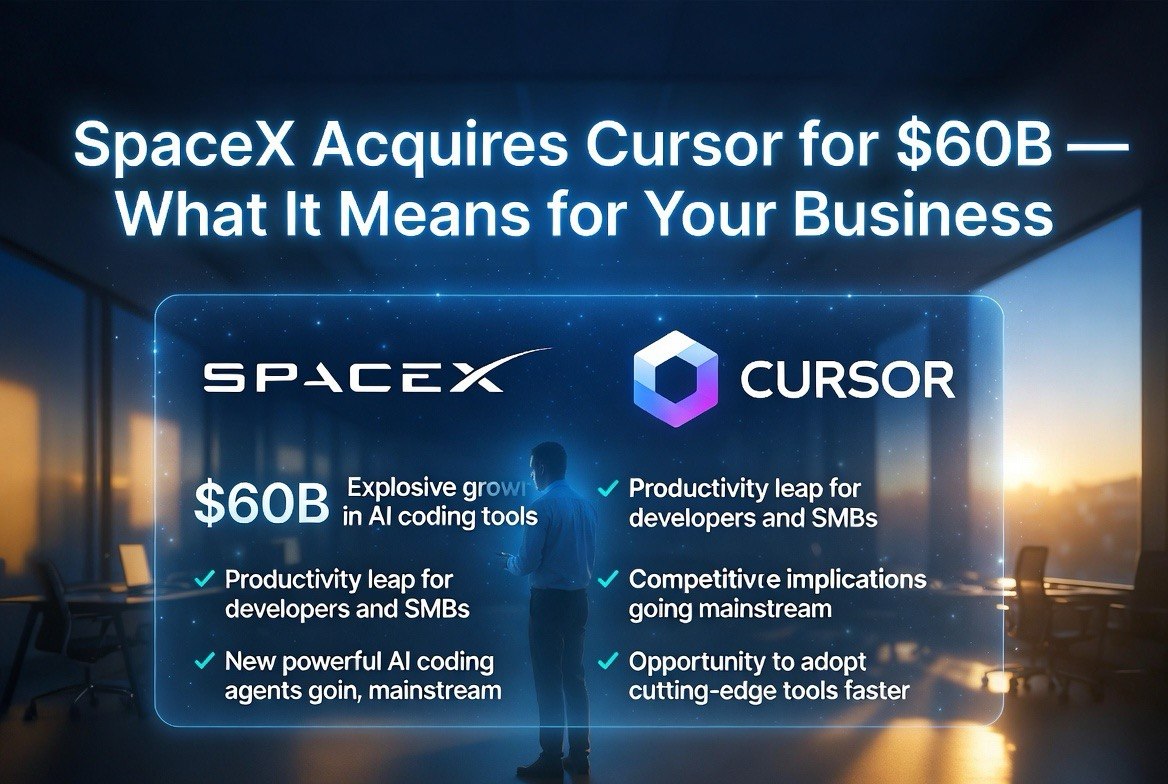
⚡ Expert Summary: SpaceX just acquired AI coding startup Cursor for $60 billion in stock, days after its historic IPO. This is the biggest AI acquisition in history — and it changes how small business owners should think about AI tools. If a $60 billion deal is happening for an AI coding agent, every business needs to pay attention to which tools will survive, which will consolidate, and how to avoid getting locked into a platform that might disappear or change its pricing overnight. Here’s what the Cursor acquisition means for your business and the tools you depend on.
SpaceX dropped a bombshell this week. Two days after its historic IPO, Elon Musk’s company announced it’s acquiring AI coding startup Cursor in a $60 billion all-stock deal. Not $2 billion. Not $10 billion. Sixty billion dollars for a startup most people had never heard of until last year.
If you run a small business, you might be thinking: “Why should I care about a space company buying a coding tool?”
Here’s why. This deal is a signal about the future of AI — and it directly affects every tool you use, every subscription you pay for, and every automation workflow you’ve built. AI consolidation is happening faster than anyone predicted, and if you’re not paying attention, you’ll get caught holding the wrong tools.
The Deal That Changes Everything
SpaceX agreed to acquire Anysphere, the company behind the AI coding agent Cursor, for $60 billion in stock. This comes just days after SpaceX’s public listing and less than two months after the two companies announced a preliminary partnership that included an option to buy Cursor for the same price.
According to TechCrunch, the deal is expected to close in Q3 2026. Before SpaceX stepped in, Cursor was set to close a $2 billion funding round from Andreessen Horowitz, Thrive Capital, and Nvidia at a $50 billion valuation. SpaceX paid a 20% premium over that.
Cursor was already the most popular AI coding agent on the market. It’s used by developers at companies of every size, from solo freelancers to Fortune 500 enterprises. According to multiple reports, Cursor grew faster than any AI coding tool in history, reaching a $50 billion valuation before SpaceX made its offer in April.
The acquisition is part of SpaceX’s broader AI strategy. The company merged with Elon Musk’s xAI earlier this year and has been building an AI division that it pitched to IPO investors as a $26 trillion addressable market opportunity. That number isn’t a typo. Twenty-six trillion dollars. SpaceX believes AI is a larger opportunity than space travel itself.
What This Means for Your AI Tool Strategy
Here’s where this gets practical for small business owners.
1. AI Consolidation Is Accelerating
The Cursor acquisition isn’t happening in a vacuum. We’ve seen a wave of AI acquisitions in 2026 that dwarfs anything from the previous year:
- Salesforce acquired Fin for $3.6B — an AI customer service platform
- Salesforce also acquired Own Company for $1.9B — AI data management
- Meta reportedly backed out of a $2B Manus deal after regulatory pressure
- Microsoft has been quietly acquiring AI startups at a rate of 2-3 per quarter
According to Crunchbase, AI-related M&A in the first half of 2026 has already surpassed the total for all of 2025. The market is consolidating fast, and not every tool you rely on today will exist as an independent product a year from now.
2. Pricing and Access Will Change
When a startup gets acquired by a larger company, pricing almost always changes. Sometimes it goes down (subsidized by the parent company). Sometimes it skyrockets (pivot to enterprise sales). Sometimes the product gets killed entirely and folded into something else.
Cursor currently charges $20/month for its Pro plan. If SpaceX folds it into its AI division, will that pricing stay? Or will it become part of a larger enterprise package that costs thousands per month?
The same question applies to every AI tool you use. Ask yourself: “If this tool doubled in price tomorrow, would I still pay for it?” If the answer is no, you need an alternative ready.
3. The “AI Agent” Category Just Got Validated
Cursor isn’t just a code completion tool. It’s an AI agent — it can plan, write, test, and deploy code autonomously. The fact that SpaceX is paying $60 billion for an AI agent company tells you everything about where the industry is heading.
Microsoft CEO Satya Nadella published an essay last week arguing that AI agents will “hollow out entire industries” and that companies need to build “token capital” — proprietary AI workflows and data sets that create competitive moats. He warned that the same concentration risk that created the 2008 financial crisis could happen in AI if companies don’t diversify their AI tool stacks.
For small business owners, this means: identify your most important AI tools, know their ownership structure, and have a backup plan for each one.
What Small Business Owners Should Do Right Now
Audit Your AI Tool Stack
Make a list of every AI tool your business uses:
- Writing and content generation
- Customer support chatbots
- Coding and automation
- Image and video generation
- Data analysis and reporting
- Email marketing and CRM
For each tool, check: Who owns it? Has it been acquired recently? Is it a startup or established company? If it’s a startup, what’s their funding situation?
Diversify Before You Need To
If 80% of your AI workflows run through a single platform, that’s a risk. If that platform gets acquired, changes pricing, or shuts down, you lose 80% of your automation overnight.
Aim for no single AI tool accounting for more than 40% of your critical workflows. The AI landscape is fragmenting — ChatGPT’s market share just dropped below 50% for the first time — and the tools that win won’t necessarily be the ones that are biggest today.
Build Transferable Workflows
The specific prompts and workflows you build should be portable. Don’t build deep into proprietary platform features that can’t be replicated. Use standard formats, document your processes, and test alternatives for every major tool.
If Cursor were to change its pricing model tomorrow — and let’s be honest, a $60 billion acquisition practically guarantees a pricing restructuring — would you be able to move your development workflows to another tool without losing months of productivity?
What Comes Next
The Cursor acquisition is the opening salvo in what will be a massive AI M&A wave. Every major tech company is looking for AI acquisition targets. Every VC-backed AI startup is hoping to be the next $60 billion exit. And every small business owner using AI tools is caught in the middle.
According to a Gartner report, 80% of organizations will have deployed generative AI applications by 2026. The tools you choose today will define your workflows for the next 3-5 years. Choose carefully. Diversify. And always have an exit strategy for every tool you adopt.
The AI gold rush is over. The consolidation phase has begun. The winners haven’t all been decided yet, but one thing is clear: the startups that survive won’t be the ones with the best technology — they’ll be the ones with the biggest acquirers.
The AI Agent M&A Wave Is Just Getting Started
The Cursor deal isn’t an outlier. It’s the canary in the coal mine for AI M&A. According to CB Insights, AI-related acquisitions in the first half of 2026 have already exceeded the total for all of 2025 by 40%. The market is consolidating at a pace we haven’t seen since the dot-com boom, and startups that would have stayed independent for years are being snapped up months after hitting product-market fit.
Why the frenzy? Because the big players realized something in 2025: building AI from scratch is too slow when your competitors are buying their way to the front of the line. Microsoft, Google, Amazon, Salesforce, and now SpaceX are all racing to acquire AI startups before their rivals do. For small business owners, this means the AI tools you use today may not exist as independent products a year from now.
The question isn’t whether your AI tools will get acquired. It’s whether the acquisition helps you or hurts you. Salesforce’s $3.6B acquisition of Fin (announced the same week as SpaceX-Cursor) will likely improve the product by giving it enterprise resources. But a startup acquired by a company that sees AI as a secondary business? That product might get neglected or parked.
How to Future-Proof Your AI Stack
Let me give you a practical framework for thinking about this. Every AI tool you use falls into one of four categories:
Tier 1: Mission-Critical, Hard to Replace
These are tools deeply embedded in your workflows. Your CRM AI, your accounting automation, your customer support agent. If they change or disappear, your business takes a real hit. For these, you need: a backup tool identified, your workflows documented outside the platform, and the ability to export your data at any time.
Tier 2: Important, Moderate Switching Cost
Your content generation AI, email marketing AI, analytics tools. These matter but you can switch in a week or two. For these: test an alternative every quarter. Keep one eye on the competition.
Tier 3: Nice-to-Have, Easy to Replace
Novelty AI tools, single-purpose chatbots, early-stage products. Don’t get attached. These are the most likely to vanish in an acquisition.
Tier 4: Emerging, Not Yet Critical
New AI tools you’re evaluating. Don’t integrate them into core workflows until they’ve been independent for at least 12 months. The first round of AI startups to hit acquisition offers will be the ones that grew fastest — and they’re often the most fragile.
The $26 Trillion Bet
SpaceX told IPO investors it sees a $26 trillion addressable market in AI. Let that sink in. The entire global economy is about $100 trillion. SpaceX is claiming AI represents a quarter of everything. Even if you cut that number by 90%, it’s still $2.6 trillion — bigger than the GDP of every country except the US, China, Germany, and Japan.
When a company that just pulled off the biggest IPO in history drops $60 billion on an AI startup, they’re not making a bet on code completion. They’re betting that AI agents become the primary interface for every digital interaction within a decade. And if Elon Musk is right, Cursor’s technology won’t just help developers write code faster — it will help every business automate complex workflows end-to-end.
According to Gartner, 80% of organizations will have deployed generative AI applications by 2026. The tools you choose today will define your workflows for the next 3-5 years. Choose carefully. Diversify. And always have an exit strategy for every tool you adopt.
The AI gold rush is over. The consolidation phase has begun. The winners haven’t all been decided yet, but one thing is clear: the startups that survive won’t be the ones with the best technology — they’ll be the ones with the biggest acquirers.
Frequently Asked Questions
Why did SpaceX buy Cursor?
SpaceX acquired Cursor to strengthen its AI division, which it built around xAI (merged earlier this year). The company sees a $26 trillion addressable market in AI, according to its IPO filings. Cursor was the leading AI coding agent and gives SpaceX immediate credibility and technology in the AI space.
How much did SpaceX pay for Cursor?
SpaceX is acquiring Cursor (Anysphere) for $60 billion in an all-stock deal. The acquisition is expected to close in Q3 2026.
Will Cursor’s pricing change after the acquisition?
Pricing hasn’t been announced yet, but acquisitions of this size almost always lead to pricing changes. Cursor currently charges $20/month for Pro. If SpaceX integrates it into its larger AI strategy, pricing could increase or shift to enterprise plans.
What does the Cursor acquisition mean for small businesses?
This deal signals that AI tool consolidation is accelerating. Small business owners should audit their AI tool stack, diversify across multiple platforms, and build workflows that aren’t dependent on any single tool. The days of relying on one AI platform are ending.
Is Cursor still available for individual users?
Yes, Cursor is still available and operational. The acquisition won’t close until Q3 2026, so individual users and businesses can continue using the tool as normal for now. Long-term availability will depend on SpaceX’s integration plans.