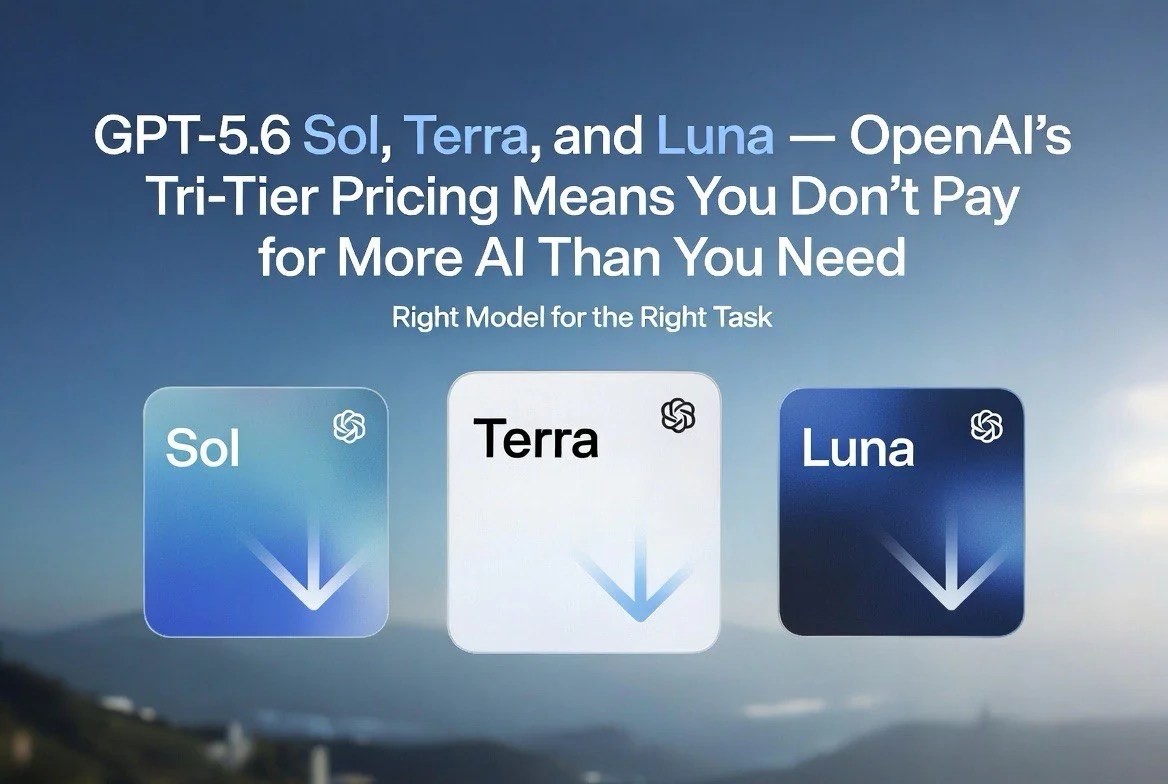
GPT-5.6 Sol, Terra, and Luna — OpenAI’s Tri-Tier Pricing Means You Don’t Pay for More AI Than You Need
⚡ Expert Summary: OpenAI launched GPT-5.6 in three tiers on July 9, 2026 — Sol ($5/$30 per M tokens), Terra ($2.50/$15), and Luna ($1/$6). For US small businesses, the real story isn”’t the frontier model. It”’s Luna: the cheapest OpenAI model ever, at one-fifth the cost of GPT-5.5. Terra matches GPT-5.5”’s performance at half the price. And Sol? It”’s for when you need frontier reasoning on complex agentic tasks. The days of overpaying for intelligence you don”’t use are over.
OpenAI dropped its GPT-5.6 family on July 9, 2026, and in typical fashion, the headlines all went to the top-tier reasoning model — the one named Sol that costs $30 per million output tokens and is apparently good enough at cybersecurity that the US government tried to slow the rollout.
But if you run a small business in the United States, Sol is probably not what you need. Not because it isn”’t powerful. It is. The GPT-5.6 Sol benchmark scores are genuinely impressive — it outperforms Claude Mythos 5 on several agentic reasoning tests while using fewer output tokens on ExploitBench, per OpenAI community data (OpenAI community, July 2026).
It”’s that you”’re paying $30 per million output tokens for reasoning depth you don”’t need. Your Monday morning customer email? Luna handles it. Your draft SOP document? Terra. That six-step agentic workflow that scrapes competitor pricing, runs sentiment analysis, and drafts a report? Maybe — maybe — you need Sol.
Here is the breakdown of exactly what each tier costs, what it does differently, and which small business use cases each one actually makes sense for.
What GPT-5.6 Sol, Terra, and Luna Actually Cost
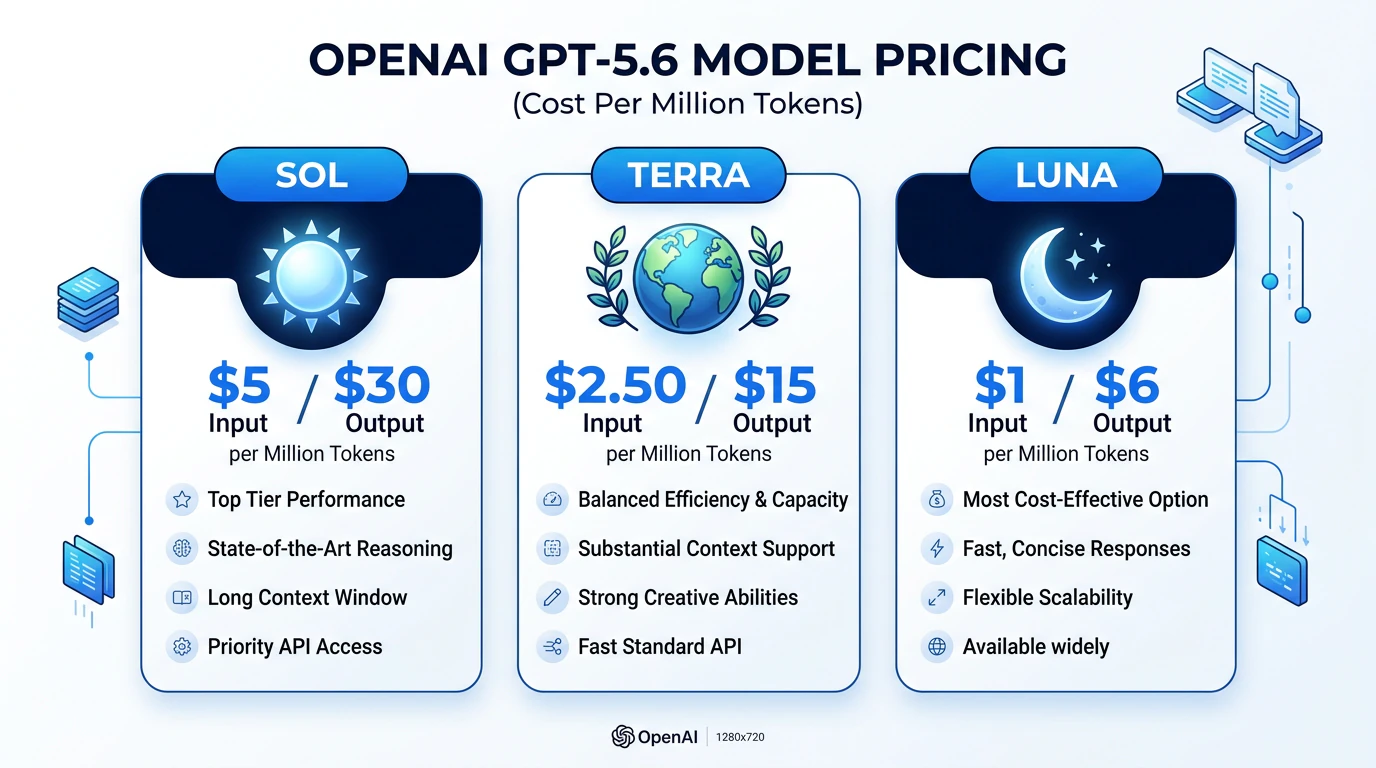
GPT-5.6 pricing at a glance: Sol (/0 per M tokens) for frontier reasoning, Terra (.50/5) for business automation, Luna (/) for everyday content and ChatGPT use. Terra matches GPT-5.5 performance at half the price.
OpenAI published the tiered pricing on its preview page June 26 (openai.com, June 2026) and launched publicly July 9, 2026 at 10 AM PT (CNBC, July 2026). The prices per million tokens are:
| Model | Input (per M tokens) | Output (per M tokens) | Best For |
|---|---|---|---|
| Sol | $5.00 | $30.00 | Complex reasoning, agentic workflows, security research |
| Terra | $2.50 | $15.00 | GPT-5.5-class performance at half the cost |
| Luna | $1.00 | $6.00 | High-volume, low-complexity tasks, fast responses |
OpenAI published these prices on its preview announcement page on June 26, 2026 (openai.com, June 2026) and confirmed them at public launch on July 9. Independent analysis by Emergent and Coursiv both verified the same pricing structure (Emergent analysis, July 2026).
To make this concrete: if your business runs 100,000 API calls per month, each averaging 500 input tokens and 150 output tokens:
- On Sol: You spend $700/month.
- On Terra: You spend $350/month.
- On Luna: You spend $140/month.
That”’s a 5x cost difference between Sol and Luna for comparable task volumes. And the key insight from OpenAI”’s own positioning — confirmed by the community preview documentation (Emergent analysis, July 2026) — is that these aren”’t just three models. They”’re three durable capability tiers that will evolve independently across future GPT versions.
Luna: The Small Business Workhorse
Luna is the cheapest OpenAI model ever released. At $1 per million input tokens, it is priced to compete directly with lower-cost models from Anthropic, Google, and DeepSeek.
What Luna handles well:
- Drafting and editing customer emails
- Summarizing documents and meeting notes
- Simple data extraction from text
- Light coding (boilerplate, scripts, documentation)
- Chatbot responses for customer-facing applications
- Content generation at scale (social posts, descriptions, listicles)
What Luna does NOT handle well: multi-step reasoning, complex math, long-horizon agentic workflows, and any task that requires maintaining context across a large codebase or document set. If you ask Luna to debug a complex application, it will try — but the result will be less reliable than Terra or Sol.
For US small businesses running AI on a budget, Luna should be the default starting point. Price out the workload on Luna first. Only move up to Terra if Luna fails consistently on that specific task.
Terra: The Migration Path for GPT-5.5 Users
If you are currently running GPT-5.5 in your business — and many US SMBs are — Terra is the obvious next step. It matches GPT-5.5”’s benchmark performance at roughly half the cost, per OpenAI”’s own positioning (openai.com, July 2026).
Terra sits in the middle of the tier stack for a reason. It handles:
- Complex business document analysis (contracts, legal documents, regulatory reports)
- Coding assistance for custom development work
- Data analysis and pattern recognition
- Customer-facing chat applications that need higher accuracy than Luna
- Multi-turn conversations where context retention matters
If your business is using GPT-5.5 through ChatGPT Plus, ChatGPT Team, or the API, switching your standard workload to Terra will save you roughly 50% on token costs without changing output quality. Keep Sol on deck for the occasional complex task that genuinely needs frontier reasoning.
Sol: When to Pay for the Frontier
Sol is OpenAI”’s strongest model yet. It outperforms Claude Mythos 5 on several agentic reasoning benchmarks while using fewer tokens on tasks like ExploitBench, according to OpenAI”’s community benchmarking (OpenAI community, July 2026). The US government asked OpenAI to delay the public rollout over cybersecurity concerns — Sol”’s defensive security capabilities were deemed sensitive enough to warrant a limited preview period (CNBC, July 2026).
For small businesses, Sol makes sense in specific scenarios:
- Agentic workflows: Tasks where an AI agent runs autonomously for extended periods, making decisions, calling tools, and adapting based on results
- Complex codebase work: If you run a small software shop and need AI-assisted development across large codebases
- Scientific or mathematical analysis: Data-heavy work that requires rigorous reasoning chains
- Competitive analysis at scale: Scraping, analyzing, and synthesizing data from multiple sources into actionable business intelligence
Do not default to Sol. Put Luna or Terra on the task first. Measure the failure rate. Only escalate to Sol if the lower tiers genuinely can”’t handle the job. At $30 per million output tokens, paying for Sol on routine work is like renting a dump truck to move a sofa.
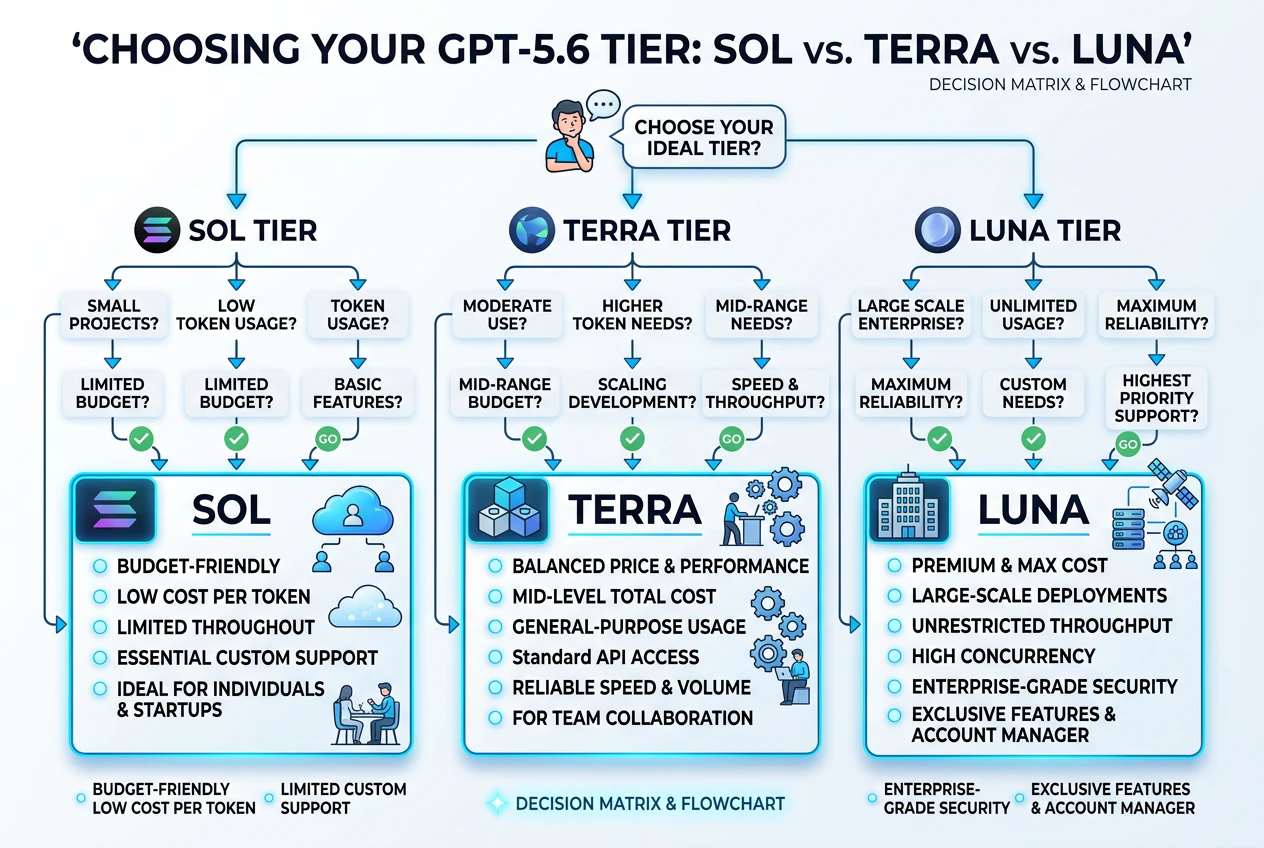
Which tier fits your workload? Luna for simple content and chat, Terra for business automation and API calls, Sol for complex agentic reasoning and coding tasks.
How to Match Each Tier to Your Business Workload
OpenAI designed these tiers to be used as a stack, not as three separate choices. The same business — the same API integration — can route different task types to different tiers:
| Task Type | Recommended Tier | Why |
|---|---|---|
| Customer email responses | Luna | Low complexity, high volume |
| Content generation (social, blog drafts) | Luna | Creative but not reasoning-heavy |
| Document analysis (contracts, reports) | Terra | Needs accuracy and context retention |
| Customer-facing chatbot | Terra | High accuracy requirement |
| Coding assistance (standard) | Terra | Matches GPT-5.5 at half cost |
| Autonomous agents (multi-step) | Sol | Requires frontier reasoning |
| Complex debugging / code review | Sol | Large context + precise reasoning |
The businesses that save the most money with this tier system are the ones that build routing logic early. Don”’t point every API call at Sol because it”’s “the best.” Route based on task complexity. Pay Luna prices for Luna work. Pay Sol prices only for Sol problems.
What the Tier System Means for the AI Pricing War
OpenAI”’s tri-tier structure is a response to a market that has been splitting into clear segments. Anthropic”’s Claude model family already spans tiers by capability. Google”’s Gemini lineup does the same. DeepSeek competes primarily on raw price.
But OpenAI”’s move makes it explicit: the era of paying one price for all AI workloads is ending. The GPT-5.6 tier structure acknowledges that a business running 10,000 simple queries per day should not pay the same per-token rate as a defense contractor running complex reasoning chains.
Luna at $1/$6 per million tokens puts direct pressure on DeepSeek”’s pricing. Terra at $2.50/$15 undercuts Anthropic”’s mid-range offerings. Sol at $5/$30 competes at the frontier where benchmarks actually matter to buyers.
For US small businesses, the practical effect is simple: you can now run AI workloads that were too expensive six months ago. A chatbot that cost $500/month on GPT-5.5 might cost $200/month on Luna. A content pipeline that was marginal on unit economics becomes clearly profitable. The tier system doesn”’t just give you options — it opens use cases that were previously closed by cost.
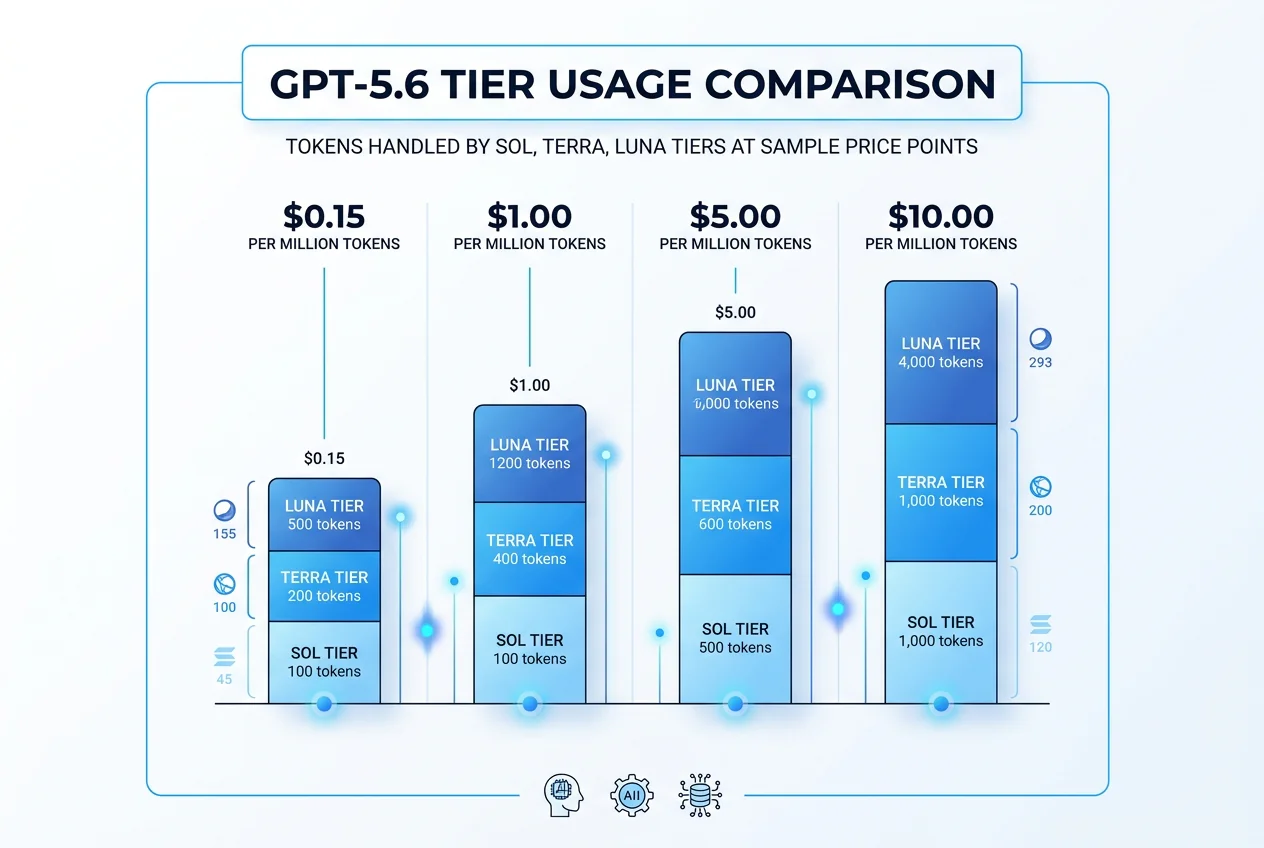
Monthly cost at 1 million tokens: Luna costs $6, Terra costs $15, and Sol costs $30. For the typical small business, Luna covers 80% of daily AI tasks at one-fifth the cost of the previous generation.
Key Takeaways for Business Owners
- Default to Luna, not Sol. Most small business AI workloads don”’t need frontier reasoning. Start with the cheapest tier that works and only escalate when a task consistently fails.
- Migrate from GPT-5.5 to Terra. Terra matches GPT-5.5”’s performance at roughly half the token cost. If you”’re on GPT-5.5 today, Terra is the direct upgrade path.
- Reserve Sol for agentic workflows. Autonomous agents, complex analysis, and security work benefit from Sol”’s reasoning depth. Everything else doesn”’t.
- Build routing logic into your AI stack. The businesses that win with GPT-5.6 are the ones that send the right task to the right tier — not the ones that point everything at the top model.
Frequently Asked Questions
When was GPT-5.6 Sol, Terra, and Luna released?
The GPT-5.6 family was previewed on June 26, 2026, with limited partner access. Full public launch was July 9, 2026, at 10 AM PT.
How much does GPT-5.6 Luna cost?
GPT-5.6 Luna costs $1 per million input tokens and $6 per million output tokens — the cheapest OpenAI model ever.
What is the difference between GPT-5.6 Sol, Terra, and Luna?
Sol is the frontier reasoning model for complex agentic tasks ($5/$30 per M tokens). Terra is the balanced everyday model matching GPT-5.5 at half the cost ($2.50/$15). Luna is the affordable high-volume model for simple tasks ($1/$6).
Should small businesses use GPT-5.6 Luna or Sol?
Most small businesses should default to Luna for routine tasks and Terra for complex analysis. Sol is only needed for agentic workflows and advanced reasoning that lower tiers can”’t handle.
How does GPT-5.6 Terra compare to GPT-5.5?
About Barak Schurr

About Barak Schurr
Barak Schurr is the founder and former president of the nightlife ticketing platform Wantickets and former Global Director of Dance and Nightlife at Eventbrite. He currently focuses on AI research and writes about practical AI for independent business owners — no hype, no corporate fluff. More at topnotchaitools.com.
Contact: [email protected]
More AI Resources for Your Business