Google Just Slashed Gemini 3.6 Flash Prices — What It Means for Your Business
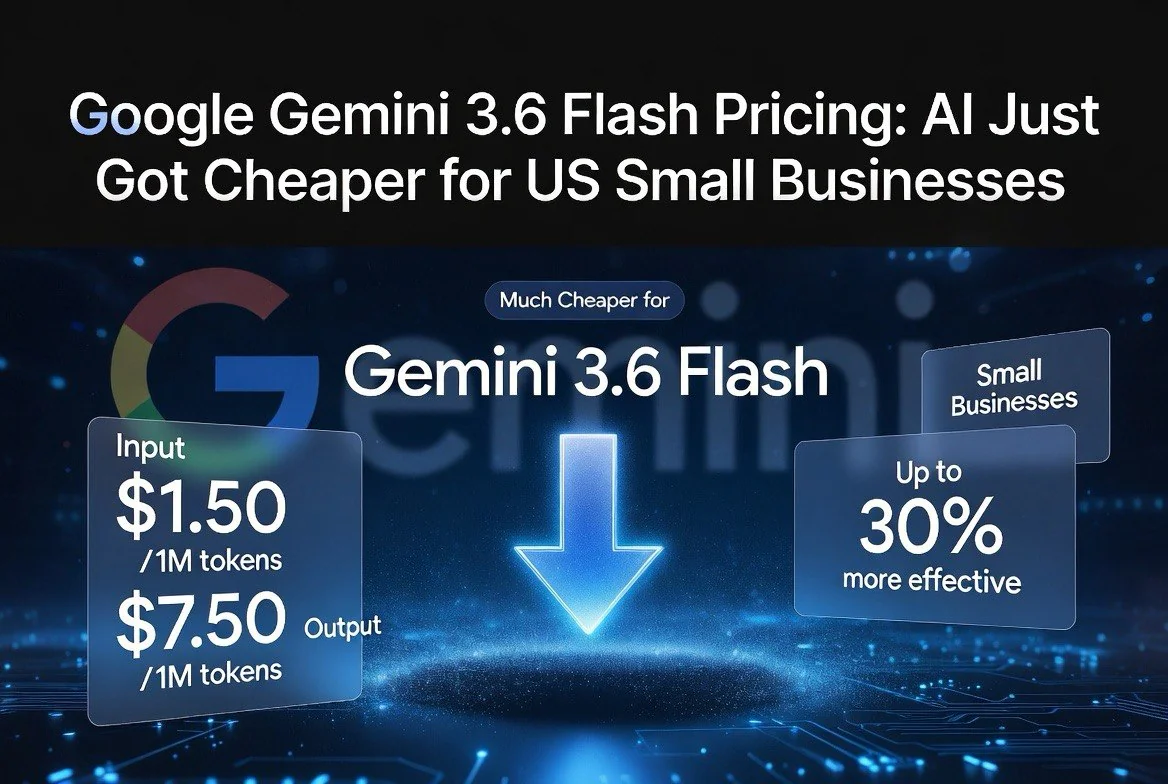
⚡ Expert Summary: Google cut Gemini 3.6 Flash API pricing by 57% on input tokens and 17% on output tokens in late July 2026, bringing input costs to $1.50 per million tokens — the cheapest per-token rate of any major frontier model. The Flash-Lite tier dropped even further to $0.50 per million input tokens. For US businesses building on AI, this extends the pricing war into the mid-tier model segment that handles the vast majority of commercial AI workloads.
The Numbers Behind Google’s Price Cut
Google announced the pricing reduction for Gemini 3.6 Flash effective July 20, 2026. The cuts apply to both the standard Flash model and the Flash-Lite tier, making Gemini the cheapest per-token option among major AI providers for high-volume commercial use.
| Model | Input Price (per M tokens) | Output Price (per M tokens) | Context Window |
|---|---|---|---|
| Gemini 3.6 Flash (new price) | $1.50 | $7.50 | 1M tokens |
| Gemini 3.6 Flash (old price) | $3.50 | $9.00 | 1M tokens |
| Gemini 3.5 Flash-Lite (new) | $0.50 | $2.50 | 1M tokens |
| Claude Sonnet 4 | $3.00 | $15.00 | 200K tokens |
| GPT-5.6 Luna | $2.50 | $10.00 | 128K tokens |
The numbers matter. At $1.50 per million input tokens, Gemini 3.6 Flash costs half what Claude Sonnet 4 charges for the same input volume. For a US business processing 50 million tokens per month — a realistic volume for a company running AI-powered customer support or content generation at scale — the difference between Gemini and Claude is $75/month versus $150/month in input costs alone.
Who Benefits Most From Cheaper Gemini Access
Not every business uses enough API volume for these price cuts to matter. But for the ones that do, the savings add up fast.
Customer support operations. A SaaS company processing thousands of support tickets through an AI agent will see the most immediate benefit. Gemini 3.6 Flash handles multi-step support workflows reliably at a fraction of the cost of reasoning-class models. The 1M token context window means it can ingest an entire product documentation set and maintain context across a full support conversation.[1]
Content production pipelines. Agencies and in-house marketing teams generating large volumes of SEO content, product descriptions, or ad copy can reduce their AI operating costs by 40-50% by routing batch tasks through Gemini Flash instead of Claude or GPT models. The quality ceiling is lower than reasoning models, but for first-draft generation and bulk processing, the trade-off is favorable.
Data extraction and classification. Businesses that process large document sets — invoice processing, contract analysis, survey response classification — benefit from Gemini’s combination of low cost and large context. Processing 100,000 pages of documents through Gemini Flash costs roughly $15-20 in API consumption versus $30-40 on competing platforms.
Startups building on API credits. Every dollar saved on inference costs is a dollar that can go toward product development. For early-stage US startups that rely on AI as a core infrastructure component, Gemini’s price cut extends runway meaningfully. A startup spending $500/month on AI inference today can reduce that to roughly $250-300 by switching to Gemini Flash.
E-commerce product enrichment. Online retailers generating product descriptions, category pages, and SEO metadata at scale see compounding savings. A catalog of 10,000 products requiring description generation through AI costs roughly $15-20 on Gemini Flash versus $35-45 on Claude Sonnet 4. At scale, those savings fund additional enrichment features like translation, attribute extraction, and review summarization.
How This Changes the Competitive Landscape
Google is playing a deliberate game with this pricing move. The company does not compete with OpenAI just on model capability — it competes on ecosystem integration and volume economics. Google’s AI infrastructure advantage (TPU v7 hardware) gives it a cost structure that pure-play AI companies cannot match on raw inference price.
The effect of this cut is immediate pricing pressure on the entire mid-tier AI market. Anthropic’s Sonnet 4 and OpenAI’s GPT-5.6 Luna now face a competitor that costs half as much for comparable capabilities. Both companies will need to respond with either their own price cuts or feature advantages that justify the premium.
The consumer-facing impact is already visible. Gemini 3.6 Flash has been free through the Google Gemini app since launch. The API price cut extends that cost advantage to commercial users who were previously crossing a mental threshold at $3.50 per million tokens. Below $1.50, the cost of AI inference for mid-tier tasks becomes a rounding error in most business expenses.
Where Gemini Flash Falls Short
Price cuts mean nothing if the model does not deliver usable results. Gemini 3.6 Flash has clear strengths and equally clear limitations.
Speed is exceptional. Gemini Flash processes requests faster than any mid-tier competitor. For real-time applications — chatbots, interactive tools, live transcription — the latency advantage is measurable and meaningful.
Reasoning depth is limited. Flash models are not built for complex multi-step analysis. If you need to analyze a 50-page contract, identify contradictions, and produce a risk assessment, you want a reasoning model. Gemini Flash will give you a plausible-looking answer with surface-level understanding.
Integration with Google ecosystem is a real advantage. Gemini’s native integration with Google Workspace, BigQuery, and Vertex AI gives US businesses already on Google infrastructure a seamless deployment path. The model reads directly from Google Drive, Sheets, and Docs without additional connectors.
Creative tasks show inconsistent quality. For marketing copy, brand messaging, and creative writing, Gemini Flash produces outputs that feel more generic than Claude Sonnet 4 or GPT-5.6 Luna. It is adequate for first drafts but requires more human editing to reach publishable quality.
Hallucination rates are higher than premium models. Independent testing shows Gemini Flash hallucinates 2-3x more frequently than Claude Sonnet 4 on factual queries. For applications where accuracy is critical — legal research, medical information, financial calculations — the cost savings do not justify the reliability risk. Always verify Flash outputs against trusted sources before making business decisions based on them.
The bottom line: Gemini 3.6 Flash is not trying to be the smartest AI model. It is trying to be the most accessible one — and at the new price point, it succeeds at that mission.
The Mixed Model Strategy Every Business Should Consider
The smartest approach in the current AI market is not picking one provider. It is matching model capability to task complexity and routing accordingly.
Simple tasks go to Gemini Flash. Quick research, document summaries, email drafting, data extraction. These tasks do not need reasoning-class intelligence. They need speed and low cost. Gemini Flash handles them better than any alternative at the new price point.
Complex tasks go to a reasoning model. Contract analysis, strategic planning, competitive research, multi-step agent workflows. These tasks benefit from the reasoning depth of Claude Opus 5 or GPT-5.6 Sol. The higher per-token cost is justified by the quality difference.
The hybrid saves 40-60% on total AI spend. Businesses that adopt a routing strategy — using Gemini Flash for 70-80% of their AI workload and a reasoning model for the remaining 20-30% — reduce total inference costs significantly compared to running everything through a single premium model.
For US small business owners evaluating their AI spending, the math is straightforward. At $1.50 per million input tokens, Gemini 3.6 Flash is cheap enough to use liberally for daily operations. The days of conserving API calls are over. The question is no longer whether to use AI — it is which model to use for which task, and the answer changes every quarter as new pricing resets the market.
The Bottom Line for Business Owners
Google’s Gemini 3.6 Flash price cut is not about matching competitor pricing. It is about resetting the pricing baseline for the entire mid-tier AI market. At $1.50 per million input tokens, AI inference for fast, capable models becomes a negligible operating expense rather than a line item that demands optimization.
For US businesses already using AI tools, this is a clear signal to evaluate current provider pricing and adjust. For businesses that have been on the fence about building AI into their operations, the cost barrier just dropped significantly. The smart money is on a mixed-model approach: Gemini Flash for volume, reasoning models for depth. Businesses that ignore the pricing trend risk overpaying for inference by 2-3x by routing every task through premium models when cheaper alternatives handle the work just as well.
FAQ
How much did Google cut Gemini 3.6 Flash pricing?
Google reduced input token pricing by 57% from $3.50 to $1.50 per million tokens, and output pricing by 17% from $9.00 to $7.50 per million tokens. Flash-Lite dropped to $0.50 per million input tokens.
When did the new Gemini pricing take effect?
The price cuts were announced and took effect on July 20, 2026. They apply to all API usage of Gemini 3.6 Flash and Flash-Lite models.
Will the Gemini price cut lower my SaaS subscription costs?
Not directly — most SaaS products use their own AI provider agreements. But the pricing pressure may cause providers to reduce costs over time, and API-accessible tools that route through Gemini will see immediate savings.
How does Gemini 3.6 Flash compare to GPT-5.6 Luna?
Gemini Flash costs 40% less than GPT-5.6 Luna for input tokens and handles a much larger 1M token context window, but Luna produces higher quality output on creative and analytical tasks.
Is Gemini 3.6 Flash good enough for business use?
Yes for straightforward tasks like summarization, extraction, classification, and support. No for complex multi-step reasoning, legal document analysis, or high-stakes decision support where accuracy is critical.
Is the AI price war going to continue?
Yes. Google’s cost advantage from TPU v7 hardware, combined with market pressure to gain API market share, suggests further price reductions through late 2026. The trend favors businesses.

About Barak Schurr
Barak Schurr is the founder and former president of the nightlife ticketing platform Wantickets and former Global Director of Dance and Nightlife at Eventbrite. He currently focuses on AI research and writes about practical AI for independent business owners that actually moves the needle — no hype, no corporate fluff. More at topnotchaitools.com.
Contact: [email protected]
More AI Resources for Your Business