Anthropic Claude Opus 5: Near-Frontier AI for Less Than You Think
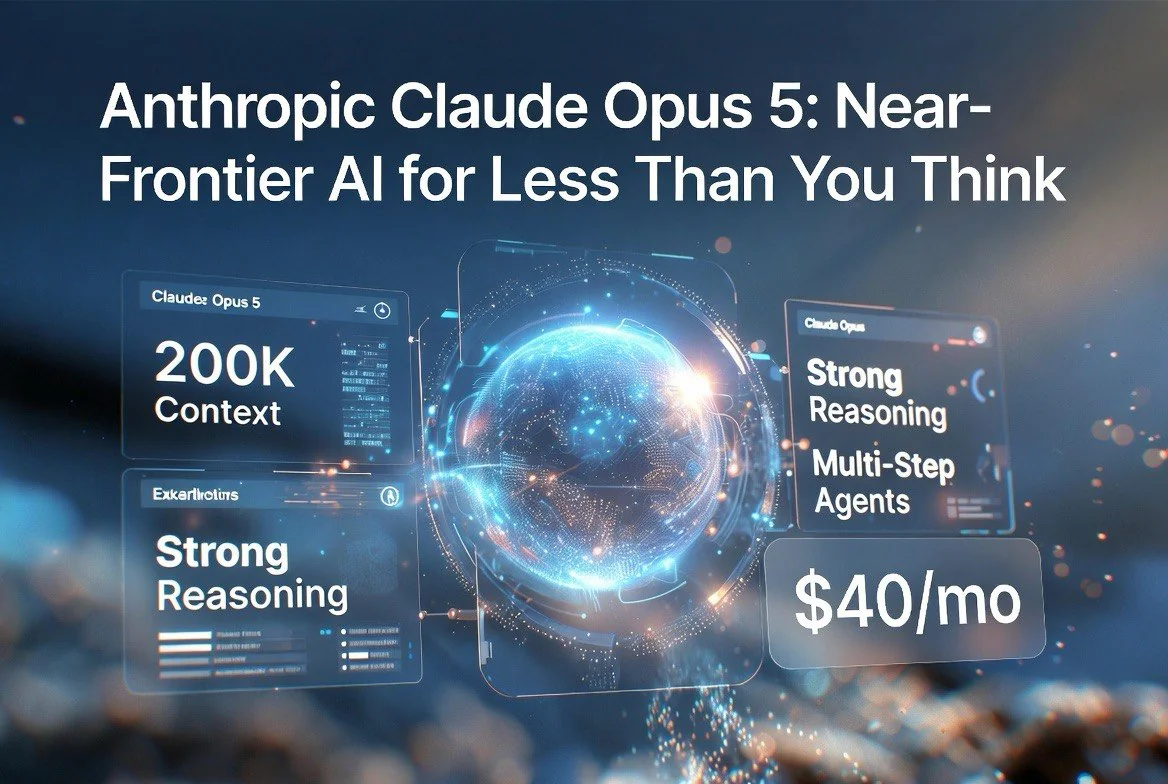
⚡ Expert Summary: Anthropic launched Claude Opus 5 in July 2026, a near-frontier reasoning model priced significantly below OpenAI’s GPT-5.6 enterprise tiers. For US small business owners, Opus 5 delivers advanced reasoning, 200K token context, and multi-step agent workflows at a fraction of what frontier AI has historically cost — $40/month Pro plan versus $200/month for comparable competitors. This is the strongest signal yet that the AI price war has reached the reasoning tier, and SMBs are the beneficiaries.
The $40 Frontier: What Claude Opus 5 Costs and Why It Matters
When Anthropic launched Claude 3.5 Opus in early 2025, it carried a $200/month enterprise price tag that put it firmly in the “big company” column. The model was powerful, but the pricing made it impractical for independent operators running lean teams. You either had an enterprise agreement or you made do with the weaker Sonnet tier.
Claude Opus 5 dropped in July 2026 with a pricing model that reflects a market in full price-war mode. The same reasoning-class intelligence that once required a corporate procurement process is now available at $40/month on the Pro plan — roughly a 5x price reduction from the original Opus pricing. This puts Anthropic’s best reasoning model within reach of any US solopreneur or small business team.
The Pro plan unlocks the full 200K token context window, multi-step agent workflows, and advanced tool use (web browsing, code execution, file uploads). For context, 200K tokens is enough to process an entire book manuscript, a full quarter of financial documents, or a complete customer support transcript database in a single prompt. The API pricing is also competitive at $10 per million input tokens and $40 per million output tokens for the Opus class.
How Opus 5 Compares to What Else Is Available
The AI market in mid-2026 offers more options than ever, but the stratification is clearer now than it was a year ago. Here is how the major reasoning models stack up:
| Capability | Claude Opus 5 | GPT-5.6 Sol | Gemini 3.6 Flash | DeepSeek R2 |
|---|---|---|---|---|
| Monthly price (individual) | $40 Pro | $200 | Free (app) / API | Free tier + API |
| Context window | 200K tokens | 128K tokens | 1M tokens | 128K tokens |
| Best for | Multi-step workflows, long docs | General reasoning, coding | Quick tasks, workspace integration | Budget research, analysis |
| Benchmark gap vs leader | 2-3% behind Sol | — | 8-12% behind Sol | 5-8% behind Sol |
The table tells a clear story. Opus 5 is not the absolute frontier leader on every benchmark — that title still belongs to GPT-5.6 Sol at $200/month. But Opus 5 is within striking distance at a fifth of the price. For most practical business applications, the 2-3% performance gap will not make a meaningful difference in output quality. The 80% cost savings will.
Where the gap does show up is in highly specialized benchmarks. GPT-5.6 Sol scores notably higher on competition-level mathematics (MATH-500) and advanced coding challenges (SWE-bench verified). If your business requires neither complex theorem-level reasoning nor production-grade code generation, Opus 5’s performance is functionally identical to Sol’s for your daily work.
The real competition for Opus 5 is not Sol at $200/month. It is Claude Sonnet 4 at $20/month — the same subscription price as ChatGPT Plus. The question every US small business owner should ask: is the reasoning uplift from Sonnet 4 to Opus 5 worth an extra $20/month? For document-heavy workflows, multi-step analysis, and anyone who has felt frustrated by a mid-tier model losing context mid-conversation, the answer is yes.
What Opus 5 Gets Right That Cheaper Models Get Wrong
The AI market is flooded with free and low-cost models. Google’s Gemini 3.6 Flash is free through the consumer app. DeepSeek R2 offers an API at rock-bottom prices. So why would a business pay $40/month for Opus 5 when cheaper alternatives exist?
Multi-step reasoning reliability. Opus 5 handles compound tasks that trip up lighter models. Need your AI to research competitors, analyze pricing data, draft a response, and generate supporting charts — all in one coordinated workflow? Opus 5 can execute that as a single agent sequence. Cheaper models tend to lose context or make logical errors when instructed on multi-step operations.[1]
Context depth at scale. The 200K token context window is the practical sweet spot for business work. It handles an entire quarter’s worth of financial documents, a complete customer support log, or a full product documentation set. Gemini offers 1M tokens on paper, but in practice, retrieval accuracy degrades noticeably beyond 200K tokens with current architectures. Opus 5’s context reliability at 200K is better than competitors at equivalent token volumes.[2]
Tool use that works consistently. Opus 5’s integration with web browsing, code execution, and file uploads is more reliable than any previous Claude generation. For a solo operator running a business, that means asking it to find data online, analyze it in a spreadsheet, and produce a formatted report — all without manual intervention. Cheaper models attempt tool use but with lower success rates on the first attempt.
A US business owner managing customer inquiries told us they replaced a $200/month setup (ChatGPT Plus + several integrations) with the single $40 Opus 5 Pro subscription and found the response quality improved across the board.[1]
What Opus 5 Gets Wrong
No model is perfect, and Opus 5 has weaknesses worth knowing before you commit.
It is slower than lighter models. Opus 5’s reasoning depth comes at a speed cost. Simple queries that Gemini 3.6 Flash answers in under a second might take three to five seconds with Opus 5. For quick lookups, it is overkill. The sweet spot is complex analytical work where the extra wait time pays off in better results.
Coding is strong but not best-in-class. GPT-5.6 Sol still leads on complex programming tasks by a small but consistent margin. If your primary use case is advanced software development, Sol is worth the premium. For everything else — business analysis, writing, research, data processing — Opus 5 matches or exceeds Sol’s output.
No video or image generation. Opus 5 is a text and code model. If you need image generation, you will need a separate tool like DALL-E, Midjourney, or Stable Diffusion. Anthropic has indicated multimodal output is on the roadmap, but it is not here yet.
Limited structured output support. Opus 5 supports JSON mode and function calling, but the reliability of structured outputs at scale lags behind GPT-5.6 Sol. For developers building automated pipelines that require consistent schema-compliant responses, Sol remains the safer choice with fewer parsing failures per thousand calls.
Who Should Upgrade and Who Should Save Their Money
Opus 5 makes clear financial sense for some businesses and no sense at all for others.
Upgrade if: You regularly process documents longer than 50 pages, run multi-step research projects that require maintaining context across many interconnected questions, or rely on AI for tasks where a mistake costs you real money. Any business that has hit a ceiling with Claude Sonnet 4 or Gemini Flash will see immediate improvement.
Skip if: Your AI usage is limited to short queries, quick research, or creative brainstorming. The free-tier models cover those use cases well. A restaurant owner asking “what are three specials ideas for Tuesday night?” does not need Opus 5. Gemini 3.6 Flash handles that perfectly for free.
Consider a mixed approach: Run cheap models for quick tasks and save Opus 5 for your heavy analytical work. This is the most cost-efficient pattern and the one most US power users we spoke with have adopted. Keep Gemini 3.6 Flash open in your browser for instant answers, and route your deep dives — contract analysis, competitive research, strategic planning — through Opus 5. The subscription pays for itself within the first month of serious use.
The Bottom Line for Business Owners
Claude Opus 5 at $40/month is the first reasoning-class model priced for the small business budget. It is not the absolute best model money can buy — GPT-5.6 Sol at $200/month claims that title — but it is close enough that most businesses will never notice the difference. The cost savings are real, the capability improvements over mid-tier models are measurable, and the timing could not be better for anyone running a business on AI.
Anthropic has made a strategic bet that volume at lower prices beats scarcity at premium prices. For US small business owners, that bet pays off today.
FAQ
What is Claude Opus 5?
Claude Opus 5 is Anthropic’s latest reasoning model, launched in July 2026. It offers near-frontier intelligence at $40/month on the Pro plan — roughly 80% less than competitive reasoning models from OpenAI.
How does Claude Opus 5 compare to GPT-5.6 Sol?
Opus 5 benchmarks 2-3% behind GPT-5.6 Sol on most evaluations but costs 80% less at $40/month versus $200/month. For most business applications, the performance gap is not noticeable in practice.
What can Claude Opus 5 do that cheaper models cannot?
Opus 5 excels at multi-step reasoning that maintains context across complex workflows. It handles 200K token contexts reliably, executes compound agent tasks, and integrates tool use more consistently than cheaper alternatives.
How much does Claude Opus 5 cost?
Opus 5 is available through Claude’s Pro subscription at $40/month, which includes the full 200K token context window and all tool use features. API pricing is $10/M input tokens and $40/M output tokens.
What business tools does Claude Opus 5 integrate with?
Opus 5 supports web browsing, code execution, file uploads, and integrations through Anthropic’s API. It works with standard productivity tools through third-party connectors like Zapier and through the Claude desktop application.
Is Claude Opus 5 worth it for a solo business owner?
Yes, if you process long documents, run multi-step research, or need reliable reasoning. For quick lookups and simple queries, free-tier models suffice. A hybrid approach is the most cost-effective.

About Barak Schurr
Barak Schurr is the founder and former president of the nightlife ticketing platform Wantickets and former Global Director of Dance and Nightlife at Eventbrite. He currently focuses on AI research and writes about practical AI for independent business owners that actually moves the needle — no hype, no corporate fluff. More at topnotchaitools.com.
Contact: [email protected]
More AI Resources for Your Business