Get The Solo Business OS — Free
The AI workflow that replaces a part-time employee for solo operators and small business owners.
Claude Opus 5.5 Just Cut Prices and Added Safeguards: What It Means for Your AI Budget
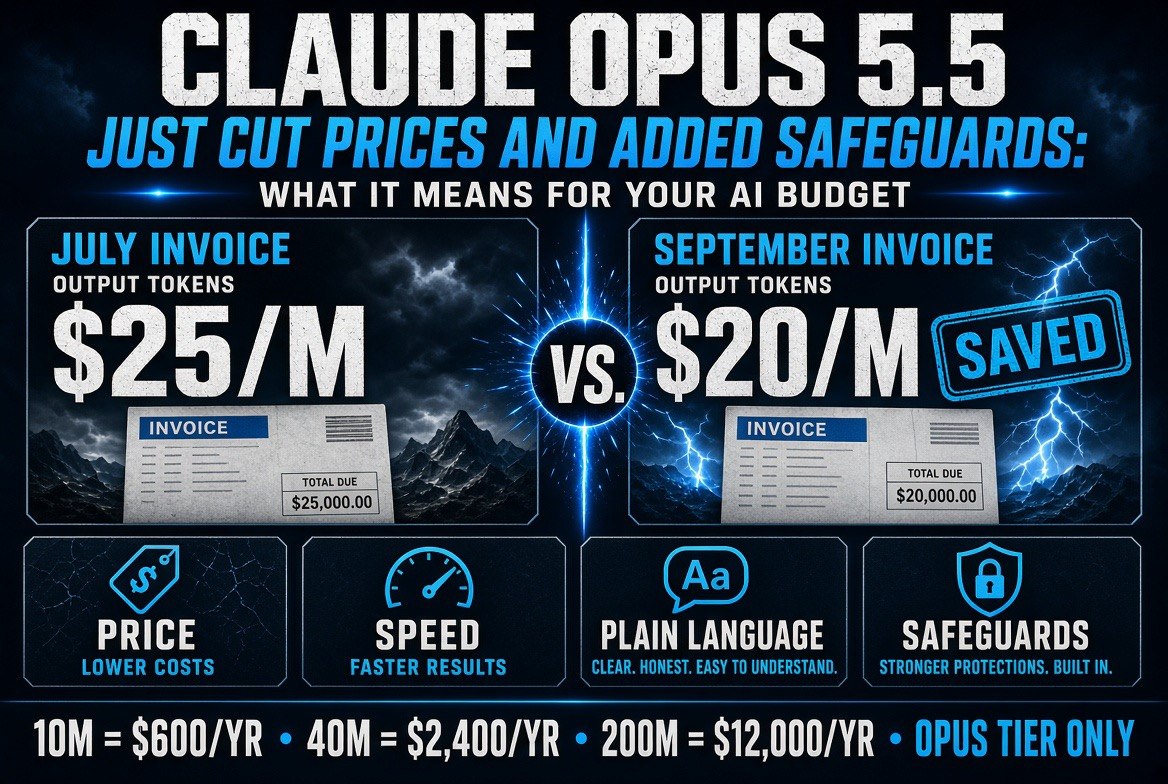
⚡ Expert Summary: Claude Opus 5.5 shipped Tuesday at $20 per million output tokens, down from $25 on Opus 5 — a 20% cut on the tier most businesses overpay for. It runs faster, beats the larger Fable model on many benchmarks, and arrives with the same stricter safeguards as Fable. Anthropic says Sonnet 5.5 and Haiku 5.5 follow in the coming weeks.
Anthropic released Opus 5.5 on Tuesday, and the headline number is the one that matters if you run a business: output tokens dropped from $25 to $20 per million. The model is also faster to run, because it needs less compute to serve. For a company paying per token across a team, that is a direct line-item reduction, not a marketing slide.
The more interesting story is what the release signals. Opus 5.5 is the first model Anthropic has shipped since CEO Dario Amodei publicly committed to “pacing the frontier” — deliberately slowing capability advancement so safety work can keep up. A cheaper, faster, more capable model arriving in the same release as tighter safeguards tells you where the industry is heading in 2026.
What Actually Changed in Claude Opus 5.5
Opus is the top tier of Anthropic’s three-model lineup: Opus is the most capable and most expensive, Sonnet sits in the middle, and Haiku is the fastest and cheapest. Opus 5.5 replaced Opus 5, which launched only two months earlier on July 24 — a rapid cadence that itself tells you something about the competitive pressure in enterprise AI.
Four changes matter for a small business:
- Price. Output tokens are $20 per million, down from $25. Anthropic reports similar price drops on other metrics.
- Speed. The model requires less compute to serve, so responses come back faster.
- Capability. Anthropic claims a new state of the art in coding and knowledge work, and says Opus 5.5 outpaces the larger Fable model on many benchmarks — including tasks Fable could not complete at all.
- Communication. Opus 5.5 is less likely to use jargon and more likely to lead with the important information at the start of a message.
That last one is easy to skim past, and you should not. Most AI frustration inside a small business is not a capability problem, it is a comprehension problem — the model knows the answer and buries it in three paragraphs of hedging. A model trained to put the conclusion first is a model your staff will actually use without being told to.
| What changed | Opus 5 (July 2026) | Opus 5.5 (September 2026) |
|---|---|---|
| Output token price | $25 per million tokens | $20 per million tokens |
| Compute needed to serve | Baseline | Lower — runs faster |
| Benchmark position vs Fable | Behind the larger model | Ahead on many benchmarks |
| Response style | Jargon-heavy | Plain language, conclusion first |
| Safety tier | Standard Opus | Fable-level safeguards |
Treat the benchmark claims as vendor claims. Anthropic is the one asserting a state of the art in coding and knowledge work, and independent scoring on this release has not caught up yet. The price and speed changes are the parts a buyer can verify against a bill.
The 20% Cut Is Real Money for a Small Team
Price cuts get filed under “nice to have” because a token line item looks small in isolation. Run the arithmetic on a team that actually uses the tool and the picture changes.
Say four people at your company push a combined 40 million output tokens a month through Claude — plausible once customer email drafts, proposal writing, spec reviews, and code assistance all route through the tool. At the old $25 rate that is $1,000 a month. At $20 it is $800. Same work, same people, $2,400 a year back.
Now scale that to a business burning 200 million output tokens a month across an AI-assisted product or a document-heavy workflow. The cut alone is $12,000 a year. That is a hire, a marketing budget, or a year of software. A 20% reduction on the tier your heaviest AI users touch is not a rounding error — it is a line item worth renegotiating your internal allocation around.
| Monthly output tokens | Cost before the cut | Cost from Tuesday | Annual change |
|---|---|---|---|
| 10 million | $250 | $200 | $600 saved |
| 40 million | $1,000 | $800 | $2,400 saved |
| 100 million | $2,500 | $2,000 | $6,000 saved |
| 200 million | $5,000 | $4,000 | $12,000 saved |
One caveat before you rebudget: this is the OPUS tier specifically. If most of your usage runs through Sonnet or Haiku, your rate did not change with this release. Check which tier your work actually lands on before you count the savings — and note that Anthropic says Sonnet 5.5 and Haiku 5.5 are coming in the coming weeks with similar performance improvements, which is where the next price move will hit.
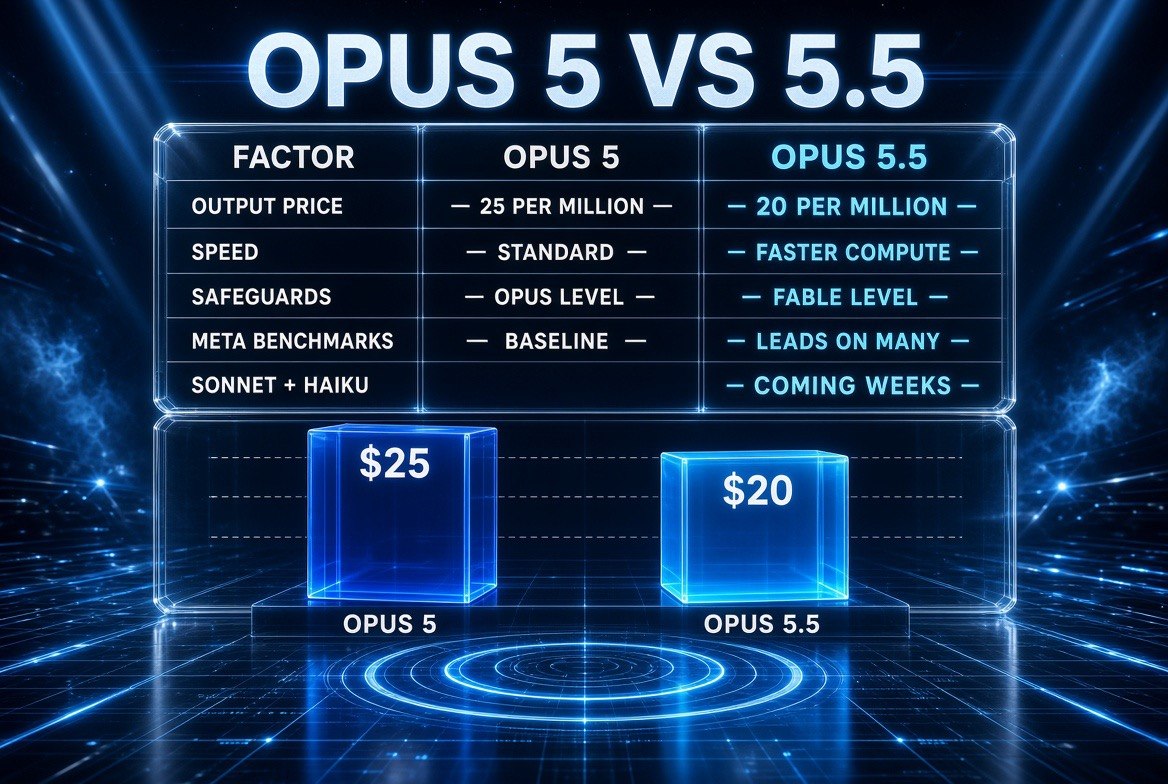
Opus 5 against Opus 5.5: output pricing drops from $25 to $20 per million tokens, with faster compute, Fable-level safeguards and stronger benchmark results arriving in the same release.
What “Pacing the Frontier” Means for Businesses Buying AI
Anthropic’s safeguards on Opus 5.5 are not boilerplate. The company says the model is comparable to Mythos in biology and cybersecurity capability, which puts it under the same restrictions as the Fable model. Those safeguards limit how far the models can be pushed to find exploits in compiled programs or to develop recognizable biological weapons, among other restricted tasks.
That is a capability ceiling imposed on purpose. The reason sits in Amodei’s own framing: he wrote that fully addressing the risks requires “even more prudence” — not just investing in risk prevention, but pacing the rate of capability advancement so prevention has time to keep up.
Opus 5.5’s safety training followed a familiar pattern: alignment testing plus pre-release evaluation by outside organizations including METR and Frontier Design. Anthropic also said more advanced training and evaluation systems are already in preparation for future models, along with improved security and monitoring, and hinted at further public-policy engagement to come.
Read that as a buyer and it is mostly good news with one operational catch. The good news: the vendor closest to the frontier is funding independent evaluation before release, which is the closest thing this industry has to a safety inspection. The catch: some capabilities are walled off, and if you were hoping to use a frontier model for security research or anything touching the restricted categories, this release is not the tool — and future ones may not be either.
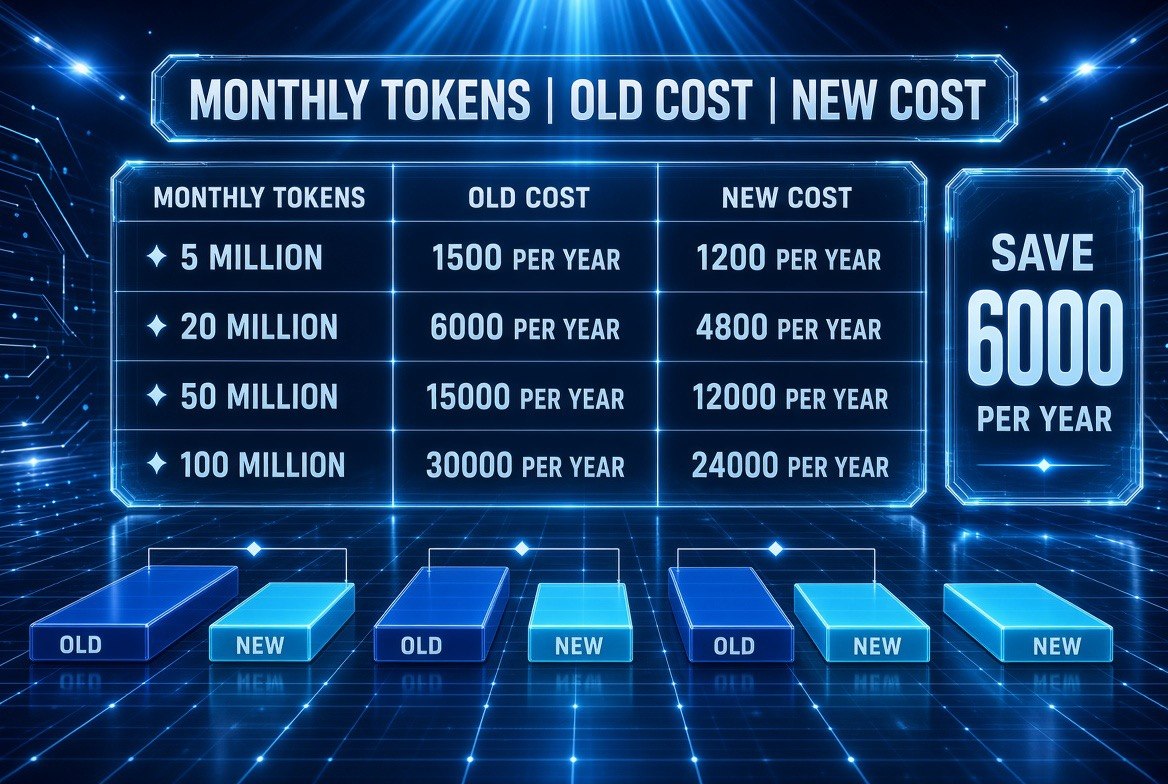
The 20% cut compounds with volume: a team burning five million output tokens a month saves $300 a year, while one burning 100 million saves $6,000 a year on the same workload.
What an AI Price Cut Actually Signals About the Market
A price cut on a flagship model is a competitive move, not generosity. Look at the cadence: Opus 5 in July, Opus 5.5 in September, with two more tiers promised within weeks. Meanwhile the wider field is moving just as fast — OpenAI shipped its 6-series models on the same day with its own aggressive pricing, and the whole category is converging on cheaper output.
Three practical conclusions for a small business owner:
- Do not sign long enterprise AI contracts right now. Rates are falling every few months. A 12-month locked-in price negotiated in July is already above the current list price on the tier that matters most.
- Model-switching costs are collapsing. When three vendors cut prices within the same quarter, the cost of changing providers keeps falling — which means your leverage keeps rising. Keep your prompts and workflows vendor-neutral enough to move.
- Re-run your AI budget assumption every quarter. If your plan assumes flat token cost, it assumes wrong. A budget review that treats AI spend as fixed is a budget that leaves money on the table.
The counter-argument worth taking seriously: cheaper inference does not mean cheaper operations. Most businesses that see a price cut respond by using more, not by banking the difference. If your team triples its output volume because tokens are cheap, your bill goes up, not down. The saving is real only if someone is actually watching the usage curve.
What to Do This Week
- Check your tier usage. Pull last month’s token report and see how much runs through Opus versus Sonnet or Haiku. The cut only helps the Opus portion.
- Re-price your top three AI workflows. Customer support drafts, proposal and estimate generation, and any coding assistance are usually the three heaviest token consumers.
- Test the communication change. The plain-language, conclusion-first output style is the difference most staff will notice immediately. Run it on one internal workflow where reading comprehension was the bottleneck.
- Map any restricted use case before you plan around it. If security research or biotech work is anywhere in your roadmap, the Fable-level safeguards are a constraint, not a detail.
- Wait on contract commitments. Sonnet 5.5 and Haiku 5.5 are weeks away with similar improvement claims. Locking pricing before those land is buying at the top of a falling market.
None of this requires a strategy document. It requires one budget line, updated on purpose, reviewed before you sign anything.
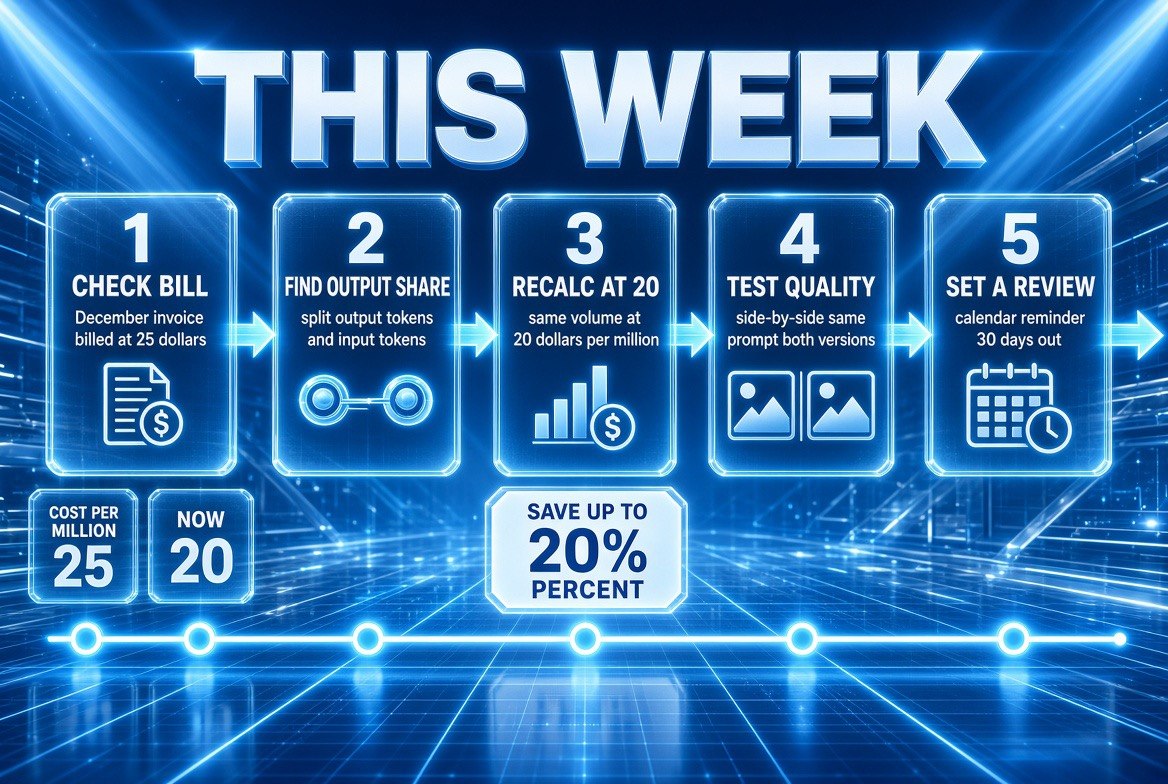
The week-one checklist: find what share of your bill is output tokens, reprice it at $20 per million, confirm quality on your own prompts, then book a review date 30 days out rather than trusting the announcement.
Frequently Asked Questions
How much cheaper is Claude Opus 5.5?
Output tokens on Opus 5.5 cost $20 per million tokens, down from $25 per million on Opus 5 — a 20% reduction. Anthropic reports similar price drops on other metrics, and the model needs less compute to serve, so it also runs faster.
When are Sonnet 5.5 and Haiku 5.5 coming?
Anthropic says the next two tiers in the Claude lineup, Sonnet 5.5 and Haiku 5.5, will be released in the coming weeks with similar performance improvements. No specific date has been confirmed.
Is Claude Opus 5.5 available for small businesses?
Yes. Opus 5.5 is generally available through Claude and the Anthropic API. The pricing change applies to API usage, so businesses building on the API get the reduction directly, while subscription users see it once Anthropic passes the change through.
Why does Opus 5.5 have stricter safeguards?
Anthropic says Opus 5.5 is comparable to Mythos in biology and cybersecurity capability, so it carries the same safeguards as the Fable model. Those limits restrict use for discovering exploits in compiled programs and developing recognizable biological weapons, among other tasks.
Does Claude Opus 5.5 beat the larger Fable model?
Anthropic claims Opus 5.5 sets a new state of the art in coding and knowledge work and outperforms the larger Fable model on many benchmarks, including completing tasks Fable failed. These are vendor-reported results and should be read as vendor claims.

About Barak Schurr
Barak Schurr built and sold a major ticketing platform, ran global nightlife operations at Eventbrite, and now spends his time figuring out which AI tools actually move the needle for independent business owners — and which ones are just noise. No hype. No fluff. Just what works.
Email: [email protected]
More AI Resources