
Get The Solo Business OS — Free
The AI workflow that replaces a part-time employee for solo operators and small business owners.
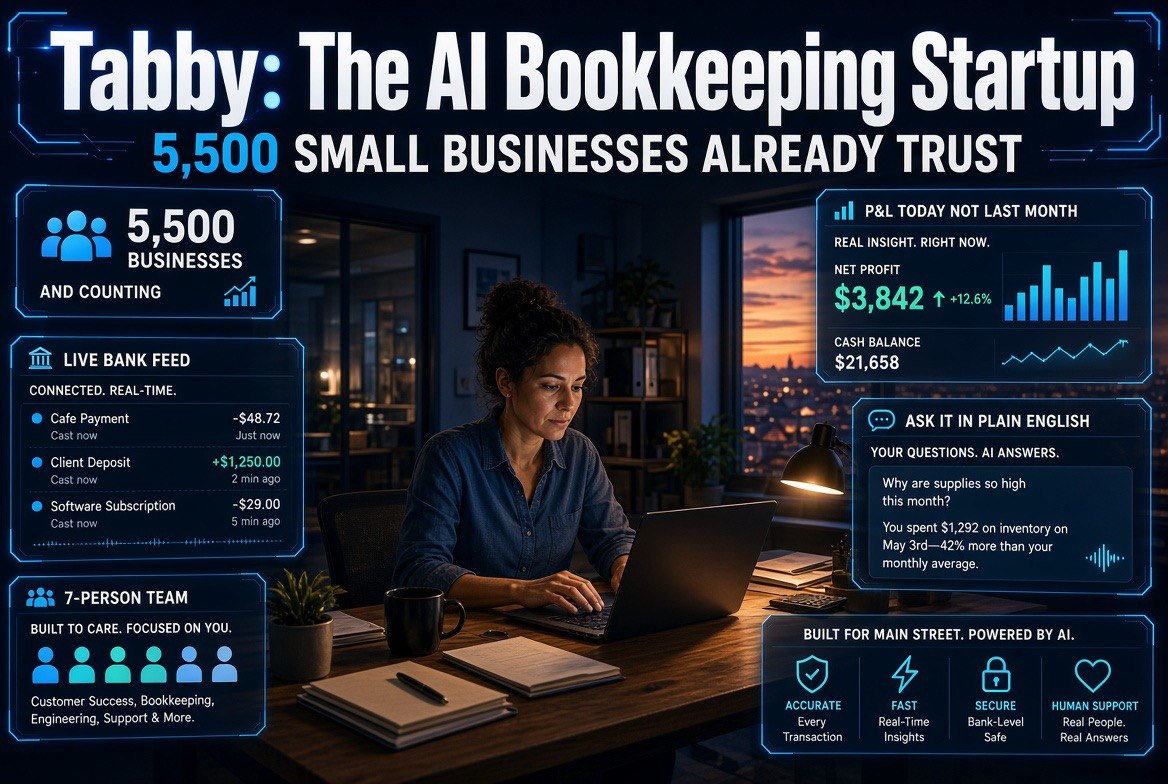
Tabby: The AI Bookkeeping Startup 5,500 Small Businesses Already Trust
⚡ Expert Summary
A former accountant who managed 20 staff and 2,000+ tax returns a year decided the problem wasn’t bad software — it was software at all. His product, Tabby, pulls live bank data through Plaid and builds a real-time profit-and-loss dashboard for 5,500 small businesses with a team of just 7 people. It cleared ~$100,000 in ARR in 14 months and is now raising a $1M pre-seed. Here’s what that model means if you’re paying a bookkeeper or wrestling QuickBooks every month.
Every small business owner has had the same conversation with their accountant. You ask a simple question — “how did last month actually go?” — and the answer arrives two weeks later, in a PDF, describing a world that no longer exists.
That lag is the entire product opportunity, and it is why a startup called Tabby is worth paying attention to this month. Its founder, Ahad Ali, spent years inside the accounting industry before deciding to attack it. He ran a firm with 20 people processing more than 2,000 returns a year — bookkeeping, accounting, sales tax, the full stack. It was stable, profitable, and exactly the kind of business most people would have kept running.
Instead, Ali noticed something that should worry every accounting firm in the country: the friction he was fighting wasn’t his clients. It was his tools.
“I realized that small businesses don’t need better accounting software,” he told TechCrunch. “They need less accounting software. They need something that just does it for them.”
What Tabby Actually Does
Tabby is not a bookkeeping platform with an AI assistant bolted on. It’s closer to the opposite: an AI system with a thin interface on top.
The mechanics matter, because this is where most “AI accounting” products quietly fail. Tabby connects to a client’s bank accounts through Plaid, the same data infrastructure behind most fintech apps. That connection provides live transaction data — not a nightly batch file, not a spreadsheet the owner uploads when they remember.
From there, the system builds a real-time dashboard of the business’s financial health, with profit-and-loss figures that reflect what has actually cleared the bank, not what was posted three weeks ago when someone finally reconciled the accounts.
There’s also a version of Tabby built for accounting firms that want an alternative to QuickBooks. But Ali’s strategy is deliberately aimed at the end user: go direct to the business owner whenever possible, and let the accountants follow.
The next piece landing is Tabby Talk, a natural-language interface. In practice that means an owner can ask a plain-English question about their numbers and get an answer, rather than opening a report, filtering a date range, and interpreting a chart.
That combination — live bank data, continuous reconciliation, conversational access — is what separates a real-time bookkeeping layer from a prettier dashboard on top of the same monthly close.
The Numbers Behind the Pitch
Vendor claims are easy to make and hard to verify, so here is what is actually on the record. Fourteen months in, Tabby reports 5,500 small businesses on the platform and roughly $100,000 in annual recurring revenue. The team is still seven people: Ali, a technical co-founder, four engineers, and one go-to-market specialist. The company is in the process of raising a $1 million pre-seed.
Read that combination carefully, because the ratio is the story. Five thousand five hundred businesses supported by seven people is not a staffing model that traditional accounting can match. A conventional firm serving that many clients would need hundreds of bookkeepers. That gap is the whole thesis — and the reason Ali frames the goal not as better software but as software that disappears.
“You can say QuickBooks digitized bookkeeping,” he told TechCrunch, “but we want to make [that visible software layer] nonexistent.”
It is worth being clear-eyed about the revenue figure. $100,000 ARR across 5,500 businesses works out to roughly $18 per business per year — well below what those businesses would pay a bookkeeper, and below what most accounting software charges. That tells you two things: the current base is likely heavy on free or low-tier usage while the product matures, and the real monetization is still ahead. This is an early company with a validated demand signal, not a finished business.
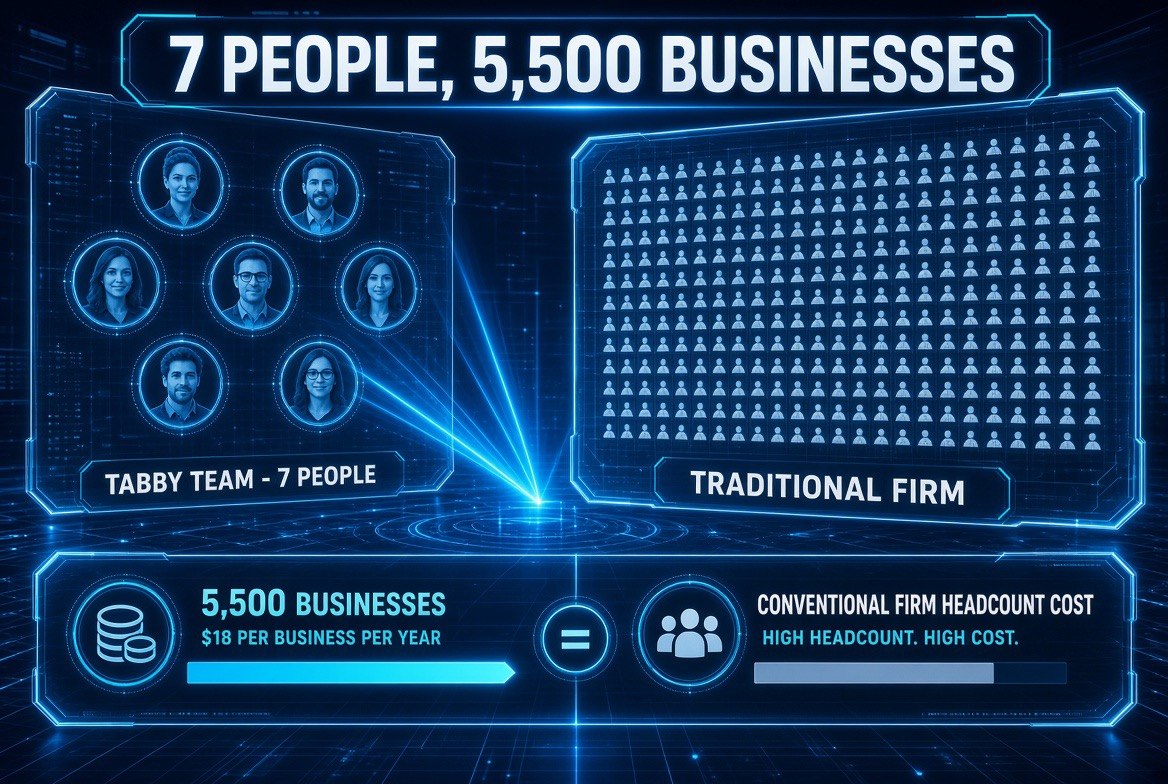
Tabby runs a seven-person team across 5,500 small businesses. A conventional bookkeeping firm serving the same client count carries hundreds of staff — that headcount gap is the entire pitch.
How Tabby Compares to What You Use Now
The honest comparison isn’t Tabby versus nothing. It’s Tabby versus the three options most US small business owners are actually choosing between.
| Factor | Tabby | QuickBooks | Part-Time Bookkeeper |
|---|---|---|---|
| Data freshness | Real-time, via live bank feeds | Depends on reconciliation cadence | Monthly close, typically 2–4 weeks behind |
| Who does the work | AI, with a dashboard you read | You, with software assistance | A person you hire and manage |
| Owner time required | Minimal — review and ask questions | Hours per month on categorization | Hours per month on handoff and review |
| Typical cost | Positioned toward a monthly service fee | Monthly subscription plus add-ons | Highest of the three by a wide margin |
| Natural-language queries | Yes — Tabby Talk | AI features added in recent updates | Yes, by email, with a delay |
| Track record | 14 months, 5,500 businesses, 7 staff | Decades, dominant market share | Varies entirely by the person |
The pattern in that table is consistent: you are choosing between freshness, control, and proof. QuickBooks gives you the deepest track record and the most accountants who already know how to work inside it, but it still expects you to do the categorization work. A part-time bookkeeper gives you a human you can call, at the highest cost and the slowest feedback loop. Tabby is betting that the owner wants neither software nor a hire — just the answer.
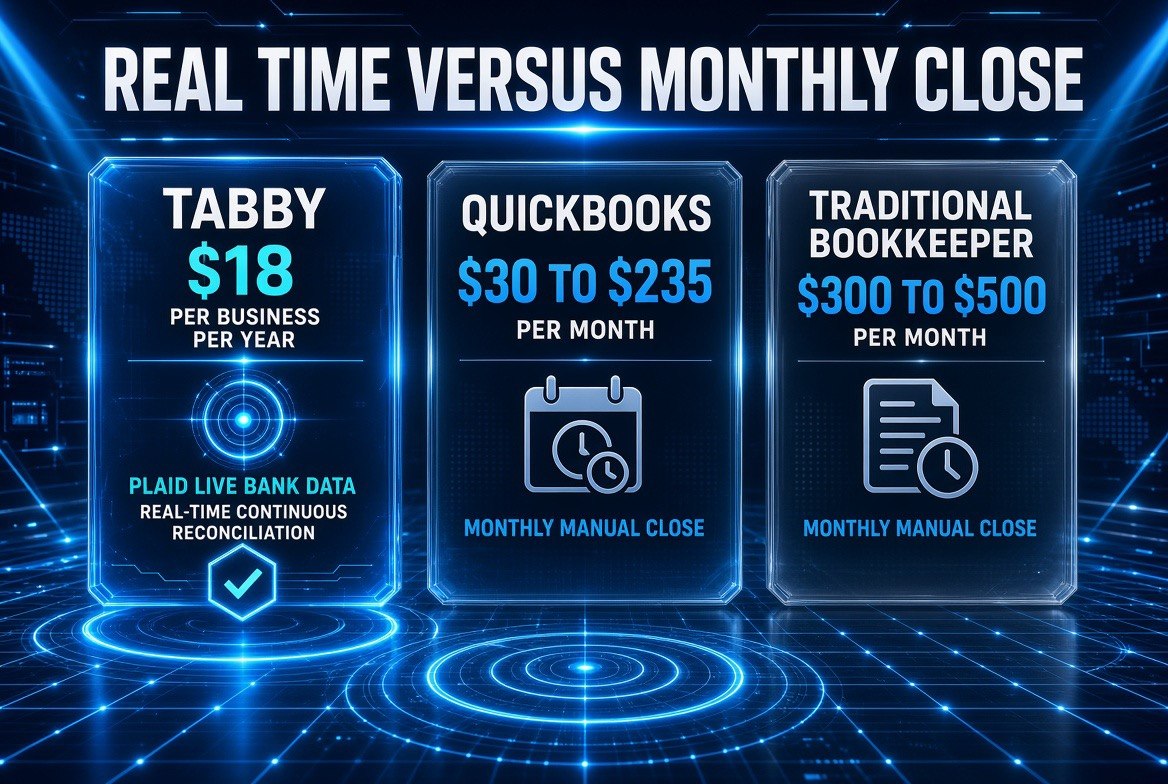
The pricing gap is the whole argument. Tabby’s roughly $18 per business per year sits against $30–$235 per month for QuickBooks and $300–$500 per month for a traditional bookkeeper.
Who Should Actually Care About This
Tabby is not going to be right for every business, and pretending otherwise would be dishonest.
It fits best if you are a service business, agency, or small retailer with straightforward revenue — invoices in, expenses out, a handful of accounts, and no inventory complexity. In that profile, live bank feeds plus continuous reconciliation can genuinely replace the monthly “send everything to the bookkeeper” ritual.
It fits poorly if your books involve inventory costing, multi-entity structures, revenue recognition rules, or heavy accrual accounting. Those are areas where human judgment is not friction to be removed — it is the product. Any AI bookkeeping tool that claims to handle them without review is selling you something it cannot deliver.
And regardless of which tool you pick, three things still belong to you:
- You own the bank connection. Tabby uses Plaid for live data. Know what you’ve authorized, and review connected accounts periodically.
- You own the tax position. Real-time bookkeeping makes filing easier. It does not make tax strategy decisions for you, and no dashboard should be treated as tax advice.
- You own the transition. Moving off QuickBooks mid-year means a clean handoff of your chart of accounts and history. Plan it for a quarter boundary, not a random Tuesday.
Why This Matters Beyond Tabby
The reason to watch this company isn’t that it will win. It’s what its existence proves about the market you’re operating in.
Tabby is walking into a crowded field. QuickBooks still owns the category. Rillet, backed by Sequoia, is attacking the same space with far more capital. And the major AI labs keep shipping their own finance and workflow tools, which means the layer beneath every accounting product is shifting under everyone’s feet.
Ali’s answer to that is volume, not features. “Everything we see is making us believe that there’s a path for other players, because the space is big,” he said. “There’s 30 million more businesses.”
Whether Tabby captures them or not, the pricing pressure is real. When a seven-person team can serve 5,500 businesses, the assumption that bookkeeping must be a recurring human cost starts to break. That’s good news if you buy accounting services, and a genuine strategic problem if you sell them.
| Decision Point | Stay With Your Current Setup | Trial an AI Bookkeeping Layer |
|---|---|---|
| Books are simple and stable | You aren’t losing much — the monthly close is not costing you decisions | Low urgency, but the freshness gain is still worth a look |
| You make decisions on stale data | You are paying for lag every month you wait | This is the strongest case — run it in parallel for one quarter |
| Year-round hiring or pricing calls | Decisions get made on last quarter’s picture | Real-time P&L changes the quality of those calls directly |
| Complex books or inventory | Keep the human in the loop — judgment is the value | Use AI for visibility, not for the close itself |
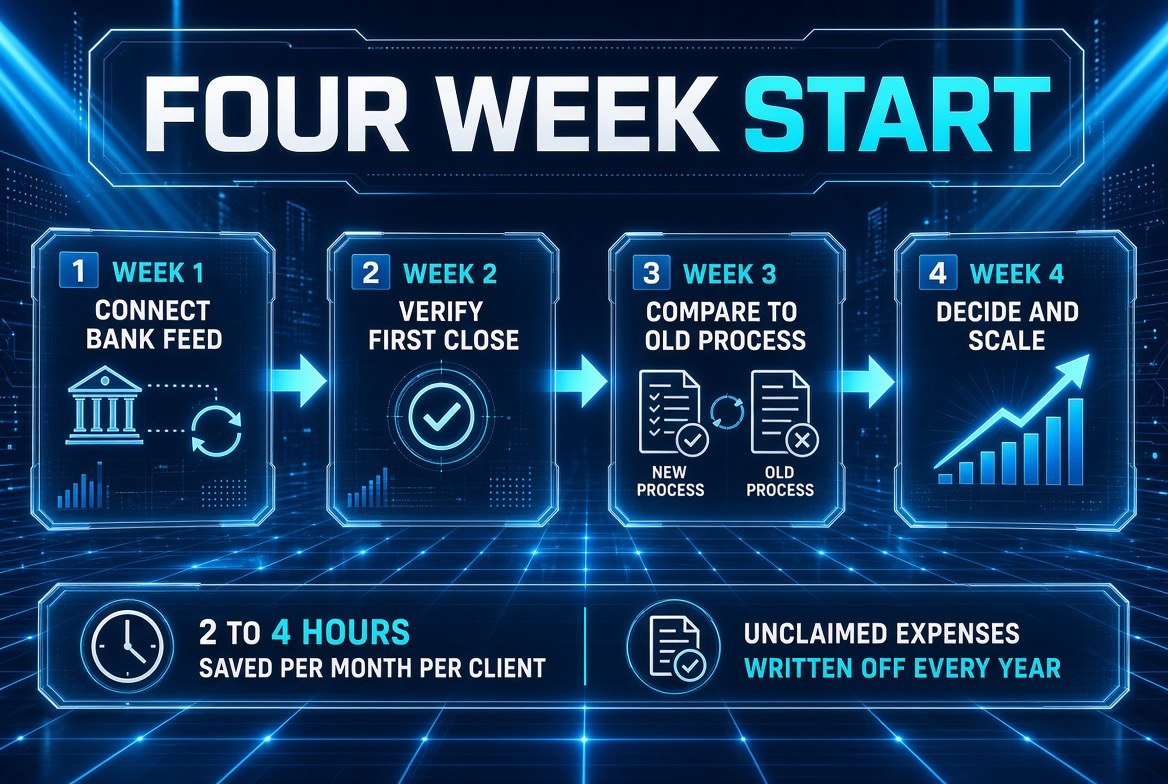
A four-week trial beats a software switch. Connect the bank feed, verify one close, compare it to your old process, then decide — with 2 to 4 hours saved per month per client on the line.
What to Do This Month
You don’t need to switch anything to benefit from this shift. You need to know your current number.
Step one: find out how old the data is that you’re making decisions on. Ask your bookkeeper when the last reconciliation was completed and how long it took. If the answer is measured in weeks, that lag has a cost you are currently absorbing silently.
Step two: estimate what you spend annually on bookkeeping and accounting software, combined. Most owners know the software line item but not the true all-in figure once human hours are included.
Step three: if the lag is real and the spend is meaningful, run a parallel test. Keep your existing setup, connect a real-time layer, and compare the two dashboards for a single quarter. You’ll either discover the freshness is worth paying for, or you’ll confirm your current process already gives you what you need. Both outcomes are useful, and neither requires you to trust a press release.
The direction of travel is clear: bookkeeping is becoming a live service rather than a monthly human project. The only question for your business is how long you want to keep deciding on numbers that are already out of date.
Frequently Asked Questions
What is Tabby?
Tabby is an AI-powered bookkeeping platform that connects to business bank accounts through Plaid and builds a real-time profit-and-loss dashboard. It was founded by Ahad Ali, a former accountant who ran a firm with 20 staff processing more than 2,000 returns a year. A version for accounting firms is also available.
How many businesses use Tabby?
Fourteen months after launch, Tabby reports 5,500 small businesses on the platform and roughly $100,000 in annual recurring revenue, run by a team of seven people. The company is in the process of raising a $1 million pre-seed round.
Is Tabby better than QuickBooks?
It depends on what you need. QuickBooks has decades of track record and near-universal familiarity among accountants. Tabby’s advantage is data freshness — live bank feeds and continuous reconciliation instead of a monthly close. If your books are simple and you want current numbers without doing categorization work, Tabby’s model is designed for you. If your books are complex, QuickBooks with a professional still makes more sense.
Can AI bookkeeping replace my accountant?
For routine bookkeeping on straightforward books, increasingly yes. For tax strategy, accrual accounting, inventory costing, and multi-entity structures, no — those require human judgment. The realistic outcome for most small businesses in 2026 is an AI layer for visibility and daily decisions, with a professional retained for tax and structural work.
What is Tabby Talk?
Tabby Talk is a natural-language interface for the product that lets owners ask questions about their financials in plain English instead of opening and filtering reports. It was preparing to launch at the time of Ali’s interview with TechCrunch.
How much does Tabby cost?
Pricing has not been published in detail. Ali has positioned the product toward a monthly service fee comparable to utilities like internet or payroll services, rather than per-seat software licensing. With roughly 5,500 businesses and about $100,000 in ARR, the current average revenue per business suggests a large portion of the early base is on free or entry-level usage.

About Barak Schurr
Barak Schurr built and sold a major ticketing platform, ran global nightlife operations at Eventbrite, and now spends his time figuring out which AI tools actually move the needle for independent business owners — and which ones are just noise. No hype. No fluff. Just what works.
Email: [email protected]
More AI Tools for Small Business

