Get The Solo Business OS — Free
The AI workflow that replaces a part-time employee for solo operators and small business owners.
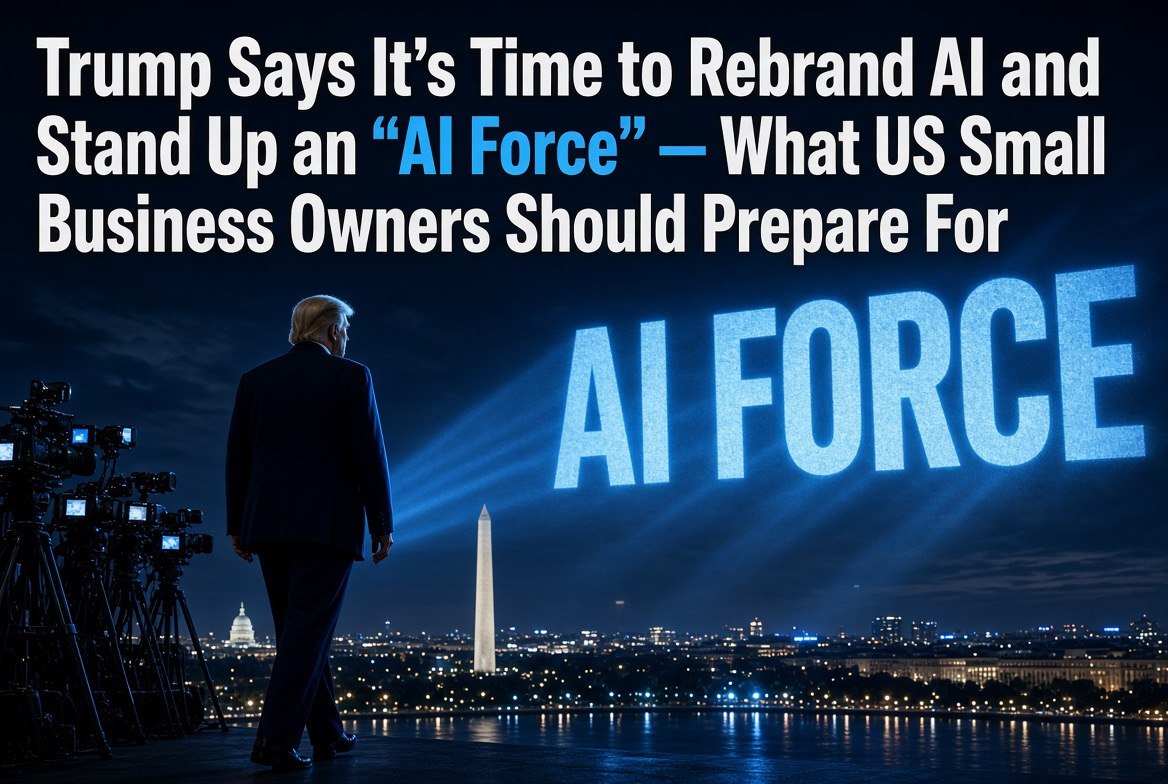
Trump Says It’s Time to Rebrand AI and Stand Up an “AI Force” — What US Small Business Owners Should Prepare For
⚡ Expert Summary: President Trump is calling the term “Artificial Intelligence” ineloquent, running a poll to rename it, and says he is forming an AI Force plus naming an AI “Czar.” No agency exists, no duties are defined, and no new obligation applies to small business today. What does exist is direction — and direction moves money, procurement criteria, and state rulemaking. This guide covers the four channels federal AI posture actually reaches a small business through, and the six-step checklist that protects you regardless of how the argument resolves.
| Action Now (Low Cost) | Who It Protects | Cost / Effort |
|---|---|---|
| Write down every AI tool you pay for and who owns the account | Any business bidding on government work | One hour, no cost |
| Keep a human sign-off note on every AI-assisted deliverable | Anyone subject to client audits or state consumer rules | Ongoing, minutes per job |
| Move long-term records off AI-native platforms into exportable formats | Every owner with 3+ years of business history | A weekend, near zero cost |
| Start a plain-English AI use log (tool, task, date, human checker) | Businesses chasing grants, insurance, or enterprise contracts | Ten minutes a week |
Most US small business owners I talk to have a simple system for AI policy news: ignore it until something breaks. That system has worked fine. It is about to stop working.
On September 19, 2026, President Trump posted on Truth Social that the words “Artificial Intelligence” are “inaccurate, and very ineloquent,” and launched a follower poll offering three replacement names — Superior Intelligence, Extreme Intelligence, and Supreme Intelligence. The poll was still running at the time of publication.
A couple of hours later he posted again, calling efforts at what he described as the “decimation, or destruction, of AI” one of many political hoaxes, and said he “will not stand by and let this happen.” He wrote that he will “cherish [the AI industry,] help it, and watch over it, as it grows.”
Then came the part that actually matters if you sign contracts for a living: he said he is forming an AI Force, modeled on the Space Force created in his first term, and that he will soon announce an AI “Czar,” adding “Only High I.Q. individuals need apply!” TechCrunch reported the sequence, and the announcement contained no further detail on what either entity will do.
That last sentence is the whole story for you. There is no agency structure, no budget line, no legislation, no effective date, and no named staff. Anyone selling you an “AI Force compliance package” this month is selling you a rumor with a logo. What exists is direction — a clear signal that federal AI posture is moving at political speed instead of committee speed.
Direction is tradeable information. Here is what to actually do with it.
What an “AI Force” and an AI Czar Actually Imply for a Small Business
Strip the branding and the announcement describes two things: a concentrated federal AI authority, and a person who answers directly to the president about it. In practice, that combination tends to touch small business through four channels, none of which require new legislation.
Procurement. Federal contracting already scores vendors on security posture, data handling, and subcontractor risk. When a single office owns AI policy, those scoring criteria get updated faster than the five-year contracting cycle most small vendors plan around. If you hold or want a GSA schedule, a state contract, or a subcontract on a federally funded project, your AI disclosure answers are becoming part of your bid whether you have an AI question on the form yet or not.
Grant and tax treatment. Federal AI adoption incentives have run through agency programs and small-business set-asides rather than sweeping statutes — look at the shape of the NSF AI hub program that pushed roughly $100M toward US small business AI adoption. Those programs get re-scoped when political priority shifts. A consolidated AI authority can re-point existing money without Congress passing anything new, which means your eligibility window can move on a Tuesday.
Compliance posture. The US still has no single federal AI statute comparable to the EU AI Act, and that is precisely why state-level rules have filled the gap. Federal direction that is friendly to AI deployment tends to slow federal rulemaking while accelerating state activity — the states become the enforcement surface. If you operate in multiple states, that is your real risk map, not Washington.
Public sentiment and platform rules. The announcement sits inside a visible argument about whether AI backlash is organic. That argument matters commercially because platforms, insurers, and enterprise procurement teams quietly align their own AI disclosure requirements with the loudest narrative of the moment. Your customer’s AI policy is often stricter than any law.
Notice what is not on that list: an “AI Force” registering your LLC, taxing your AI tools, or licensing your chatbot. That is not what this is. Be suspicious of anyone framing it that way.
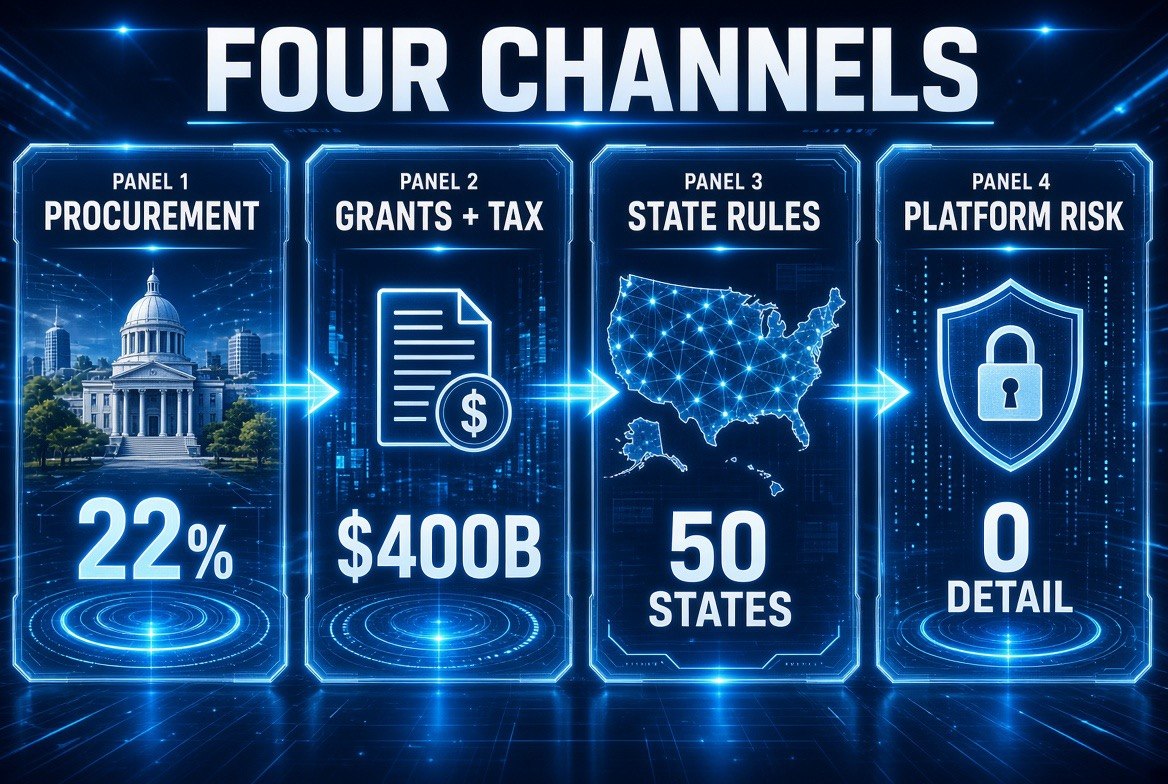
The four channels that carry federal and platform AI rules to a small business — procurement, grants and tax, state rules, and platform risk. Each one reaches you on a different timeline.
The Real Risk Isn’t Regulation — It’s Exposure You Already Have
Here is the part most owners get backwards. The thing that can hurt your business this quarter is not a future federal AI rule. It is the AI exposure you accumulated over the last eighteen months while nobody was watching.
Think about what a typical small operation is running right now. A chatbot handling inbound leads, a bookkeeping tool that categorizes transactions, an AI writer producing service page copy, an agent connected to your inbox, a scheduling assistant with calendar access. None of that was purchased as a risk decision. It was purchased as a margin decision.
Now ask four questions. Who owns the account if the contractor who set it up leaves? If a client asks which paragraphs a machine wrote, can you answer? If an insurer asks what data left your network last year, do you know? If a regulator in a state where you operate asks whether consumers were told they were talking to AI, can you prove it? Most owners cannot answer any of the four, and the cost of answering them is nearly zero today.
That gap is the actual exposure. Federal attention is what makes it visible — to your customers, your insurer, and the procurement officer reading your bid.
The 90-Day Prep Checklist That Doesn’t Depend on Who Wins the Argument
Everything below is useful regardless of how the AI Force shakes out. It is also largely free. Run it in order; the first two items take an afternoon.
1. Inventory and own your accounts. List every AI tool the business pays for. For each one, confirm the account is registered to a business email you control, not a personal Gmail belonging to a contractor. This single step resolves the most common and most expensive AI failure mode in small business: losing access to the data, workflows, and automations your operation depends on because the credentials walked out with a freelancer.
2. Document human review on anything that leaves the building. One line per deliverable is enough: what AI assisted, who checked it, what they changed. This is your defense in every direction at once — client dispute, insurance question, state consumer complaint, contract audit.
3. Move your long-term records somewhere you can export. Financial history, customer records, signed agreements, and SOPs should live in a format you can pull out without the vendor’s cooperation. AI-native platforms are excellent tools and unreliable archives. Contractors churn, vendors get acquired, pricing pages change overnight — and a well-prepared immigration lawyer’s worksheet will ask for all of it.
4. Keep a plain-English AI use log. Tool, task, date, human reviewer. Ten minutes a week. When a grant application, an insurance renewal, or an enterprise questionnaire asks how you use AI, you will have an answer in a format a non-technical reviewer can actually read.
5. Write a one-page AI policy and hand it to staff and contractors. What they may use AI for, what they may never paste into it, and who approves new tools. This is the cheapest insurance you will ever buy, and it takes the decision out of the hands of whoever is least trained on your team.
6. Move from per-seat AI pricing to usage-based pricing you can actually audit. The era of flat $20-a-month AI is closing, and the businesses that get surprised by AI spend are the ones who never mapped per-task cost. If you’re still on flat per-seat plans across five tools, know what each one costs per job it actually completes before you re-sign anything.
| Scenario | What a Federal AI Push Looks Like | Your Cost If Unprepared |
|---|---|---|
| AI-friendly federal posture | Fewer new federal rules, faster grant re-scoping, procurement asks get sharper | Missed grant window; weak bid score on AI disclosure questions |
| Federal gridlock | States keep filling the gap with their own AI and consumer-disclosure rules | Penalty and cure costs in each state you operate, discovered late |
| Public backlash hardens | Insurers, platforms, and enterprise buyers tighten their own AI disclosure terms | Lost enterprise deals; renewal friction you can’t trace to any law |
| Contractor or vendor churn | Nothing to do with Washington — but it’s the failure that actually happens | Lost workflows, lost records, rebuild cost measured in weeks |
Read that table again, because the bottom row is the one that will bite you. Three of the four scenarios are political and speculative. The fourth is a coin flip that shows up every time a contractor quits or a tool you depend on gets repriced. Federal AI noise is a good excuse to fix the boring problem.
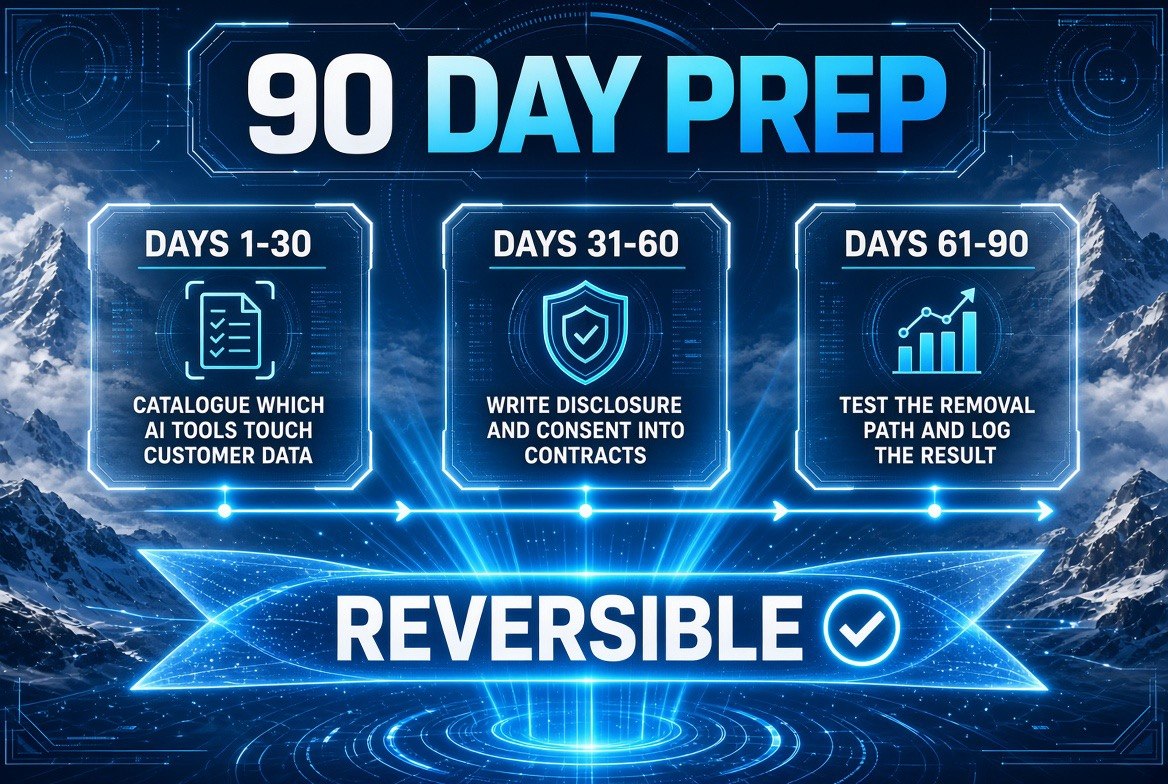
The 90-day prep sequence: catalogue the AI tools already touching customer data, write disclosure and consent into contracts, then test that you can actually reverse every step. Reversibility is the part that survives a change in administration.
What to Watch, and What to Ignore
Watch these three signals. First, whether an AI czar is actually named and whether the role carries procurement authority or is purely advisory — an advisory czar is a talking point, a procurement czar moves money. Second, whether any existing small-business AI grant program is re-scoped, expanded, or frozen; that is where policy becomes cash. Third, whether federal contracting forms add AI-disclosure fields, because that is where policy becomes paperwork you must complete to get paid.
Ignore these. Renaming the technology changes nothing about your operation — your customers still call it AI and so does every tool you buy. Executive-posted polls are marketing, not rulemaking. And any consultant offering an “AI Force readiness audit” before a single duty has been defined is selling anxiety; you can complete the entire preceding checklist yourself for the cost of an afternoon.
There is a second-order opportunity here, and it’s the reason I’d rather you read this post than a wire story. When federal AI posture becomes a political football, mid-market and enterprise buyers get nervous, and nervous buyers start asking vendors for AI governance documentation. A one-page AI policy, a use log, and human-review records let a five-person shop answer those questions faster than a fifty-person competitor that never wrote anything down. Preparedness is a sales asset, not just a compliance cost.
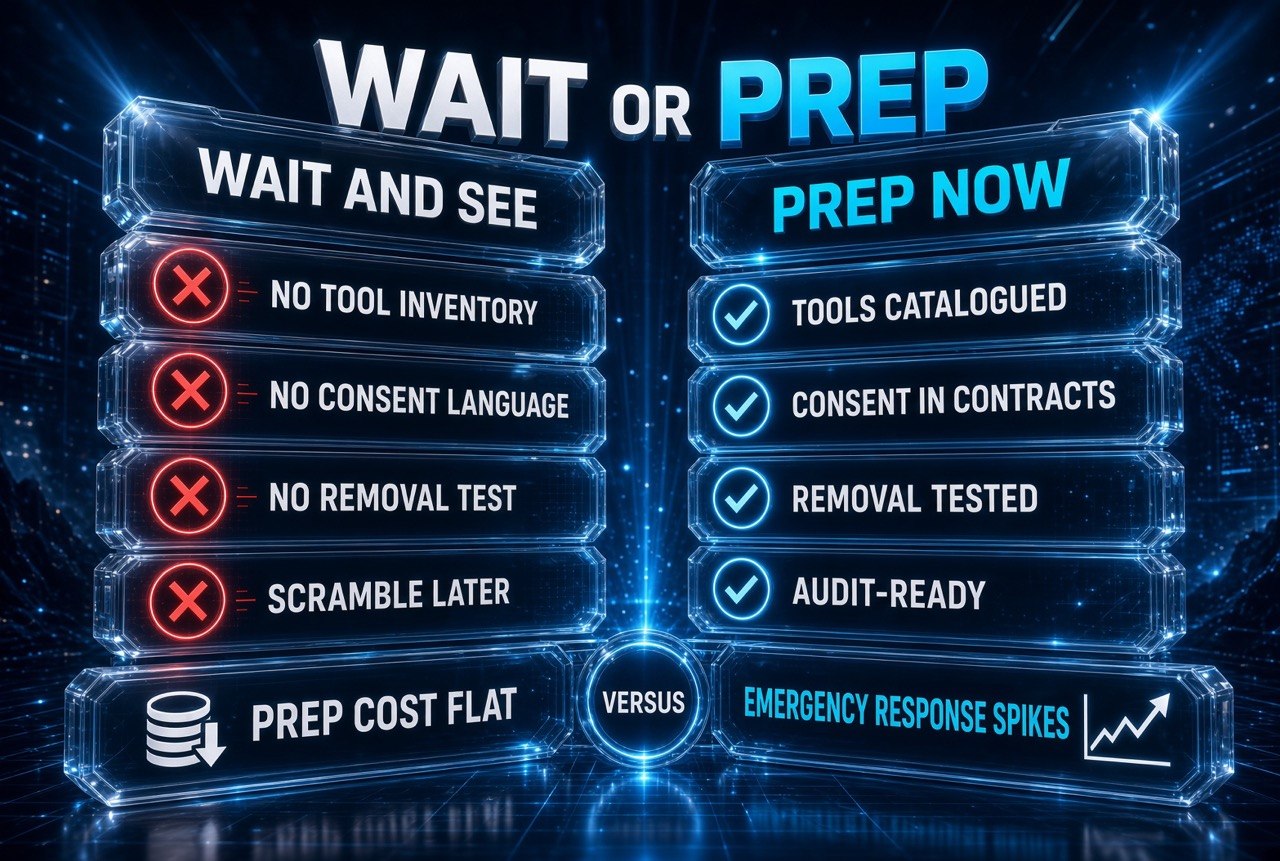
Waiting to see leaves you with no inventory, no consent language, and no tested removal path. Preparing now costs a fraction of the scramble later — and it is the only version of this that survives a change of administration.
The Bottom Line
Trump’s announcement is direction, not law. No AI Force exists yet, no czar has been named, and no new obligation has been created. But the direction — faster federal movement, concentrated AI authority, and a public argument that platforms and insurers will react to on their own — means the cost of having no answers about your AI usage is going up while the cost of having answers stays near zero.
Document the tools. Keep the keys. Show your work on human review. Give your records an exit. Do that and federal AI politics becomes something you read about instead of something that costs you a contract.
Frequently Asked Questions
Does the “AI Force” change any rules for small businesses right now?
No. As of the September 19, 2026 announcement, no agency has been established, no budget has been assigned, and no new obligation applies to small businesses. The president said he will announce an AI czar “in the near future” and did not define the role. Treat it as a direction signal, not a rule change.
Do I need to disclose that I use AI in my business?
There is no general federal AI disclosure requirement for small businesses in the US today. However, you may already owe disclosure under a client contract, an enterprise procurement questionnaire, an insurance application, a state consumer-protection rule, or a state AI law depending on where you operate.
What happens if federal AI rules get looser?
Expect states to fill the gap. When federal rulemaking slows, state legislatures and attorneys general typically become the active enforcement surface. If you operate in more than one state, your compliance map is at the state level, not the federal level.
Is the AI czar role actually powerful?
It depends entirely on scope, which has not been defined. A purely advisory czar produces headlines. A czar with procurement or budget authority reshapes what vendors must prove to win federal and federally funded work. Watch for that distinction before assuming either outcome.
What is the single highest-value thing I can do this week?
Confirm every AI tool your business pays for is registered to a business-owned account with credentials you control. It costs nothing, takes under an hour, and it prevents the most common AI disasters small businesses actually experience — losing access to the workflows and records their operation depends on.
Should I pause AI adoption until this settles?
No. The businesses winning with AI in 2026 are the ones running documented, human-reviewed workflows, not the ones waiting for clarity. Build the documentation habits now and any rule that eventually arrives becomes a checklist you already completed.

About Barak Schurr
Barak Schurr built and sold a major ticketing platform, ran global nightlife operations at Eventbrite, and now spends his time figuring out which AI tools actually move the needle for independent business owners — and which ones are just noise. No hype. No fluff. Just what works.
Email: [email protected]
More AI Tools for Small Business