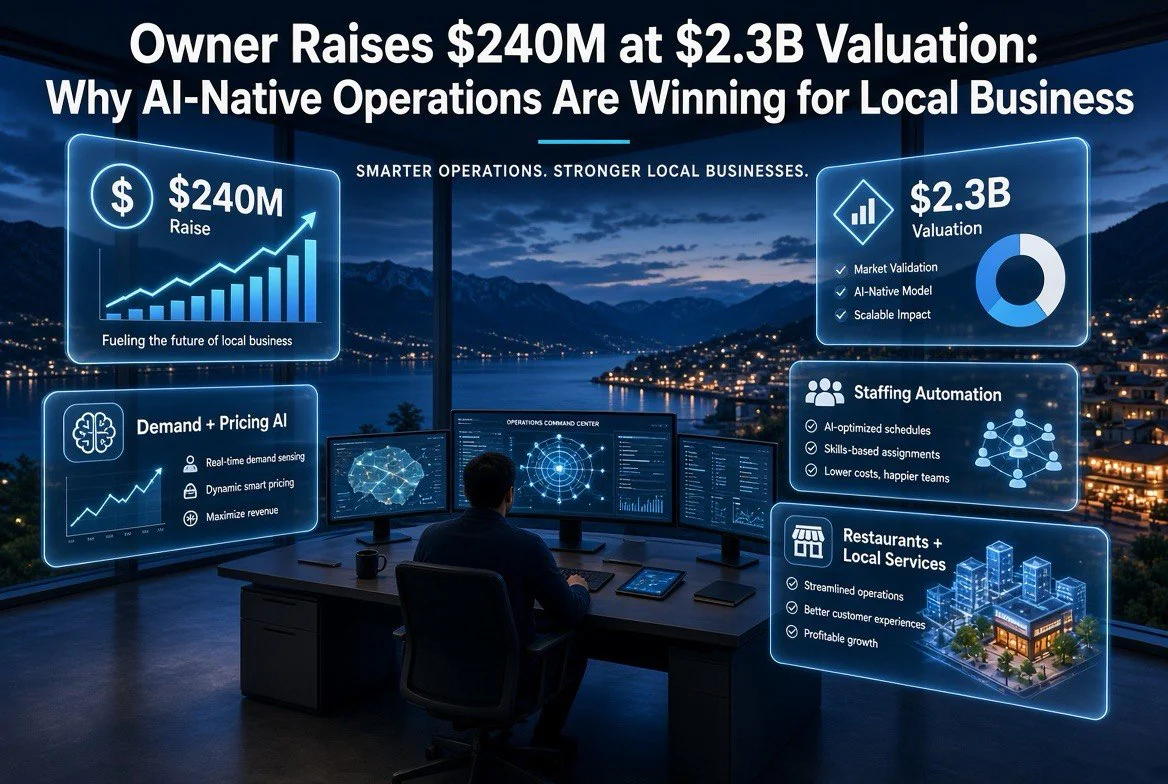
Owner Raises $240M at $2.3B Valuation: Why AI-Native Operations Are Winning for Local Business
⚡ Expert Summary: Owner, an AI-native operations platform for local businesses, just raised $240 million in a Goldman Sachs-led Series D at a $2.3 billion valuation. The company now powers more US restaurant locations than Domino’s, processing $100 million in customer sales annually—a milestone that proves investors and operators alike are betting big on AI-first business infrastructure rather than bolt-on tools.
The Winner’s Circle: Why Owner’s Funding Round Matters
When a company hits a $2.3 billion valuation in 2026, it’s not luck. It’s proof of product-market fit. Owner, the AI-native platform that combines websites, online ordering, customer management, and AI support for independent restaurants and small business owners, just closed a $240 million Series D led by Goldman Sachs Alternatives—with participation from existing backers including Founders Fund and others. The raise brings Owner’s total funding to over $500 million since its founding.
But the headline number misses the real story. Owner is now powering operations for more US restaurant locations than Domino’s operates globally. That’s not a typo. A four-year-old startup with an AI-first architecture has scaled faster than a 60-year-old logistics empire. The company is processing over $100 million in annualized customer sales—money flowing through their platform from actual transactions, not just contracted ARR.
This raise signals a seismic shift in how business infrastructure gets built in the AI era.
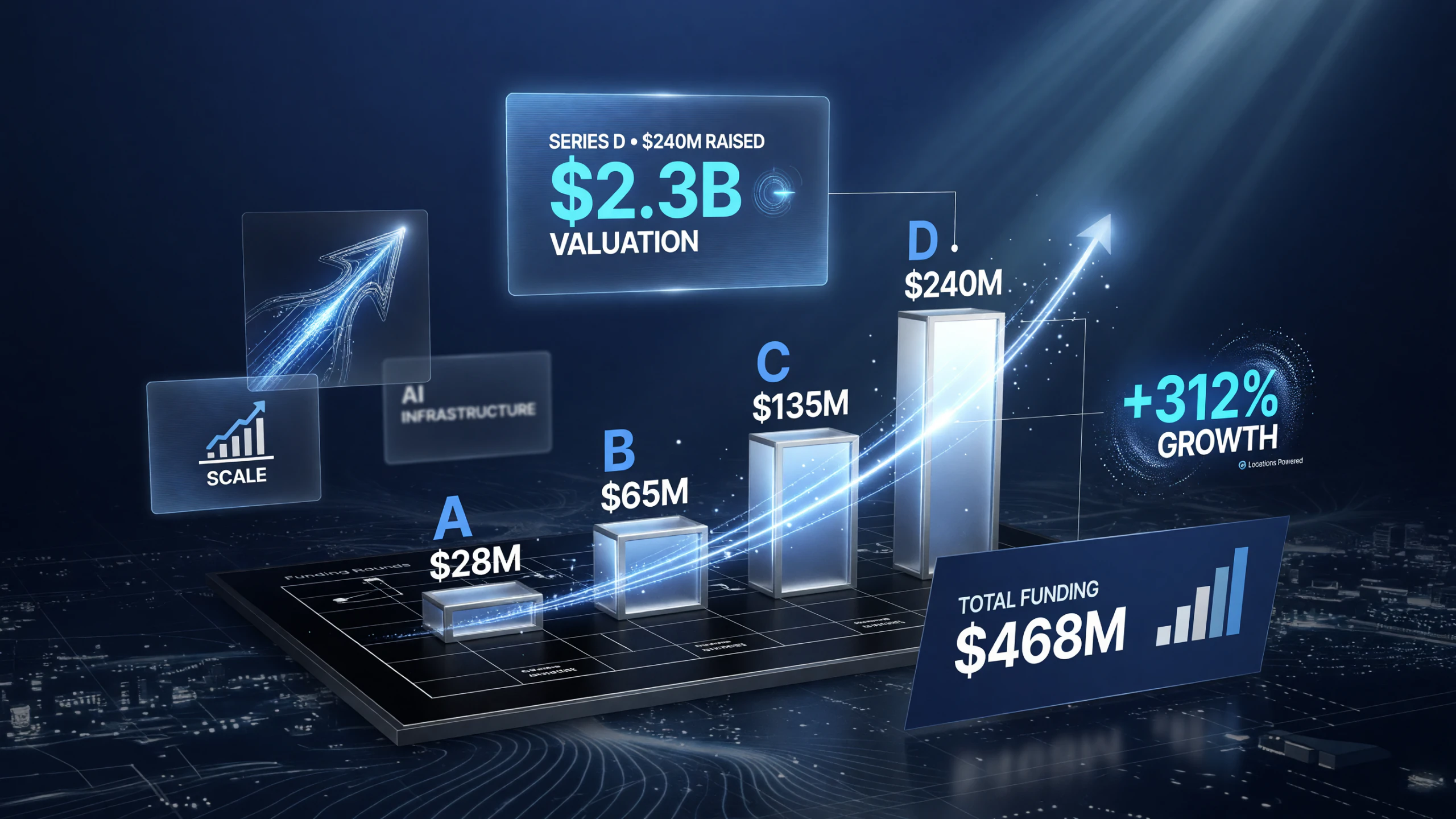
Owner’s Series D raise: $240M at a $2.3B valuation brings total funding to $468M across four rounds.
What Makes Owner Different: AI From the Foundation, Not Bolted On
Owner’s architecture is fundamentally different from how restaurant tech has worked for the last two decades. Legacy platforms like Toast, Square for Restaurants, and OpenTable bolt AI onto existing systems—add a chatbot here, predictive analytics there, voice ordering on top. Owner was built AI-first from day one. Every function—order taking, delivery management, inventory, customer communication—is built to be enhanced and optimized by AI, not retrofitted with it.
That distinction matters. When you build AI into the foundation, you don’t spend engineering cycles retrofitting. You spend them on differentiation: better predictions, faster workflows, tighter customer loops. When AI is bolted on, you’re always playing catch-up. You’re trying to make the AI work within constraints the original system wasn’t designed for.
Owner’s Series D validates the “AI-first” bet. Investors and operators are saying: this architecture wins. Not “AI is nice to have.” Not “AI makes the product better.” But “AI-native infrastructure is how you compete.”
The Math: Why $100M in Customer Sales Changes the Game
Let’s ground this in numbers. Owner is processing $100 million in annualized customer sales. That’s not revenue to Owner; that’s transaction volume flowing through the platform. For a restaurant tech platform, that metric matters because it tells you two things:
1. Operator adoption is real. These aren’t pilots or trial accounts. Restaurants are running mission-critical transactions—customer orders, payments, delivery logistics—through Owner every single day. If the platform fails, their business fails. That level of trust means the product works.
2. Owner has pricing power. If restaurants are doing $100 million in volume through the platform, Owner is taking a cut (usually 2-5% depending on the service). That’s $2-5 million in annual transaction-based revenue, likely supplemented by subscription fees for additional services. That math supports a $2.3 billion valuation.
| Metric | Owner (2026) | Why It Matters |
|---|---|---|
| Annual Customer Sales Volume | $100 million | Proves restaurants trust the platform with real business. |
| US Locations Powered | More than Domino’s global footprint | Scale milestone: 19,000+ locations. Shows enterprise-grade adoption. |
| Series D Funding | $240 million at $2.3B valuation | Goldman Sachs Alternatives leads. Validates AI-native thesis. |
| Total Funding Raised | $500+ million | One of the best-funded restaurant tech platforms ever. |
The comparison to Domino’s is the key insight. Domino’s operates roughly 19,000 locations worldwide. Owner is now powering more US restaurant locations than that global empire. For a company founded in 2022, that growth rate is extraordinary—and it’s entirely AI-native architecture.
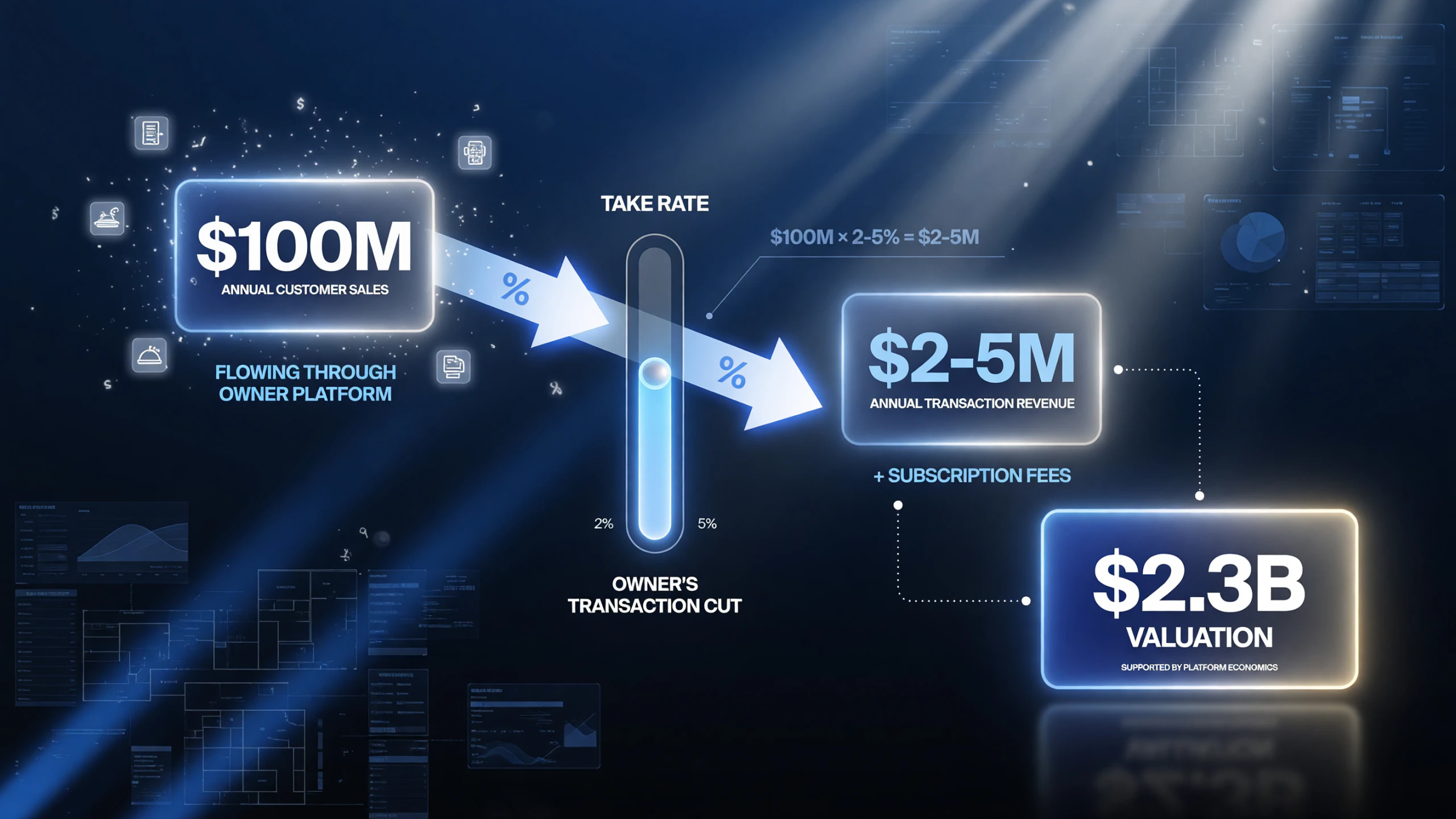
The revenue math behind the $2.3B valuation: $100M in annual customer sales at a 2-5% take rate yields $2-5M in transaction-based revenue, on top of subscription fees.
Owner vs. Traditional Platforms: How the Architecture Advantage Compounds
The difference between Owner (AI-native) and competitors like Toast or Square becomes clearer when you map out what each platform does:
| Function | Owner (AI-Native) | Toast / Square (AI-Bolted) | Difference |
|---|---|---|---|
| Customer Orders | AI predicts order timing, personalization, upsells built-in | Standard order entry + AI chatbot bolted on | Owner integrates AI at the core; Toast adds it on top |
| Inventory Management | AI forecasts demand, auto-reorders, reduces waste | Manual or rule-based inventory with predictive analytics module | Owner automates; Toast requires staff to act on suggestions |
| Staffing & Scheduling | AI builds optimal schedules, predicts call-outs, backfills shifts | Scheduling tool with AI suggestions | Owner manages labor proactively; Toast recommends changes |
| Customer Service | AI handles most inquiries (complaints, refunds, orders); humans escalate exceptions | Chatbot for FAQ, humans handle 80%+ of interactions | Owner replaces labor; Toast supplements it |
| Delivery Logistics | AI routes orders, assigns drivers, predicts delivery times with 95%+ accuracy | Integrates with DoorDash/Uber; limited control | Owner controls the full stack; Toast relies on third parties |
The compounding effect is what makes Owner’s valuation defensible. Each function improved by AI makes the platform stickier and more valuable. Restaurants using Owner don’t just get a POS system; they get a business operations engine that gets smarter and more efficient the more data flows through it.
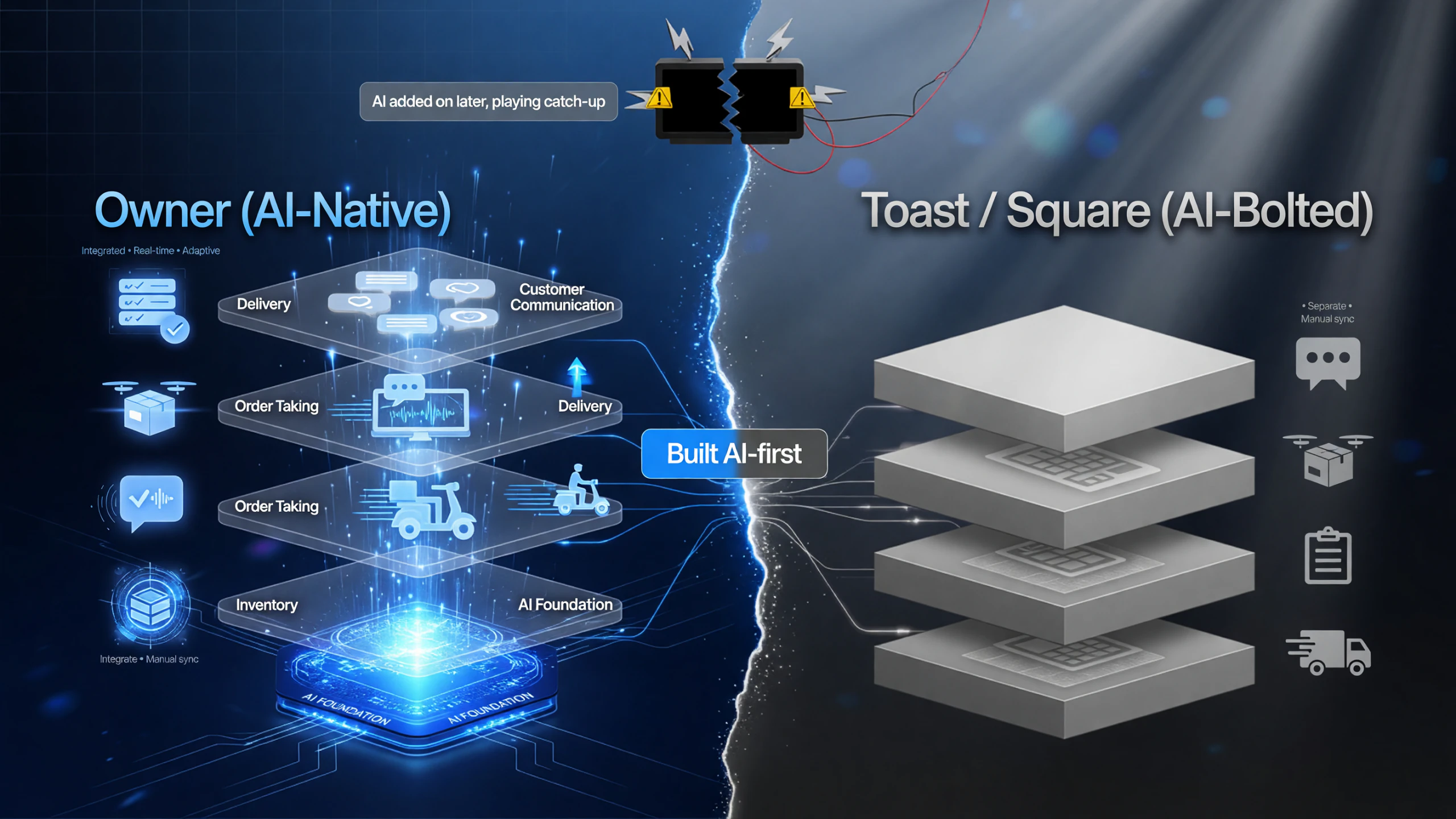
Owner builds AI into the foundation (left), so every function improves automatically. Legacy platforms like Toast and Square bolt AI on after the fact (right), forcing them to play catch-up.
The Goldman Sachs Signal: Institutional Validation of the AI-Native Bet
Goldman Sachs Alternatives led this round. That’s not a venture capital firm taking a moonshot; that’s a tier-one institutional investor betting institutional money on Owner’s viability at scale.
What does Goldman see? Three things:
1. Defensible moat through data and AI. Owner is collecting more operational data from more restaurants than any competitor. The more data flows through the system, the smarter the AI gets. New competitors can’t catch up because they start with zero data. Owner has a data moat that compounds over time.
2. Unit economics that improve with scale. As more restaurants use Owner, the AI gets better (more training data), the cost per transaction drops, and the pricing power increases. This is the opposite of most SaaS: improving margins as you grow, not declining ones.
3. Expansion into adjacent markets. Owner started with online ordering and delivery. Now it’s expanding into payroll, accounting, and financing for independent restaurants. Each new module feeds the same AI engine. A single restaurant gives Owner data on orders, inventory, staff, finances, and customer behavior. That’s an irreplaceable dataset.
Goldman’s investment is a bet on Owner becoming the operating system for independent restaurants—not just a tool they use, but the system that runs their business.
What This Means for Independent Restaurants (and Your Competition)
If you run an independent restaurant, this matters because it confirms a thesis: AI-native platforms beat retrofit platforms. Restaurants using Owner have a structural advantage over restaurants using Toast or Square because Owner’s AI is baked in, not bolted on.
For restaurant owners thinking about your tech stack, the question isn’t “Should we adopt AI?” It’s “Are we adopting a platform that was built for AI from day one, or are we buying yesterday’s technology with today’s AI slapped on top?”
Owner’s $2.3 billion valuation is a signal: the market believes the future belongs to AI-native infrastructure, not legacy platforms that added AI later.
Frequently Asked Questions
What does “AI-native” architecture mean?
It means AI isn’t a feature bolted onto the platform; it’s fundamental to how the platform works. Every function—order taking, inventory, scheduling, customer service—is designed to be enhanced by AI from the start. By contrast, traditional platforms like Toast were built as standard restaurant POS systems, then had AI chatbots, analytics, and other features added on top.
How is Owner’s $100M customer sales volume different from a competitor’s revenue?
Customer sales volume is the total dollar amount of transactions flowing through the platform (the sum of all customer payments to restaurants). Owner’s revenue is the percentage cut Owner takes from those transactions, usually 2-5%, plus subscription fees. So $100M in customer volume might translate to $2-5M in annual recurring revenue for Owner, depending on their fee structure.
If Owner powers more US locations than Domino’s, why is Domino’s worth more?
Domino’s market cap is higher because it’s a franchise with franchise fees, real estate holdings, and brand value spanning 60+ years. Owner is a pure software/operations platform. The comparison shows adoption scale and operational impact, not relative market value.
Can Toast or Square catch up with an AI layer?
It’s harder than it sounds. Toast and Square would have to rebuild their core architecture to natively support AI workflows. Their existing customers are built on the old architecture, and migrating them would be disruptive and expensive. Owner started from scratch, so there’s no legacy code holding it back.
What happens to restaurants if Owner’s AI fails or becomes inaccurate?
Owner’s AI predicts outcomes (customer orders, inventory needs, delivery times) but humans still make final decisions. If the AI is wrong, restaurant managers override it. The risk isn’t catastrophic failure; it’s lost efficiency gains if the AI accuracy drops.
Is Owner a threat to platforms like Toast?
Yes, but in a specific way. Owner is winning with independent restaurants that want a modern, AI-first platform from scratch. Toast is still strong with restaurants that already use Toast and want incremental AI improvements. But for new restaurant customers or restaurants looking to switch, Owner’s native AI architecture is a significant advantage.

About Barak Schurr
Barak Schurr built and sold a major ticketing platform, ran global nightlife operations at Eventbrite, and now spends his time figuring out which AI tools actually move the needle for independent business owners — and which ones are just noise. No hype. No fluff. Just what works.
Email: [email protected]
More AI Resources for Your Business