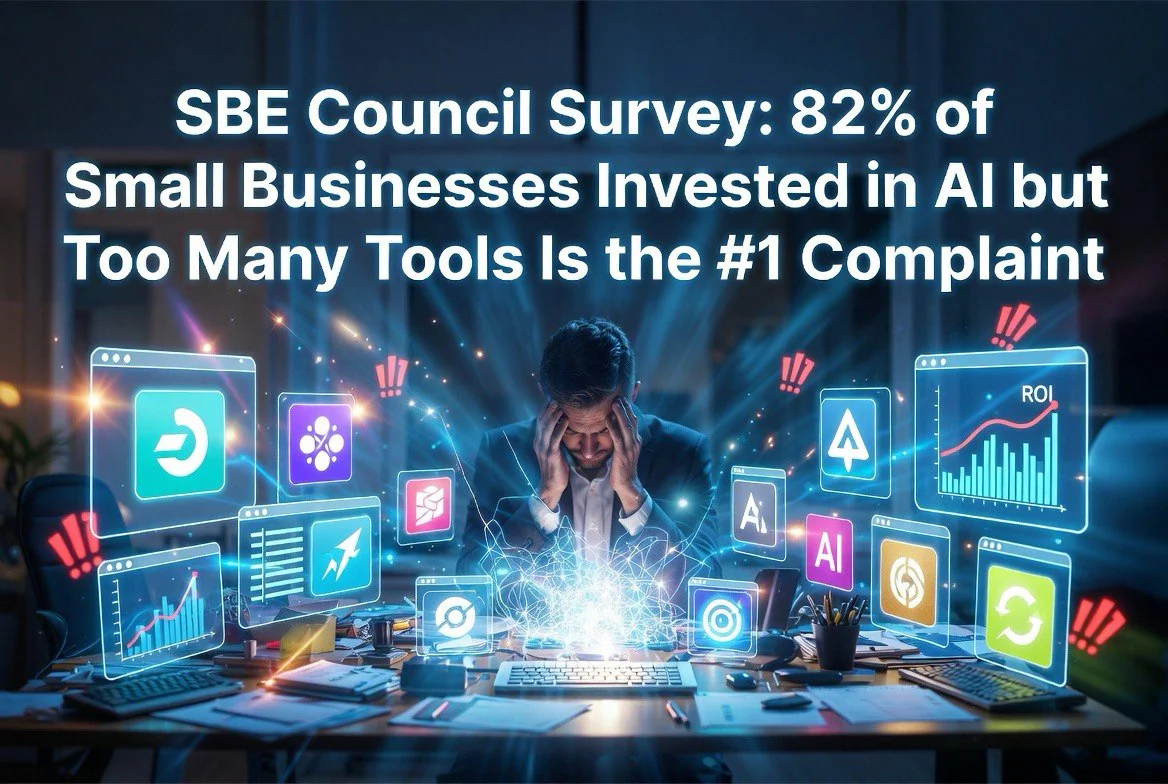
SBE Council Survey: 82% of Small Businesses Invested in AI — But “Too Many Tools” Is the #1 Complaint
⚡ Expert Summary: The Small Business & Entrepreneurship Council’s 2026 Tech Use Survey reveals that 82% of small business employers have adopted at least one AI tool, with the typical business using five different AI platforms and spending a median of $2,200 annually. While 66% of users report revenue gains from AI and 93% plan to continue investing, the top complaint is clear: too many tools without enough clarity. The survey highlights a growing tension between AI adoption enthusiasm and the operational complexity of managing a fragmented AI stack.
The Small Business & Entrepreneurship Council released its 2026 Tech Use Survey in March, based on a national survey of 517 small business employers. The headline number grabbed attention: 82% of small businesses have invested in at least one AI tool.
But the deeper story is more interesting than the adoption rate. The survey, which has been widely cited across business media through May, reveals a small business sector that is fully committed to AI — but struggling with the consequences of rapid, uncoordinated adoption.
The Numbers That Stand Out
The SBE Council survey is one of the most detailed looks at small business AI adoption in 2026, and several data points deserve attention:
82% have adopted AI. This is up sharply from comparable surveys in 2024 and early 2025. The acceleration is driven by embedded AI features in existing platforms (QuickBooks, Canva, Google Workspace, Microsoft 365) as much as standalone tools.
Median of 5 tools per business. The typical small business isn’t using one AI tool. They’re using five. This creates a management overhead that many owners didn’t anticipate.
Median annual spend of $2,200. Per business, per year. That’s roughly $183 per month on AI tools — a meaningful but not crippling expense for most small businesses.
66% see revenue gains. Among users who track results, two-thirds report revenue increases they attribute to AI. Of those, 22% saw gains exceeding 10%.
93% plan to keep investing. The commitment to AI is not wavering. Almost all current users plan to continue, and 62% expect to increase their AI spending.
81% say AI is important to competitiveness. This is the number that explains the others. Small business owners overwhelmingly believe that AI adoption is tied to their ability to compete.
The “Too Many Tools” Problem
Here’s where the survey gets interesting. The top complaint among respondents wasn’t cost, quality, or training. It was fragmentation. Business owners reported that managing multiple AI tools — keeping track of subscriptions, learning different interfaces, troubleshooting across platforms — was consuming time that the tools were supposed to save.
The median of five tools per business means most owners are juggling that many separate logins, billing cycles, feature updates, and support teams. For a business with a single owner-operator or a small team, that overhead is significant.
The complaint maps directly to what tools are popular. The survey found the most common AI use cases were:
General business research (37%). ChatGPT, Claude, and Perplexity dominate here — quick answers to business questions without needing a specific tool.
Content creation (30%). Writing blog posts, social media captions, email newsletters, and ad copy. ChatGPT and Jasper are the leaders.
Marketing automation (~25%). Social media scheduling, email sequencing, ad optimization. Tools like Buffer, HubSpot, and Mailchimp with AI features.
Project management (~25%). Notion AI, Asana intelligence, and ClickUp AI are the main players here.
Design and image generation (~20%). Canva Magic Studio dominates this category with its embedded AI features.
The problem isn’t any single tool. It’s that businesses end up with one tool per use case, and before long they’re managing five or more subscriptions with no unifying platform.
What the Survey Says About AI ROI
The SBE Council numbers on revenue gains and continued investment are encouraging for the AI industry. But they sit alongside the QuickBooks AI Impact Report from the same period, which found that over 50% of businesses can’t actually measure whether their AI investments are paying off.
The two surveys together tell a nuanced story. Small businesses are adopting AI at record rates and reporting positive outcomes. But the measurement gap is real. The “too many tools” complaint suggests that the operational burden of managing AI is starting to offset the productivity gains.
This is the natural maturation of any fast-adopted technology. The first wave is enthusiasm and experimentation. The second wave is consolidation and optimization. The SBE Council survey suggests small businesses are entering that second wave — looking to reduce tool count, improve integration, and actually measure what’s working.
Who Is Adopting AI and Who Isn’t
The 82% adoption number is an average, but the SBE Council survey reveals significant variation across business types and sizes that’s worth understanding.
Micro businesses (1-5 employees) are the most likely to have adopted AI — 87% reported using at least one tool. These are the owner-operators and solopreneurs who personally feel the time pressure of running every aspect of their business. For them, AI is not a nice-to-have. It’s a survival tool that lets one person do the work of three.
Small businesses (6-25 employees) show 79% adoption. These businesses are more likely to have dedicated staff for specific functions, which paradoxically slows AI adoption — there’s someone already doing the work, so the urgency to automate is lower. But when they do adopt, they tend to buy more tools: the median for this segment is seven AI platforms, compared to three for micro businesses.
Mid-sized small businesses (26-99 employees) show the lowest adoption rate at 74%, despite having the most resources. The reason appears to be existing software infrastructure. These businesses are more likely to have established enterprise agreements with platforms like Salesforce, Microsoft, or Oracle that have been slower to integrate AI features.
The takeaway for tool developers and resellers: the micro business segment is saturated and competitive. The mid-sized segment is underpenetrated and represents the biggest growth opportunity.
How the “Too Many Tools” Problem Actually Manifests
To understand why five tools per business is a problem, it helps to look at a typical stack and see where the friction accumulates.
A typical five-tool small business setup in 2026 might include: ChatGPT for research and writing, Canva for design, QuickBooks for accounting and AI financial insights, a CRM like HubSpot or Salesforce with AI features, and a social media scheduling tool with AI content suggestions. Each one has its own login, billing cycle, learning curve, support channel, and feature update schedule.
The owner spends time each month on password resets, subscription management, and reconciling data across tools that don’t talk to each other. The AI insights from the CRM don’t flow into the accounting tool. The AI-generated content from ChatGPT needs manual formatting before it goes into Canva. Each integration gap is a time sink that the AI was supposed to eliminate.
The SBE Council survey is the first major data point that captures this frustration at scale. It’s not that the tools don’t work individually. It’s that they don’t work together, and the cost of managing that fragmentation is starting to eat into the gains.
What the AI Industry Is Doing About It
The “too many tools” complaint hasn’t gone unnoticed by the platforms themselves. Several major trends in 2026 are responses to exactly this problem:
Platform consolidation. Canva is adding more AI features to reduce the need for separate design and content tools. QuickBooks is adding AI analytics and automation. HubSpot is embedding AI across its entire CRM suite. The all-in-one platform strategy is accelerating because the market is demanding it.
API-first tools. More AI tools are being built as API-first products that connect to existing platforms rather than requiring standalone apps. This reduces the login and interface overhead, though it increases technical complexity for the business setting them up.
AI orchestration layers. A new category of tool is emerging — platforms like Zapier with AI features, integration-focused AI assistants, and workflow automation tools that sit between the AI tools and manage them as a unified system. These are still early stage, but the SBE Council survey suggests the demand is real.
For small businesses, the implication is clear: if you’re feeling the tool fragmentation pain, you’re not alone. The industry is responding to it. The question is whether your preferred platforms will consolidate before the overhead gets worse.
What Small Business Owners Should Do With This Data
If you’re a small business owner running five AI tools and feeling the friction, the survey validates your experience. Here’s the practical advice it suggests:
Audit your AI stack. List every AI tool you’re paying for. Note what it does, how often you use it, and whether it integrates with your other tools. You’ll likely find at least one subscription you forgot about.
Consolidate where possible. Look for platforms that combine multiple functions. Canva does design and content. HubSpot does marketing and CRM. Google Workspace does email, documents, and basic AI. Every tool you eliminate reduces management overhead.
Measure before you expand. The 93% of businesses planning to increase AI spending should first establish baselines for their current tools. Without measurement, more spending just means more fragmentation.
Watch for platform consolidation. The market is moving toward integrated suites. QuickBooks adding AI analytics, Canva adding AI video, Zapier adding AI task management. All-in-one platforms are becoming more viable for small businesses, which could reduce the need for five separate tools.
The Bottom Line
The SBE Council survey confirms what many small business owners already know: AI is essential to staying competitive in 2026, but managing a growing collection of AI tools is its own kind of work. The businesses that win in the next phase won’t be the ones with the most AI tools. They’ll be the ones that consolidate, measure, and optimize.
Frequently Asked Questions
What percentage of small businesses use AI in 2026?
According to the SBE Council’s 2026 Tech Use Survey, 82% of small business employers have invested in at least one AI tool. The typical business uses a median of five different AI tools and spends $2,200 annually.
What are the most common AI use cases for small businesses?
The top use cases are general business research (37%), content creation (30%), marketing automation (~25%), project management (~25%), and design/image generation (~20%). Most businesses use a separate tool for each function.
Are small businesses seeing ROI from AI investments?
66% of AI users report revenue increases they attribute to AI, with 22% seeing gains exceeding 10%. However, a separate QuickBooks study found that over 50% of businesses lack the measurement systems to verify these results.
What is the “too many tools” problem?
The survey found that the top complaint among small business AI users is the fragmentation of managing multiple separate AI subscriptions. With a median of five tools, owners spend significant time managing logins, billing, and feature updates across different platforms.
How can small businesses reduce AI tool overload?
Conduct an AI stack audit to identify unused subscriptions, consolidate onto platforms that offer multiple functions (like Canva or HubSpot), establish baseline measurements for current tools, and prioritize integrated suites over standalone applications.
Does the SBE Council survey match other AI adoption studies in 2026?
The 82% figure is higher than the QuickBooks AI Impact Report’s 77% and the U.S. Chamber of Commerce’s 58% for generative AI specifically. The differences are explained by methodology — SBE Council surveyed a broader range of AI tools including embedded features, while the Chamber focused on generative AI tools like ChatGPT. All three studies agree on the direction: AI adoption among small businesses is accelerating rapidly and is now mainstream.
What AI tools do small businesses use most in 2026?
ChatGPT leads for research and content creation with over 60% usage among AI-adopting small businesses. Canva Magic Studio dominates design at roughly 45%. QuickBooks AI features lead in accounting at 40%. HubSpot and Zapier with AI features are the top choices for CRM and automation respectively.
Barak Schurr built and sold a major ticketing platform, ran global nightlife operations at Eventbrite, and now spends his time figuring out which AI tools actually move the needle for independent business owners — and which ones are just noise. No hype. No fluff. Just what works.
More AI Resources for Your Business