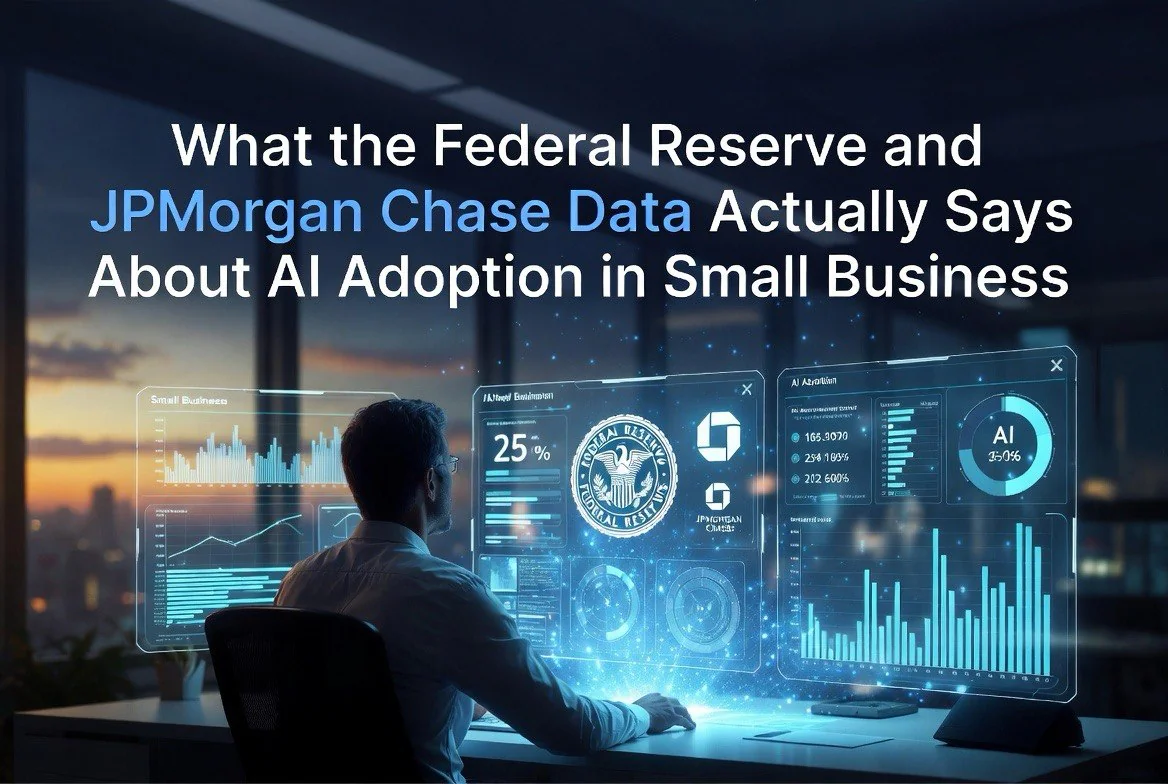
What the Federal Reserve and JPMorgan Chase Data Actually Says About AI Adoption in Small Business
Two of the most credible institutional sources on small business economics just published 2026 reports on AI adoption. Not tech blogs. Not vendor surveys. The Federal Reserve and the JPMorgan Chase Institute. The data tells a more nuanced story than the hype suggests.
The Federal Reserve Numbers: 46% Adoption, 71% Productivity Gain
The Fed’s 2025 Small Business Credit Survey, published March 2026, surveyed 6,525 small employer firms nationwide. The headline: nearly half of firms (46%) reported that their business or its employees currently use AI. Another 15% planned to adopt within 12 months. One-third have no plans to use AI at all.
But the most interesting data is what happens after adoption. Of the businesses using AI:
– 71% reported increased productivity
– 39% noted improved quality of goods and services
– 31% reported higher sales
– The vast majority saw no change in labor costs
The last point matters. The fear that AI would replace workers isn’t showing up in the Fed’s data. Businesses are getting more output from the same headcount, not cutting jobs.
The Integration Reality Check
Here’s where the hype meets reality. Of the firms using AI:
– About half said their business is experimenting with AI
– 44% had partially integrated AI into their business processes
– Only 7% had fully integrated AI
That 7% number is the most important stat in the entire survey. Most coverage focuses on the 46% adoption figure and stops there. But adoption doesn’t mean mastery. The overwhelming majority of small businesses are still figuring out how to make AI work inside their actual operations.
The most common tasks: writing and marketing (83%), individual productivity (61%), and planning or analysis (51%). These are the entry points — the low-hanging fruit. Very few businesses have pushed AI into their core operational workflows.
The JPMorgan Chase Institute: Who’s Actually Adopting
JPMorgan Chase’s Institute approach digs deeper than the Fed’s survey by analyzing actual business data across their customer base. Their findings reinforce the Fed’s numbers but add an important layer: adoption is not evenly distributed.
Larger small businesses adopt AI faster than smaller ones. Businesses with 10-49 employees are significantly more likely to use AI than solo operators or micro-businesses. This makes sense — AI tools require time to implement and train on, and time is the one thing solo operators don’t have.
Industry also matters. Professional services, technology, and information businesses lead adoption. Manufacturing and construction lag. Retail and hospitality fall in the middle. The JPMorgan analysis draws on multiple data sources including the U.S. Census Bureau’s Business Trends and Outlook Survey and the OECD’s SME Digitalisation Survey. The consistent finding across all of them: AI adoption in small business is real and growing, but it follows the same pattern as every previous technology wave — larger firms and certain industries lead, and the rest catch up over time.
The SBE Council Stack: Five Tools Is the New Normal
The Small Business & Entrepreneurship Council’s own 2026 survey found that 82% of small business employers have invested in AI tools — a higher adoption number than the Fed’s 46% because it includes businesses that purchased tools but may not consider themselves “AI users.”
The SBE Council data shows the typical small business now runs a median of five AI tools. The most common stack includes:
1. A core AI assistant — ChatGPT, Claude, or Gemini — for research, writing, and brainstorming
2. A marketing and content creation tool — Canva, Jasper, or Copy.ai for design and copy
3. An automation or workflow tool — Zapier or Notion for connecting apps and managing projects
4. A customer service or sales tool — HubSpot or Tidio for CRM and chatbots
5. A finance or operations tool — QuickBooks or Xero for bookkeeping and forecasting
The “stack approach” is replacing the “single magic tool” mindset. Businesses are learning that AI isn’t one thing — it’s a set of specialized tools that work together.
One of the most interesting findings from the SBE Council survey: 97% of small businesses using AI pricing tools reported positive revenue impact. Pricing optimization is emerging as the highest-ROI AI application for small businesses, even though it gets less attention than content generation.
Three Sources, Three Different Adoption Numbers — Why the Gap Matters
The Fed says 46% of small businesses use AI. The SBE Council says 82% have invested in AI tools. JPMorgan Chase’s data confirms adoption skews toward larger firms. These numbers aren’t contradictory — they’re measuring different stages of the same process.
The Fed asks “do you use AI?” and gets a yes/no answer that captures active usage. The SBE Council asks “have you invested in AI tools?” and captures anyone who’s purchased a subscription, tried a chatbot, or run a pilot. JPMorgan Chase looks at actual business data patterns and sees which firms are using AI consistently versus experimentally.
All three tell you something useful. The Fed tells you how many businesses are currently active. The SBE Council tells you the total addressable market that’s at least trying AI. JPMorgan Chase tells you which businesses are getting the most value.
The gap between 46% and 82% is roughly 36% of businesses that bought AI tools but haven’t truly “adopted” them yet. That’s the churn zone — and it’s where most of the disappointment lives. If you bought an AI subscription, used it twice, and let it expire, you’re counted in the SBE Council’s 82% but not the Fed’s 46%.
The Accuracy Problem Nobody’s Solved
The Fed survey also surfaced what the SBE Council confirms: the top challenge for AI users is accuracy (46%). This is the unglamorous reality that every small business owner eventually discovers. Your chatbot will occasionally say something wrong. Your AI writer will invent a statistic that sounds plausible but doesn’t exist. Your pricing tool will make an aggressive recommendation that doesn’t account for a niche market condition.
Accuracy issues are particularly painful for small businesses because there’s no dedicated AI oversight team. A large company has a data scientist checking model outputs. A small business has the owner — who’s already wearing seventeen other hats. When the AI gives you a wrong answer and you don’t catch it, the cost can be significant.
The second most common challenge, cited by 43% of AI users: adapting tools to meet business needs. Off-the-shelf AI doesn’t fit every business perfectly. A chatbot trained on general customer service data might not understand your specific product line. A content generator might not capture your brand voice. The most successful adopters are the ones willing to invest time in customization, prompt engineering, and training.
For firms that plan to use AI in the next 12 months, the top challenges shift. Finding tools to meet business needs jumps to 54%. The time required to implement or train employees on AI is 37%. These numbers tell you that the barrier isn’t skepticism anymore — it’s execution. Most businesses want to adopt, they just don’t know how to start efficiently.
Among the 33% of businesses with no plans to use AI, over half said it’s not applicable to their business. Another 30% said they prefer not to use it. This group is shrinking over time, but it won’t disappear entirely. Some businesses genuinely don’t benefit from AI. A local plumber with one van and a flip phone doesn’t need to optimize their marketing funnel.
What the Data Says About the Future
All three data sources point to the same trajectory: AI adoption in small business will continue accelerating, but the pattern will mirror previous technology waves. The businesses that adopt early and integrate deeply will build competitive advantages. The laggards will eventually catch up using cheaper, more commoditized tools — but they’ll be playing from behind.
The Fed data shows that only 7% of businesses have fully integrated AI. That number will grow. But the question every small business owner should ask isn’t “should I use AI?” — it’s “how do I integrate AI better than the 93% of businesses that haven’t figured it out yet?”
The businesses that will win are the ones that move from experimentation to integration. From buying five tools to connecting five tools. From asking AI to write a draft to building a workflow where AI handles research, writing, editing, and publishing in sequence.
That’s where the 71% productivity gain lives. Not in the tool purchase. In the integration.
What This Means for Your Business
What percentage of small businesses use AI in 2026?
The Federal Reserve’s Small Business Credit Survey found 46% of small businesses currently use AI, with an additional 15% planning to adopt within 12 months. The SBE Council’s survey found 82% have invested in AI tools, which includes businesses that own tools but haven’t fully adopted them yet.
Does AI actually improve small business productivity?
Yes. The Fed survey found 71% of AI users reported increased productivity, 39% improved quality, and 31% higher sales. The SBE Council found 97% of businesses using AI pricing tools reported positive revenue impact. These are institutional survey results, not vendor marketing.
What AI tools do small businesses actually use most?
The typical small business runs a median of five AI tools. The most common stack: ChatGPT or Claude as the hub, Canva for marketing, Zapier for automation, HubSpot for customer management, and QuickBooks for finance and operations.
Is AI replacing small business jobs?
The Fed data shows the vast majority of AI users saw no change in labor costs. Businesses are getting more output from the same headcount, not cutting employees. The most common use case is writing and marketing at 83%, which augments rather than replaces existing roles.
What’s the biggest challenge with AI for small businesses?
Accuracy is the top problem at 46%, followed by adapting tools to business needs at 43%. The most successful adopters build verification into their workflow and invest time in customization rather than trusting AI output blindly.

Contact: [email protected]
More AI Resources for Your Business