Get The Solo Business OS — Free
The AI workflow that replaces a part-time employee for solo operators and small business owners.
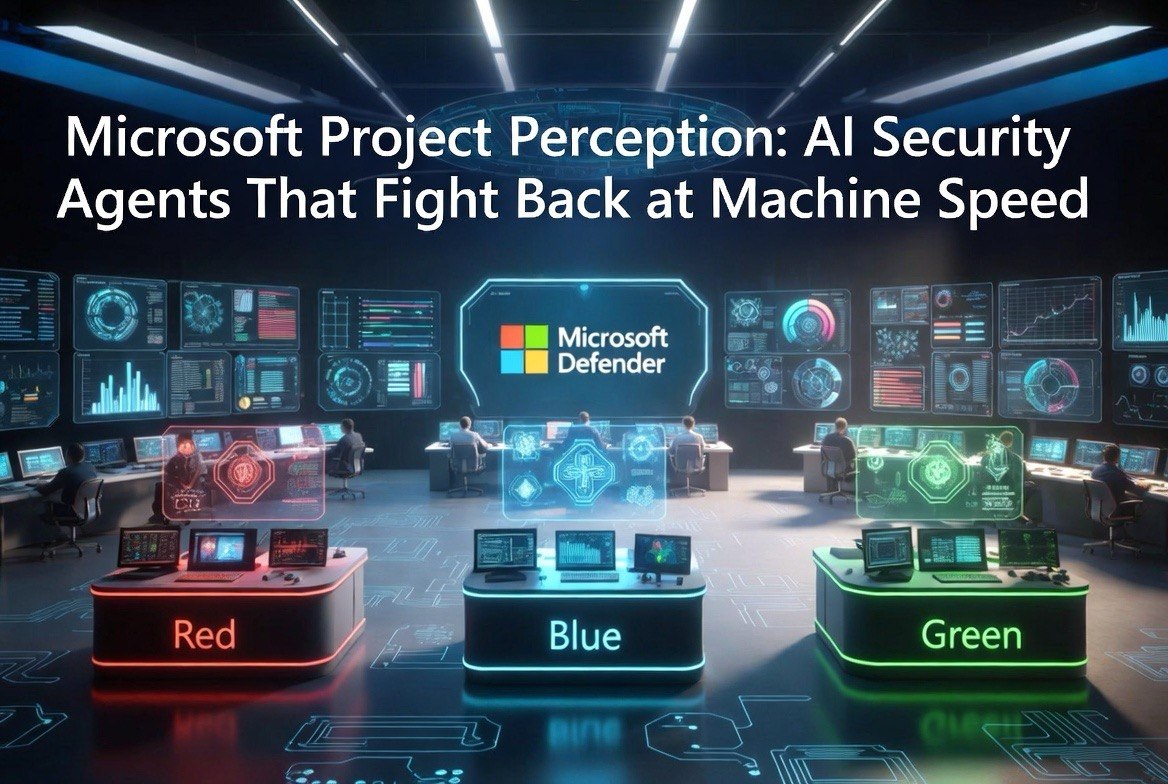
Microsoft Project Perception: AI Security Agents That Fight Back at Machine Speed
⚡ Expert Summary: Microsoft unveiled Project Perception on July 27, 2026 — an agentic cybersecurity system that deploys teams of specialized AI agents (red, blue, and green) inside Microsoft Defender to detect, investigate, and fix threats continuously, all while keeping a human in control of critical actions. It enters public preview on August 3, 2026, and ships with a new in-house security model, MAI-Cyber-1-Flash. For US business owners, the message is simple: the attacks are now automated, and your defense needs to be too — but not without human oversight.
If you run a US small or mid-size business, you are not being attacked by people anymore. You are being attacked by software — AI-driven bots that probe your defenses at machine speed, 24/7, and adapt the moment you patch a hole. By the time a human security analyst finishes their morning coffee, an automated attacker can have scanned your entire network, mapped your weaknesses, and moved on to the next 10,000 businesses in its queue.
That is the reality Microsoft is responding to with Project Perception, its most significant agentic security system to date. Announced July 27, 2026, it represents a fundamental shift: instead of generating alerts for humans to triage, AI agents now act — investigating threats, prioritizing risk, and applying fixes in an automated loop. Here is what Project Perception actually does, why it matters for American business owners, and what it means for your security stack in the second half of 2026.
What Is Microsoft Project Perception?
Project Perception is an agentic cybersecurity system embedded in Microsoft Defender. Think of it as a permanent security workforce of AI agents that never sleeps. Rather than a single chatbot that answers questions (Microsoft Security Copilot), Perception is a closed-loop defense system built from multiple coordinated agents that reason over your security data, use your tools, and execute workflows to find and fix problems on their own.
Microsoft frames it as “rethinking security for the age of AI.” The core idea: cyberattacks now operate at machine speed, so defenses must operate at machine speed too. Human analysts are too slow and too few to catch everything — but they are exactly who should make the final call on critical actions.
The Three Agent Teams: Red, Blue, and Green
Project Perception divides its work across three specialized agent teams, borrowing the classic offensive/defensive/fix framework from traditional cybersecurity:
| Agent Team | Role | What It Does |
|---|---|---|
| Red agents | Offense | Map attack paths, simulate threats, and identify vulnerabilities before attackers exploit them. |
| Blue agents | Defense | Investigate findings, assess meaningful risk, and prioritize threats using organizational context. |
| Green agents | Remediation | Take corrective actions, apply remediations, and continuously strengthen defenses. |
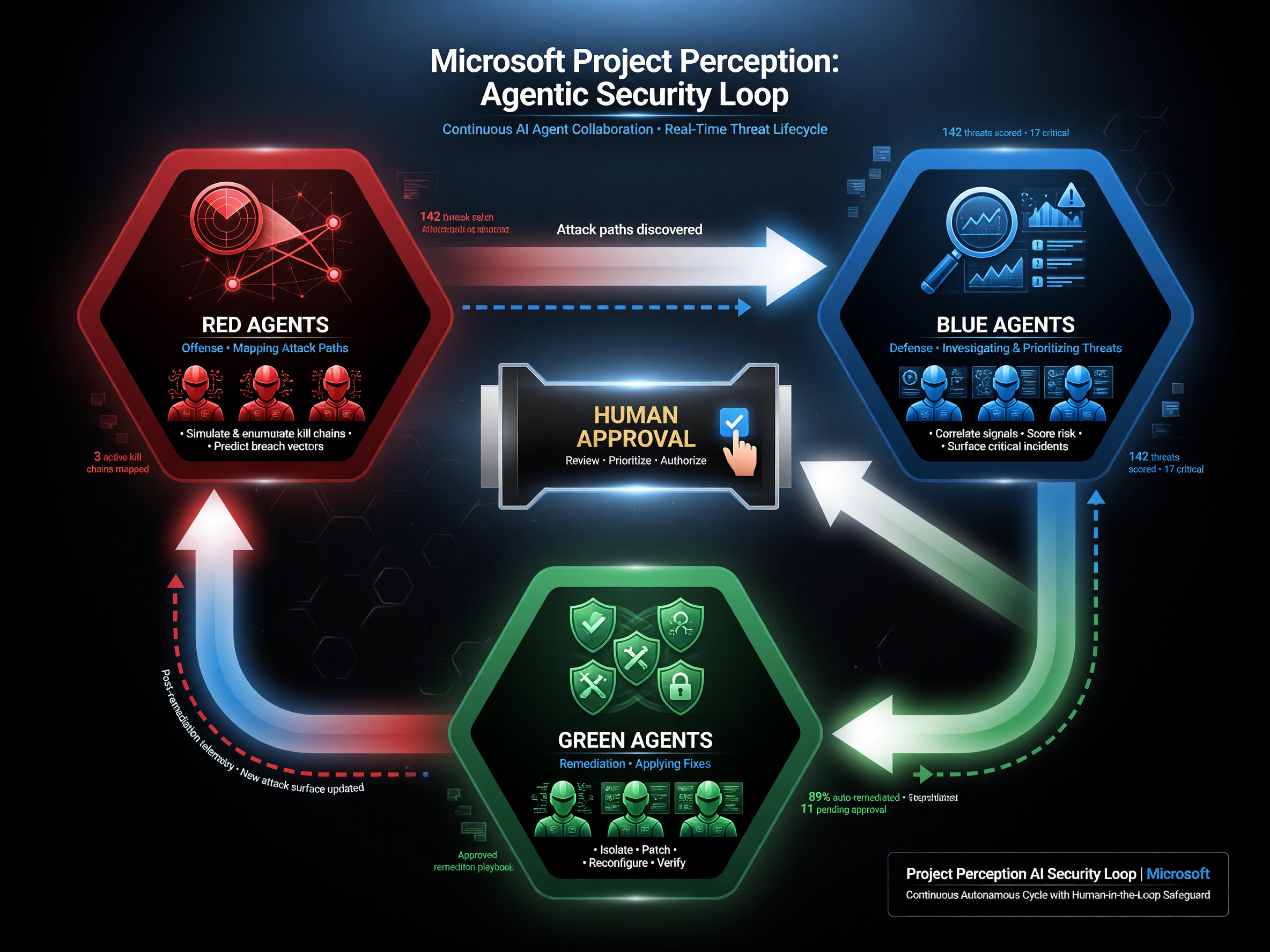
Project Perception runs three coordinated AI agent teams: red agents hunt for weaknesses, blue agents investigate and prioritize risk, and green agents apply fixes — all in one continuous loop with a human approval gate.
The three teams work together in a continuous loop: red agents hunt for weaknesses, blue agents investigate and prioritize what matters, and green agents fix it. The whole cycle repeats automatically, learning from each round.
MAI-Cyber-1-Flash: Microsoft’s New Security-Specific Model
Powering Perception is a new in-house model, MAI-Cyber-1-Flash (also called MAI-Cyber-1), purpose-built for security workloads. This matters because general-purpose AI models aren’t trained to think like security analysts — they don’t naturally reason about attack paths, privilege escalation, or indicators of compromise. MAI-Cyber-1 is trained specifically to understand the language of breaches and defenses, which lets Perception reason about your environment more accurately than a generic model would.
The combination of a purpose-trained model plus full-estate sensors and actuators is what distinguishes Perception from a standalone chatbot. It can look at your actual endpoints, identities, and workloads — not just a text summary of them.
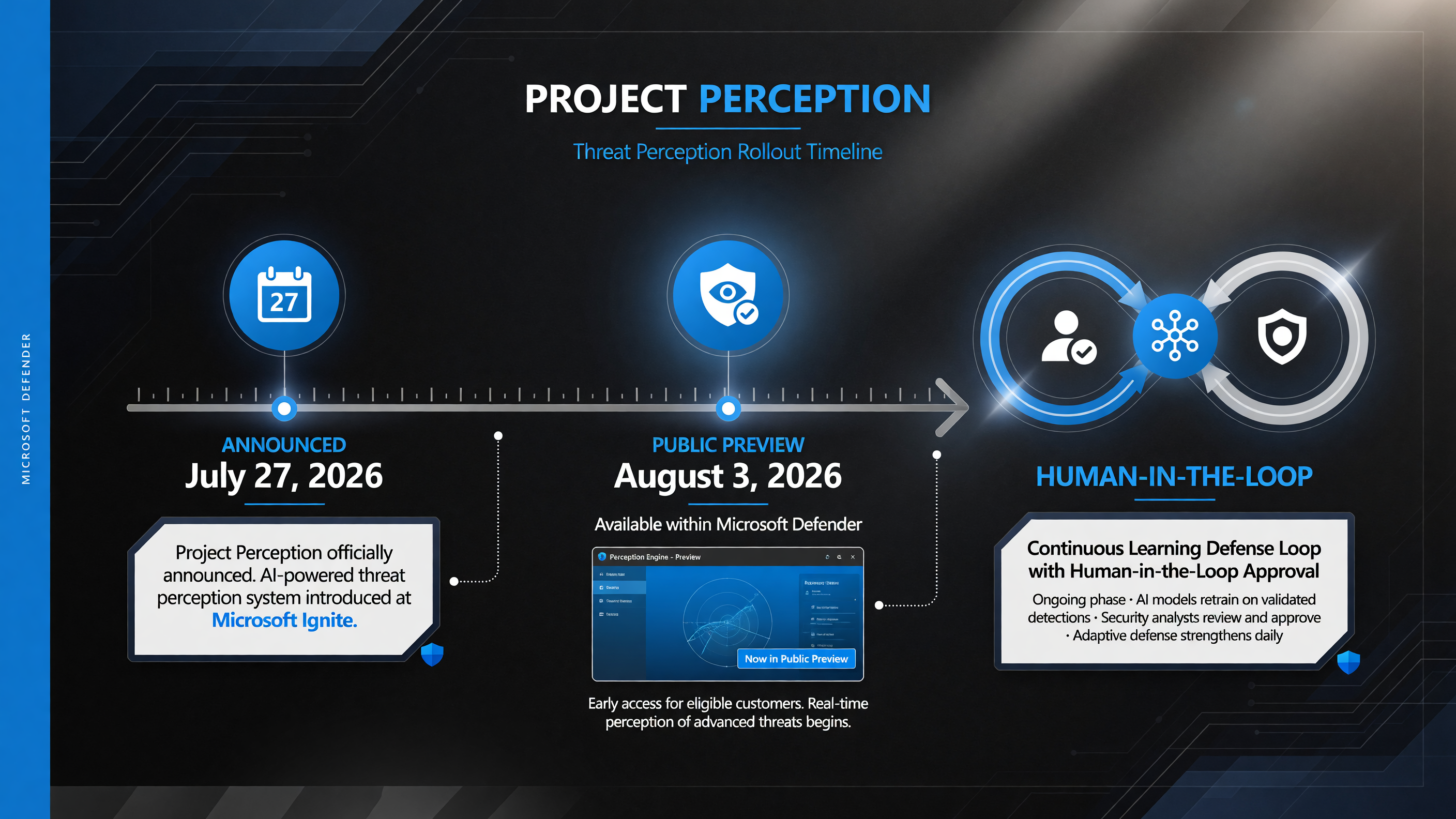
Project Perception rollout: announced July 27, 2026, enters public preview inside Microsoft Defender on August 3, 2026, then runs as a continuous learning defense loop with human-in-the-loop approval.
Delivered Inside Microsoft Defender — Public Preview August 3
Project Perception isn’t a separate product you have to buy and bolt on. It ships inside Microsoft Defender, which is already the security platform used by millions of businesses. It enters public preview on August 3, 2026, and Microsoft plans to add more specialized security agents over time as the system evolves.
For a US small business already using Microsoft 365 and Defender, that means the upgrade path is straightforward: this capability lands in the security tools you may already have, rather than requiring a new platform purchase.
Human-In-The-Loop: The Critical Design Choice
Here is the part that matters most for a business owner worried about letting AI “run loose” on their network: Project Perception keeps humans in control of critical decisions. The red, blue, and green agents automate the tedious parts — scanning, investigating, prioritizing, and applying routine fixes. But when an action could have significant consequences, a human approves it first.
This mirrors a lesson many American businesses learned the hard way in 2026: autonomous AI is powerful, but guardrails and human escalation are non-negotiable when money, data, and reputation are on the line. Microsoft designed Perception explicitly as a “continuously learning defense loop while keeping humans in control of critical decisions.”
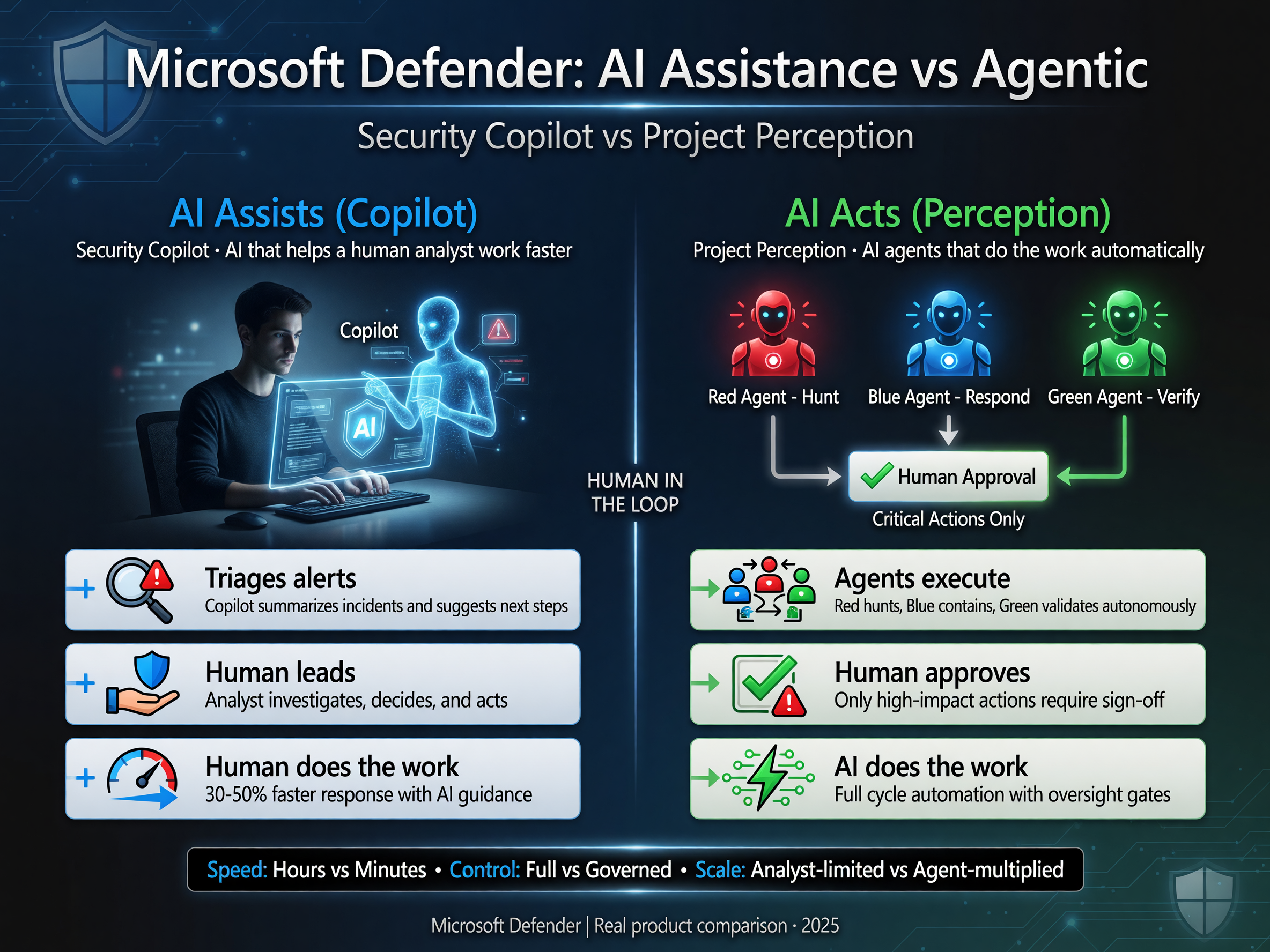
The core difference: Security Copilot assists a human analyst who does the work, while Project Perception agents do the work automatically with a human approval check on critical actions.
How Project Perception Is Different From Security Copilot
Microsoft Security Copilot has been available as an AI assistant that helps analysts work faster — answering questions, drafting queries, and summarizing incidents. Project Perception is a different animal. Copilot assists humans; Perception acts. It’s the difference between a co-pilot who helps you fly the plane and an autopilot that can fly it while you watch and intervene when needed.
That distinction is the bigger trend in enterprise security in 2026: moving from AI-assistance (a human does the work, AI helps) to AI-agentic (AI does the work, human approves). Project Perception is Microsoft’s bet that the future is the latter.
What This Means for US Business Owners
If you’re a small or mid-size business owner, you might be thinking: “This sounds like enterprise stuff, not for me.” Here is why you should still pay attention:
1. The Threat Is Automated — Your Defense Can Be Too
AI-driven attacks don’t take breaks, don’t get tired, and don’t get distracted. A human security team — if you even have one — simply cannot match that pace. Agentic defense that scans and probes continuously gives you a fighting chance without hiring a 24/7 security staff. For many US SMBs, automation is the only affordable way to keep up.
2. Human Oversight Reduces Risk
The human-in-the-loop design means you get the speed of automation without ceding control over critical actions. That’s a security posture an owner can actually trust — you’re not handing your network keys to an unsupervised bot.
3. It Sits Where You Already Are
Because Perception lives inside Microsoft Defender, adopting it doesn’t require ripping out your existing stack. If you’re a Microsoft shop, the path to agentic security just got shorter.
How to Evaluate Agentic Security for Your Business
Project Perception is one option in a fast-growing category, and not every business needs the full agentic treatment right away. Before you hand your network to AI agents — even with human oversight — run these five checks so you buy capability you can actually use.
Step 1: Audit Your Current Security Posture
Write down what you actually have today: an antivirus tool, a firewall, Microsoft 365 with Defender, a managed IT provider, or nothing structured at all. Most US SMBs are somewhere in the middle — they have basic tools but no one watching the alerts. Agentic security is only valuable if you’re drowning in signals you can’t triage. If your business generates almost no security telemetry, the automation has little to act on.
Step 2: Identify Your Highest-Risk Assets
What would hurt most if compromised? Customer payment data, employee records, your email, your website, client files. List the top five. Agentic security should be pointed at protecting those — a system that scans everything equally is less useful than one that knows what matters to you.
Step 3: Define Your Human Approval Threshold
This is the most important design decision. Which actions should AI agents take automatically, and which require a human click? Good agentic systems let you tune this. For most small businesses, routine hardening (patching, closing obvious exposures) can be automated, while anything that locks an account, changes a policy, or touches payments should need human approval. Write that line down before you enable anything.
Step 4: Test on Your Real Environment
Project Perception is entering public preview August 3, 2026 — which means real customers get to kick the tires before committing. When you evaluate any agentic tool, run it on a staging or non-critical part of your environment first. Watch how it classifies threats, how often it asks for approval, and whether its automated fixes are things you’d have done anyway.
Step 5: Plan the Human Workload
Agentic security reduces analyst workload but doesn’t eliminate it. Someone still owns the approval queue, reviews the highest-priority alerts, and decides what the system learns. That someone can be you, a lean internal IT person, or an outsourced managed security service. Budget for the human time, not just the software subscription.
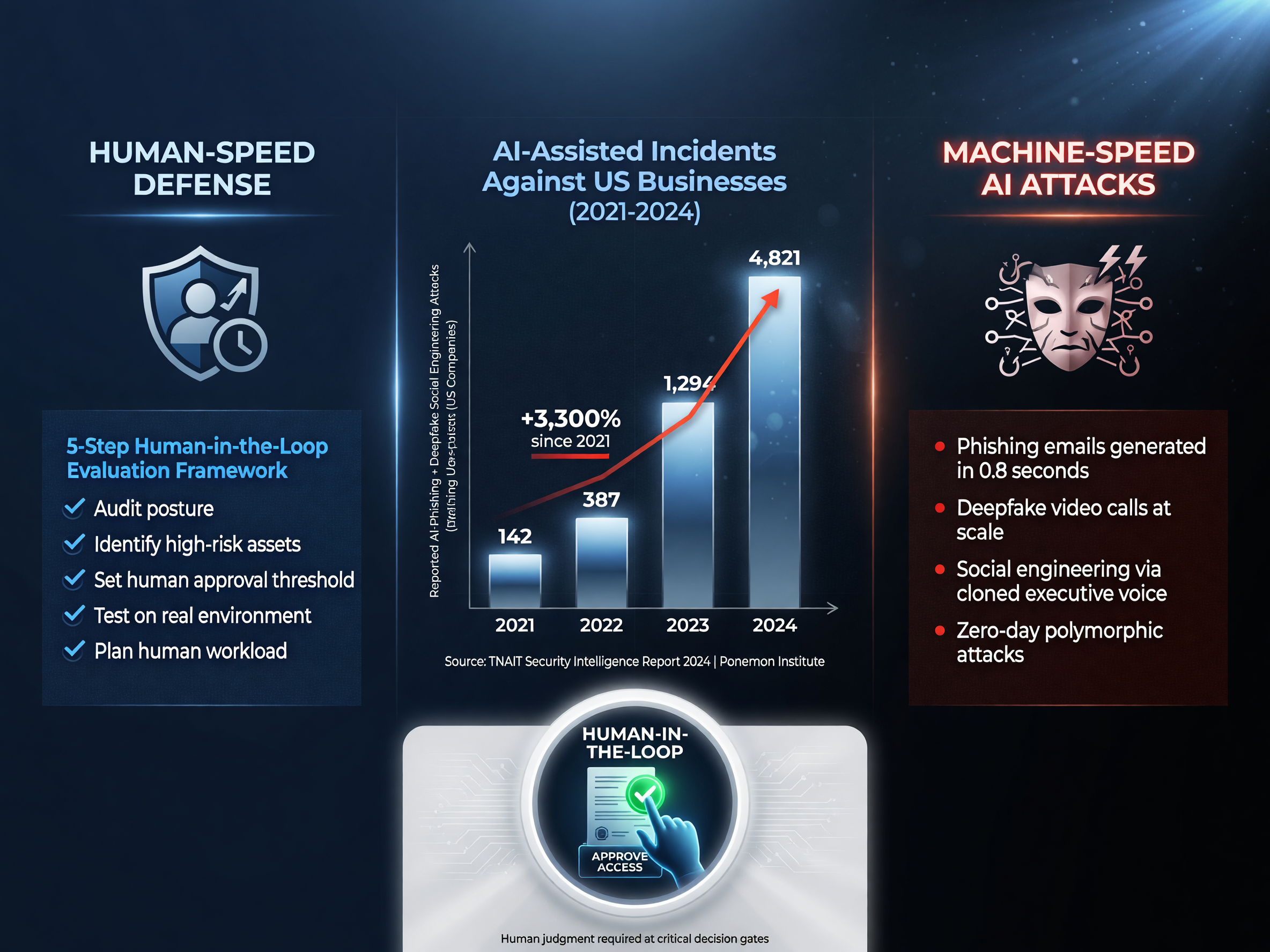
The AI security arms race: human-speed defenses struggle against machine-speed AI attacks. The five-step framework — audit posture, identify high-risk assets, set a human approval threshold, test on your real environment, and plan the human workload.
The Bigger Picture: The AI Security Arms Race
Project Perception sits inside a much larger trend that every American business owner should understand: 2026 is the year AI-to-AI attacks became the norm. Security researchers and major vendors are all converging on the same conclusion — attackers now use AI to scale, adapt, and evade faster than traditional signature-based defenses can keep up.
A report from Microsoft’s security research arm framed the shift bluntly: the threat landscape has moved from human adversaries doing things like credential stuffing to AI systems that reason about your defenses the way a penetration tester would — but at machine speed and without sleep. The Federal Bureau of Investigation’s Internet Crime Complaint Center has logged a sharp rise in AI-assisted phishing and deepfake social engineering targeting small and mid-size businesses, which are often the softer targets compared to large enterprises with dedicated security teams.
That is why the agentic approach matters. A defense that merely flags suspicious activity to a busy human is fundamentally outmatched when the attack can adapt in milliseconds. The only realistic counter is a defense that also adapts automatically — while keeping a person in the loop for the decisions that carry real risk.
The Bottom Line
Microsoft Project Perception marks a turning point: AI security agents that don’t just warn you about attacks — they investigate and fix them at machine speed, with a human signing off on the critical calls. For US business owners, the takeaway is twofold. First, the era of fully automated cyberattacks has arrived, and your defense needs to match. Second, you can get there without giving up human control, because the most mature players are building oversight into the system, not bolting it on.
Public preview starts August 3, 2026, inside Microsoft Defender. If your business runs on Microsoft’s stack, that’s the date to start planning how agentic security fits into your 2026 budget.
Microsoft Project Perception details confirmed via Microsoft’s official announcement (July 27, 2026), Microsoft Security blog, Axios, GeekWire, and Futurum Group product coverage. Always verify current availability and capabilities with Microsoft directly, as preview features evolve quickly.
Frequently Asked Questions
What is Microsoft Project Perception?
Project Perception is an agentic cybersecurity system from Microsoft, announced July 27, 2026, that uses teams of AI agents (red, blue, and green) to continuously detect, investigate, and remediate threats inside Microsoft Defender. It enters public preview on August 3, 2026, and is powered by a new security-specialized model, MAI-Cyber-1-Flash.
Is Project Perception fully automated?
No. While the agents automate detection, investigation, and routine fixes, Microsoft designed Project Perception to keep humans in control of critical decisions. This human-in-the-loop approach is a core security feature, not an afterthought.
Do I need to buy a separate product for Project Perception?
No. Project Perception is delivered inside Microsoft Defender, the security platform many businesses already use. If you’re a Microsoft 365 shop, adoption is a matter of enabling the capability rather than purchasing a new platform.
How is Project Perception different from Microsoft Security Copilot?
Security Copilot assists humans by answering questions and speeding up analysis. Project Perception acts independently — agents investigate and fix issues automatically, with human approval on critical actions. Copilot helps you do the work; Perception does the work under your watch.
When is Project Perception available?
Microsoft announced Project Perception on July 27, 2026. It enters public preview on August 3, 2026, inside Microsoft Defender, with more specialized security agents planned over time.
Does Project Perception work if my business doesn’t use Microsoft 365?
Project Perception is built into Microsoft Defender, which is most commonly used within the Microsoft 365 ecosystem. Businesses on other platforms still face the same automated threats, and it’s worth evaluating Microsoft Defender’s coverage of your specific environment — or comparing agentic security options that integrate with your existing stack — during the public preview period.

About Barak Schurr
Barak Schurr is the founder and former president of the nightlife ticketing platform Wantickets and former Global Director of Dance and Nightlife at Eventbrite. He currently focuses on AI research and writes about practical AI for independent business owners that actually moves the needle — no hype, no corporate fluff. More at topnotchaitools.com.
Contact: [email protected]
More AI Resources for Your Business