caliper.run Open-Source AI Cost Tracker: How to Save $10k+ Per Month on AI Tools
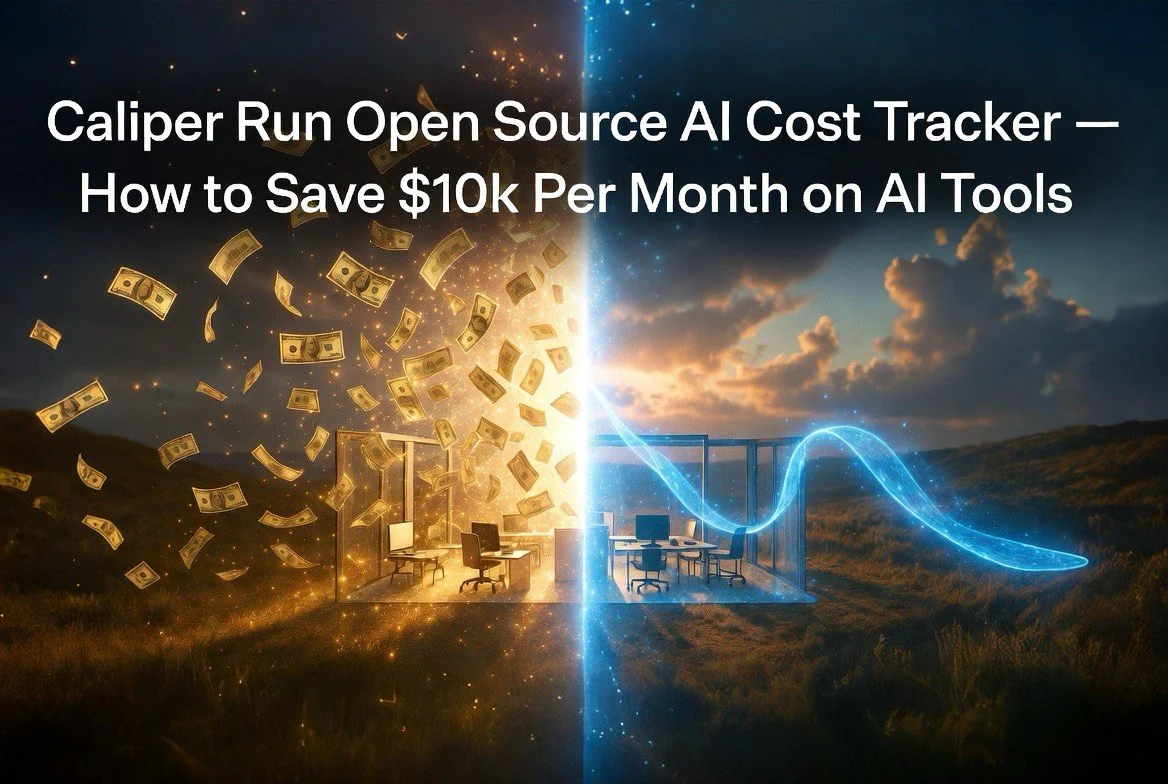
⚡ Expert Summary: Caliper is a free, open-source AI cost tracking tool that shows every dollar your AI tools spend, broken down by workflow and model. Its founder documented a $10,730 monthly savings gap between Claude Code and open models — then built Caliper to make that gap visible for everyone. For American small businesses burning cash on AI without knowing exactly where it goes, Caliper is the missing instrument panel.
Why AI Cost Tracking Matters More in 2026 Than Ever Before
If you’re running a business that uses AI agents for coding, content, customer support, or workflow automation, there’s a good chance you have no idea what you’re actually spending.
Here’s the problem: AI pricing in 2026 is fragmented across dozens of providers with different per-token rates, context window markups, and feature-dependent surcharges. A single Claude Code session that runs for an hour could burn through tens of dollars in tokens without surfacing the cost anywhere visible. Multiply that across a team, and you’re looking at thousands of dollars per month — with no breakdown of where it went or whether you could have gotten the same results cheaper elsewhere.
According to Caliper’s data, monthly AI spend in enterprise coding workflows has grown 7x in 8 months. Most of that growth is invisible — charged to credit cards, billed as vague “platform fees,” or simply not tracked at all.
Enter Caliper — an open-source (MIT license), model-agnostic cost tracking and routing tool that plugs directly into your AI workflows and shows you exactly where every dollar goes.
What Caliper Actually Does
Caliper installs as a plugin into your existing AI harness (starting with Claude Code, with Codex, Cursor, Windsurf, Zed, and Pi coming soon). Once installed, it tracks:
- Per-workflow spend — See exactly how much each task type costs: feature development, bug fixes, code reviews, test suites, deployments
- Per-model breakdown — Which models are costing you the most, and where cheaper alternatives could handle the same work
- Savings opportunities — Direct comparisons showing what you’d save by routing specific workloads to open-source models like DeepSeek, Qwen, Llama, or Gemma
- Total spend over time — Track AI costs as a line item and spot runaway usage before it hits your monthly invoice
All data comes from your actual run logs — not estimates — and stays entirely local if you choose the self-hosted option. No data leaves your machine unless you opt into the hosted service.
The $10,730 Gap That Started It All
Caliper was built by Dennison Bertram, who documented his personal AI spending in June 2026:
- Claude Code tokens burned: $13,836
- Same work on open models (DeepSeek, GLM, Llama): $3,106
- Monthly savings gap: $10,730
That’s $128,760 per year — one developer, one laptop, one month of data. For a small team of three developers, the gap could exceed $30,000 per month if they’re all using premium models for tasks that cheaper models could handle just as well.
The reason most businesses don’t capture these savings is simple: they can’t see the cost breakdown. Their developers spend tokens, the bill arrives at the end of the month as a lump sum, and there’s no way to attributing $13,836 of Claude Code vs. $3,106 of open-model work without a tracking tool. Caliper provides that breakdown automatically.
How It Works: Installation and Routing
Getting started with Caliper takes under five minutes:
Step 1: Install the Claude Code plugin
/plugin marketplace add Cost-Caliper/caliper
/plugin install caliper@caliper
Step 2: Review your cost breakdown
Caliper immediately starts tracking every token your AI harness uses, categorized by workflow. You’ll see which models are being used for which tasks and exactly what each task costs.
Step 3: Route to cheaper models
Based on the data, you can configure automatic routing rules. For example: “Route all code review tasks to Llama 3.3 70B instead of Claude Code” or “Use DeepSeek for test suite generation.” Caliper’s smart routing engine (coming soon) will handle this automatically based on your cost and quality tolerances.
Step 4: Fine-tune your own model (coming soon)
Caliper’s endgame is custom fine-tuned open models — trained on your exact usage patterns — that take over routing automatically. These models stay private, hosted locally or in Caliper’s American-hosted cloud, and improve over time as your workflows evolve.
Why This Matters for American Small Businesses
For a small business with 2-5 team members using AI tools daily, the stakes are different than for enterprise teams burning millions in tokens. But the math still works:
| Team Size | Estimated Monthly AI Spend | Potential Savings (30-75%) | Annual Savings |
|---|---|---|---|
| Solo entrepreneur | $500-1,500 | $150-1,125 | $1,800-13,500 |
| Small team (2-5) | $2,000-6,000 | $600-4,500 | $7,200-54,000 |
| Growing team (5-15) | $6,000-20,000 | $1,800-15,000 | $21,600-180,000 |
The tier that matters most here is the “small team” category — the US businesses that have adopted AI tools enthusiastically but haven’t built the infrastructure to manage AI costs. According to the US Chamber of Commerce’s 2026 small business survey, 76% of small businesses now use AI, but fewer than 30% have any formal cost management for their AI spending.
Caliper addresses that gap with zero upfront cost (open source, MIT license), zero data risk (runs locally), and immediate visibility into where the money goes.
Caliper vs Everything Else: What Makes It Different
There are other AI cost management tools, but Caliper’s approach is distinct in three ways:
1. Open source by default. You can inspect, self-host, and fork the code. No black box, no opaque billing engine, no surprise logic changes. For a small business that wants to audit its tooling, this matters.
2. Harness-agnostic. It works inside Claude Code today, but the roadmap includes Codex, Cursor, Windsurf, Zed, and Pi — all from the same installation. Most cost tools lock you into a single ecosystem.
3. Routes AND fine-tunes. Most cost trackers are read-only — they show the problem but don’t solve it. Caliper routes workloads to cheaper models automatically and plans to train custom models on your usage data. That’s a closed feedback loop: measure → optimize → improve.
The Open vs. Closed Model Cost Gap: Why It Keeps Growing
The gap between proprietary model costs and open-source alternatives isn’t narrowing — according to MIT Sloan’s 2026 analysis, it’s widening. Open model inference costs are now roughly 87% lower than closed alternatives: approximately $0.23 per million tokens for open models versus $1.86 for closed ones. That means closed models cost users roughly 6x more per token.
For a small business doing 10 million tokens per day across its AI tools, the annual savings from switching to open models can exceed 85%. The key insight from MIT’s research: the break-even point for self-hosting open models lands around 500,000 to 1 million tokens per day. Below that threshold, the convenience of closed models may still win. Above it, you’re leaving money on the table every single day.
Caliper directly addresses this by showing you exactly where you cross that threshold. Without a tracking tool, you have no idea whether your business is at 200,000 tokens per day or 2 million. Caliper surfaces that number in the first five minutes of installation.
Practical Next Steps: How to Start Saving Today
For the American small business owner who wants to stop overpaying for AI tokens, here’s the actionable path:
- Install Caliper — Five minutes, no signup. Get visibility into your current spend for one full week.
- Review the breakdown — Identify which workflows cost the most. You’ll likely find that code reviews, test generation, or long-context tasks are driving 70% of your costs.
- Test routing to open models — Pick one workflow category and route it to an open model like DeepSeek or Llama 3.3. Run it for three days and compare output quality side by side.
- Scale what works — Once you’ve validated quality on the test workflow, expand routing to other categories. Industry data suggests 30-50% of AI workflows produce equivalent or better results on open models at a fraction of the cost.
- Monitor monthly — AI models and pricing change fast. A model that was expensive last quarter may have dropped in price. Caliper’s ongoing tracking keeps you current.
The businesses that will win in 2026 and beyond aren’t the ones using the most expensive AI models — they’re the ones using the right models for each job. Caliper gives you the data to make that judgment.
The Bottom Line on AI Cost Visibility
The era of unlimited AI token budgets is already ending. As models get more powerful, they get more expensive, and businesses that don’t track their AI costs will see silent budget bleed that compounds month after month.
Caliper is a practical response to that problem: free, local, open-source, and immediately useful. For the American small business owner who’s been wondering why their AI tool bill keeps creeping up, it’s the first honest answer they’ll get.
FAQ
Is Caliper free to use?
Yes. The core Caliper plugin for Claude Code is free, open-source (MIT license), and requires no signup. A paid Pro tier with advanced features like team management and hosted infrastructure is planned for launch but not required for basic cost tracking.
What AI tools does Caliper work with?
Caliper currently works with Claude Code. Support for Codex, Cursor, Windsurf, Zed, and Pi is coming soon. The SDK will also integrate with AI SDK, Smithery, eve, Mastra, and LangSmith for broader compatibility.
Can a small business really save $10k per month with Caliper?
The $10,730 figure comes from Caliper’s founder comparing Claude Code costs against open models for the same work. Savings vary by team size and usage patterns, but small teams of 2-5 people can realistically expect 30-75% savings by routing appropriate tasks to cheaper models.
Does Caliper send my data anywhere?
No. Caliper runs entirely on your machine by default. All tracking data stays local. A hosted service is available for teams that want zero-ops management, but the self-hosted open-source version keeps everything under your control.
What open-source models does Caliper support for routing?
Caliper supports routing to GLM 5.2, DeepSeek, Qwen, Llama, and Gemma — all available through American-hosted inference providers. The routing engine is model-agnostic, so adding new open models as they launch is straightforward.

About Barak Schurr
Barak Schurr is the founder and former president of the nightlife ticketing platform Wantickets and former Global Director of Dance and Nightlife at Eventbrite. He currently focuses on AI research and writes about practical AI for independent business owners that actually moves the needle — no hype, no corporate fluff. More at topnotchaitools.com.
Contact: [email protected]
More AI Resources for Your Business